-
-
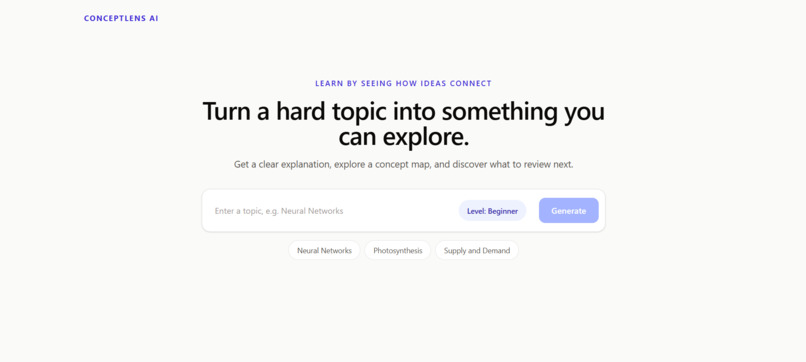
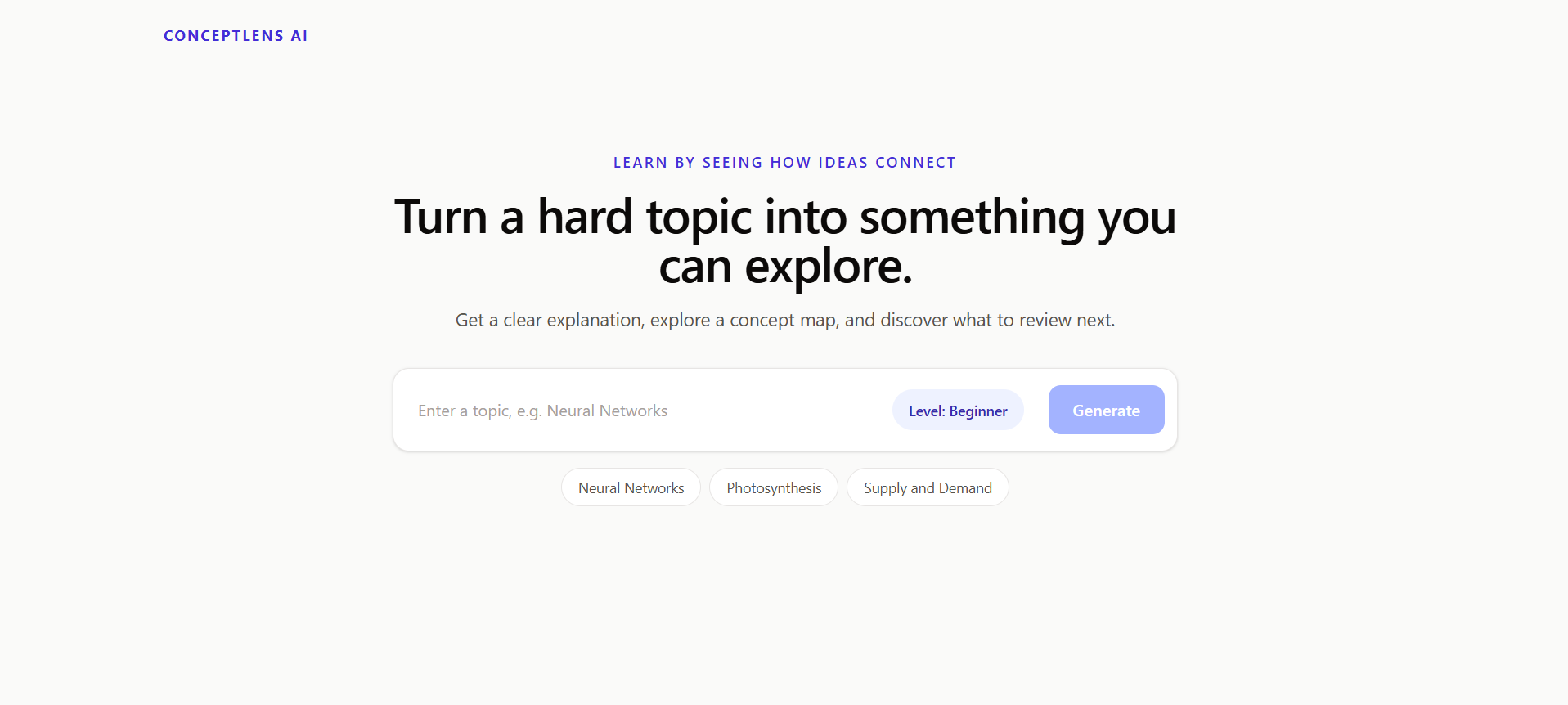
FRONT PAGE
-
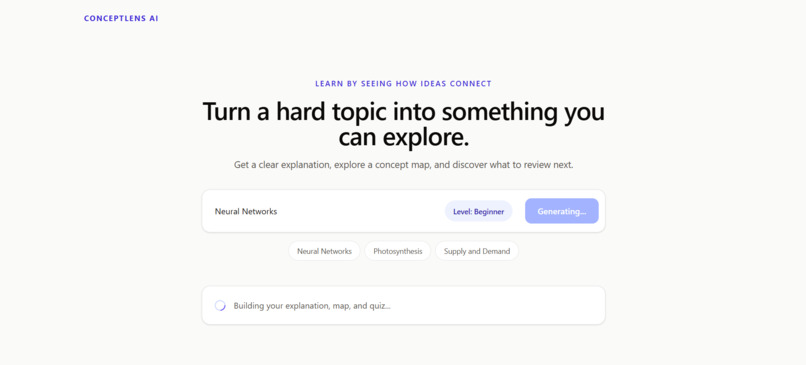
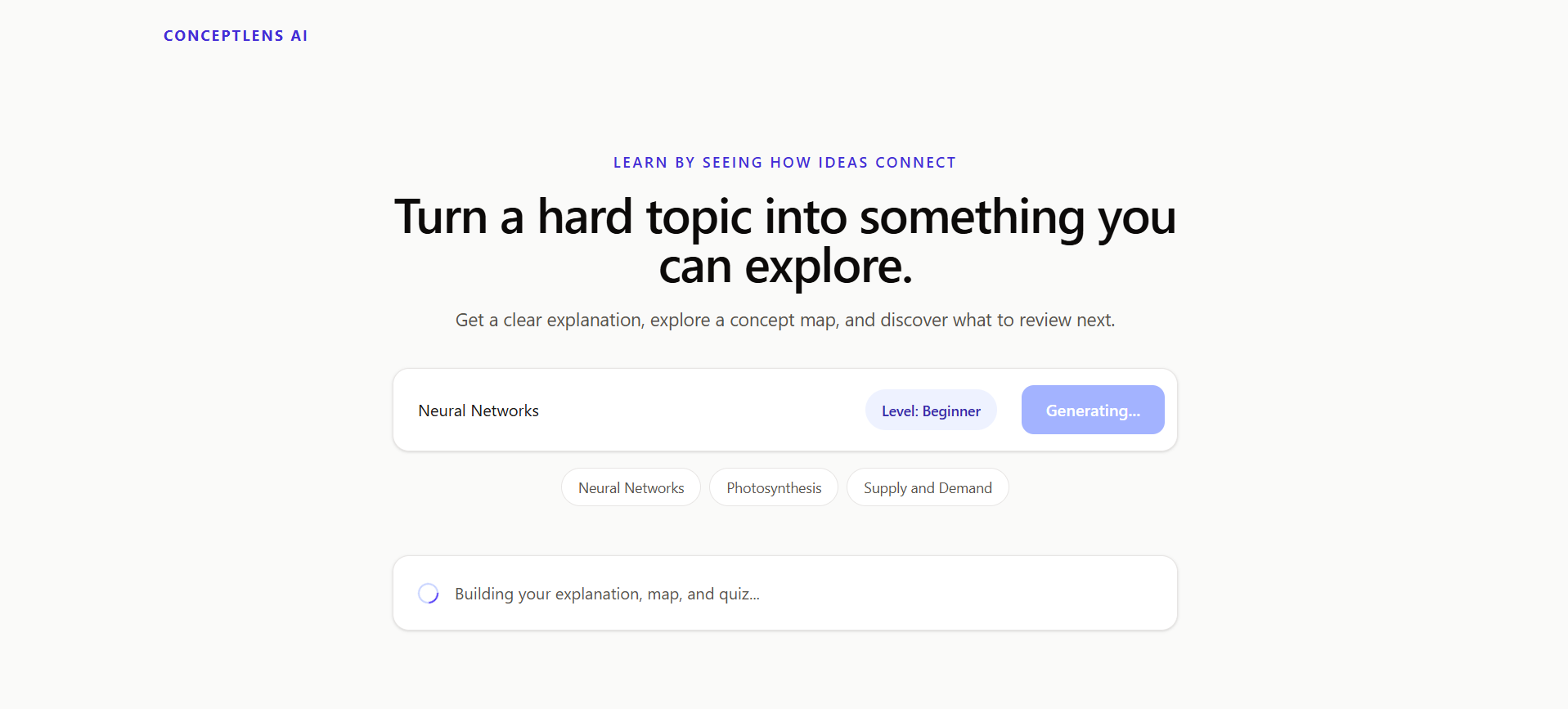
ENTRY PAGE
-
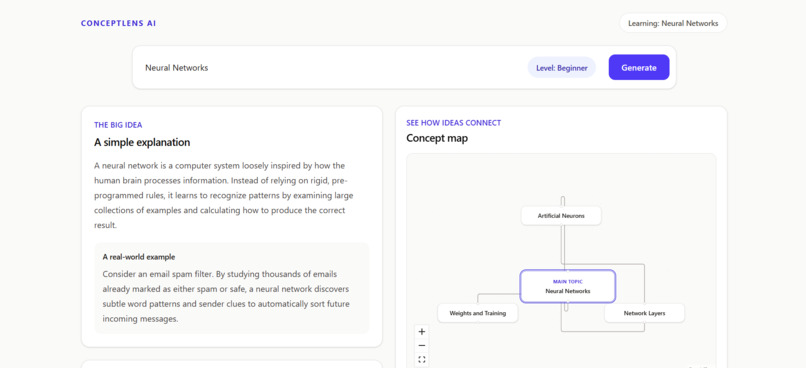
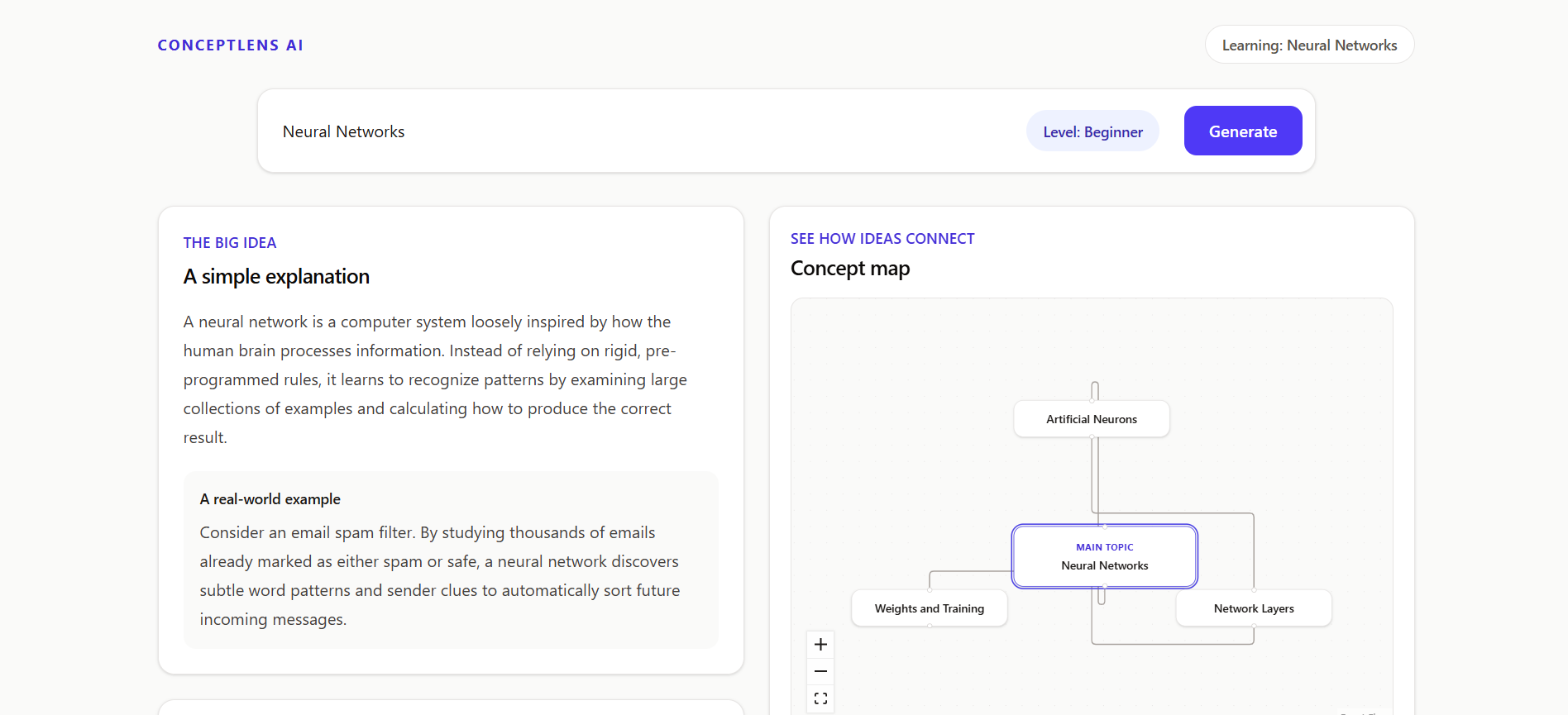
DESCIPTION FOR THE TOPIC
-
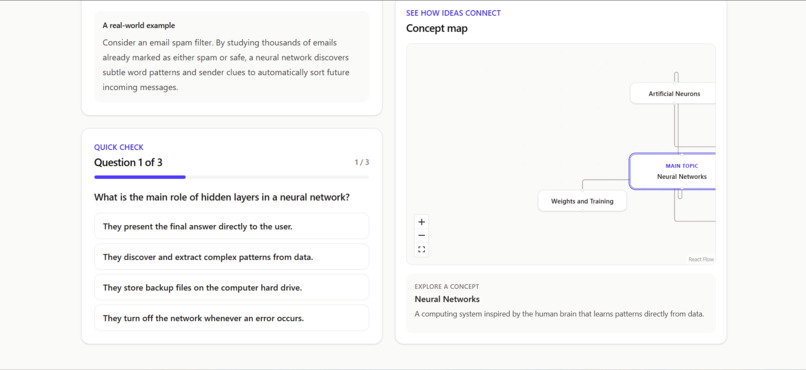
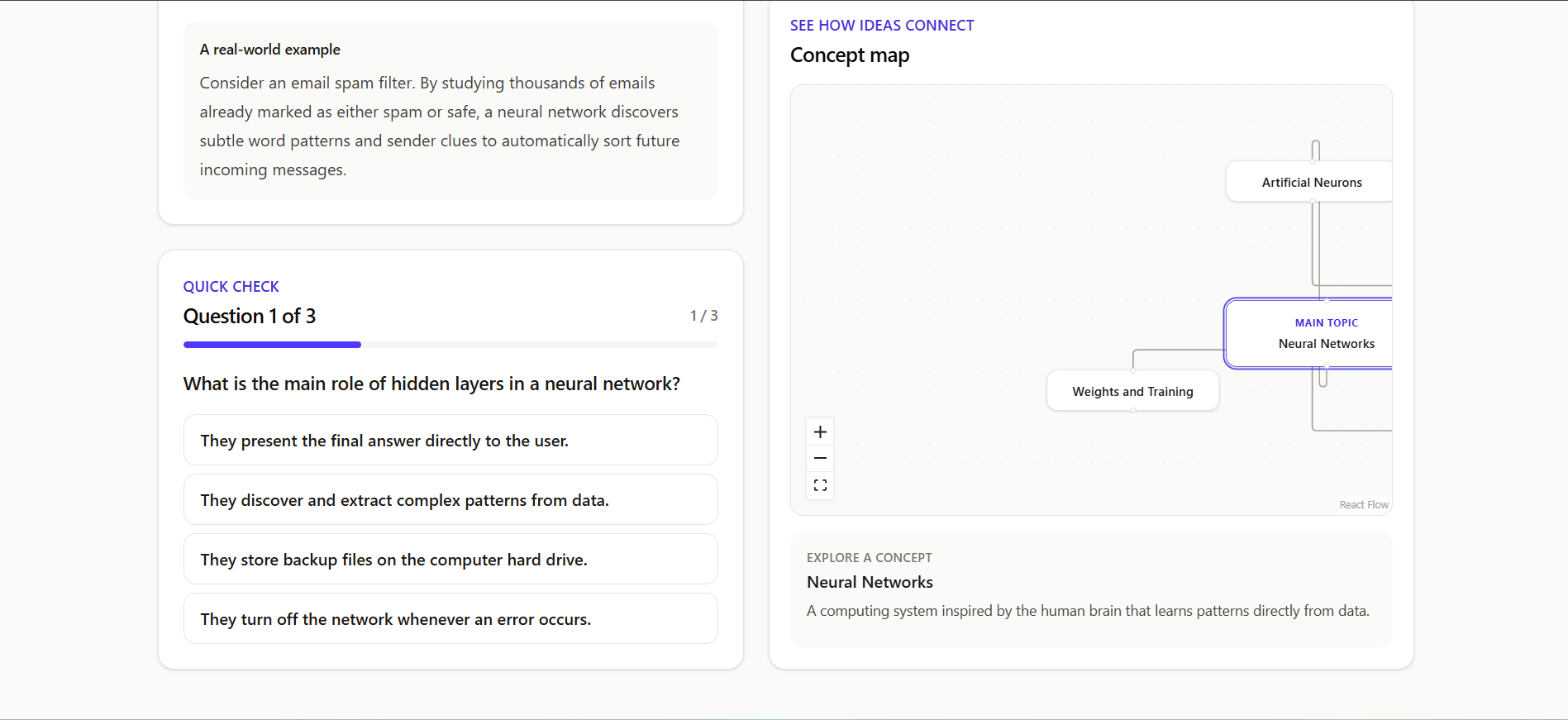
QUESTIONS
Inspiration
Many students get stuck on a hard topic because textbook explanations are long and linear. Even after reading, it's hard to tell which concept they actually misunderstood. I wanted a learning tool where the explanation, the visual map, and the quiz are one connected loop, not three separate AI outputs.
What it does
ConceptLens AI is a single-page web app for school and college students.
- Enter a topic (for example, "Neural Networks") at Beginner level.
- Get a short explanation with a real-world example, plus an interactive concept map.
- Click any map node to see a short explanation of that sub-concept.
- Take a 3-question quiz with immediate feedback. If you answer wrong, the app explains why your choice is wrong and why the correct answer is right.
- The concept that question tests lights up in amber on the map with a "Review this" tag, and the map pans to it. The final summary lists the same nodes.
That wrong-answer-to-map link is the core idea: the quiz tells you where to go back to on the map.
How I built it
- Frontend: React, Vite, TypeScript, Tailwind CSS, and React Flow for the concept map.
- Backend: a small local Node/Express API with one endpoint,
POST /api/generate. - AI: one Gemini call per topic that returns the explanation, map, and quiz as a single structured JSON result.
- Validation: a shared Zod schema defines the response. The server also checks that every quiz question's
nodeIdexists in the map, that there are exactly 3 questions, and that answer indexes are valid. Bad output gets one retry, then a friendly error. No partial results are ever shown. - Key safety: the Gemini key lives only in a gitignored
server/.env. The browser never sees it.
I built it with the Devpost Learn Skill Pack, writing scope.md, prd.md, and spec.md before any code.
Challenges
- Rate limits: Gemini returned HTTP 429 mid-build. The app maps it to a friendly "busy" message with a cooldown. I also added a dev-only fixture, enabled by an explicit flag and never used as a fallback, so I could keep building the UI while quota was blocked.
- Valid is not the same as correct: Zod proved a quiz
nodeIdexisted, but not that it pointed to the concept the question actually tested. Running the live flow showed some questions pointed at the root topic. I tightened the prompt so each question targets the most specific concept. - Shallow feedback: my first quiz feedback gave the right answer without the reason. I extended the schema to include explanations for each option and rewrote the prompt so students learn from mistakes.
What I learned
- Plan first. Writing the scope, requirements, and spec before coding kept the project small and focused.
- Structured output has two layers: the model can follow a schema, but the server still has to check the relationships between fields.
- Handle failure on purpose: loading states, rate limits, and malformed output are part of the product, not afterthoughts.
- Keep secrets in server-side config, and check by eye that the live output means what the schema says it does.
What's next
Intermediate and Advanced levels, a "what to study next" list, and saved progress.
Built With
- claude-code
- express.js
- gemini-api
- git
- google-gemini
- node.js
- react
- react-flow
- tailwindcss
- typescript
- vite
- zod

Log in or sign up for Devpost to join the conversation.