-
-
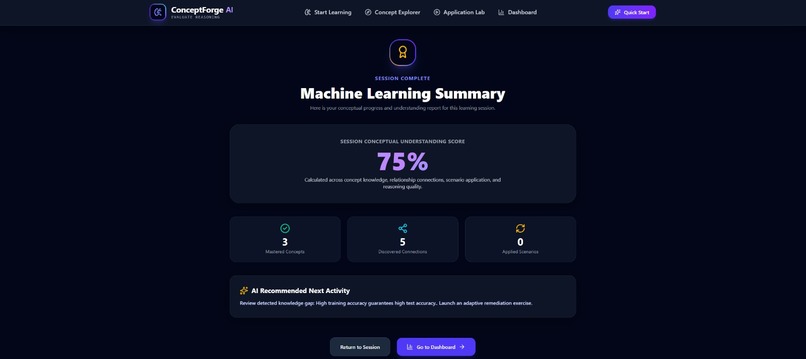
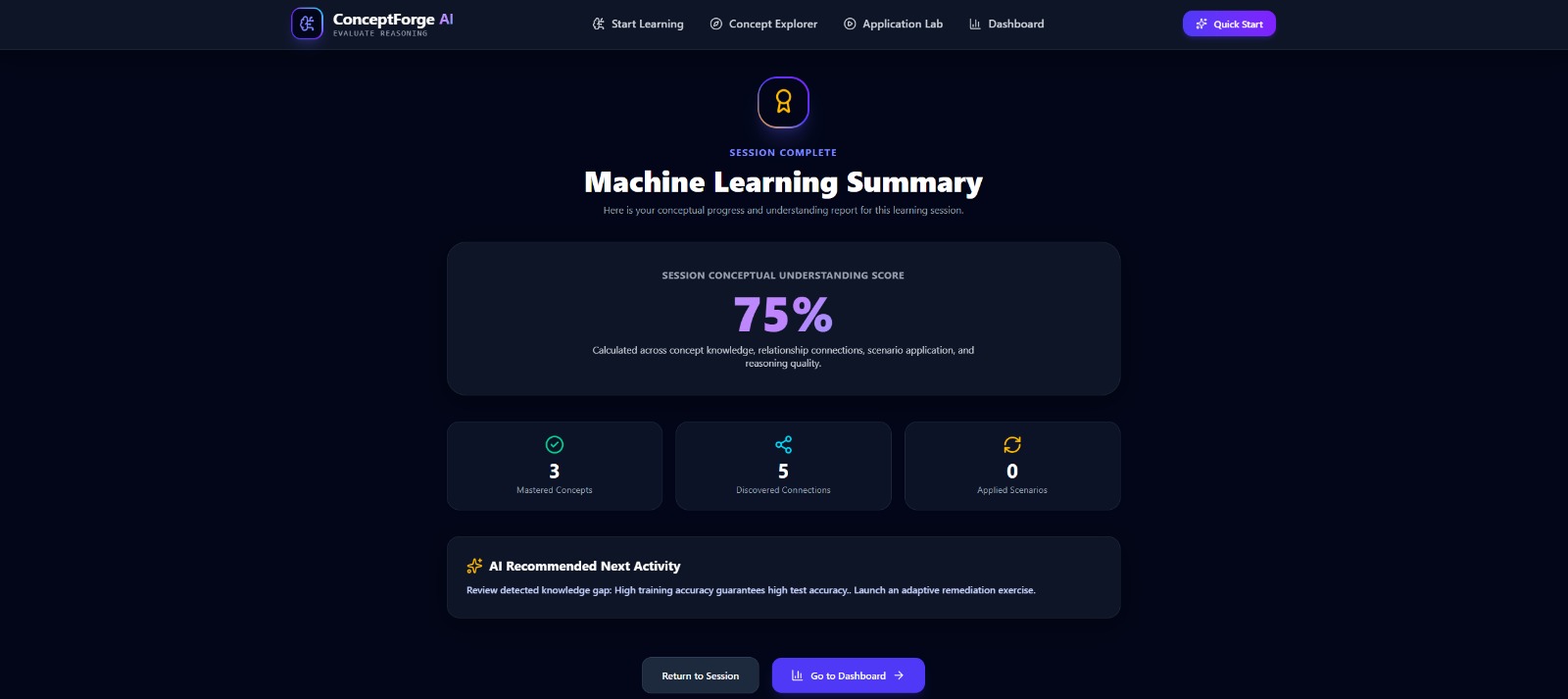
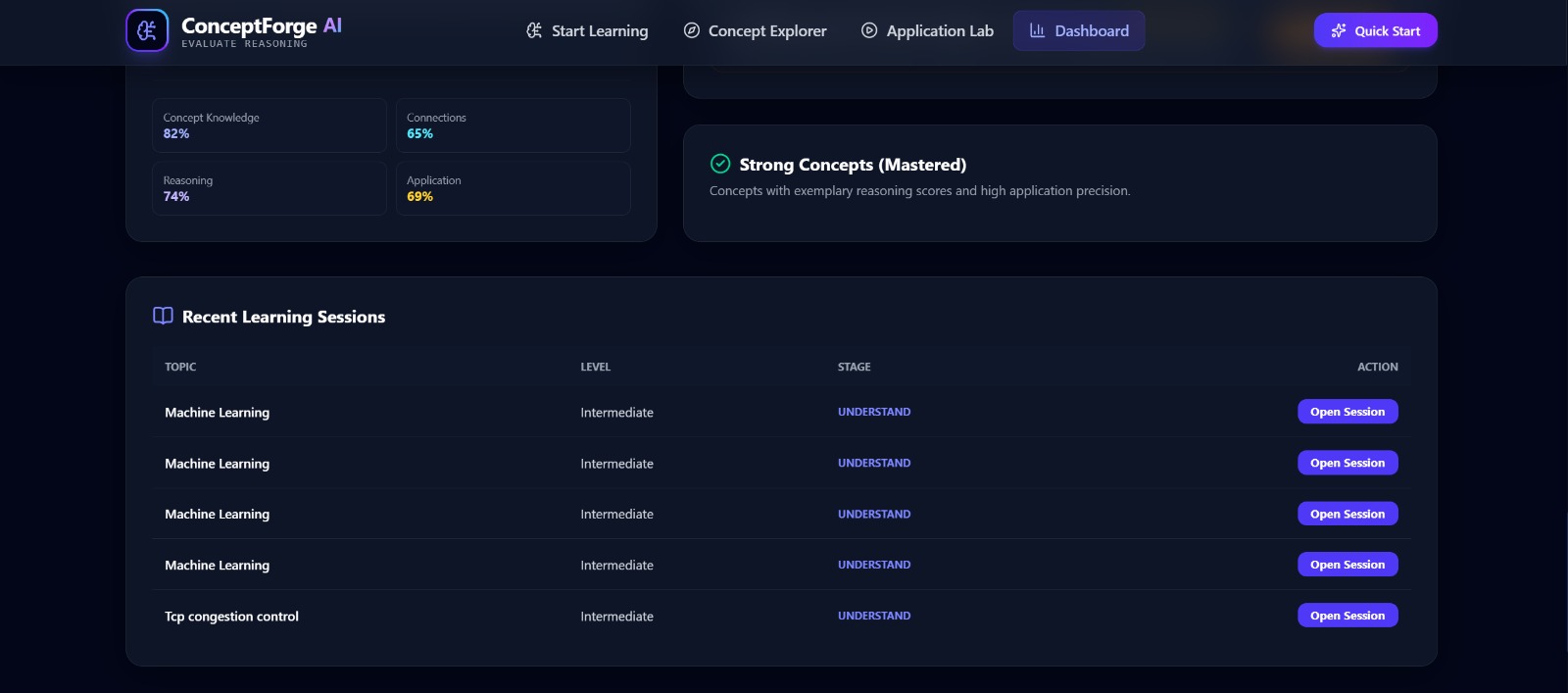
Session Summary: Review learning scores, mastered concepts, and next steps.
-
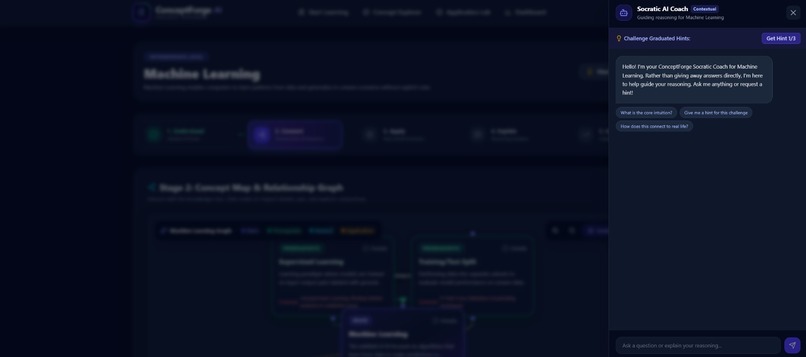
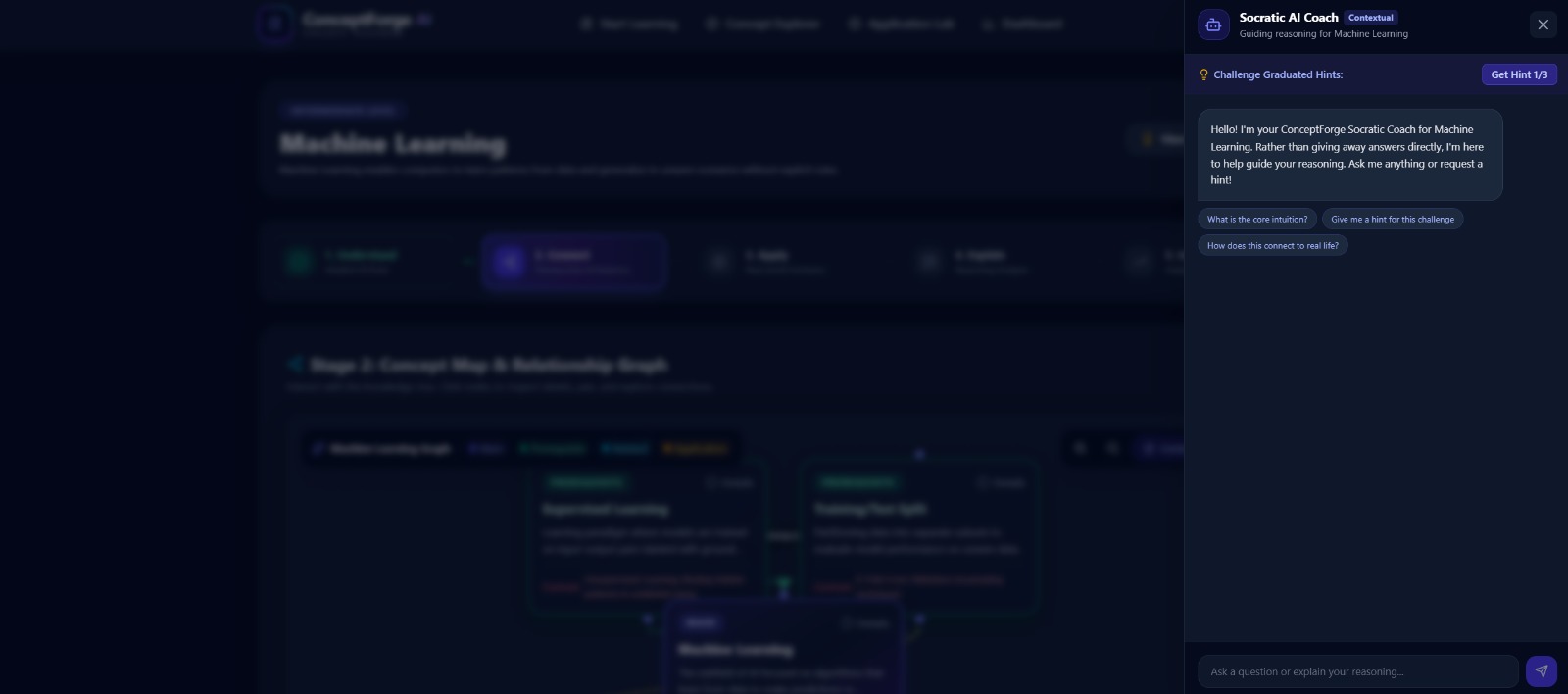
Socratic AI Coach: Get guided hints and questions to strengthen reasoning and critical thinking.
-
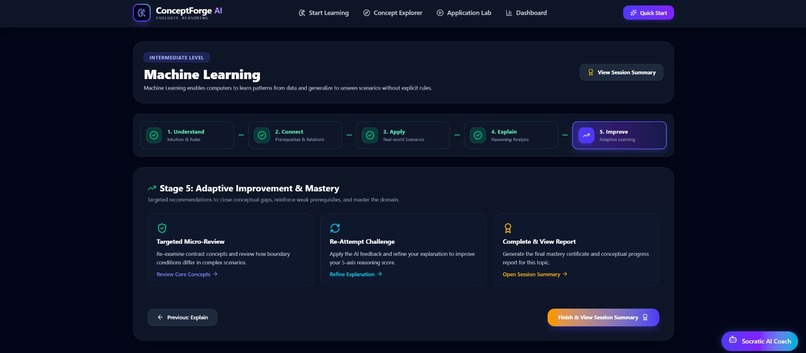
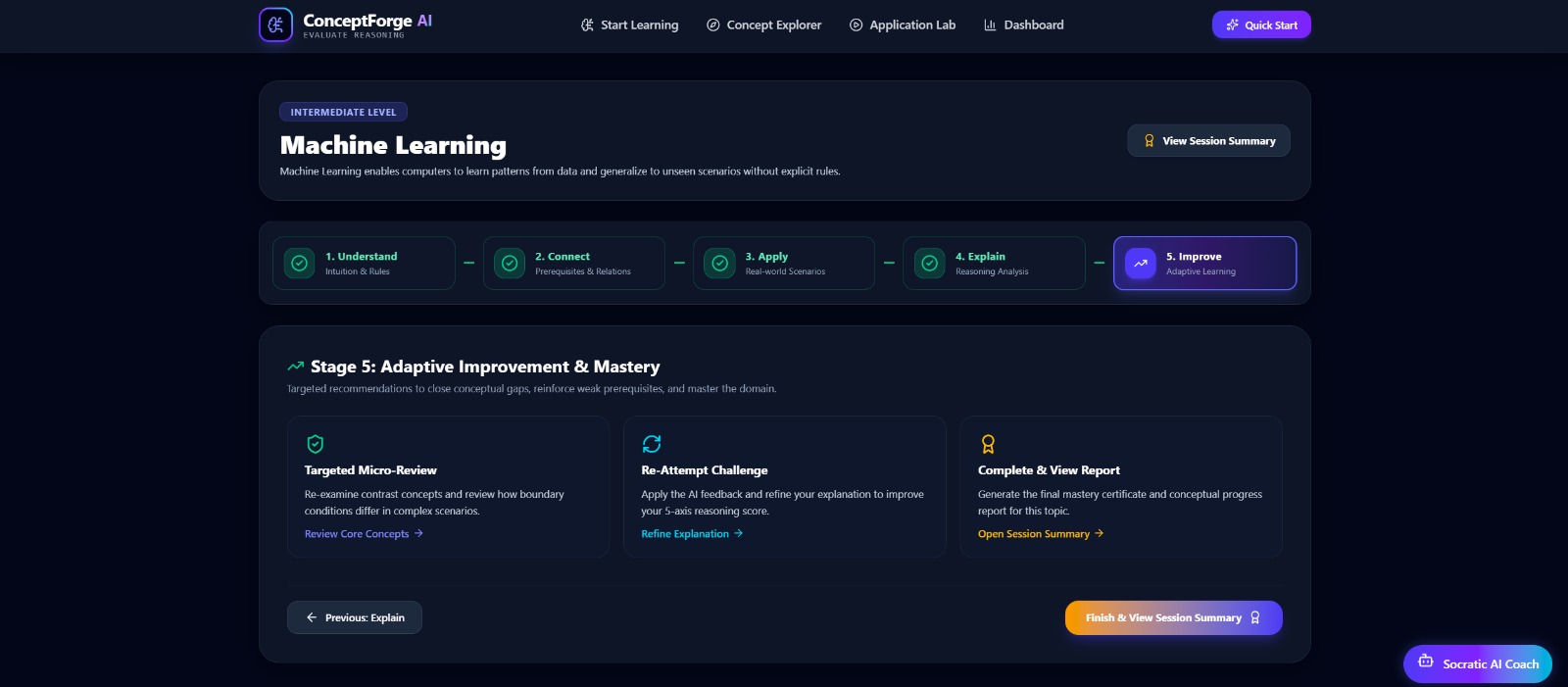
Adaptive Improvement: Improve mastery with targeted reviews and personalized challenges.
-
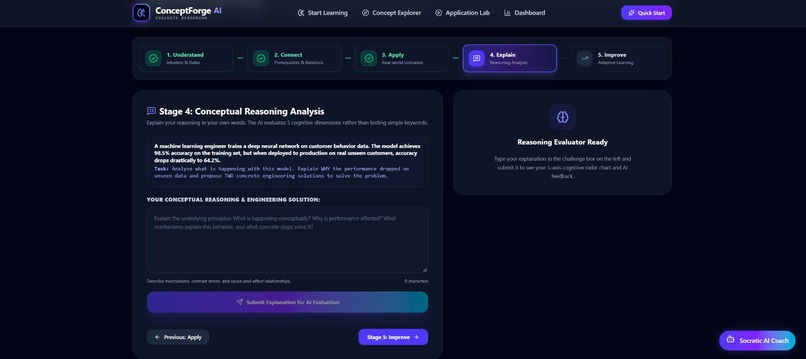
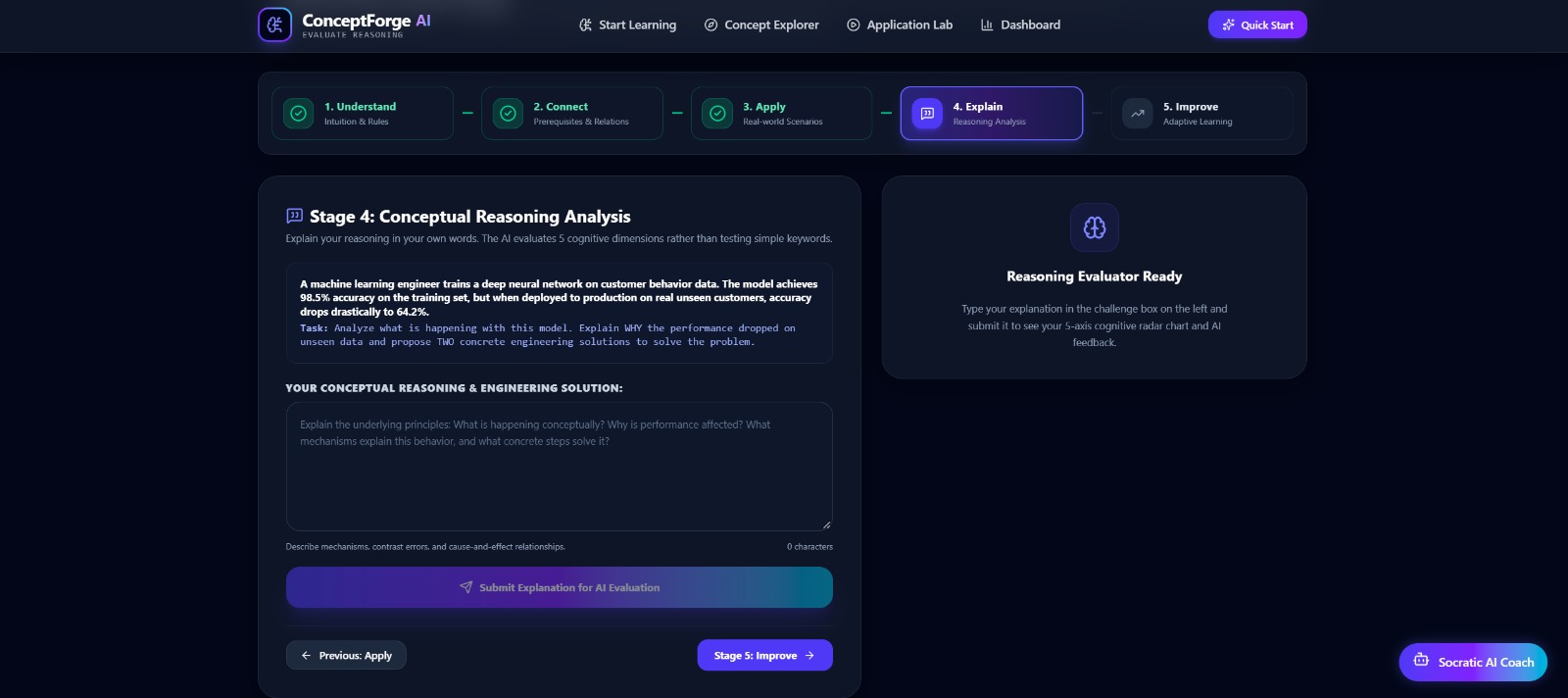
Reasoning Analyzer: Evaluate explanations and identify conceptual knowledge gaps.
-
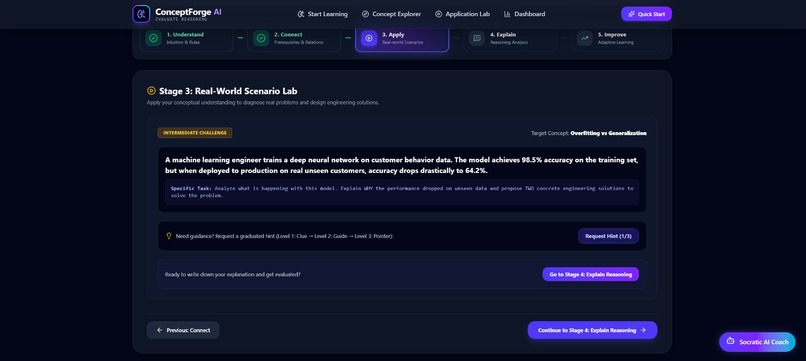
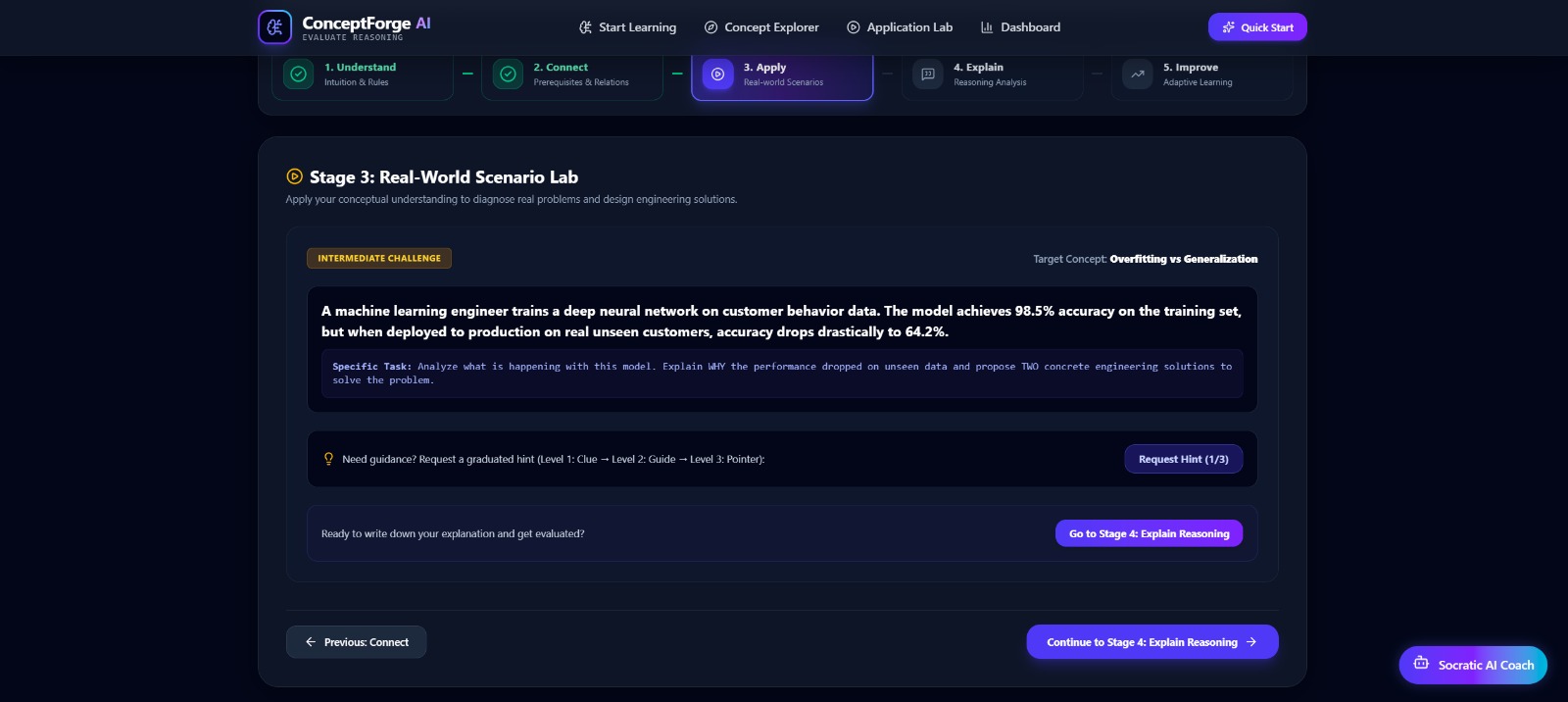
Scenario Lab: Solve real-world problems using conceptual knowledge and engineering solutions.
-
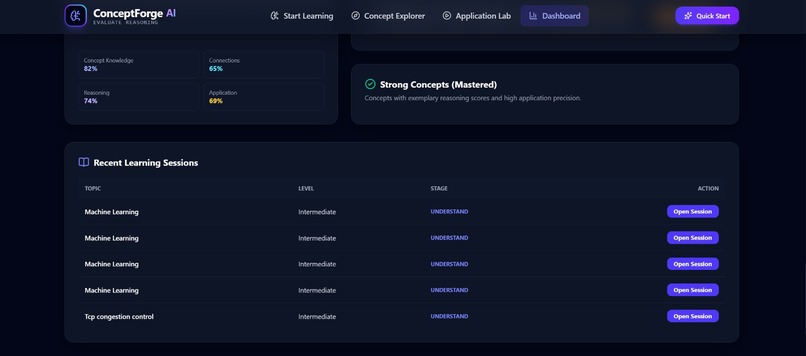
Learning Dashboard: Track recent learning sessions, concept mastery, and progress across subjects.
-
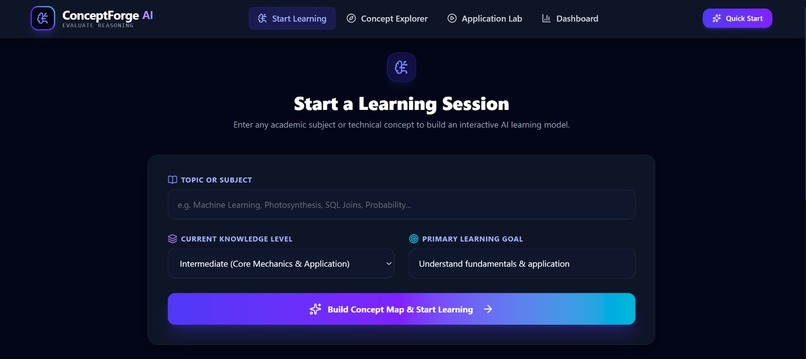
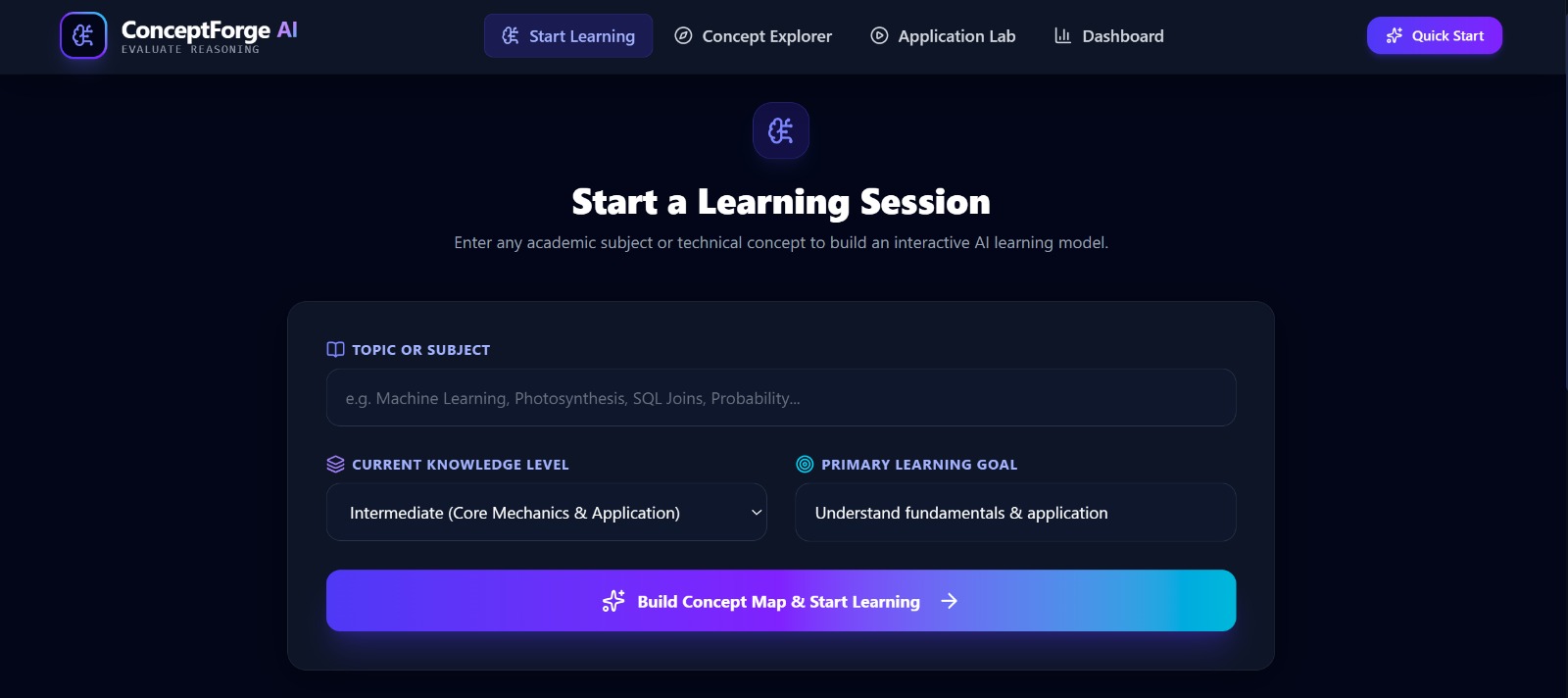
Start Learning: Select a topic, set your knowledge level, and begin personalized AI-guided learning.
-
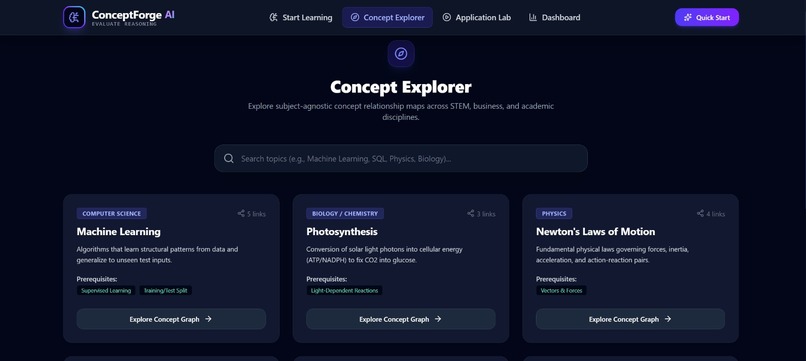
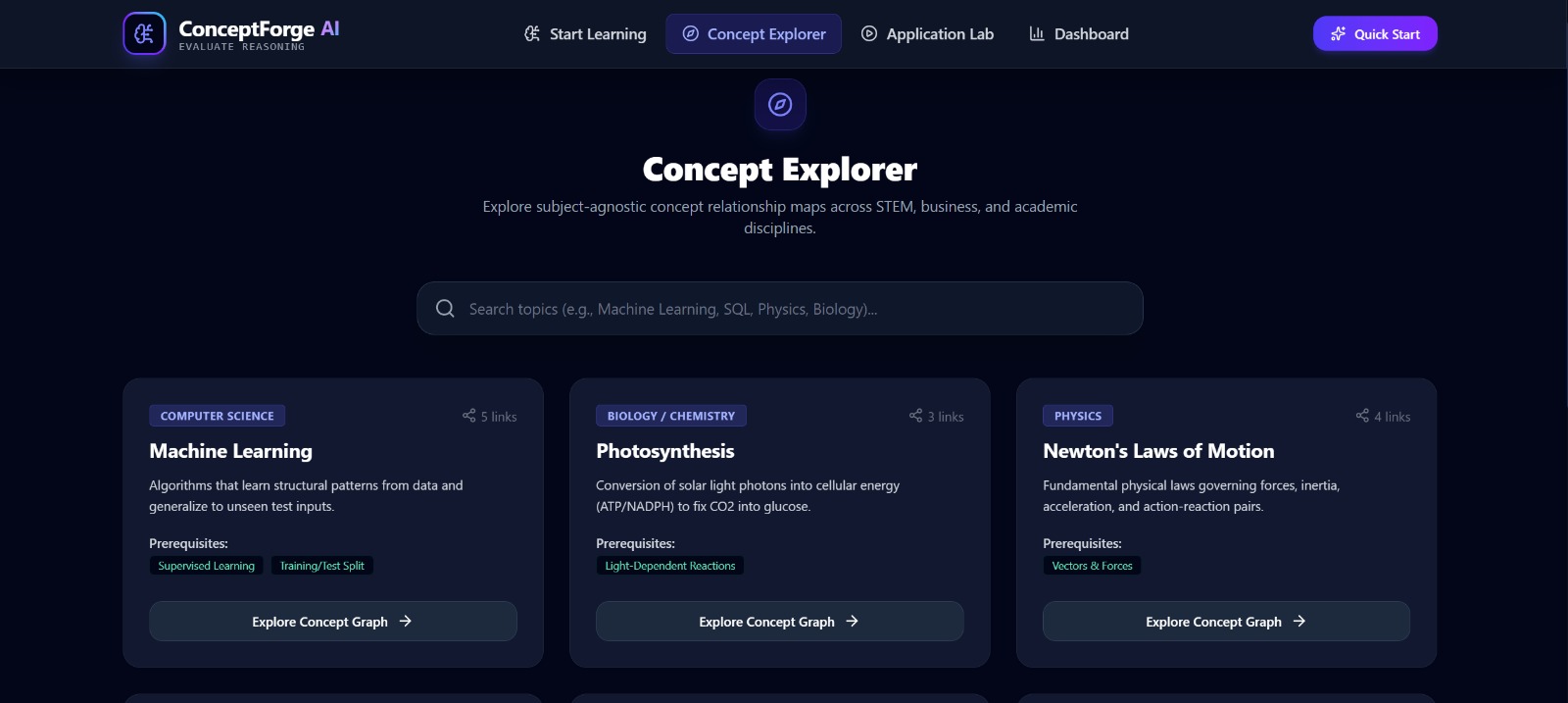
Concept Explorer: Discover concepts across subjects and explore their prerequisites and relationships.
-
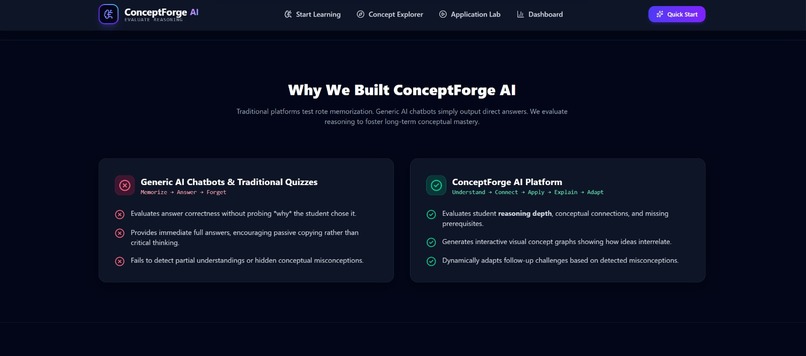
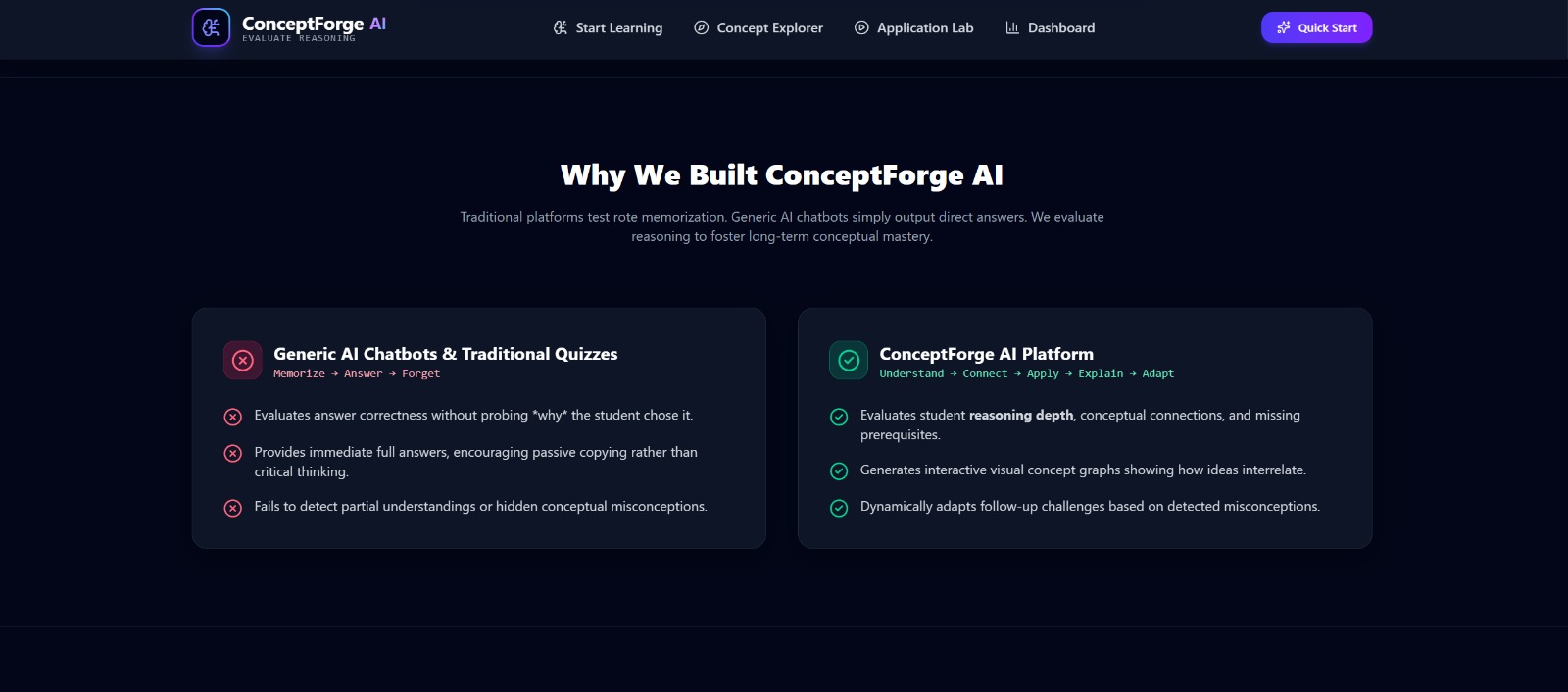
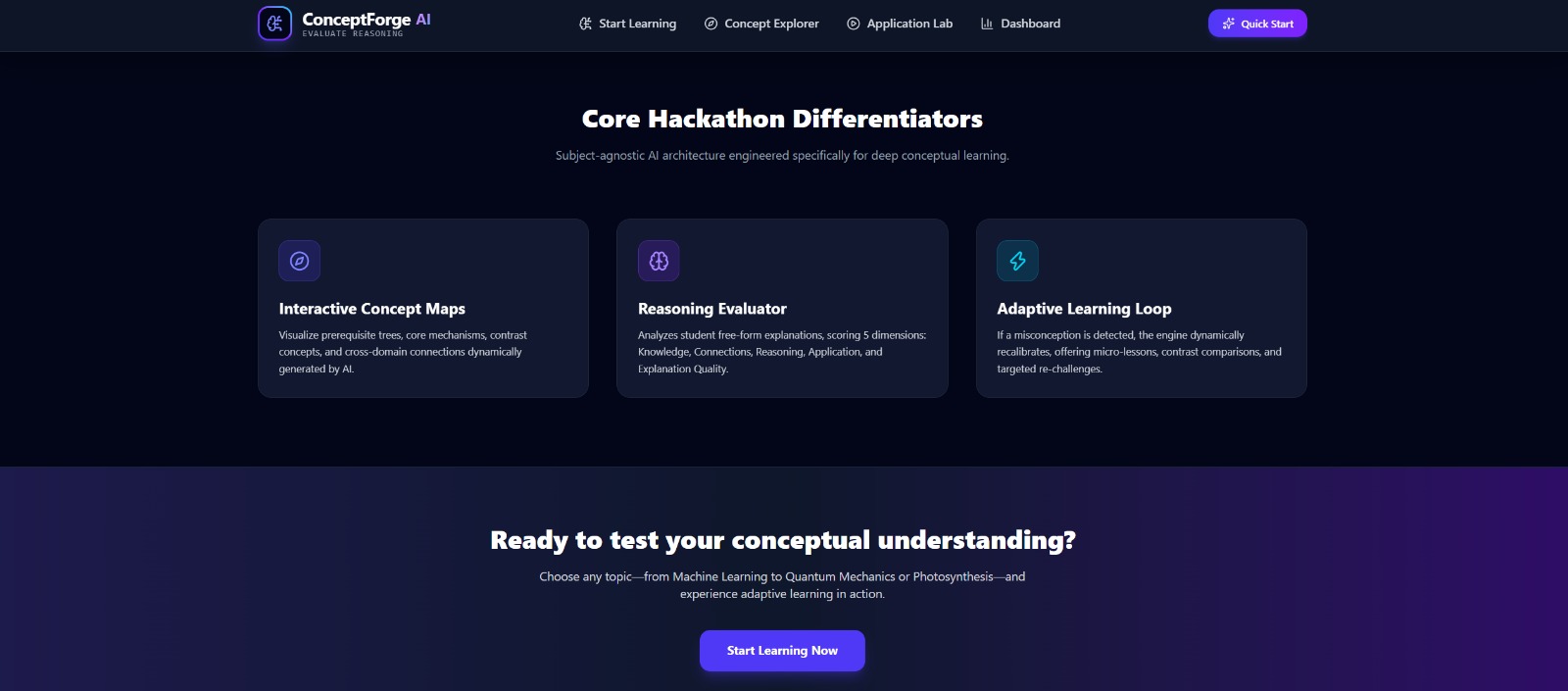
Why ConceptForge AI: Compare traditional quizzes with AI-driven learning that identifies misconceptions and improves reasoning.
-
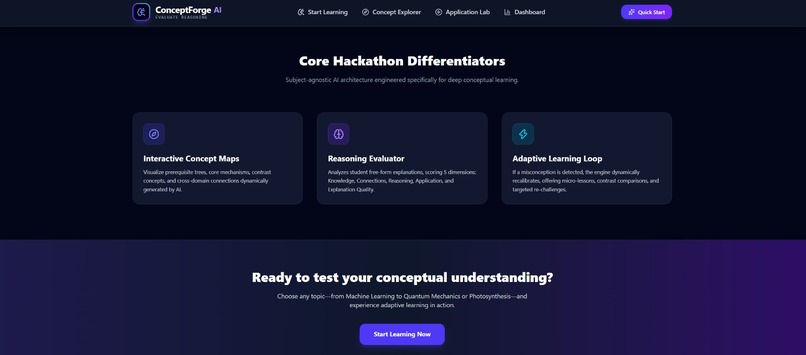
Core Differentiators: Highlight interactive concept maps, AI-powered reasoning evaluation, and adaptive learning.
-
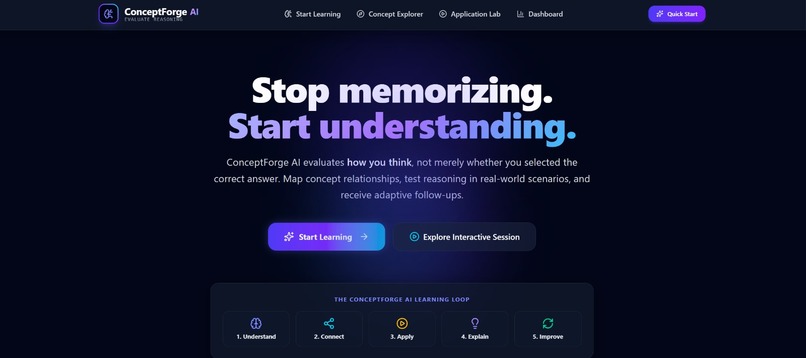
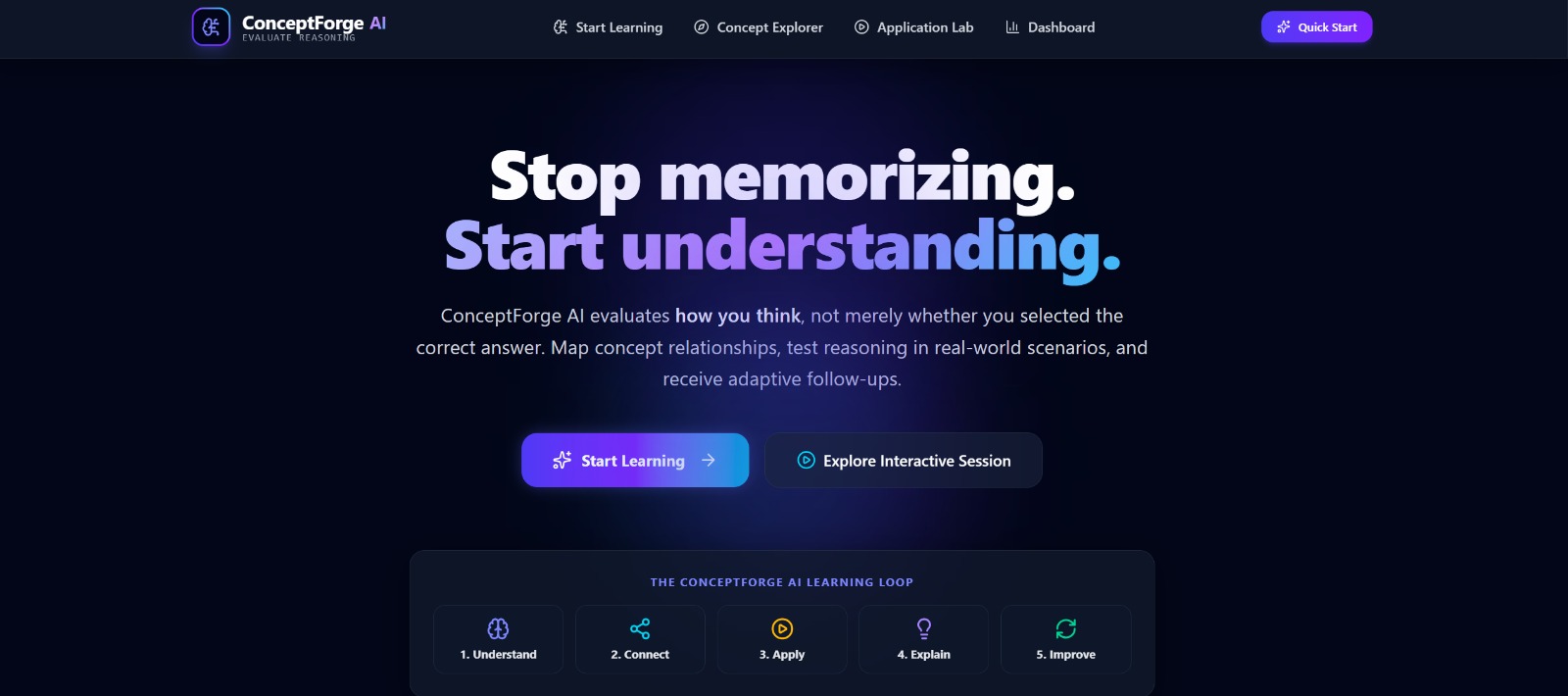
Homepage: Introduce ConceptForge AI’s learning approach through concept mapping, real-world challenges, and personalized improvement.
-
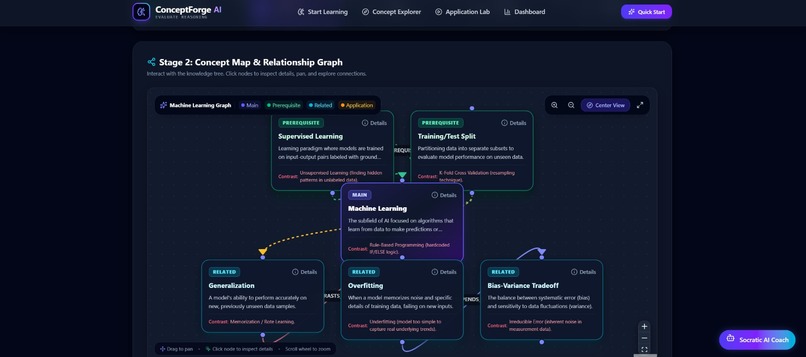
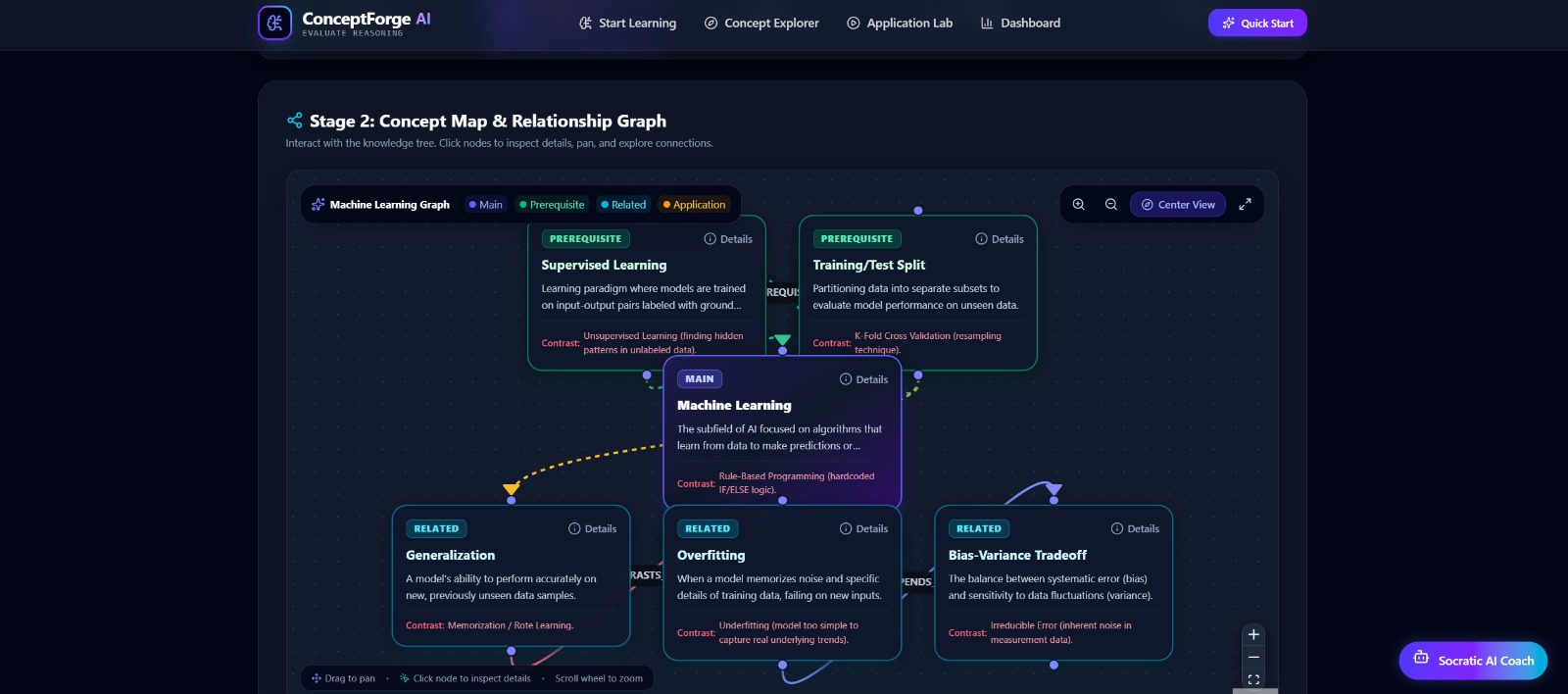
Concept Map: Explore machine learning concepts and their relationships through an interactive graph.
-
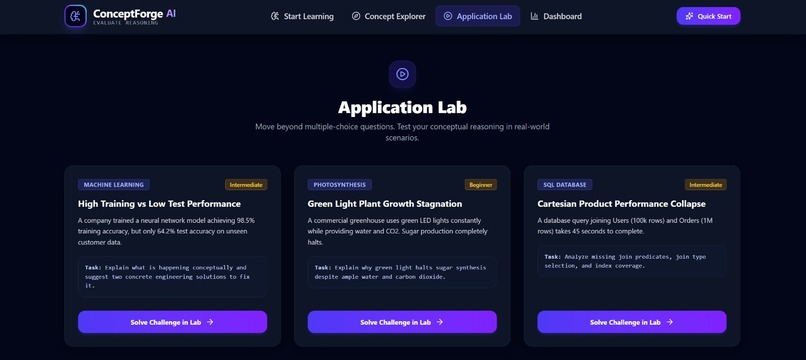
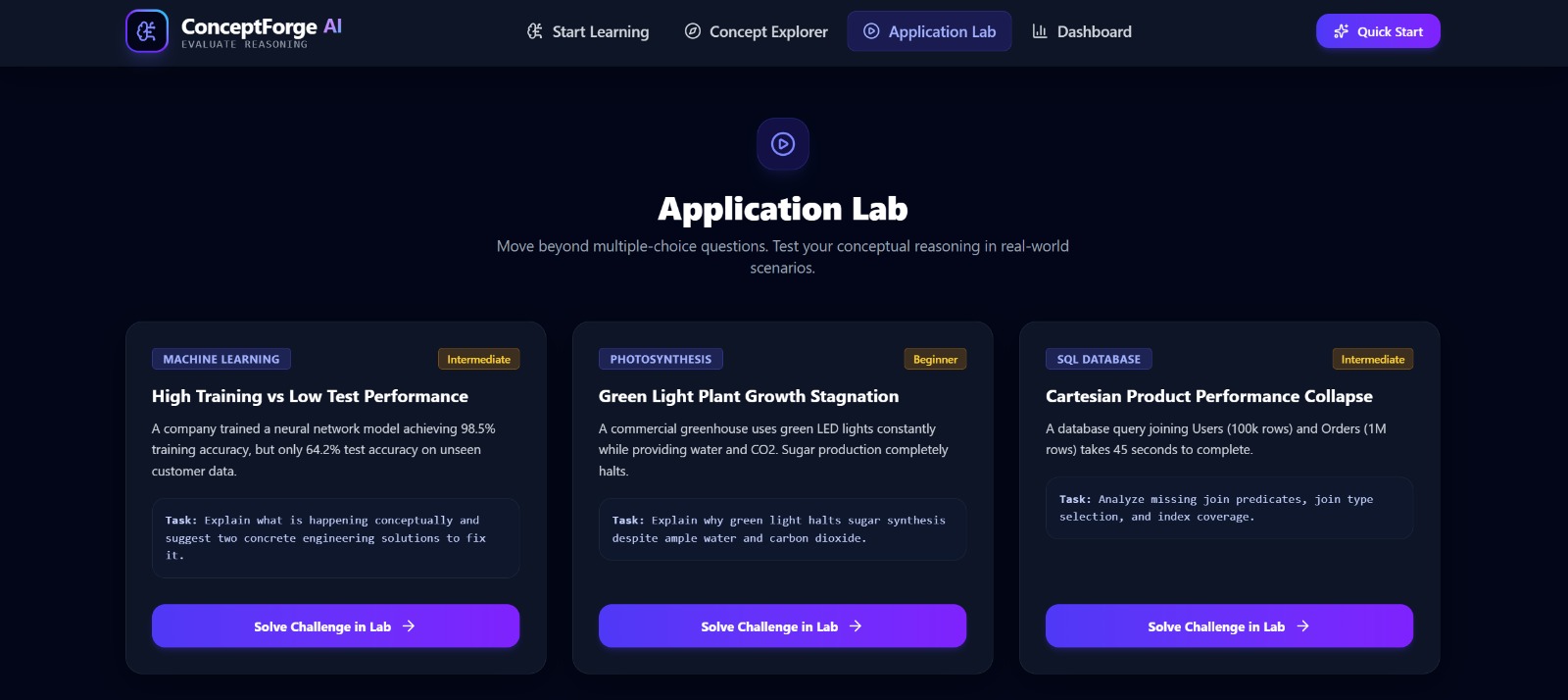
Application Lab: Practice conceptual reasoning through real-world challenges in machine learning, biology, and SQL.
-
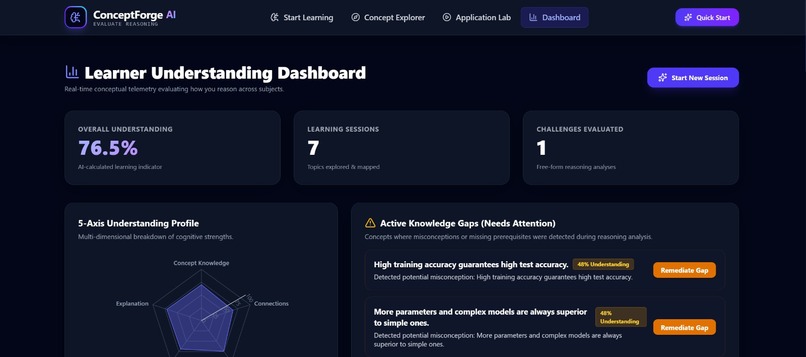
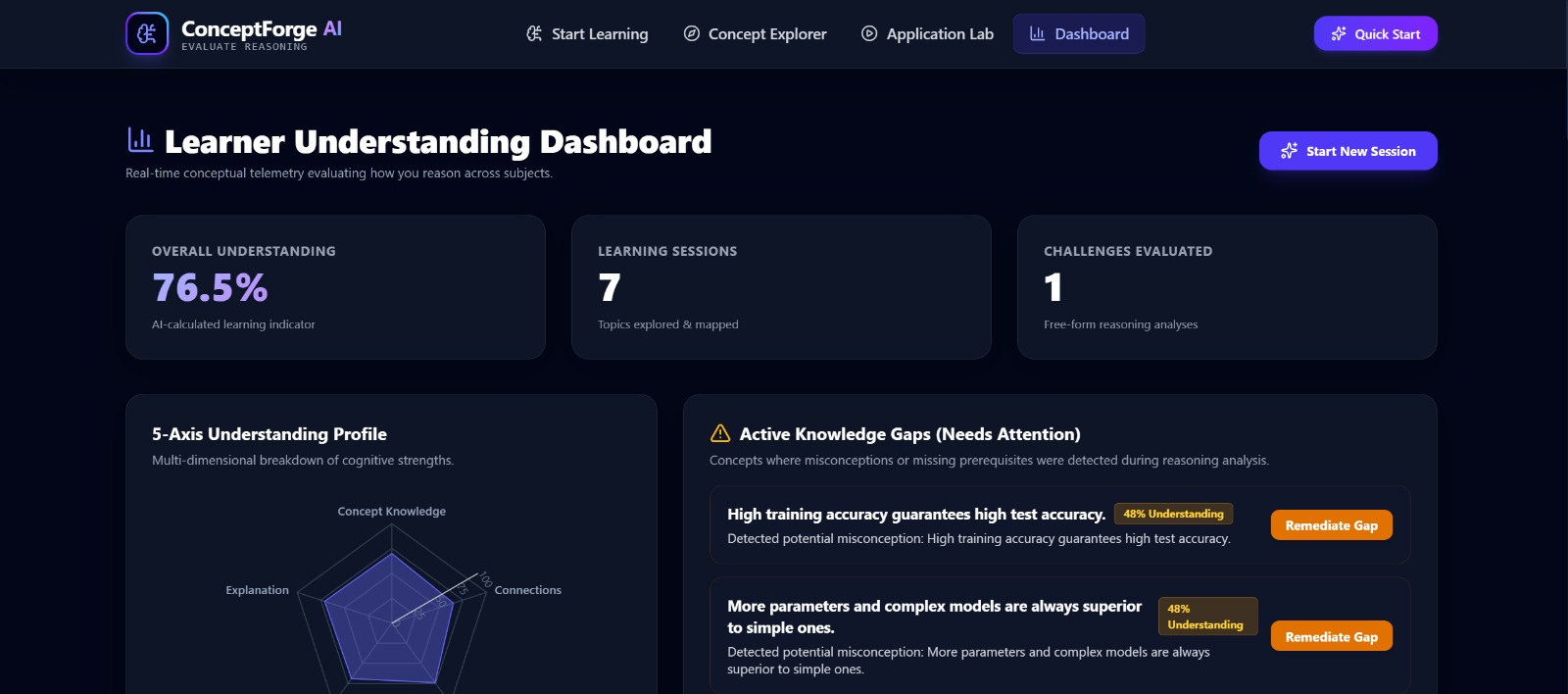
Understanding Dashboard: Analyze learning performance, identify knowledge gaps, and receive targeted improvement recommendations.
-
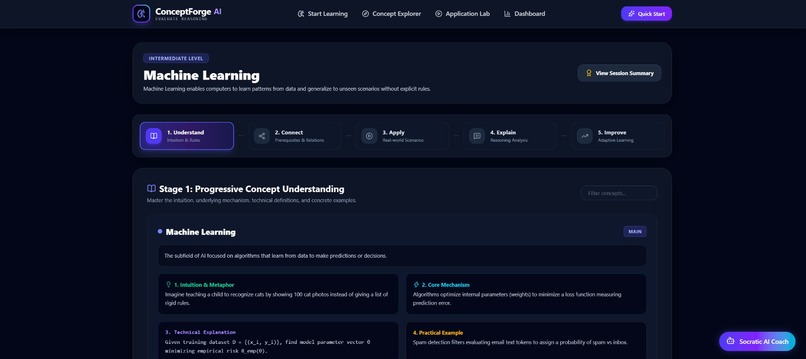
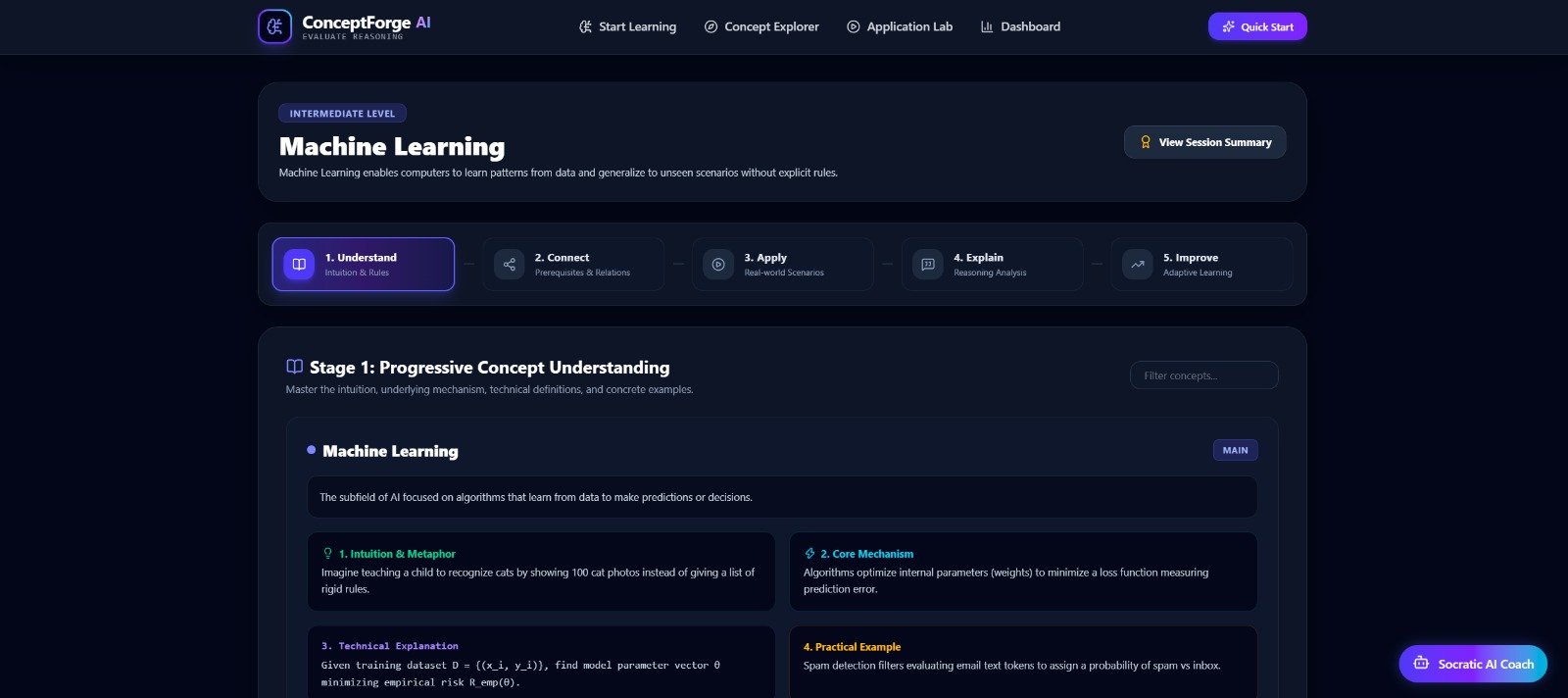
Concept Learning: Understand machine learning through definitions, intuitive examples, and core mechanisms.
ConceptForge AI — Learn Beyond Memorisation
Inspiration
Many students can memorise definitions, reproduce formulas, and answer familiar questions but struggle when they need to explain why something works or apply it to a new situation. We wanted to explore how AI could help learners develop genuine understanding rather than simply provide answers.
This inspired us to build ConceptForge AI, an adaptive learning platform designed around a simple idea: learning should be measured not only by what students answer, but also by how they think and reason.
What It Does
ConceptForge AI transforms a topic into an interactive learning journey:
Understand → Connect → Apply → Explain → Improve
Learners enter a topic, explore its fundamental concepts, discover relationships between ideas, and solve real-world challenges. After a learner submits an explanation, the AI analyzes their reasoning, identifies missing concepts or possible misconceptions, and recommends a targeted next activity.
Instead of treating every incorrect answer the same way, the platform aims to identify what the learner understands, what is missing, and what they should practice next.
Key Features
- AI Understanding Diagnosis: Evaluates free-form explanations across concept knowledge, connections, reasoning, application, and explanation quality.
- Interactive Concept Maps: Visualizes prerequisites, related concepts, dependencies, and real-world applications through an interactive graph.
- Application Lab: Challenges learners with scenario-based questions that require explanation and problem-solving rather than memorization alone.
- Misconception Detection: Highlights incomplete reasoning, missing prerequisites, and potential conceptual misunderstandings with constructive feedback.
- Adaptive Learning: Uses the learner's previous response to guide the next explanation or challenge, adjusting the learning experience to address identified gaps.
- Socratic AI Tutor: Provides graduated hints and guiding questions to encourage independent thinking before revealing a solution.
- Learning Progress Dashboard: Summarizes understanding across multiple dimensions and highlights concepts that need further practice.
- Reliable Demo Mode: Provides a deterministic learning experience when an AI API key is unavailable or the external AI service fails.
How We Built It
We built ConceptForge AI as a full-stack application with a React and TypeScript frontend and a Python FastAPI backend. Tailwind CSS provides the interface styling, React Flow powers the interactive concept graph, and SQLAlchemy with SQLite supports local data persistence.
The AI layer integrates Google's Gemini API for generating learning content, evaluating explanations, identifying potential knowledge gaps, and recommending follow-up activities. A separate demo provider supplies structured example content when the external AI service is unavailable.
The learning workflow uses structured data models to represent concepts, relationships, application challenges, reasoning analyses, and adaptive recommendations. This helps connect the AI output to the learner-facing interface instead of presenting everything as an ordinary chat response.
Challenges We Faced
One of the central design challenges was moving beyond simple answer correctness. A response can be partially correct, incomplete, or based on a misconception, so the platform needs to provide more informative feedback than a basic right-or-wrong result.
We also needed to connect AI-generated content, concept visualization, response evaluation, and adaptive follow-up activities into one coherent workflow. Another important challenge was reliability: an educational demo should remain usable even when an external AI service is unavailable. We addressed this by separating the AI provider from a deterministic demo provider.
What We Learned
Building ConceptForge AI helped us explore how structured AI outputs, full-stack integration, interactive visualizations, and adaptive feedback can work together to support learning.
We also learned that useful educational AI should do more than explain a topic. It should encourage learners to articulate their thinking, connect ideas, recognize gaps, and attempt a new problem.
Real-World Impact
ConceptForge AI is designed for school students, college students, and independent learners across subjects such as mathematics, science, engineering, and computer science.
By emphasizing reasoning and application, the platform aims to help learners identify weaknesses earlier and practice more purposefully. It can also offer educators a framework for thinking about learning progress beyond marks alone.
ConceptForge AI is a learning-support tool, not a replacement for teachers or a validated measure of academic ability. Its AI-generated evaluations are intended to guide reflection and further practice.
What's Next
We envision adding curriculum-aligned learning paths, teacher-created challenges, richer visual explanations, and evaluation methods validated with real learners and educators.
Our goal is to make AI a partner in understanding—not just a shortcut to an answer.
ConceptForge AI — Learn the concept. Connect the ideas. Apply the knowledge.
Built With
- artificial-intelligence
- fastapi
- gemini
- generative-ai
- machine-learning
- pydantic
- python
- react
- react-flow
- rest-api
- sqlalchemy
- sqlite
- tailwindcss
- typescript
- vite

Log in or sign up for Devpost to join the conversation.