
Inspiration
Students can memorize Bayes’ theorem and still confuse two different questions:
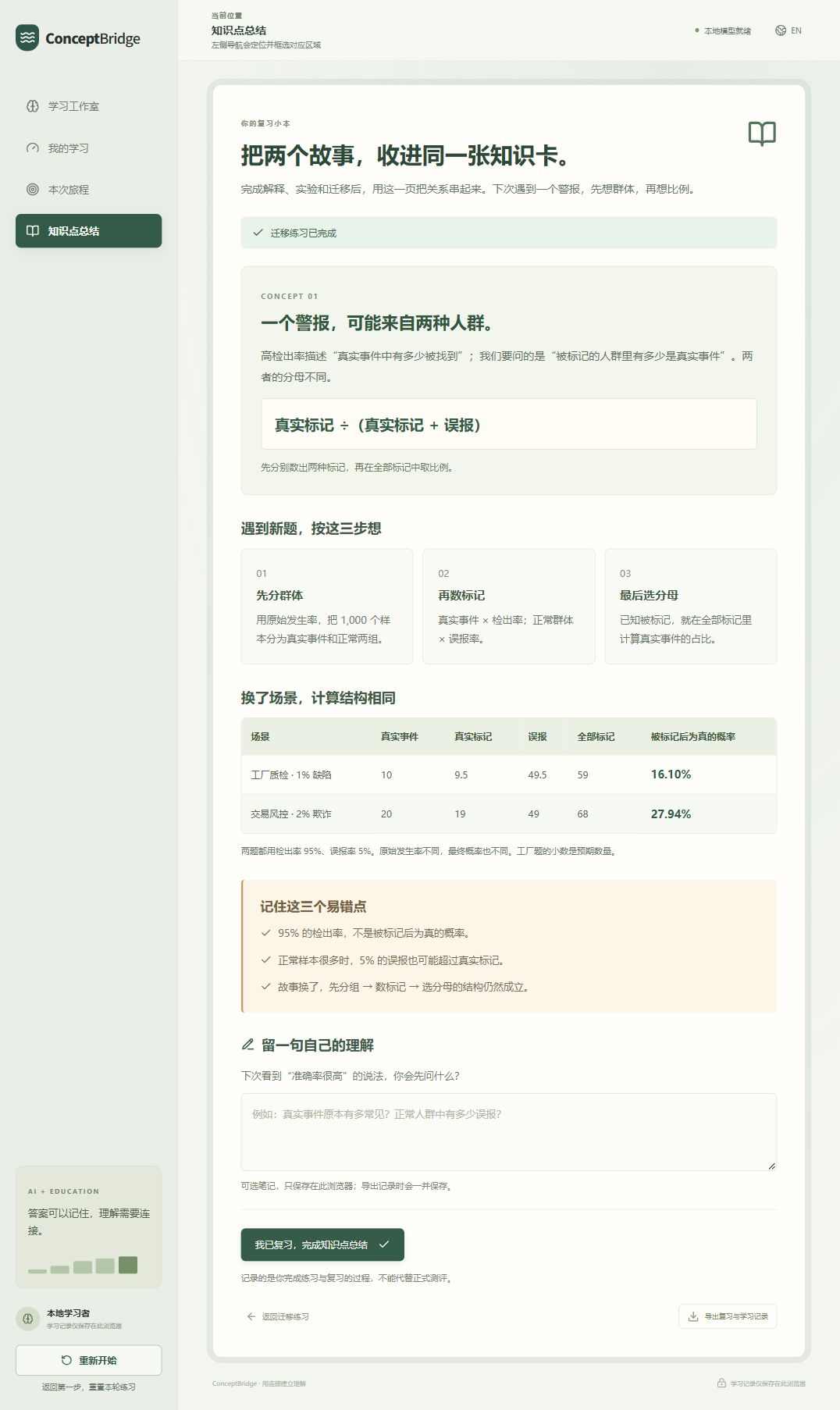
- How often does a detector flag a real event?
- Given a flag, how likely is the event to be real?
We wanted to build a learning experience that makes this hidden difference visible instead of giving learners another formula to memorize.
What it does
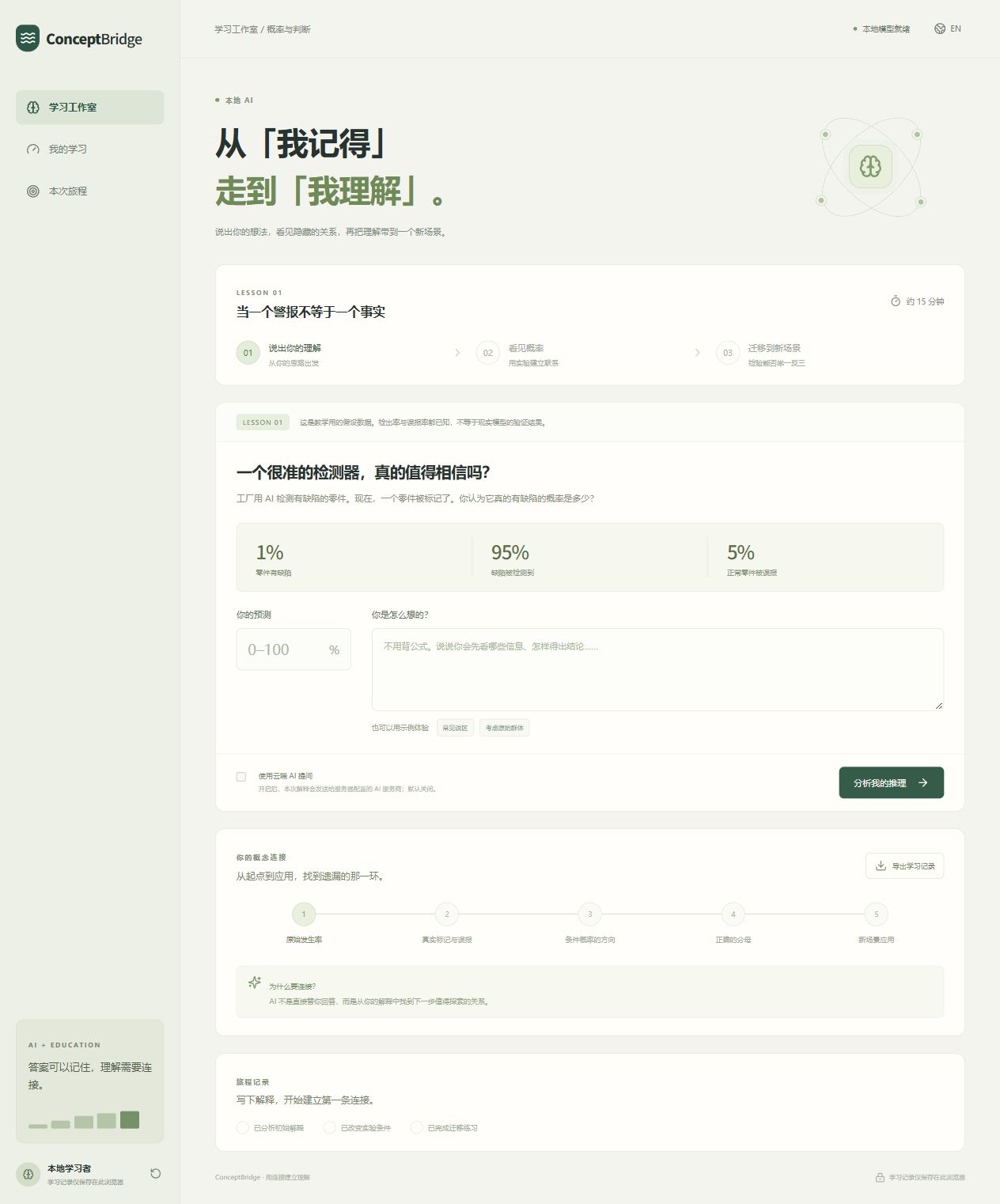
ConceptBridge guides learners through one complete learning loop:
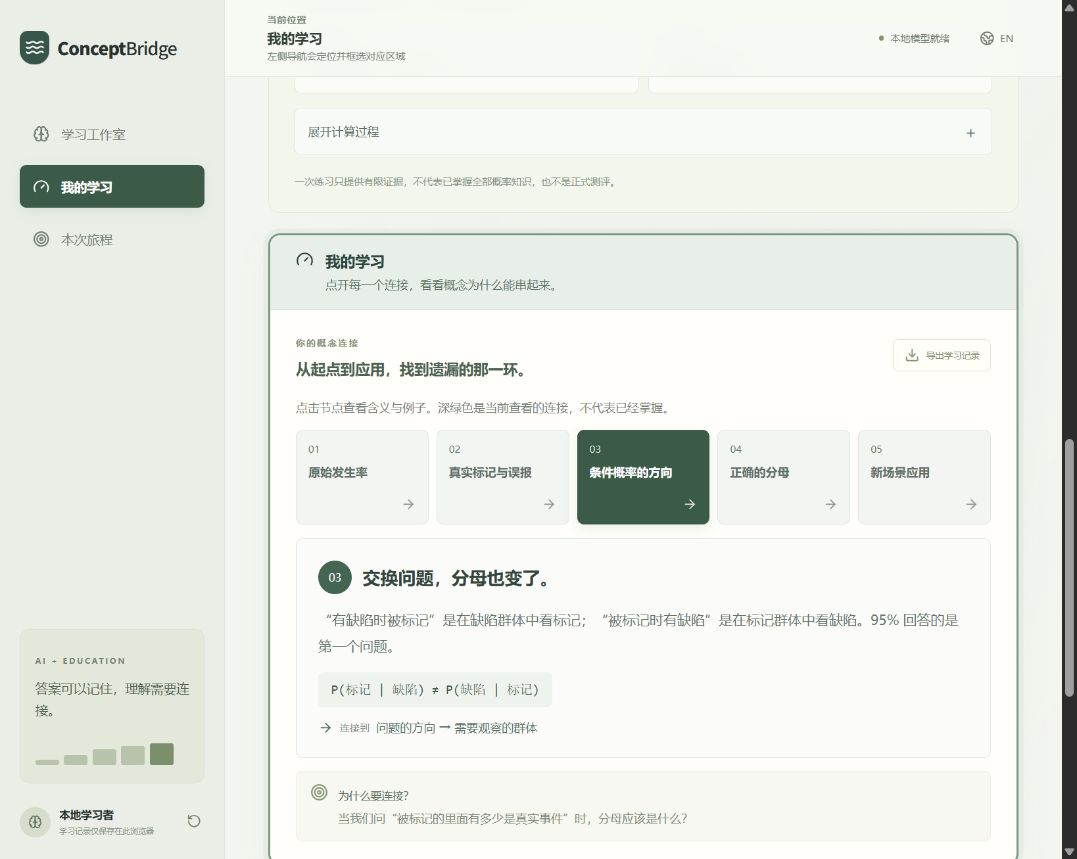
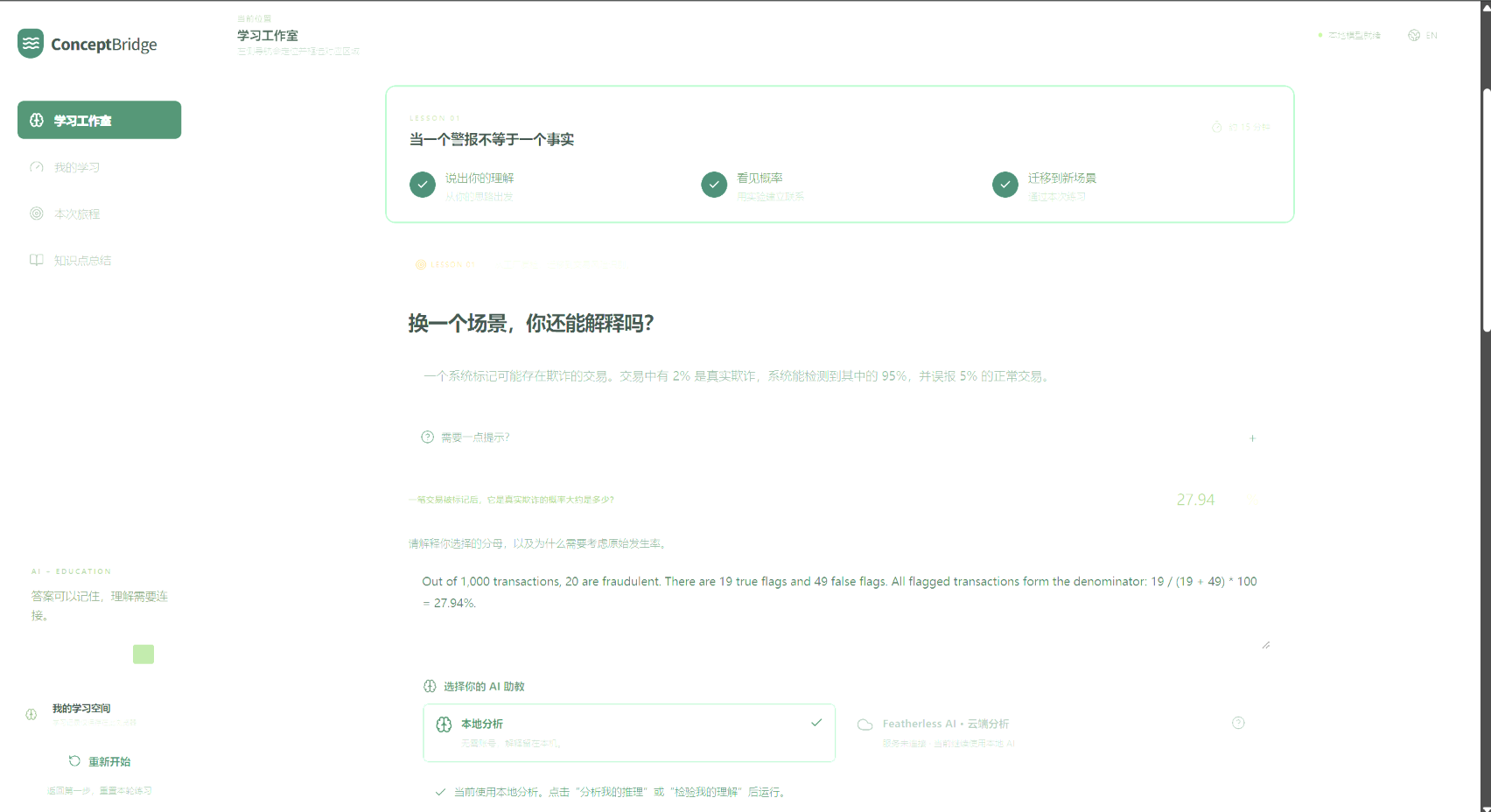
- Explain their own reasoning about a probability problem.
- Receive an AI-generated reasoning clue.
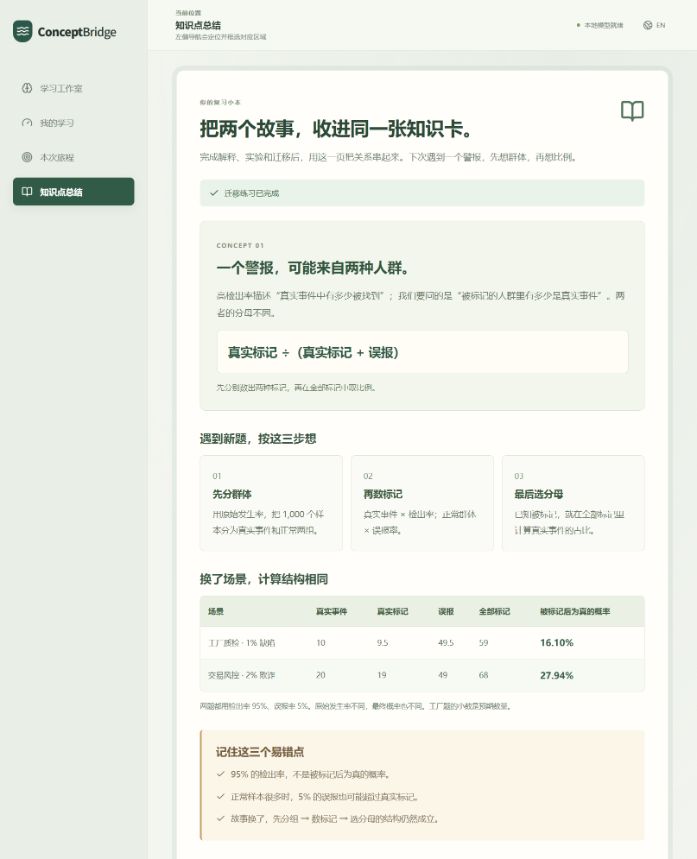
- Use an interactive natural-frequency experiment to count true flags and false flags.
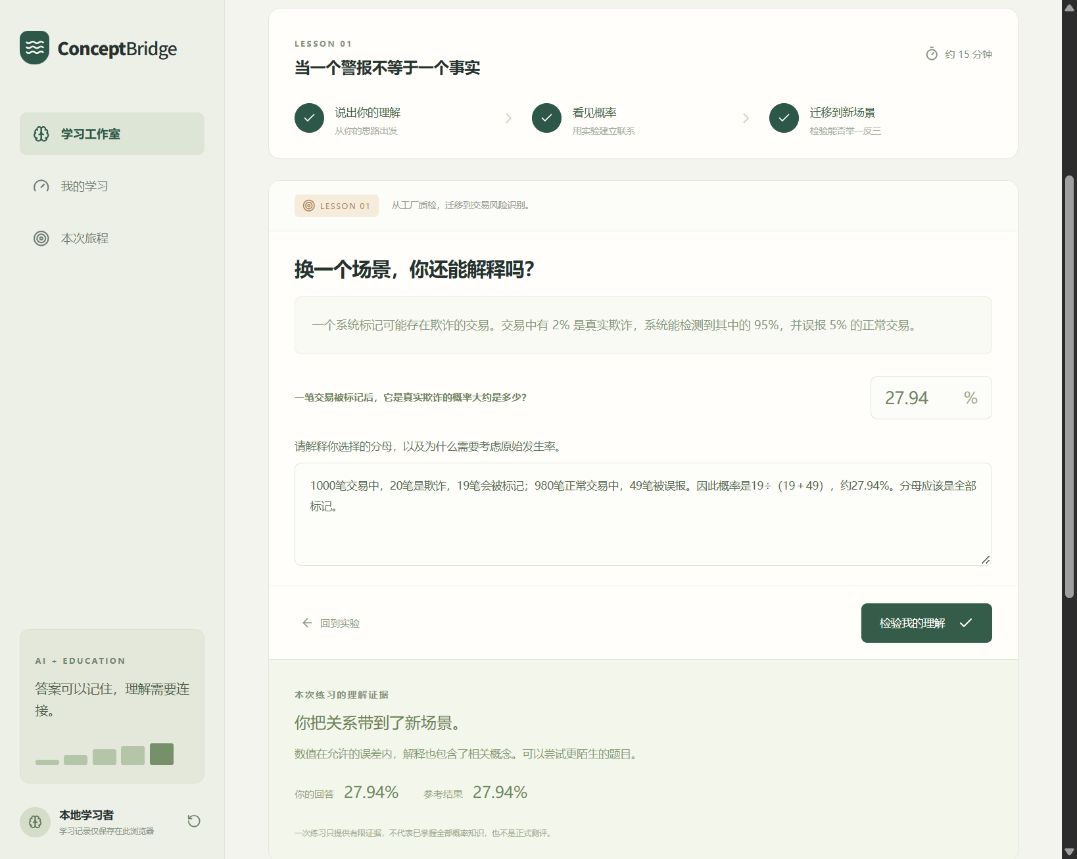
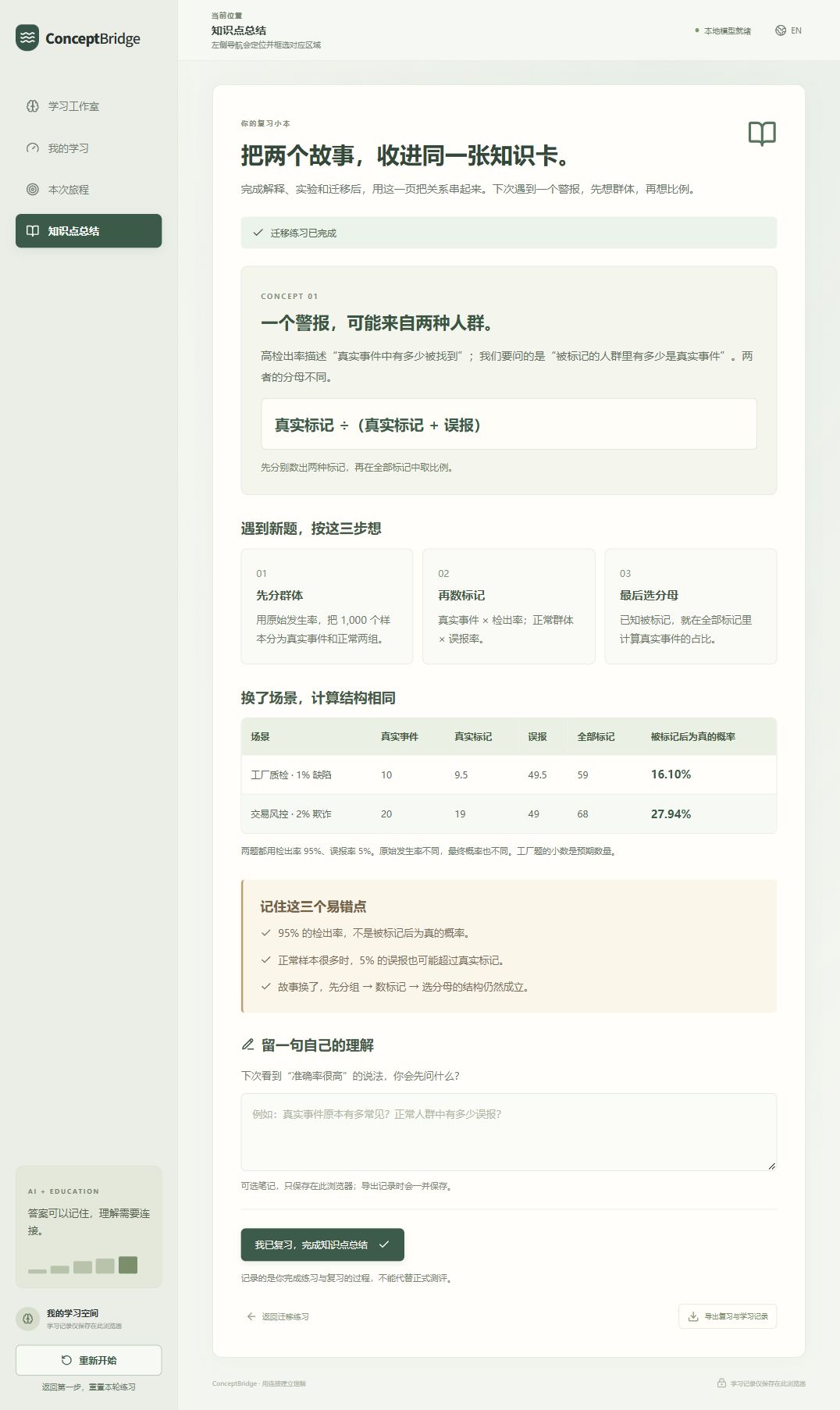
- Apply the same relationship to a new transaction-fraud scenario.
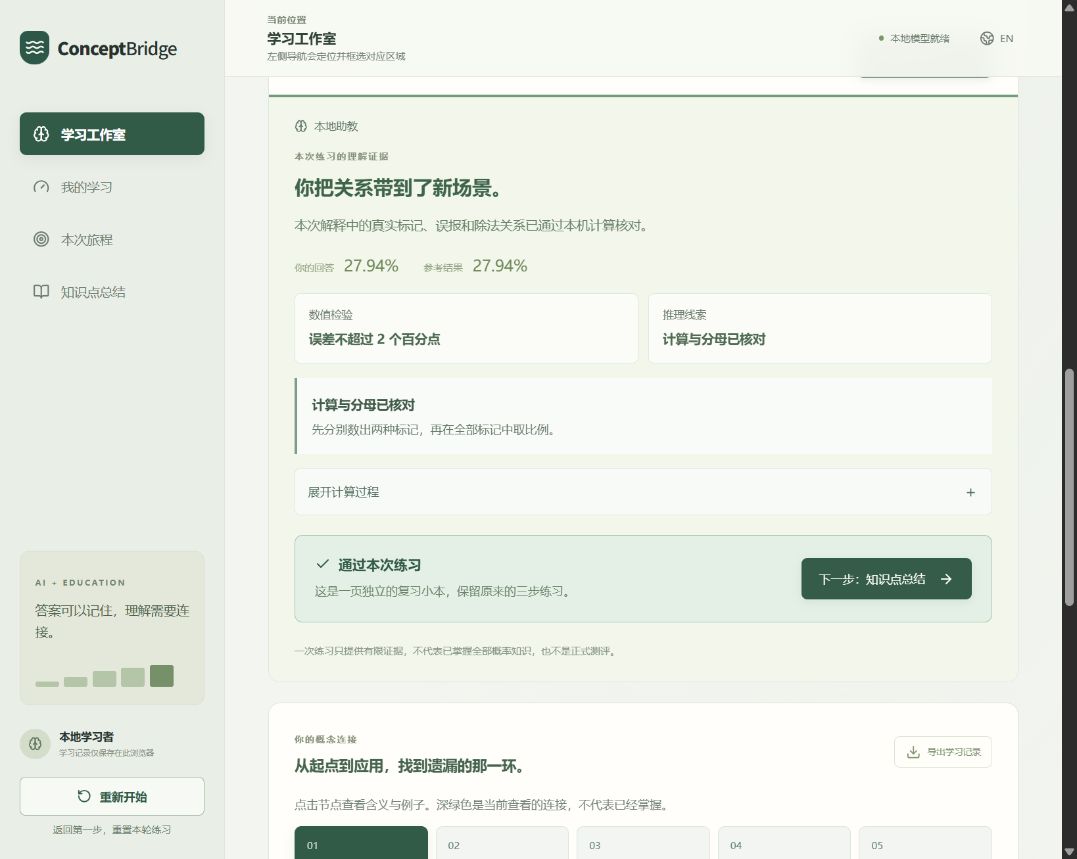
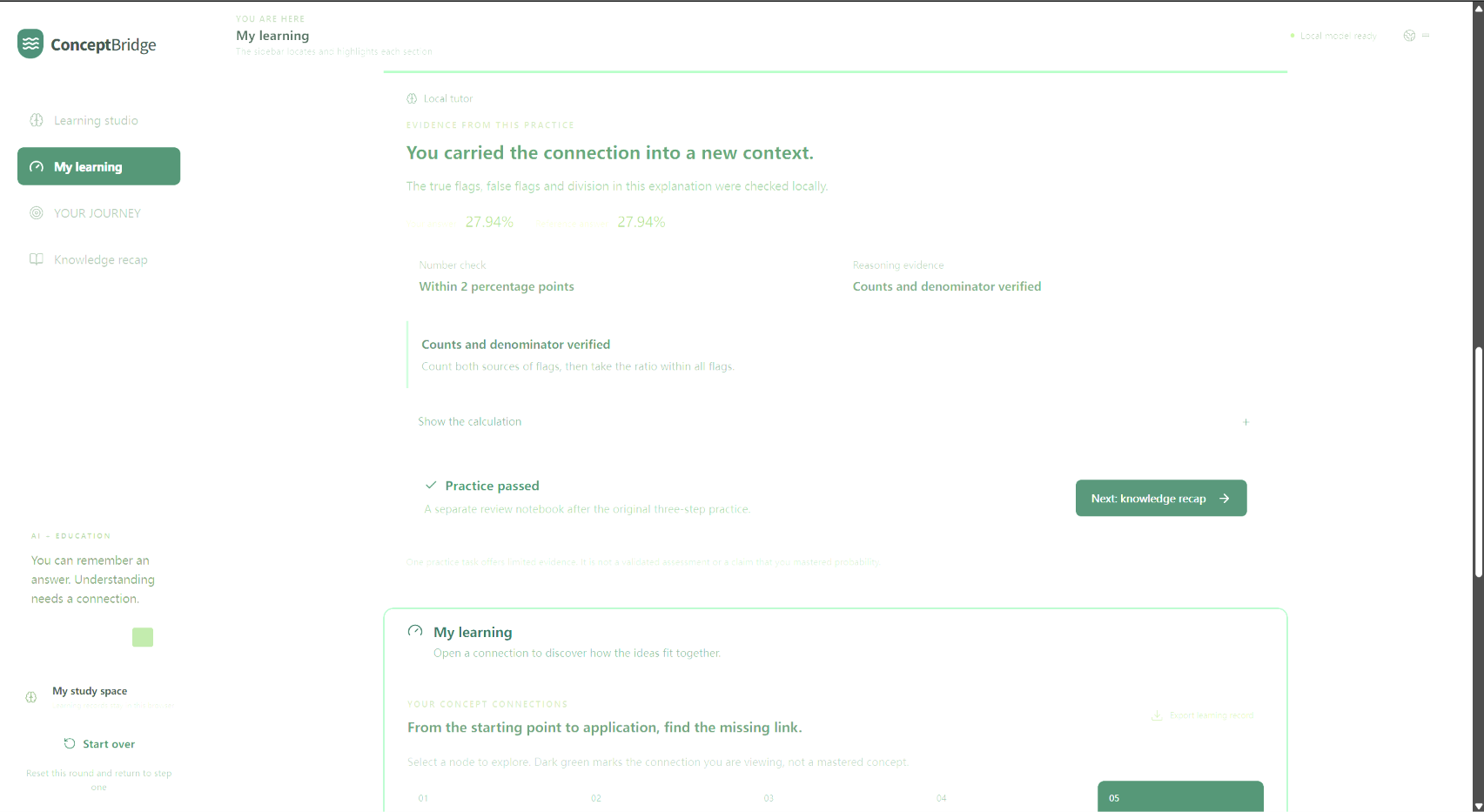
The system checks numerical evidence and reasoning evidence separately. It can also abstain when an explanation does not contain enough evidence for a reliable interpretation.
The interface is bilingual in Chinese and English, and the core experience runs locally without a paid API, external dataset, or GPU.
How we built it
The frontend uses React, TypeScript, Vite, and responsive CSS. The backend uses FastAPI and scikit-learn.
Our local reasoning model uses character-level TF-IDF features and logistic regression trained on 71 authored bilingual examples. It identifies patterns such as:
- base-rate neglect;
- reversed conditional probabilities;
- supported reasoning;
- insufficient evidence.
Probability calculations are deterministic and separate from the language model. The experiment uses natural frequencies to show how prevalence, detection rate, and false-positive rate affect the meaning of a flag.
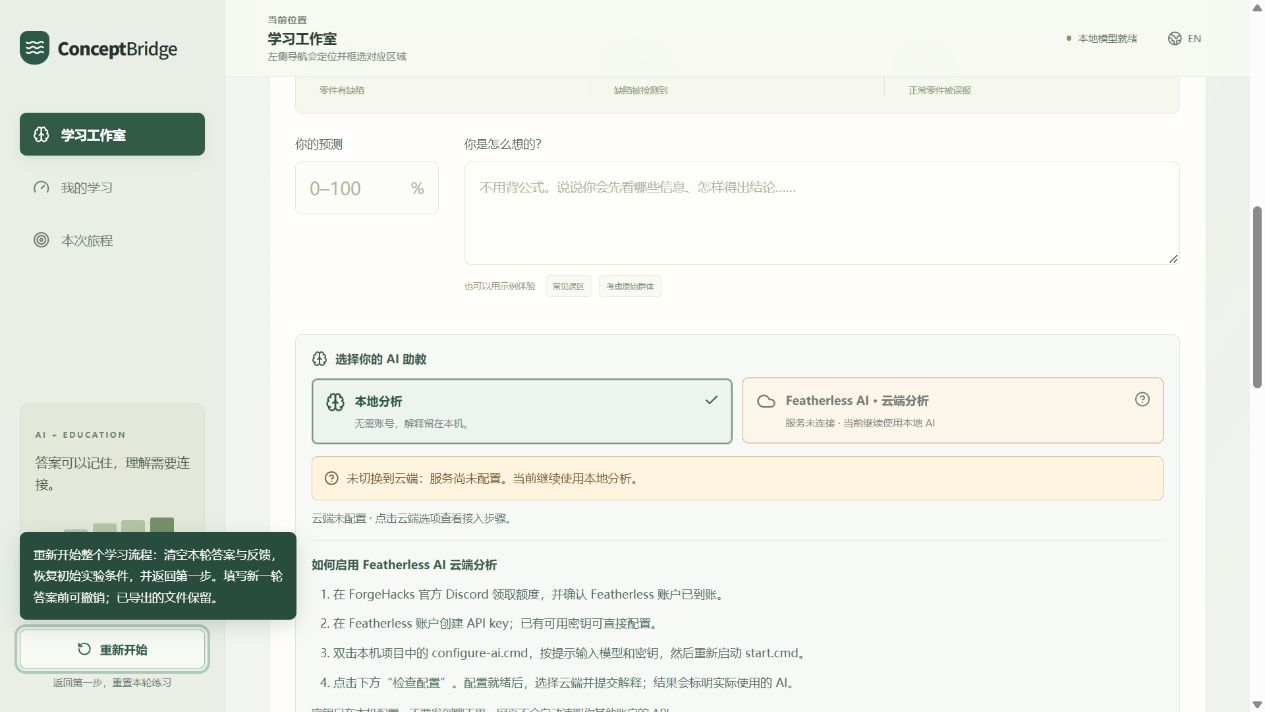
We also included an optional cloud-analysis adapter for an OpenAI-compatible provider. Cloud output is validated, and the application falls back to local feedback if the provider is unavailable.
Challenges we ran into
The main challenge was giving useful guidance without pretending that one answer proves mastery.
We separated exact arithmetic from AI interpretation so that the model cannot change the mathematical result. We also had to handle unfamiliar wording, bilingual explanations, fractional expected counts, and the difference between a correct answer and a correct explanation.
Accomplishments that we're proud of
We built a complete explain → experiment → transfer workflow instead of a simple answer generator.
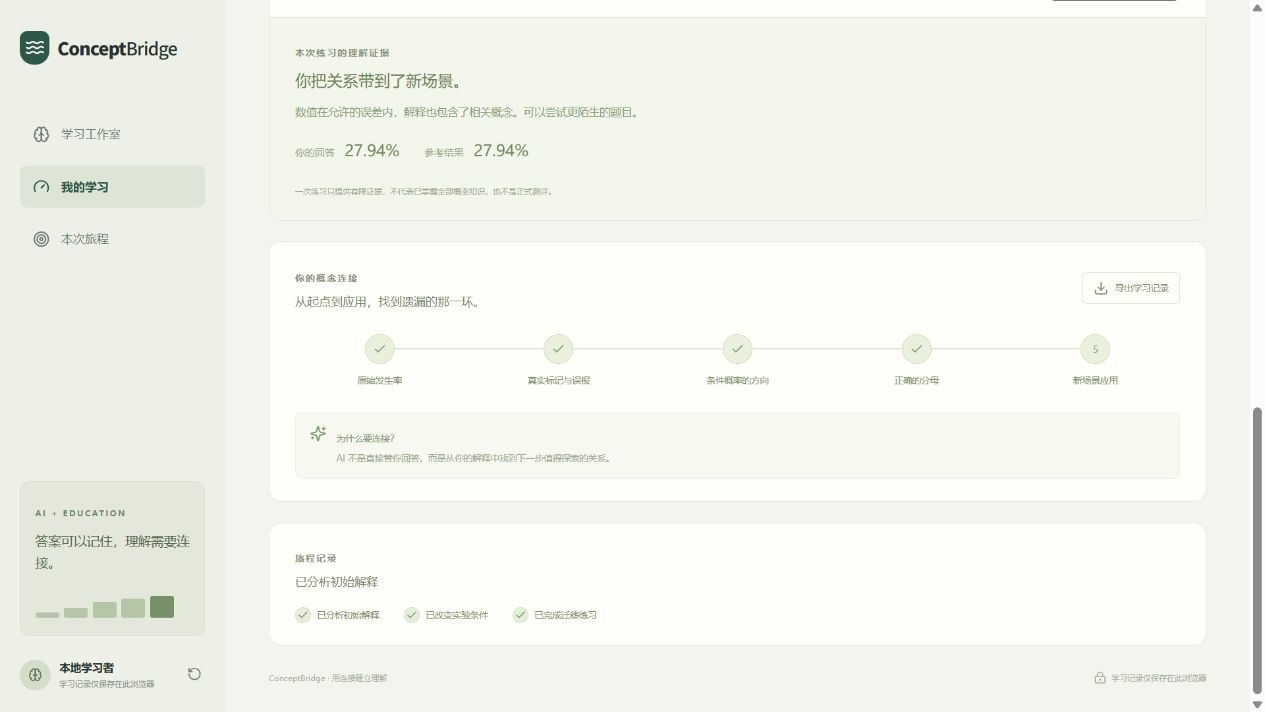
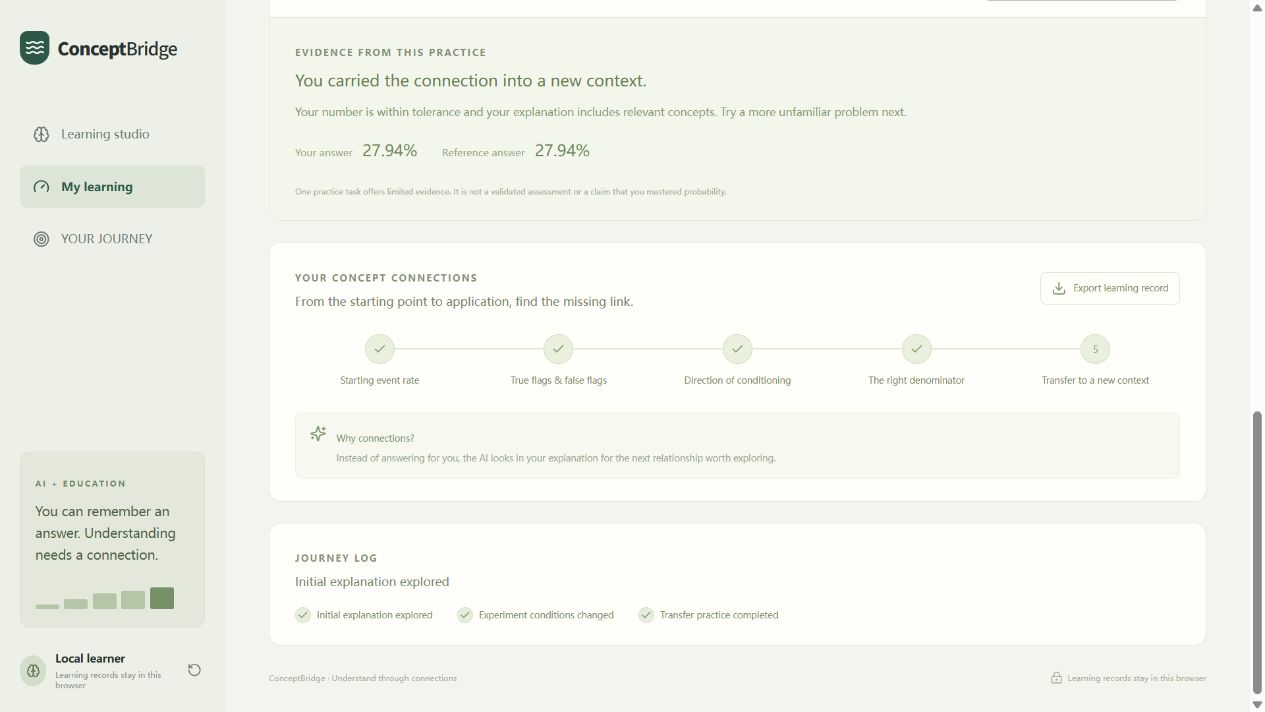
The learner can see the denominator change, predict what will happen when the population changes, and then apply the same concept to a new context. The system records the learning journey locally and clearly distinguishes practice evidence from a formal assessment.
What we learned
AI is more useful for education when it chooses the next relationship for a learner to explore instead of immediately revealing the answer.
We also learned that a small, transparent, topic-specific model can be more appropriate for a focused learning interaction than a general chatbot. A model should be allowed to say that there is not enough evidence rather than presenting every interpretation with false confidence.
What's next for ConceptBridge: Learn Beyond Memorization
We will test the experience with more independent learners and use their feedback to improve explanations, accessibility, and abstention behavior.
The next content modules will keep the same learning structure while introducing related contexts such as medical screening, spam detection, and risk analysis. We also plan to add teacher-facing progress summaries and more carefully validated learning assessments.
This prototype is an educational experience, not a validated assessment or a claim of measured learning improvement.
Built With
- ai
- bilingual
- css
- education
- fastapi
- html
- probability
- python
- react
- scikit-learn
- tf-idf
- typescript
- vite


Log in or sign up for Devpost to join the conversation.