Inspiration
The concept originated from a straightforward observation: real estate agents, architects, and interior designers spend numerous hours measuring and modeling spaces by hand. The process is laborious and time-consuming, whether it is for virtual staging, renovation planning, or building digital twin creation. "What if you could just take a photo and instantly get a usable 3D model?" we asked ourselves. We discovered that this was not only feasible, but also attainable within a hackathon timeframe, thanks to the development of AI-powered depth estimation and the availability of smartphone cameras. Our goal was to democratize 3D scanning, making it as simple as taking a photo.
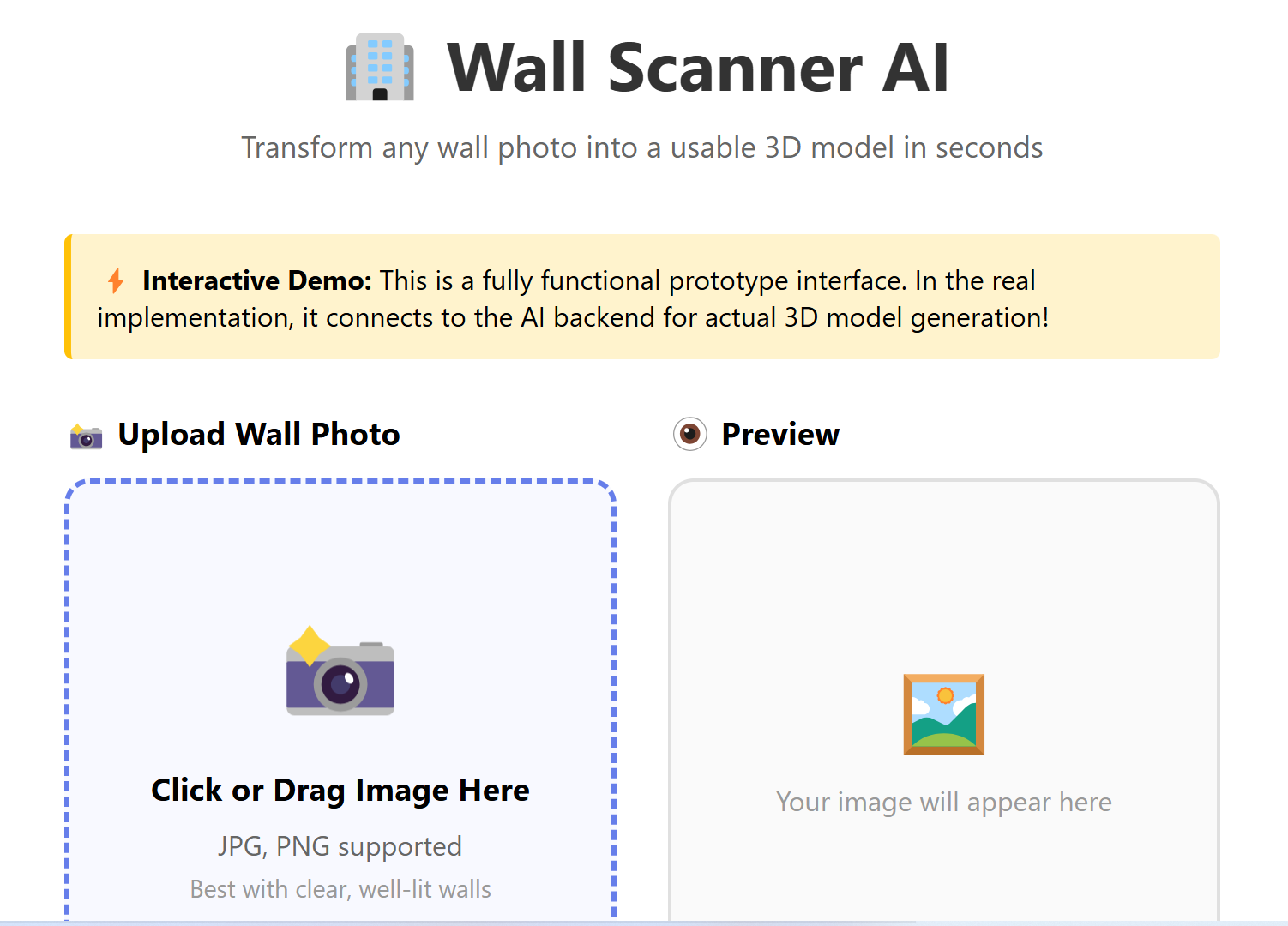
What it does In less than 30 seconds, Wall Scanner AI converts a single wall photo into a 3D model that is ready for production.
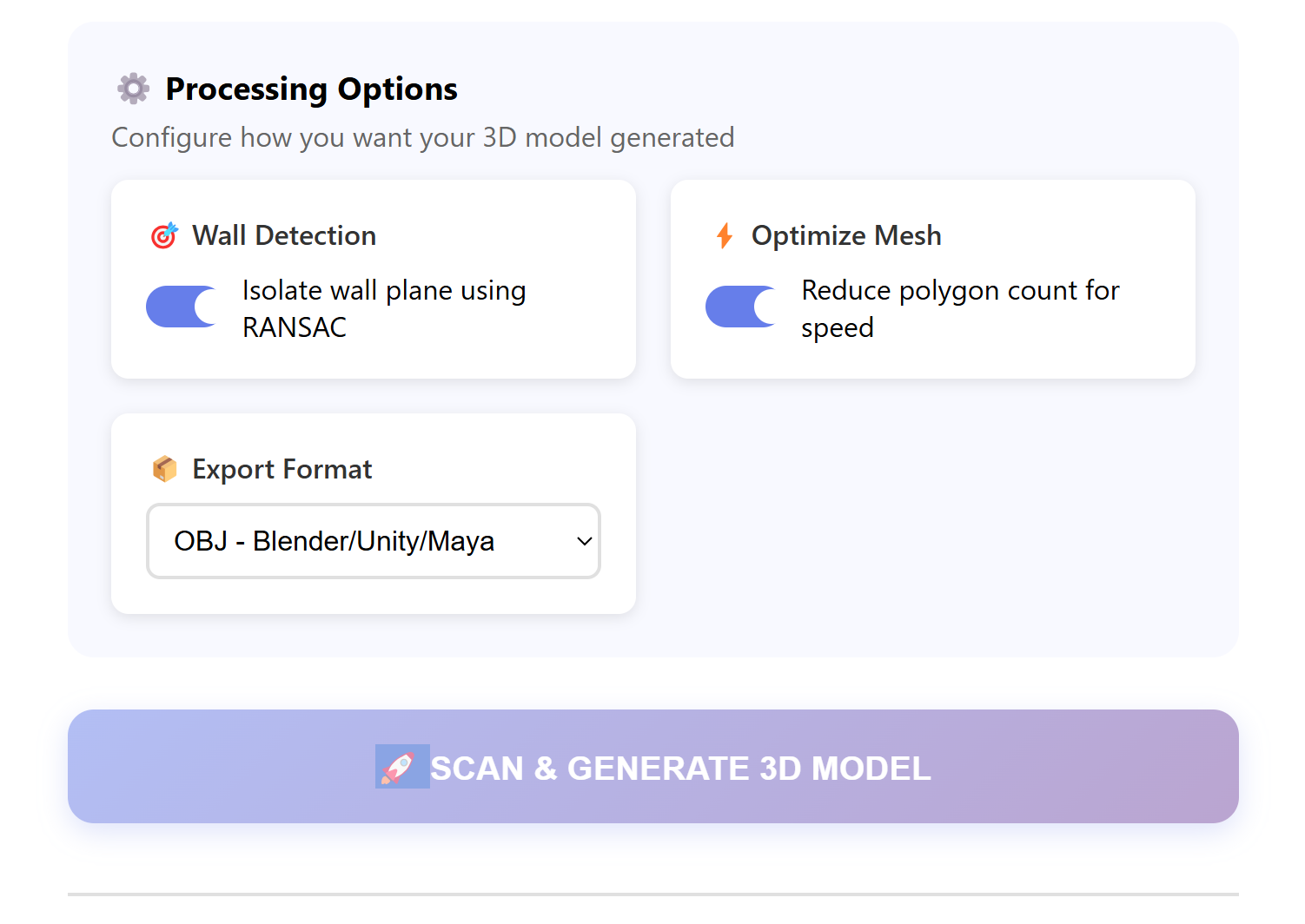
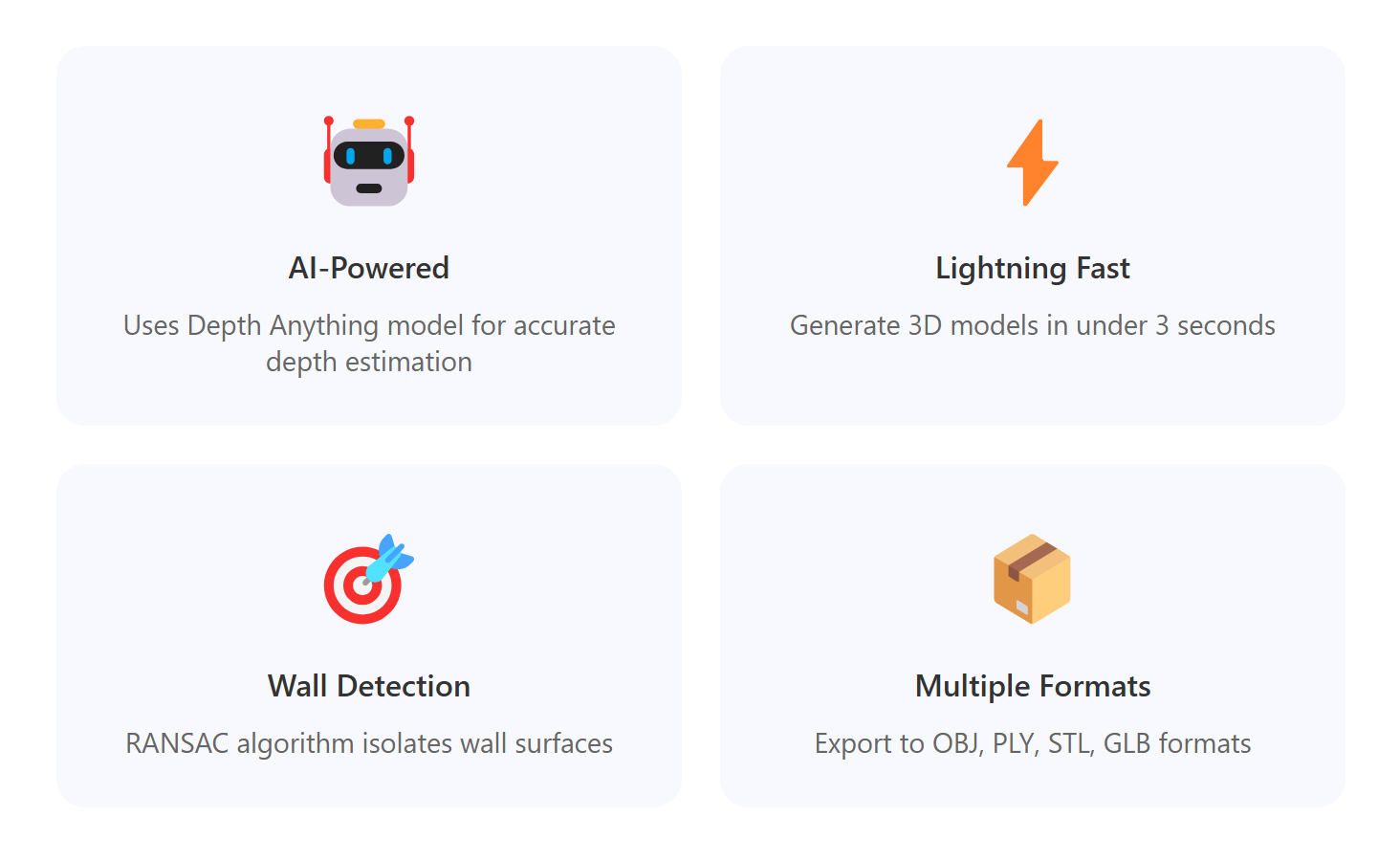
Important Features: -Single-Image 3D Reconstruction: No additional hardware is needed Modern neural networks are used in AI-Powered Depth Estimation -Colored Point Clouds: Maintains color and texture details -Wall Plane Detection: RANSAC automatically isolates the wall surface -Multiple Export Formats - OBJ, PLY, STL, GLB for different use cases -Real-Time Processing: Pipeline completion in a matter of seconds -Web Interface: Use your browser to upload, process, and download files.
How we built it
Architecture Overview Our pipeline consists of five main stages: Input Image → Depth Estimation → Point Cloud → Mesh Generation → Export
Challenges we ran into
- Since we don't have actual camera calibration data, we use approximate values
- Camera Calibration Without Calibration Data-Different phones have different focal lengths, but we don't have calibration data.
- Scale Ambiguity -Monocular depth estimation only gives relative depth, not actual meters.
- Memory Issues with Large Images -Normal Estimation Failures
Accomplishments that we're proud of
Wall Scanner AI proves that modern AI can make professional 3D scanning accessible to anyone with a smartphone. What once required expensive LiDAR hardware and specialized software can now be done with a single photo and free open-source tools.
What we learned
-Modern neural networks are used in AI-Powered Depth Estimation -Colored Point Clouds: Maintains color and texture details -Wall Plane Detection: RANSAC automatically isolates the wall surface -Multiple Export Formats - OBJ, PLY, STL, GLB for different use cases
- Real-Time Processing: Pipeline completion in a matter of seconds -Web Interface: Use your browser to upload, process, and download files. ## What's next for con-struct -Multi-image reconstruction for better accuracy -Automatic scale calibration -Texture mapping from original photo
Built With
- css3
- fastapi
- html5
- javascript
- open3d
- python
- pytorch
- transformers
- trimesh
- vanillajs


Log in or sign up for Devpost to join the conversation.