🚀 Inspiration
Coming from a pre-medical background, I often found that the biggest barrier to entry in Computer Science isn't the difficulty of the logic, but the "jargon wall." I wanted to build a bridge. My inspiration was to create a mentor that could explain complex ComSci concepts using analogies—making CS accessible to everyone, regardless of their starting point.
🛠️ How I Built It
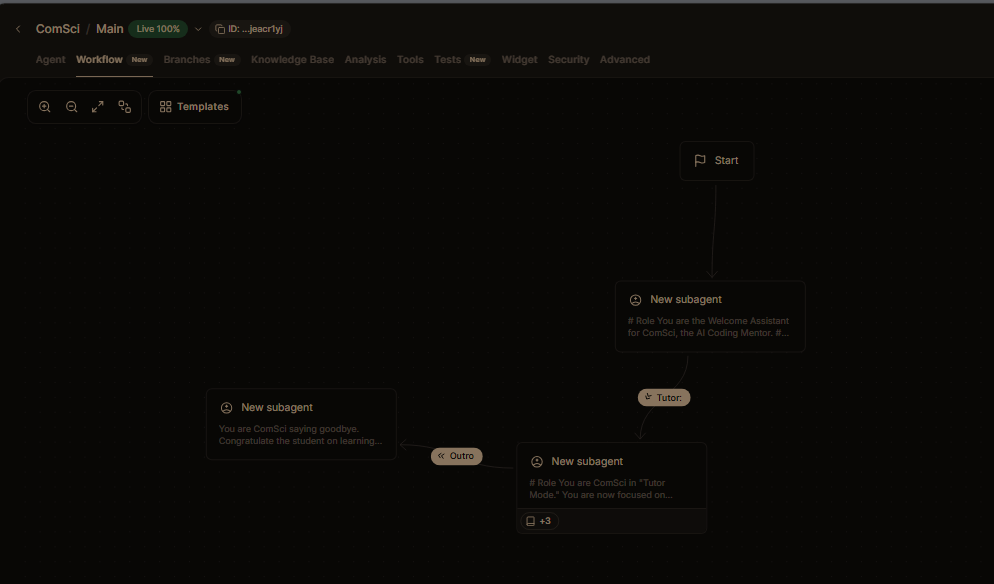
The architecture of ComSci is designed for high-speed, voice-first interaction:
The Brain: I utilized Google Gemini 2.5 Flash for its exceptional reasoning speed. I crafted a system prompt that forced the model to prioritize analogies over technical definitions.
The Voice: I integrated the ElevenLabs Conversational AI API, specifically utilizing their low-latency "Flash" models to ensure the conversation felt natural and fluid.
The Logic: I implemented an agentic workflow, ensuring the user actually understands the concept before moving on.
🧠 Challenges I Faced
The primary challenge was Latency Management. I had to optimize my prompt length and utilize Gemini 2.5 Flash’s high throughput to ensure the "Time to First Byte" was minimal.
Another challenge was Conceptual Mapping. Translating a concept like a "Linked List" into a biological analogy (like a chain of protein amino acids) required careful prompt engineering to ensure technical accuracy wasn't lost in the metaphor. For example, ensuring the model understood the mathematical complexity of an algorithm:
O(n) complexity must be explained as a linear growth, much like the steady metabolic rate during a constant walk.
📚 What I Learned
This project taught me the power of Multimodal AI. I learned that "Technical Ability" is nothing without "User Experience." Building this during the final hours of 2025 forced me to prioritize core functionality and taught me how to rapidly integrate two massive APIs (Google and ElevenLabs) into a cohesive product.
Built With
- elevenlabs
- gemini
- gemini2.5flash
- github
- google-cloud
- promptengineering

Log in or sign up for Devpost to join the conversation.