-
-
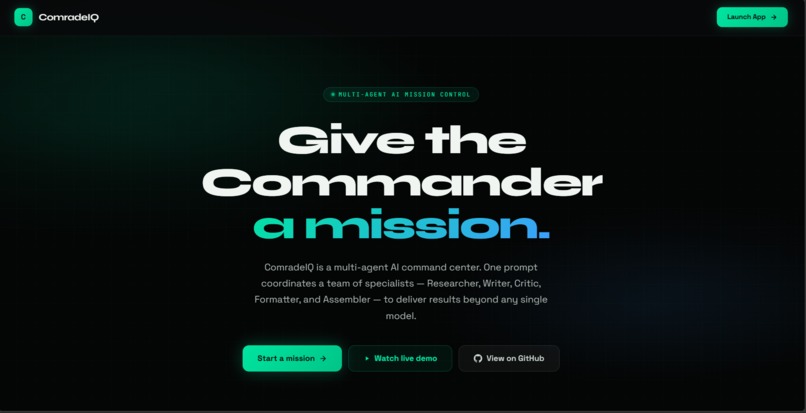
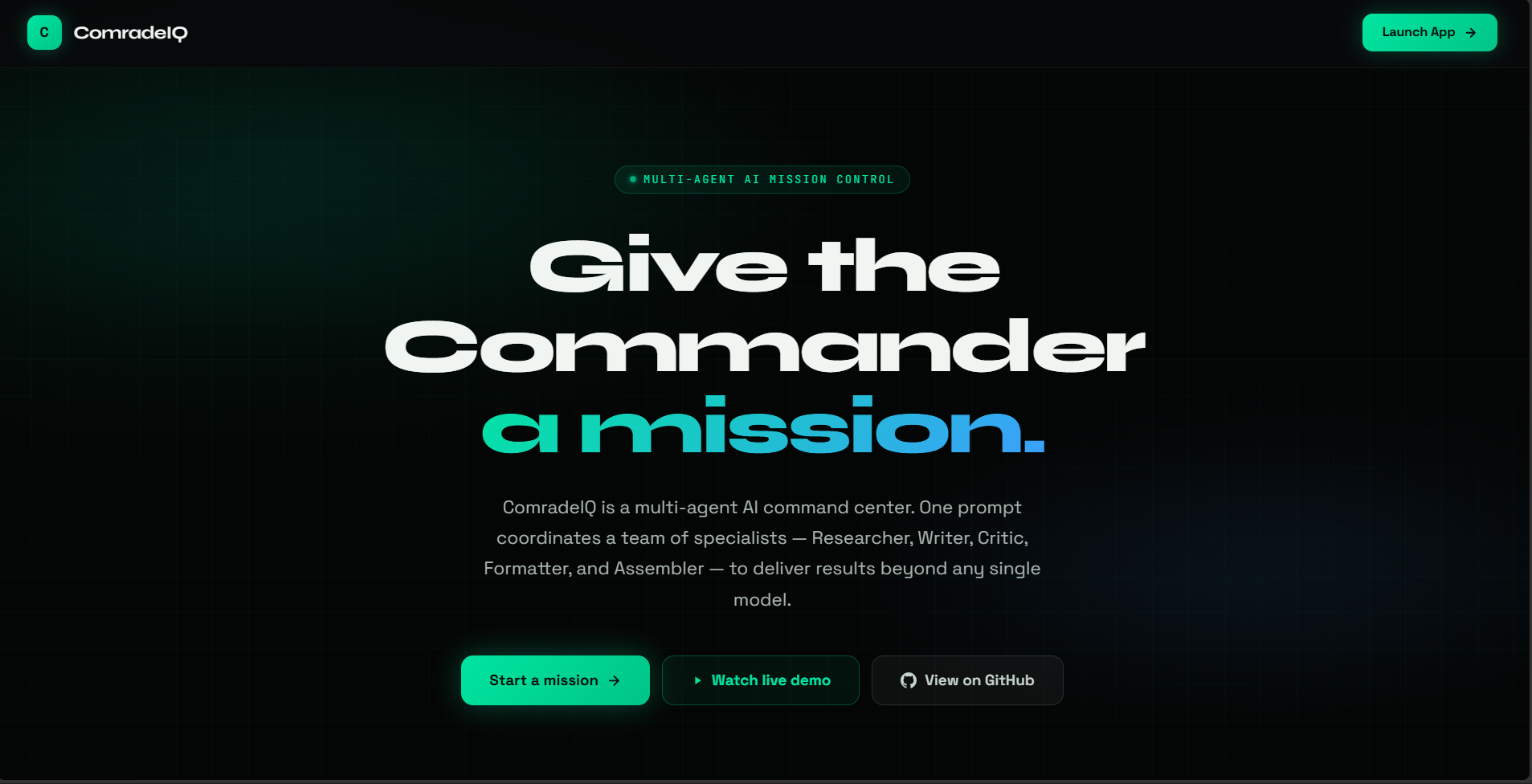
Landing Page
-
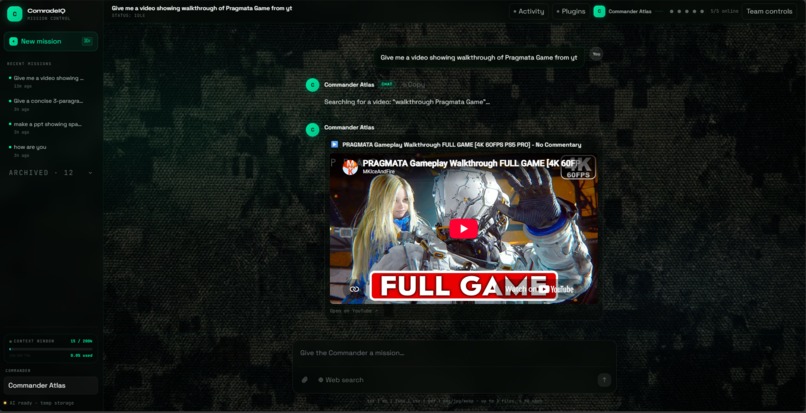
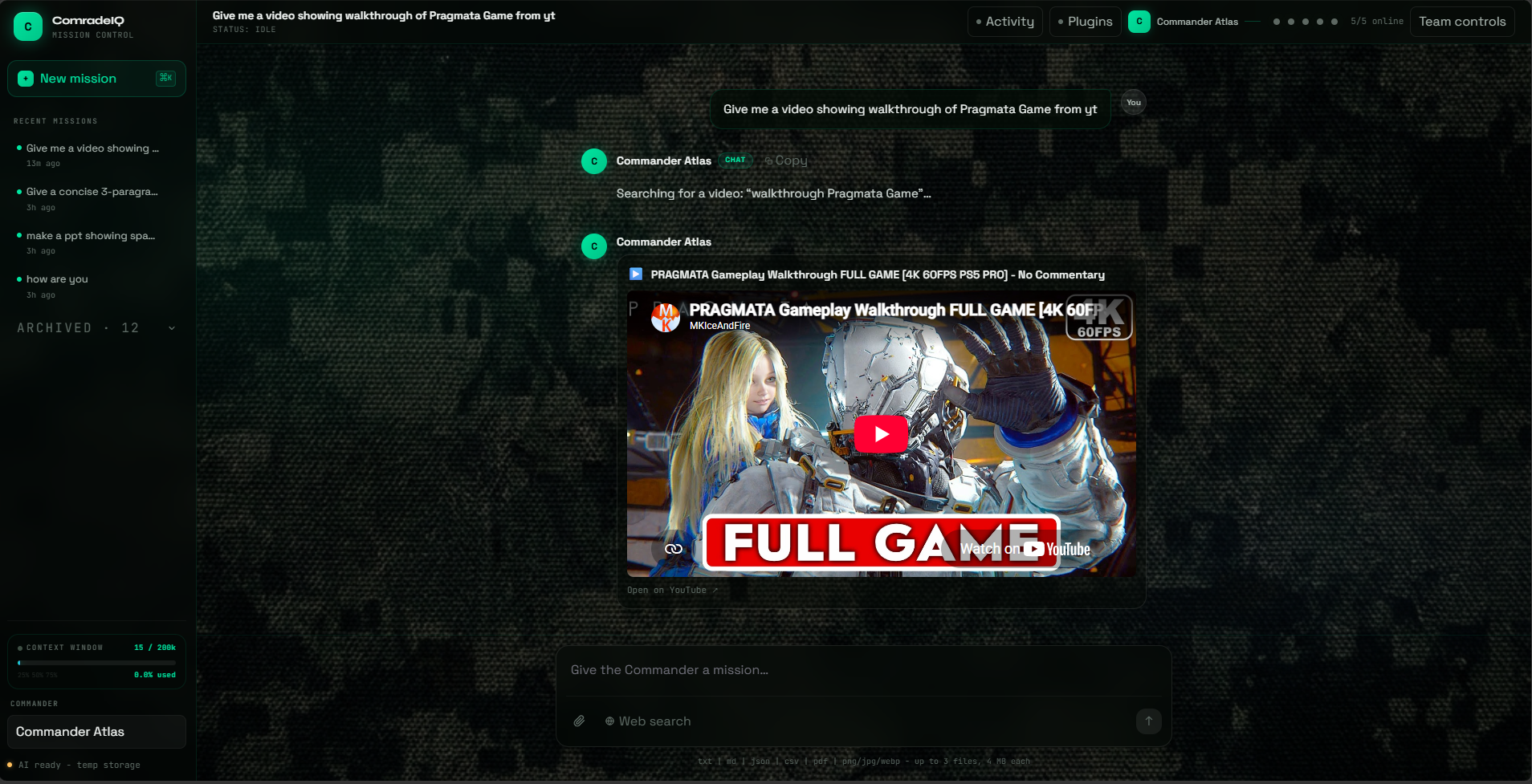
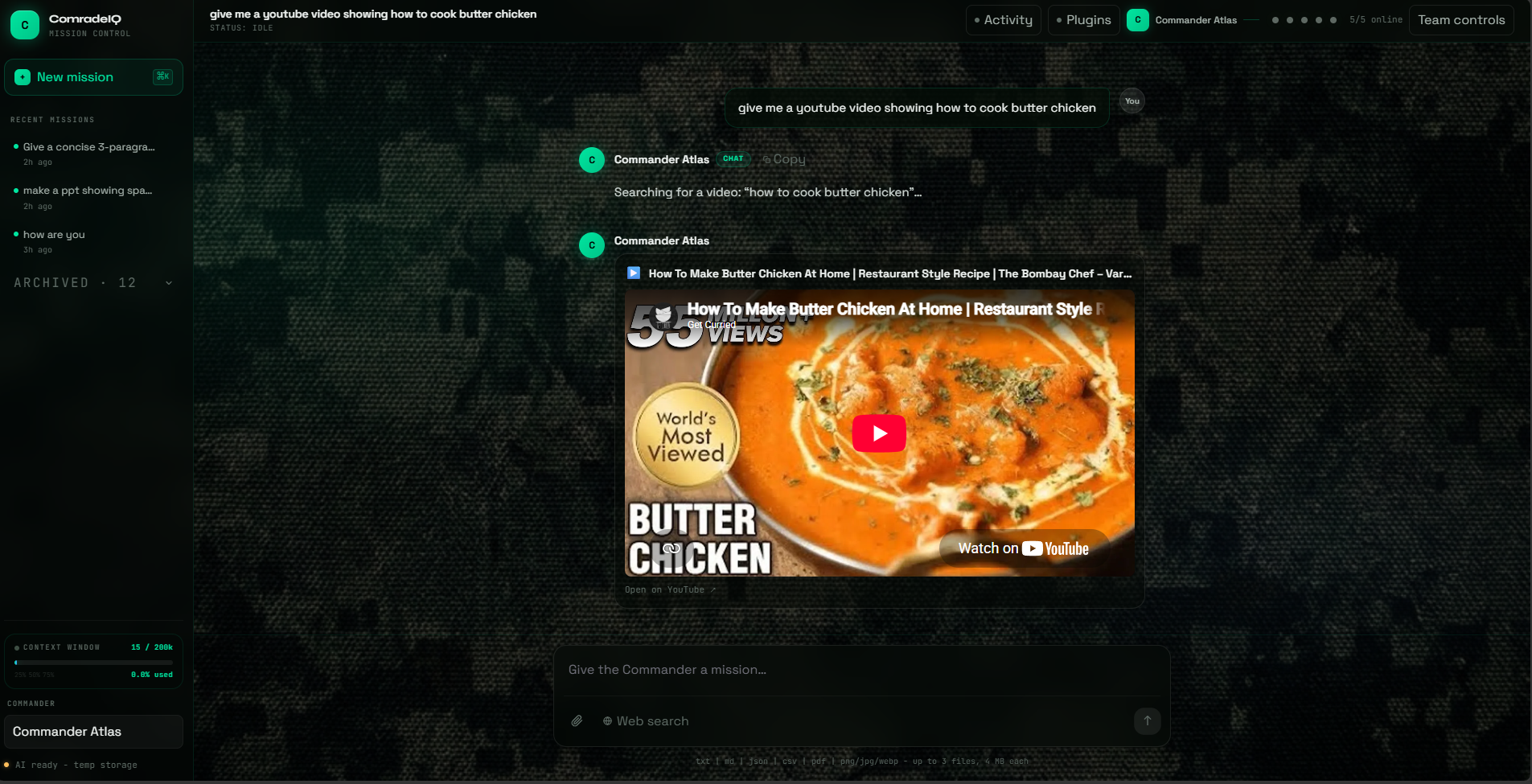
Extract any video from youtube with a given description , watch directly in chat!
-
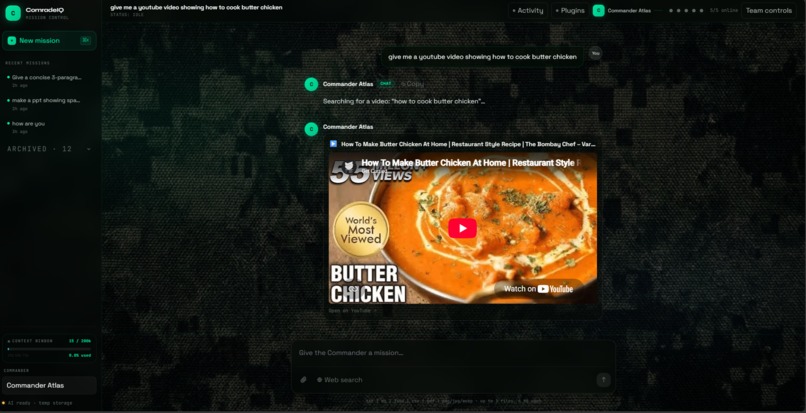
Extract any video from youtube with a given description , watch directly in chat!
-
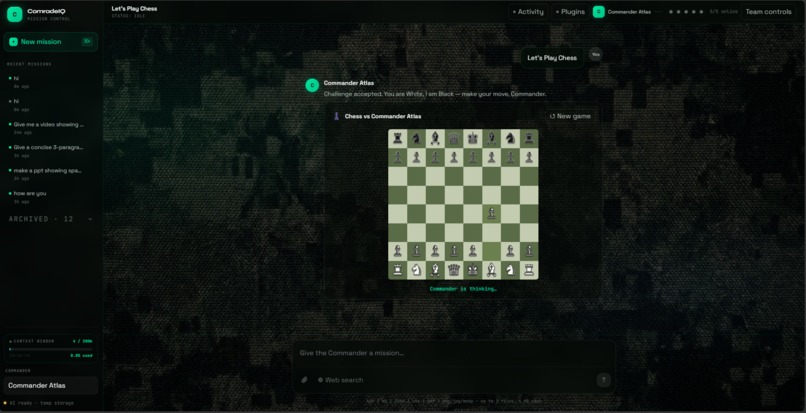
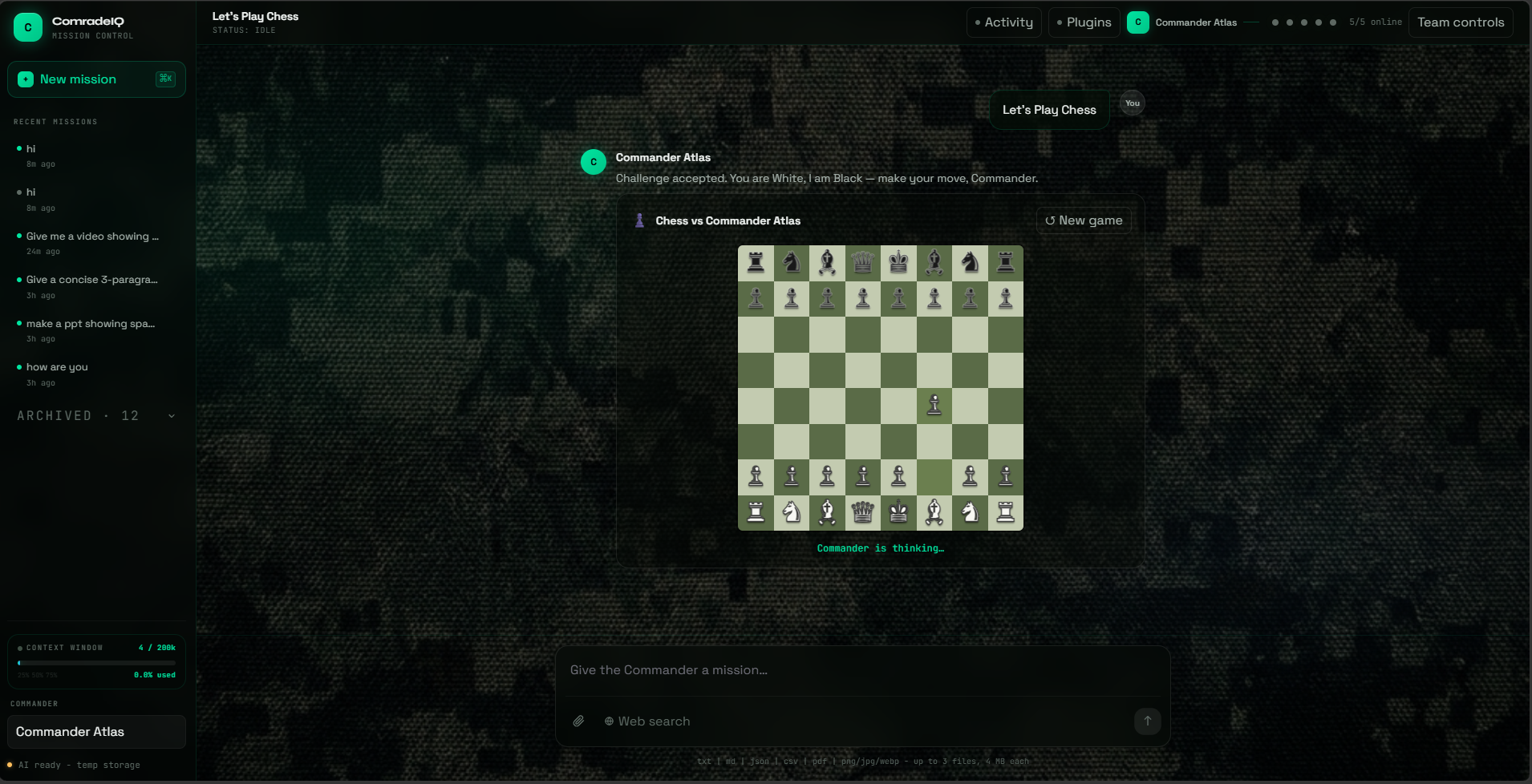
Play Chess with commander whenever you like
-
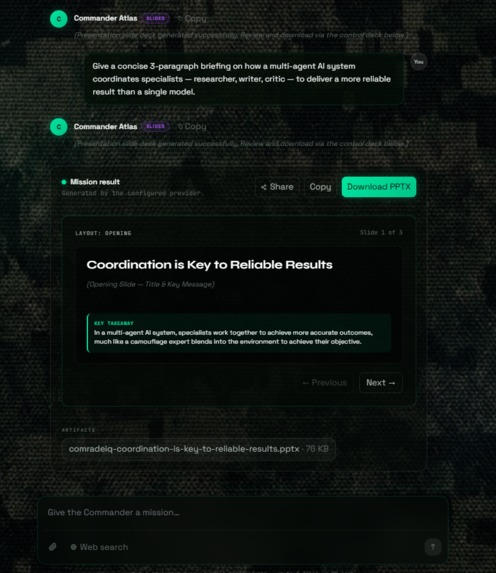
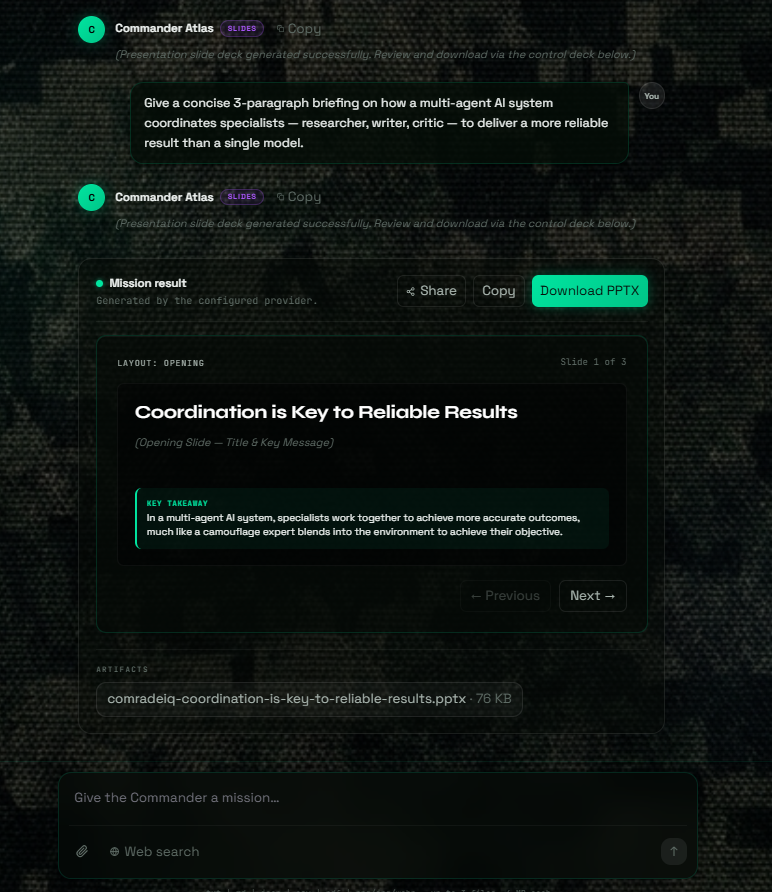
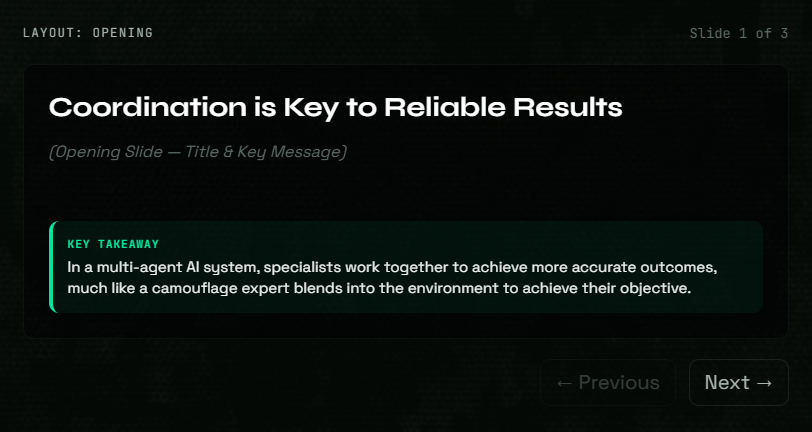
Create any Presentation you like !
-
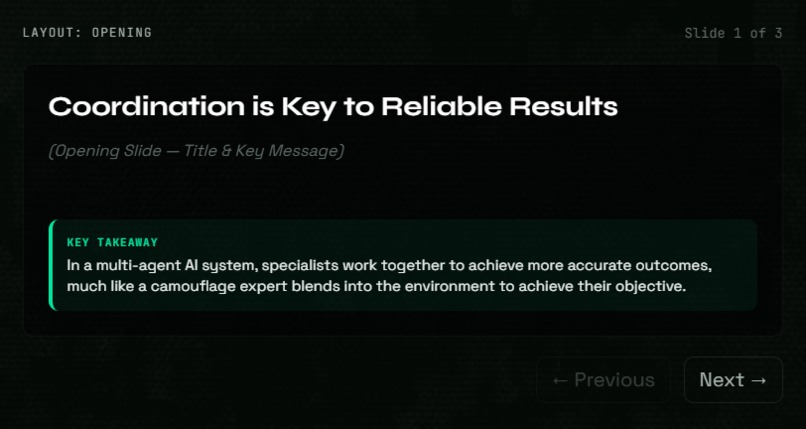
Create any Presentation you like !
-
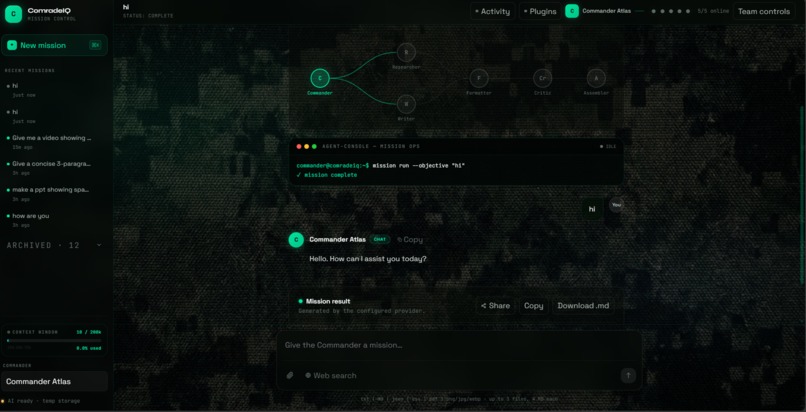
-
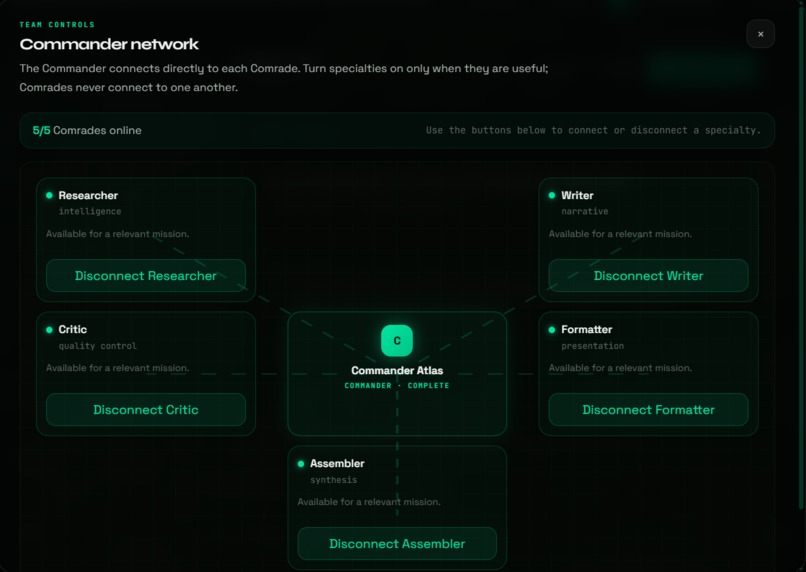
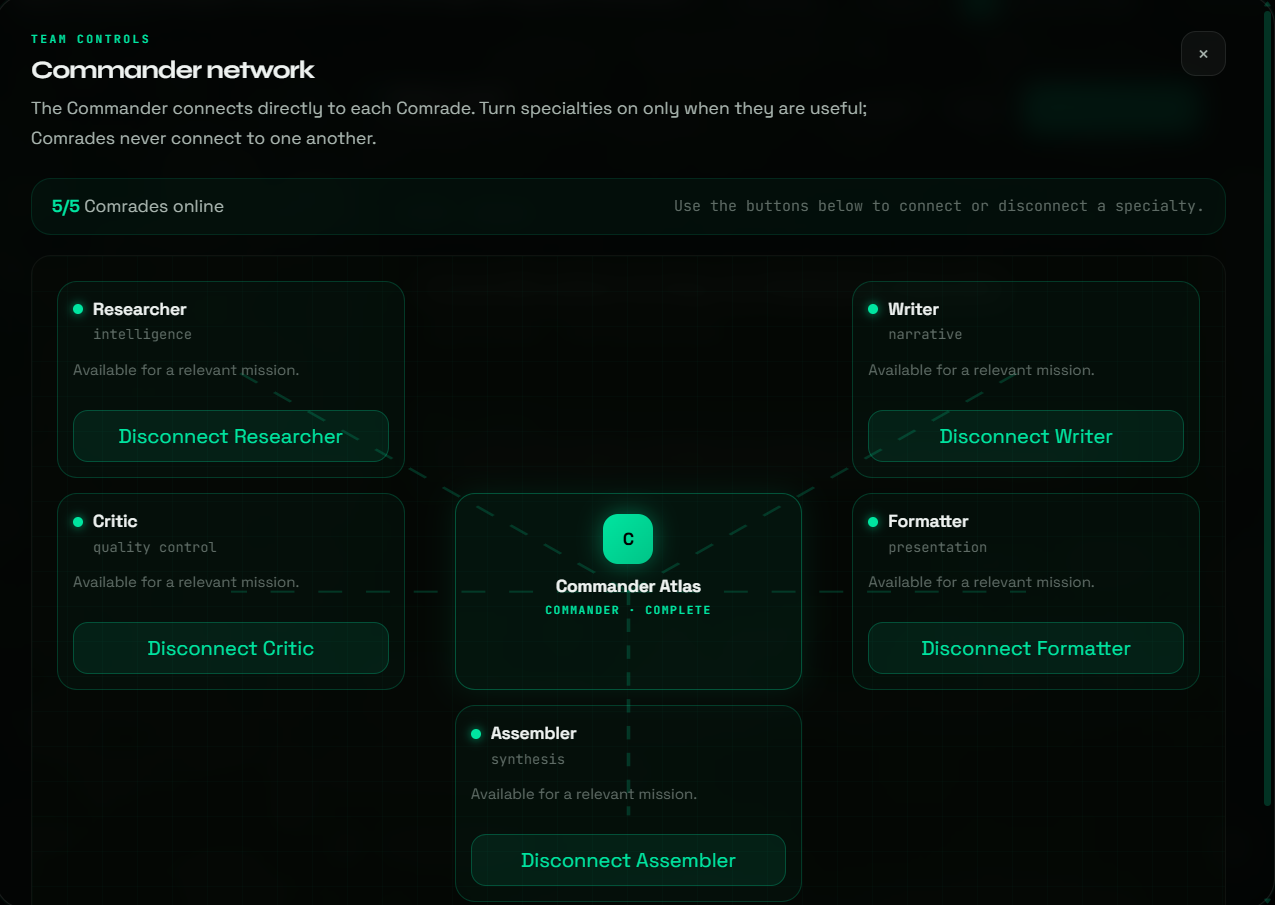
Connect/Disconnect Any Soldier(Agent) in the Network
-
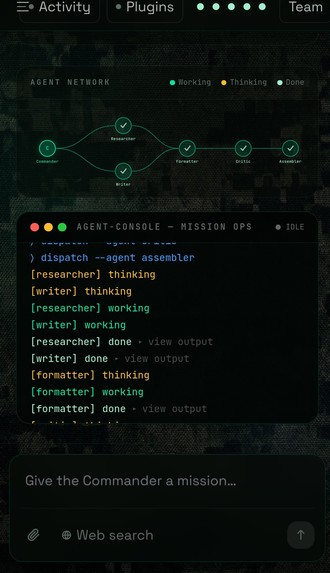
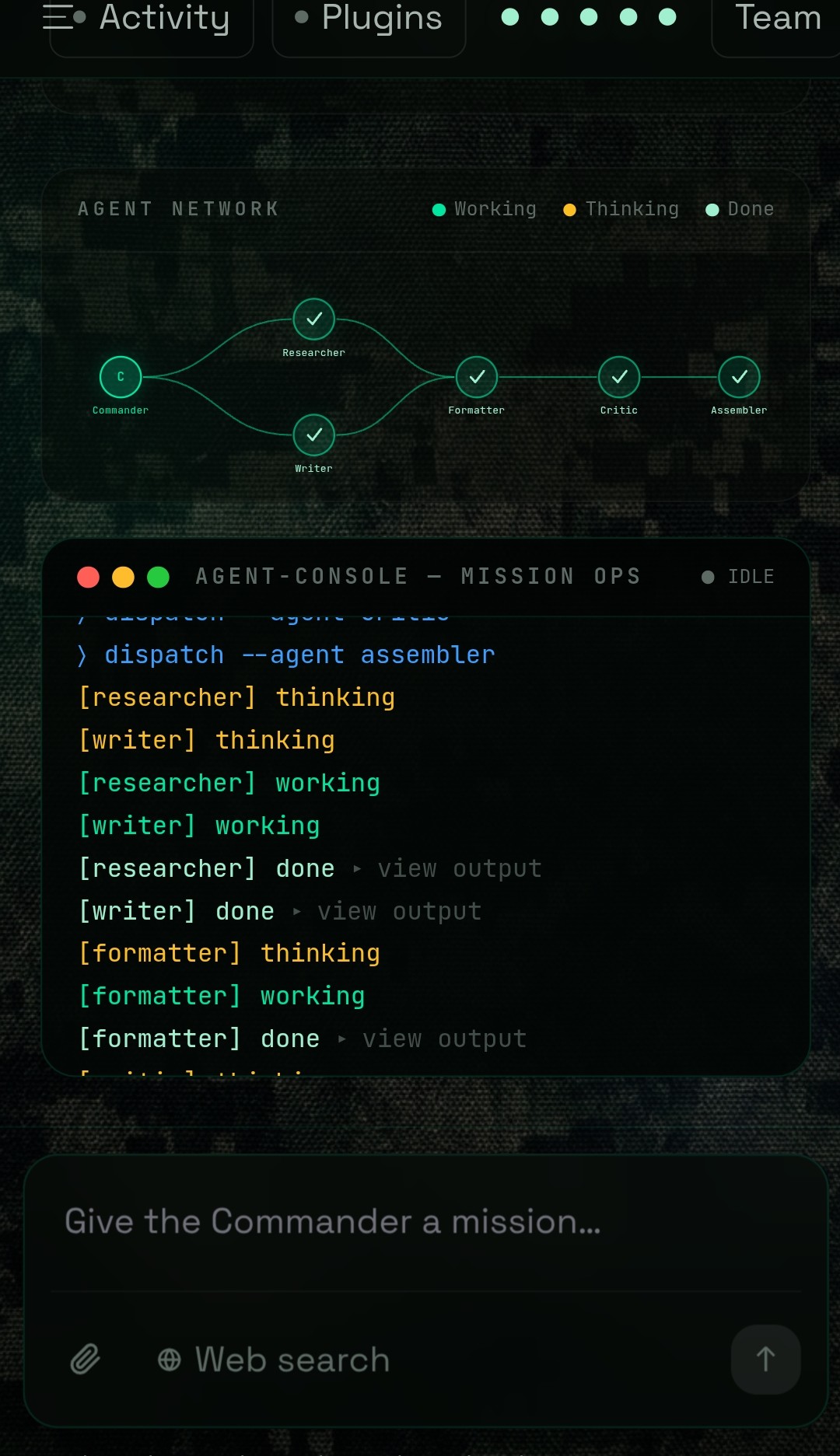
Live Terminal
-
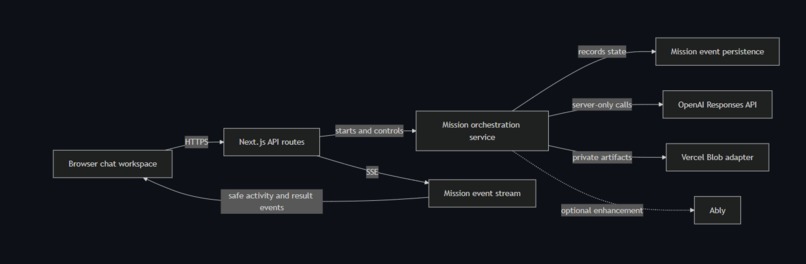
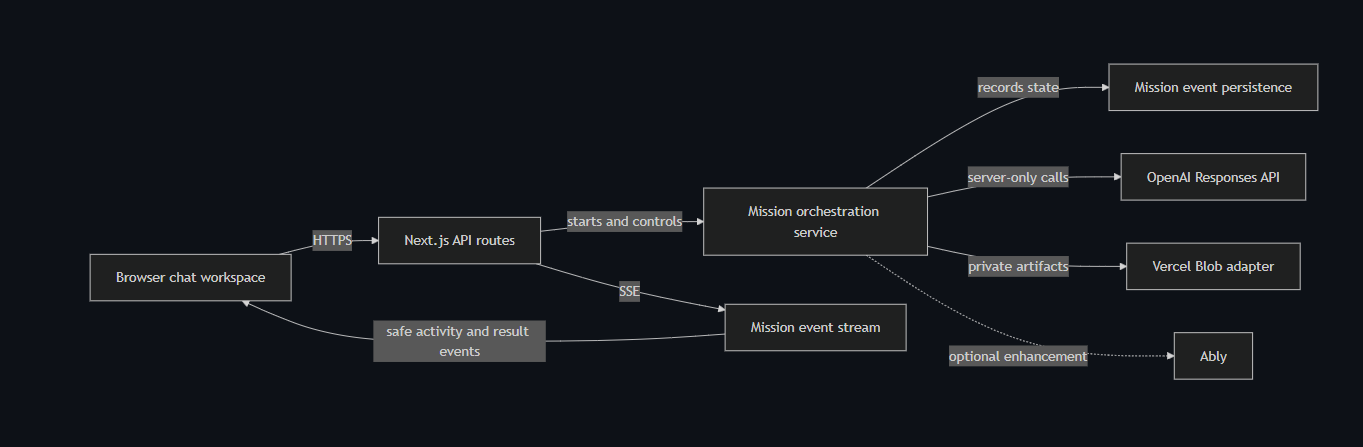
Process Flow
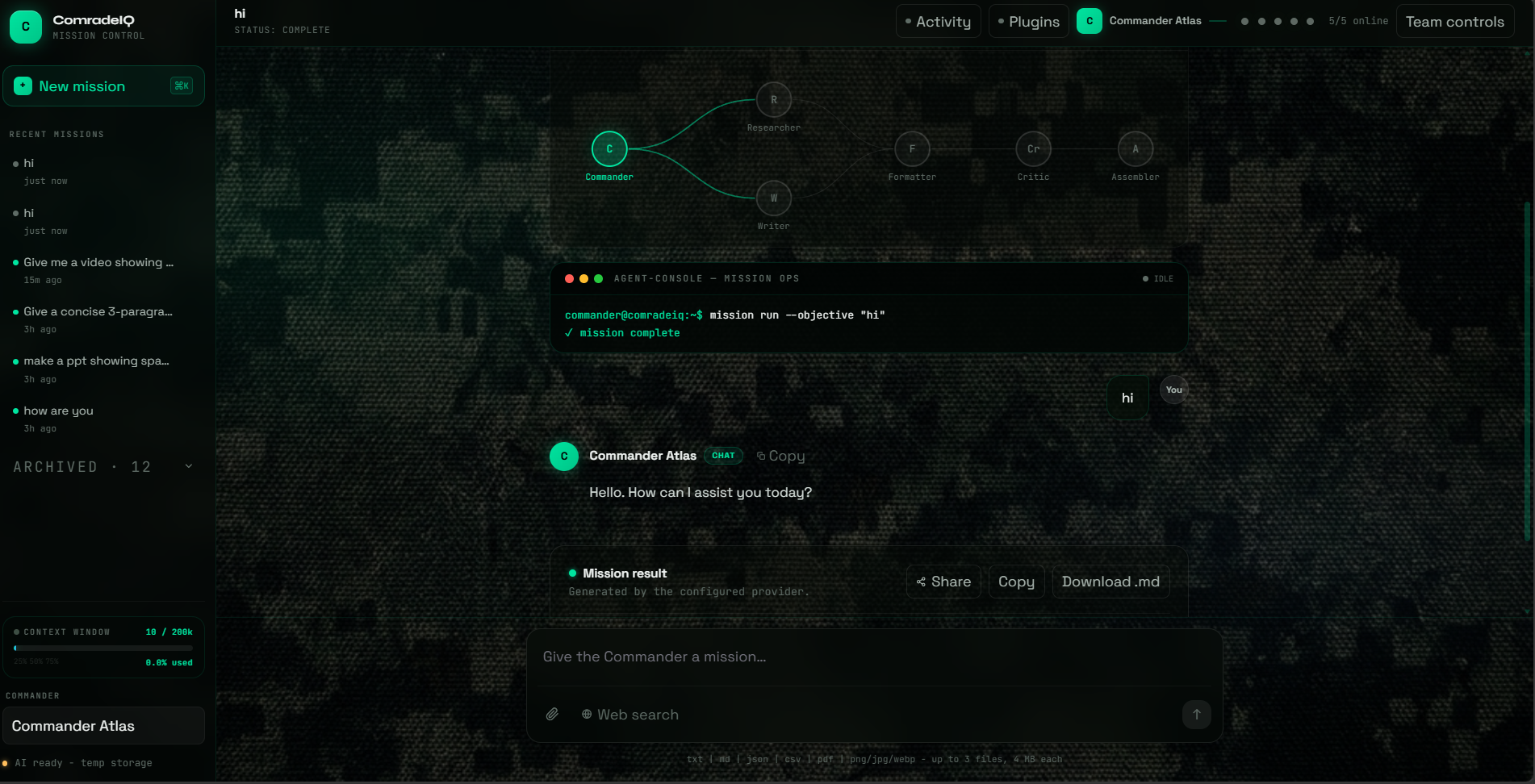
One prompt. A whole team. A finished deliverable — and you watch every step happen.
ComradeIQ is an AI mission control: you give Commander Atlas an objective, and a coordinated team of specialists — Researcher, Writer, Critic, Formatter, and Assembler — works through a real dependency pipeline to hand you back a verified, downloadable result. Not another chat box. A command center.
💡 Inspiration
Most "multi-agent" demos are theater — spinning cards that invent their own progress, phantom parallel calls, and confident answers with no traceable source. We wanted the opposite.
ComradeIQ started from a single question:
What would AI coordination look like if every visible step had to be **provably true?
No simulated research. No fabricated artifacts. No fake agents. Just a Commander with an honest dependency graph and a team that only activates when it's genuinely needed.
🎯 What it does
You type one objective. ComradeIQ routes it to the right workflow automatically:
- 💬 Direct chat — quick questions get a fast, single answer, no overhead.
- 📄 Document missions — ask for a README, spec, or report → get a downloadable Markdown file.
- 📊 Presentation missions — ask for a deck → get a styled, downloadable PPTX in one of 4 themes (Camo, Cyberpunk, Minimal, Ocean).
- 🔬 Research missions — opt-in web access returns sourced, cited answers — never invented URLs.
For anything that needs coordination, the Commander builds an explicit dependency DAG and executes it for real:
Researcher → Writer → Formatter → Critic → Assembler → Commander QA
Each specialist waits for its actual upstream output. And you see it happen two ways at once:
- 🟢 Live agent graph — every specialist node lights up in real time (thinking → working → done) as work flows down the graph.
- 🖥️ Live agent console — a terminal-style ops log streaming the real mission events (
dispatch --agent writer,[critic] working,✓ mission complete), with each line expandable to reveal that agent's actual contribution.
And two things purely for delight:
- ♟️ Play chess with the Commander — say "play chess with me" and a real, rules-validated board opens in chat. You're White; Commander Atlas plays Black through the same LLM that runs missions — literally the Commander playing you.
- ▶️ In-chat video — ask for "a video of how jet engines work" and ComradeIQ searches YouTube and embeds a playable player right in the conversation.
Finished missions get shareable read-only permalinks, and every chat has a hover menu to share, archive, or delete it.
If a provider, storage layer, or capability isn't configured, ComradeIQ says exactly what's missing — it never fakes a capability.
🛠️ How we built it
- Next.js 15 + React 19 + TypeScript — a responsive chat workspace with server-only API routes and end-to-end type safety.
- Groq (
llama-3.3-70b) over an OpenAI-compatible API — provider-agnostic model calls with structured routing, JSON-Schema output for decks, and vision-ready image input. - A dependency-aware orchestrator — a real DAG, not cosmetic parallelism. Upstream results are the literal inputs to downstream agents, and each role sees only its own inputs — no shared transcript.
- SSE-first streaming — the plan, dispatch, per-agent status, and result all stream to the browser with no external realtime dependency.
- PptxGenJS for server-side decks, chess.js for a legality-validated board with an LLM opponent, and a keyless YouTube search + embed for in-chat video.
- Zustand for client state, Vercel Blob for durable mission/artifact storage, and Vitest + Playwright for routing, DAG, state, a11y, and reconnect coverage.
🧗 Challenges we ran into
Resisting theatrical shortcuts. Making a multi-agent UI look impressive is easy; making every visible update trace to a real event, every artifact to real storage, and every error to an honest error took discipline at every layer.
Serverless reality. The deployed build 500'd on every API route — but only in production. The culprit: the production bundler skipped Node file tracing, so a heavy dependency (pdf-parse) crashed each function at import time. We diagnosed it from the raw response headers (X-Matched-Path: /500, no platform error), moved the build to the stable path, externalized the offending packages, and lazy-loaded them off the request path.
Honest state everywhere. Ownership boundaries, cancellation, reconnect, and truthful "what's missing" states turned out to be as much work as the model calls themselves.
🏆 Accomplishments we're proud of
- A real mission dependency DAG — not decorative agent cards.
- A live agent graph + ops console that visualize the actual pipeline, with click-to-expand per-agent output.
- Play chess against the Commander and in-chat video search & embed — real, interactive, embedded.
- Downloadable Markdown & PPTX artifacts, 4 deck themes, and shareable permalinks.
- A product that never fabricates — honest providers, storage, and capabilities throughout.
📚 What we learned
Reliable AI UX is mostly systems design — routing, observability, cancellation, and truthful errors matter as much as the prompt.
We also learned why decomposition wins. A single model gives you one pass. Add a Critic that catches a fraction $p$ of a draft's errors, and the expected residual error becomes:
$$\varepsilon_{\text{final}} \approx \varepsilon_{\text{draft}}\,(1 - p)$$
The innovation isn't a new model — it's role specialization + a dependency graph + an explicit review stage, made visible and shippable. That's how real production AI is built.
🚀 What's next for ComradeIQ
Authenticated team workspaces, richer source-provenance UI, evaluation dashboards that compare artifact quality across routing strategies, connector-backed business data, and configurable retention — kept honestly as future work rather than pretending they already exist.
Built With
- api
- codex
- css
- gpt-5.6
- next.js
- node.js
- openai
- python
- react
- tailwind
- typescript
- vercel


Log in or sign up for Devpost to join the conversation.