-
-
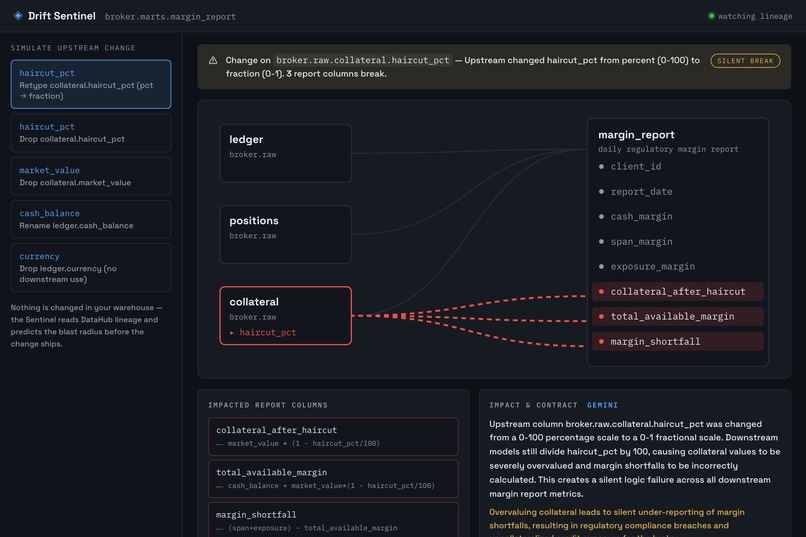
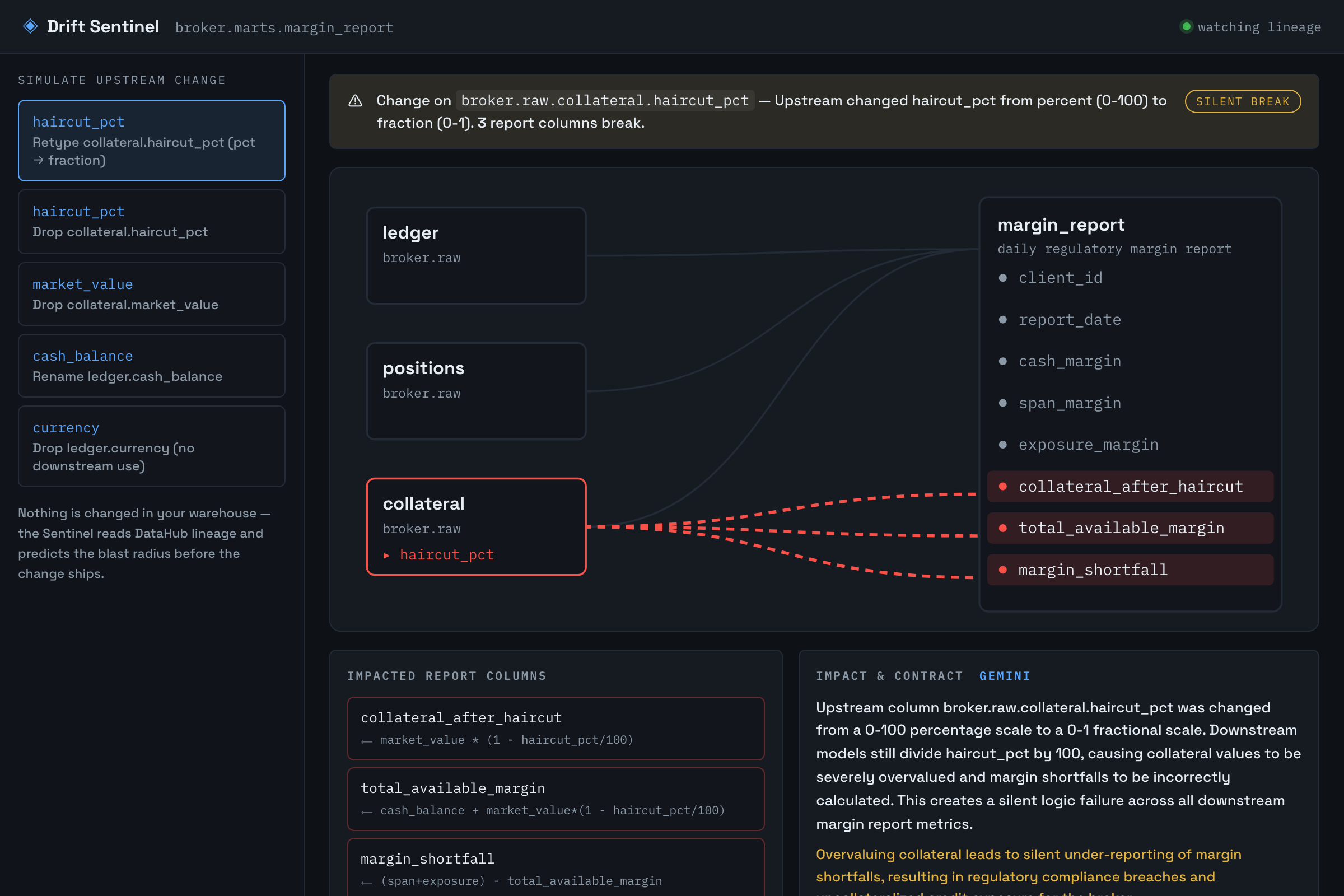
Retyping haircut_pct (pct to fraction) lights the drift path the exact 3 margin columns that silently miscompute. No error raised.
-
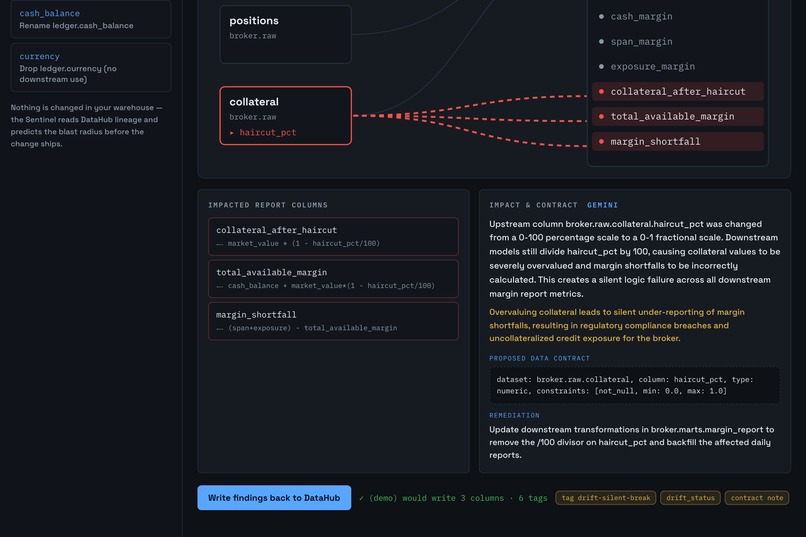
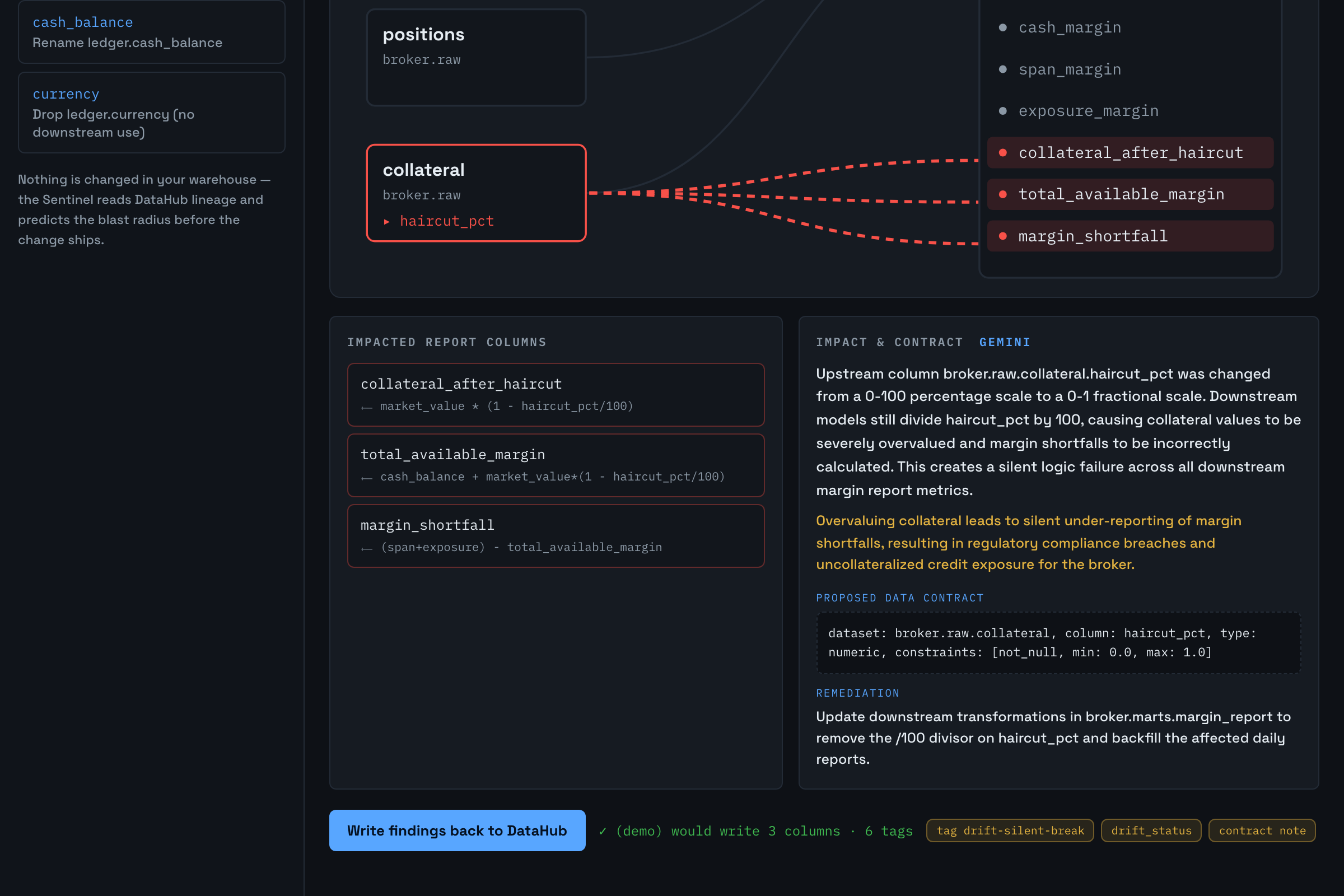
One click writes findings back through the same MCP interface it reads from: 3 columns, 6 tags, contract. Hosted demo = safe mode.
-
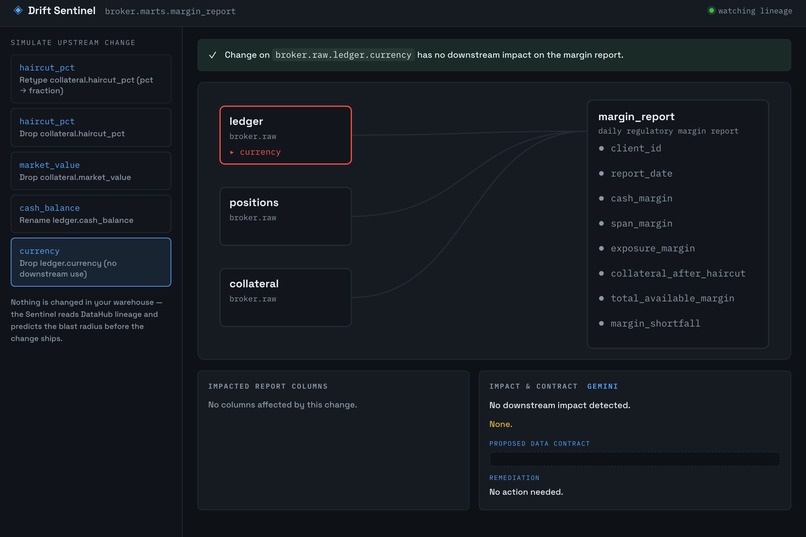
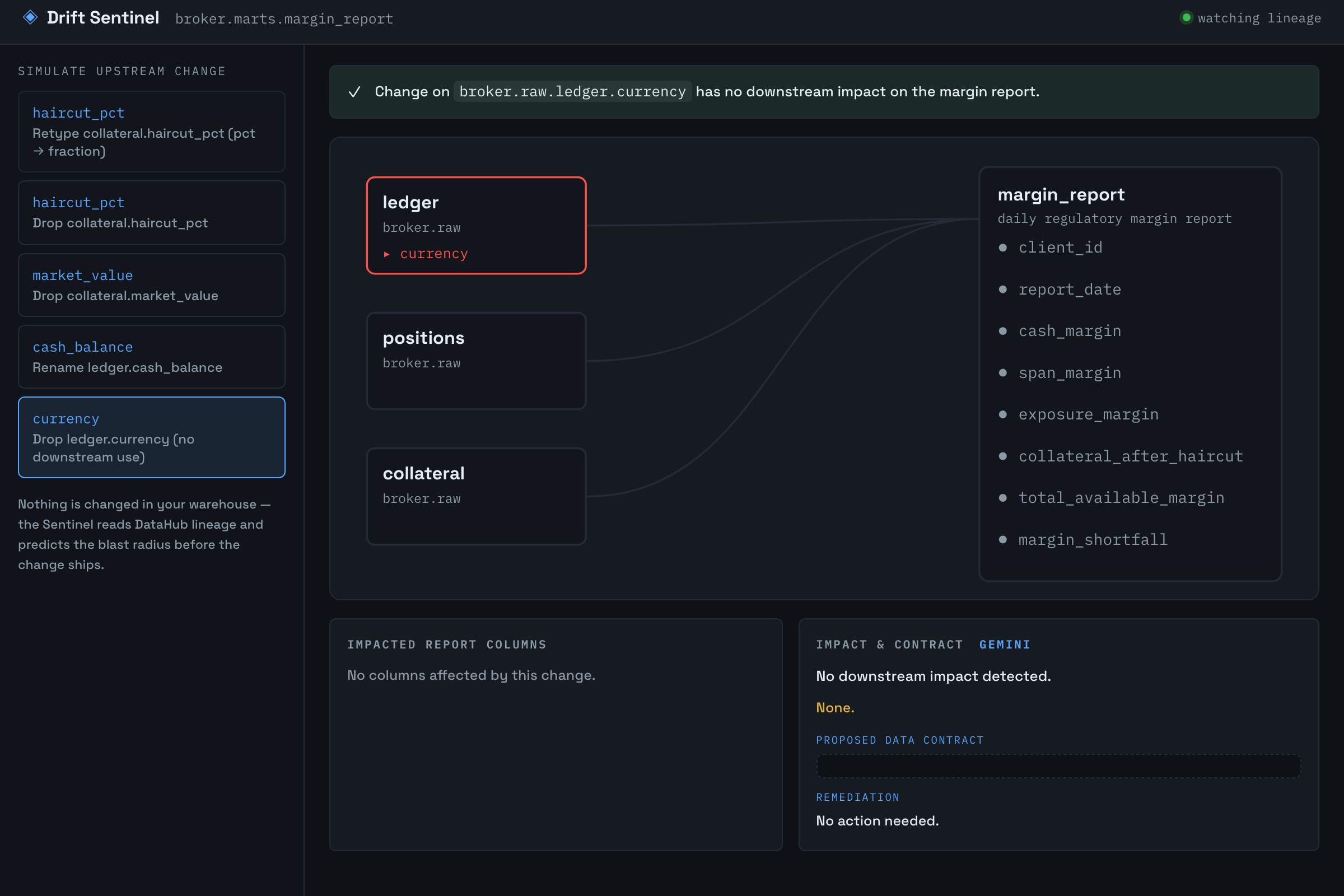
Dropping ledger.currency touches nothing downstream, and it says so. Column-precise impact means no false alarms.
-
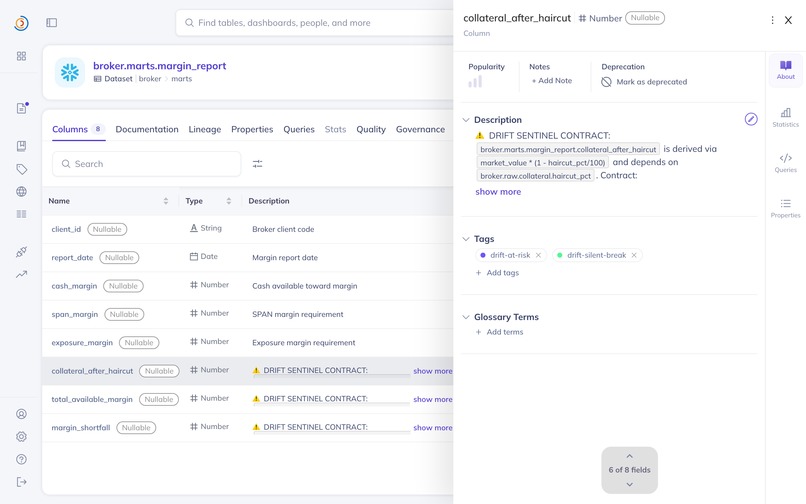
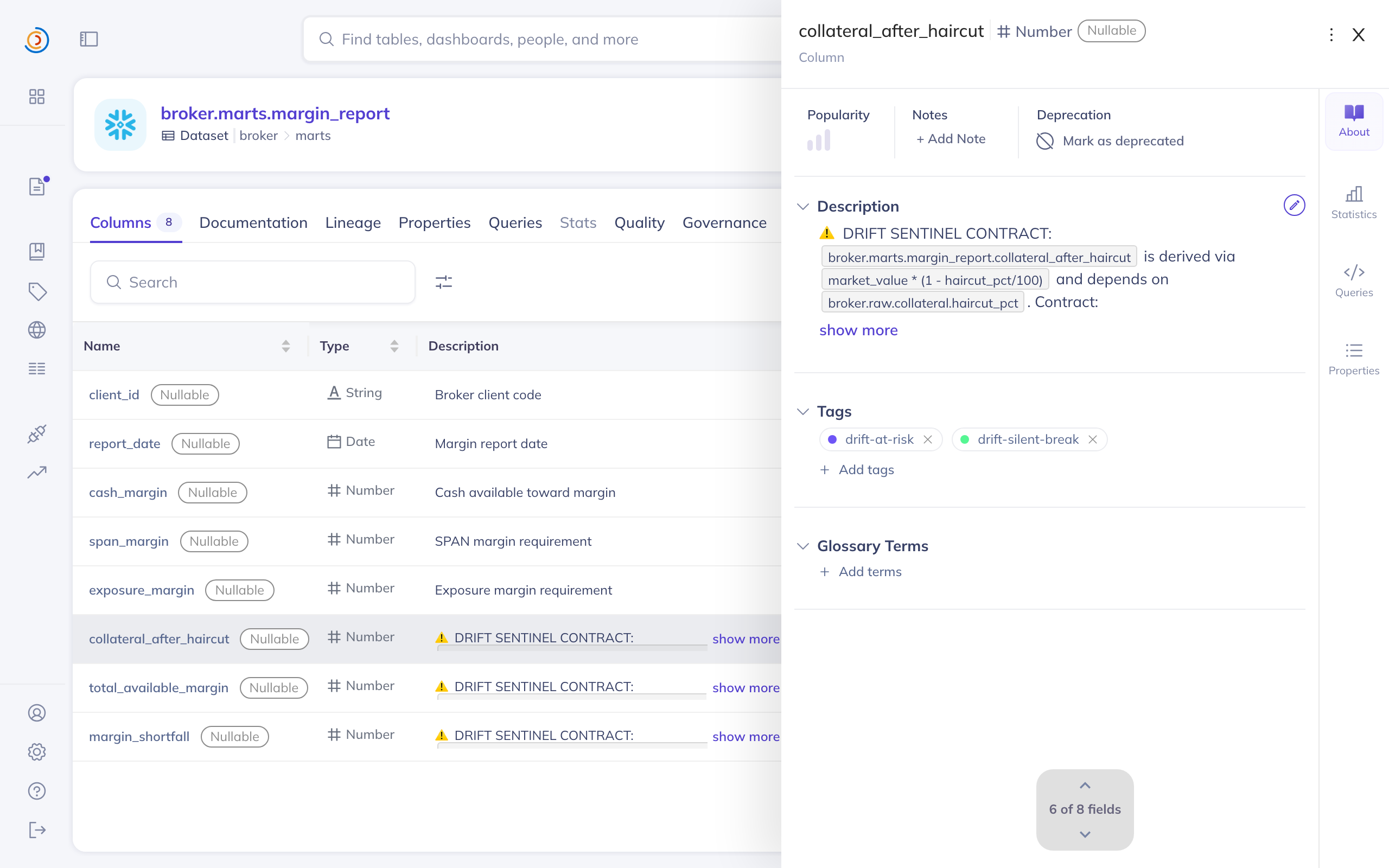
Proof inside DataHub: drift-at-risk + drift-silent-break tags, a drift_status property, and the contract in the description.
Inspiration
Every data team lives in fear of the silent break: someone renames or retypes a column three hops upstream, and a regulatory report quietly starts shipping wrong numbers — no error, no alert, until an auditor finds it. DataHub already knows the lineage. What it doesn't do is reason about the blast radius of a change before it lands. We wanted an agent that answers, precisely: "if this upstream column changes, which downstream report columns break — and what contract would have caught it?" — and then writes that answer back so the next engineer inherits it.
What it does
Compliance Drift Sentinel takes a proposed upstream schema change and:
- Reads column-level lineage from DataHub and traces it to the exact downstream columns.
- Classifies severity — a drop/rename is a
hard_break; a retype is asilent_break(the dangerous one: values still flow but miscompute). - Narrates the impact with Gemini and drafts an enforceable data contract.
- Writes back to DataHub — tags, a
drift_statusproperty, and the contract — through the same MCP interface it reads from.
We demo it on a synthetic broker margin-report pipeline: retyping collateral.haircut_pct
(percent → fraction) silently breaks three margin columns that still divide by 100 — a regulatory
misreport with no error anywhere.
How we built it
- DataHub v1.5 (local quickstart) as the context platform;
mcp-server-datahubfor both reads and write-back. - A deterministic impact engine (Python) that traverses
fineGrainedLineagesto compute the exact broken columns — the LLM never decides what breaks. - Gemini (
gemini-flash-latest) narrates and drafts the contract, grounded strictly in the engine's facts. - FastAPI backend + React/Vite terminal-themed UI with a live lineage graph that lights
the drift path. The impact analysis runs in-process, so the app deploys on a free tier without
the 7-container DataHub stack. On the hosted demo, write-back therefore runs in demo mode —
it reports exactly what it would write, since there is no DataHub in the cloud to write to. The
video shows the real write-back landing in a live DataHub, and
make up && make devreproduces it locally. - Packaged the workflow as a reusable DataHub Skill (
datahub-drift-contract).
Challenges we ran into
- Column-precise impact. The MCP
get_lineage(column=...)only resolves to the downstream dataset, not the exact columns. The real column→column edges live in the report'supstreamLineage.fineGrainedLineagesaspect — we read that via the graph SDK and traverse it ourselves. That was the difference between "this table is affected" and "these three columns silently miscompute." - Write-back gotchas.
add_tagsfails unless the tag entity already exists; structured properties attach to the schemaField URN (not acolumn_pathsargument); and mutation tools are disabled by default. Each was a live-API discovery, not something the docs spelled out. - A model deprecation mid-build.
gemini-2.5-flashstarted returning 404 "no longer available to new users" — we switched to thegemini-flash-latestalias so it can't happen again. - Making DataHub deployable. An 8GB, 7-container stack won't fit a free tier, so we made the impact analysis computable from an in-process pipeline definition; only write-back needs the live instance.
Accomplishments that we're proud of
- Silent-break detection that's actually column-precise — the failure mode humans miss most.
- A grounded agent: the deterministic engine owns correctness, so Gemini can be impressive without ever hallucinating impact.
- A genuine open-source contribution — the
datahub-drift-contractskill fills a real gap in the official registry (lineage traces, quality checks, but nothing does drift → contract). - End-to-end and verified: detect → narrate → write-back, provable in the DataHub UI.
What we learned
- Fine-grained lineage is where column-level truth actually lives — dataset-level lineage isn't enough for impact analysis.
- You have to provision your vocabulary (tags, structured properties) before an agent can write it back.
- Keeping the LLM out of the correctness path — deterministic core, LLM for narration — is what makes an agentic tool trustworthy.
What's next for Compliance Drift Sentinel
- Run the Sentinel as a CI gate on every schema-change PR.
- Emit the drafted contract as a native DataHub assertion.
- Upstream the
datahub-drift-contractskill to the official registry.
Built with
datahub · mcp-server-datahub · python · fastapi · react · vite · gemini · docker
Built With
- ai-agent
- data-contracts
- data-governance
- data-lineage
- data-quality
- datahub
- docker
- fastapi
- gemini
- mcp
- model-context-protocol
- playwright
- pydantic
- pytest
- python
- react
- render
- typescript
- vercel
- vite

Log in or sign up for Devpost to join the conversation.