-
-
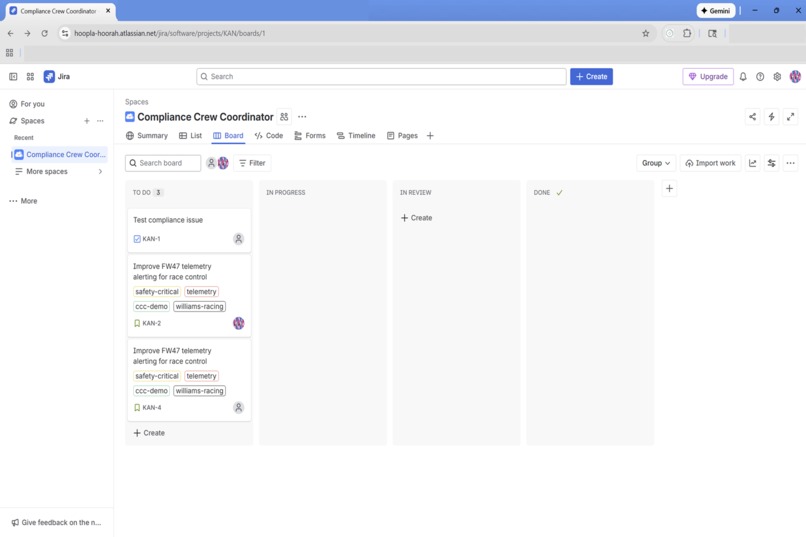
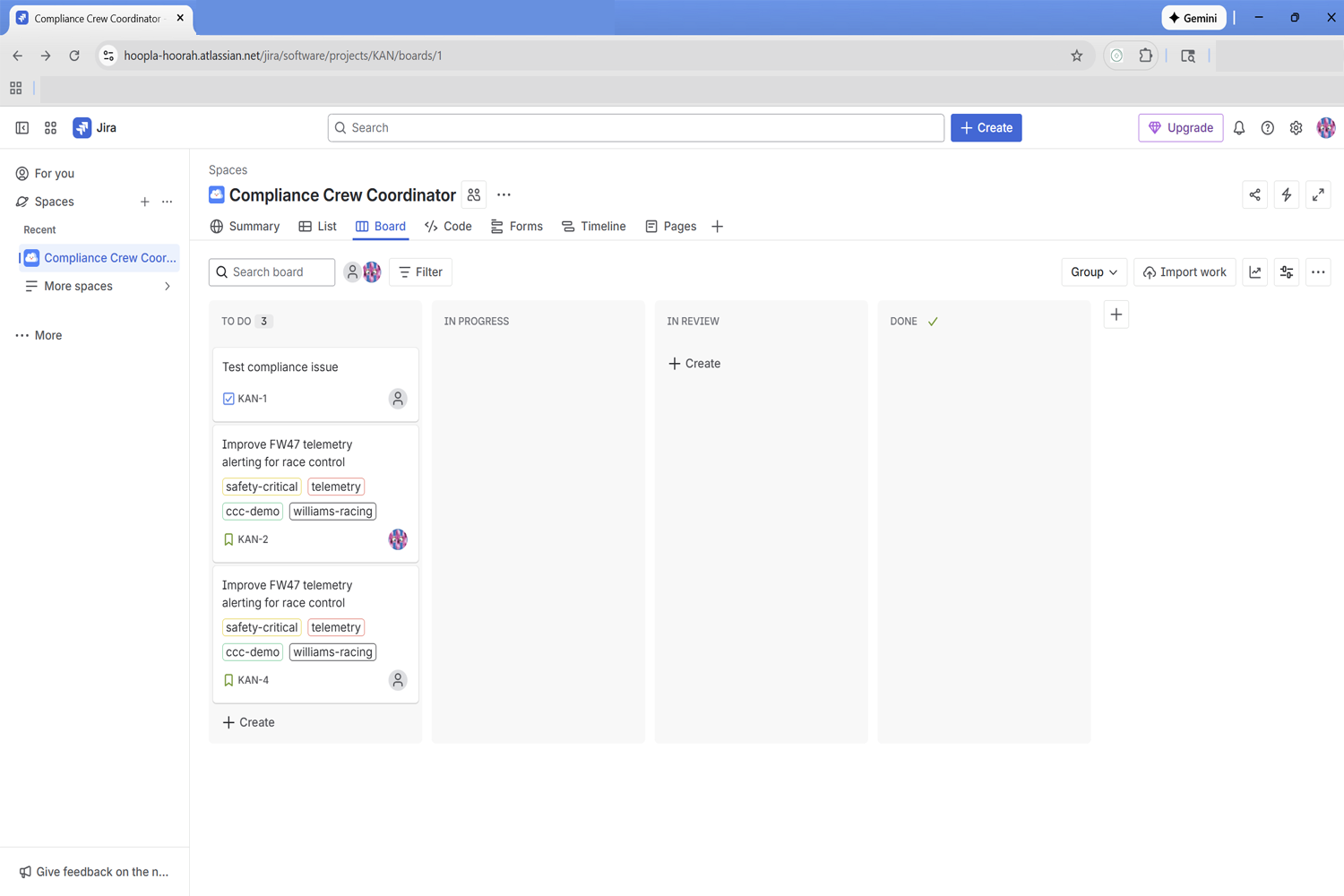
Compliance Crew Coordinator Jira board with test issue and FW47 telemetry stories queued in the To Do column.
-
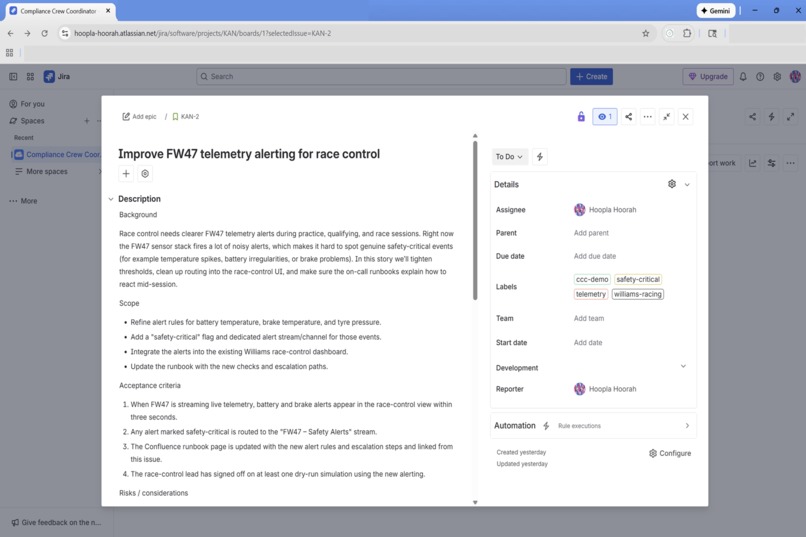
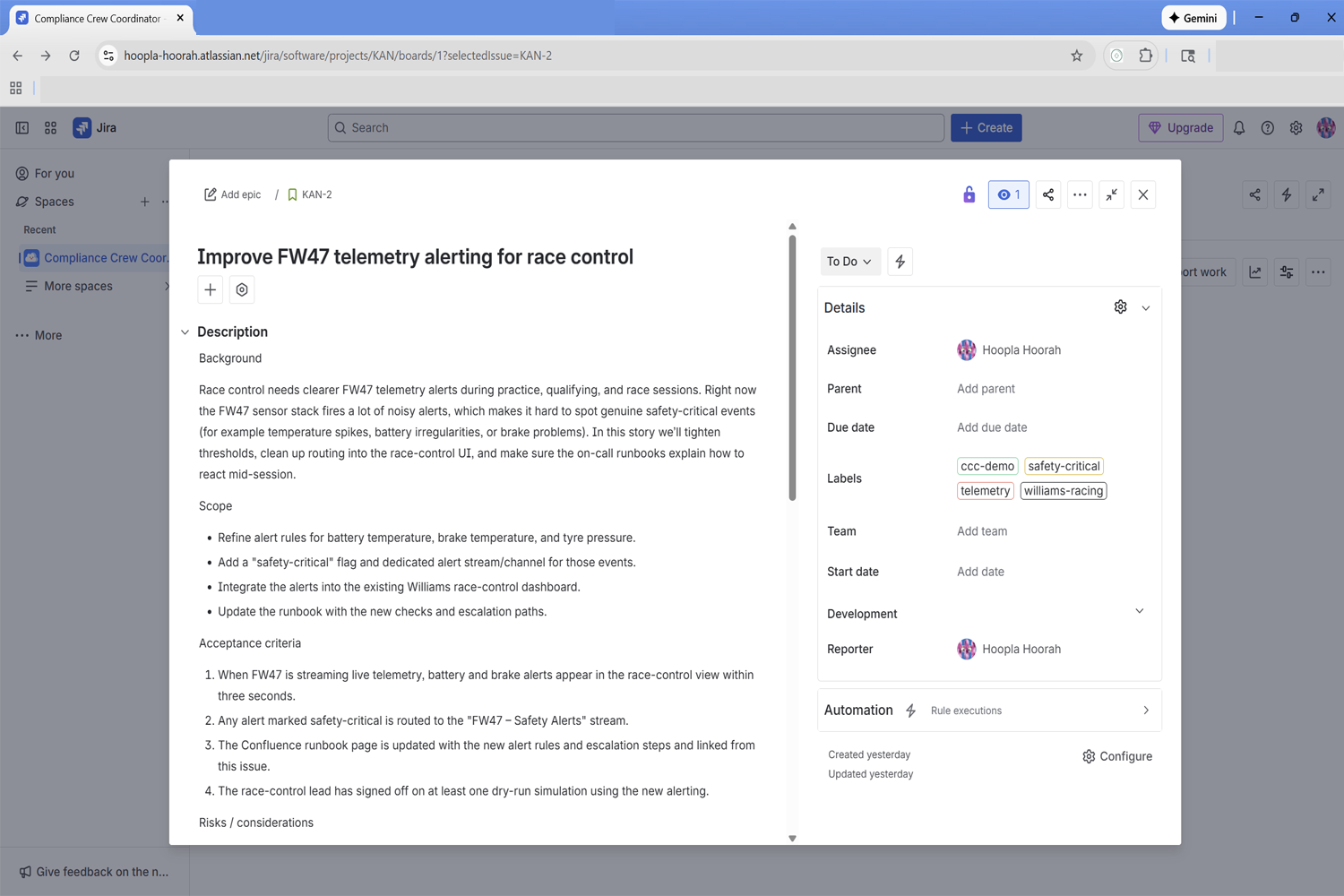
FW47 telemetry hero issue in Jira, fully written out with background, scope, acceptance criteria, and risks.
-
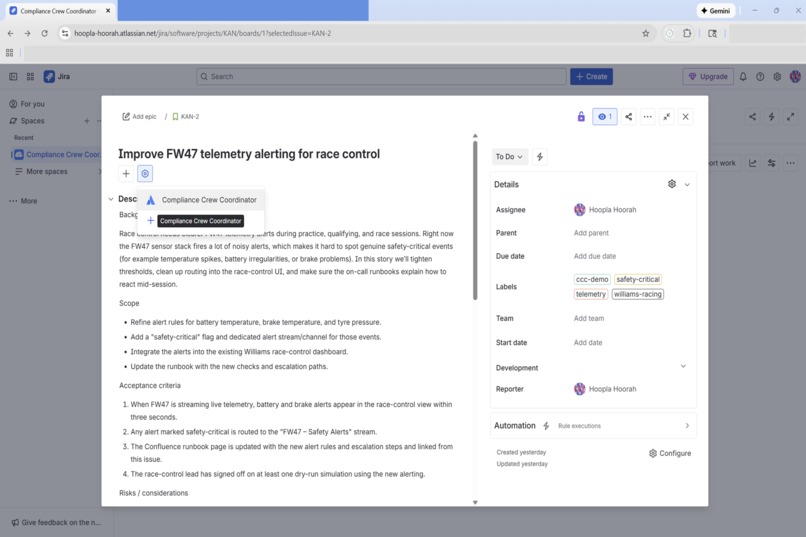
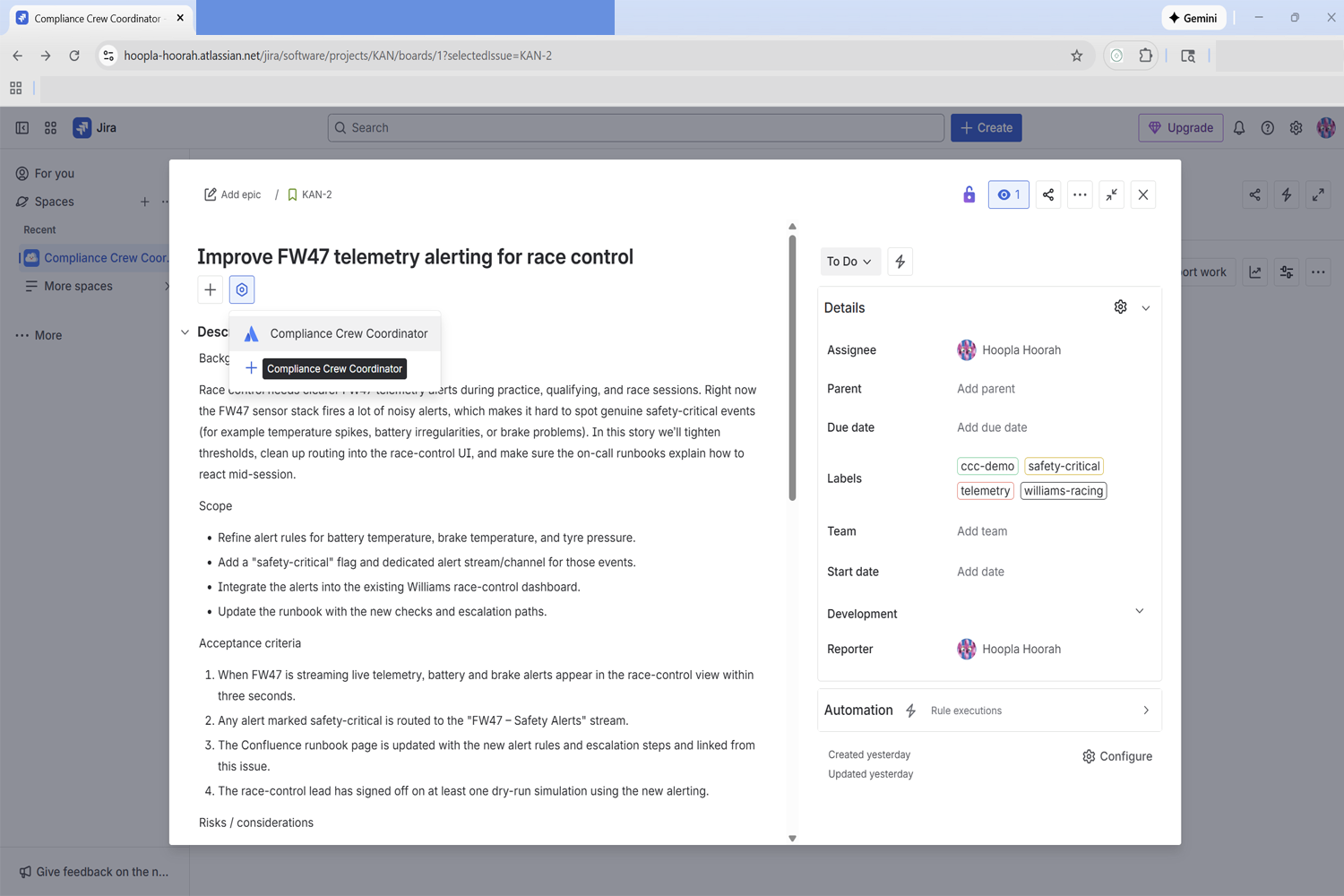
Launching the Compliance Crew Coordinator app from the FW47 Jira issue toolbar.
-
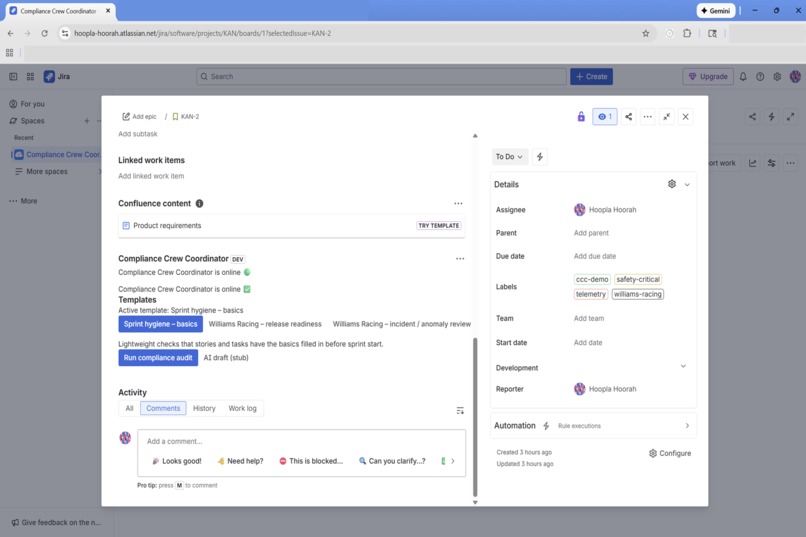
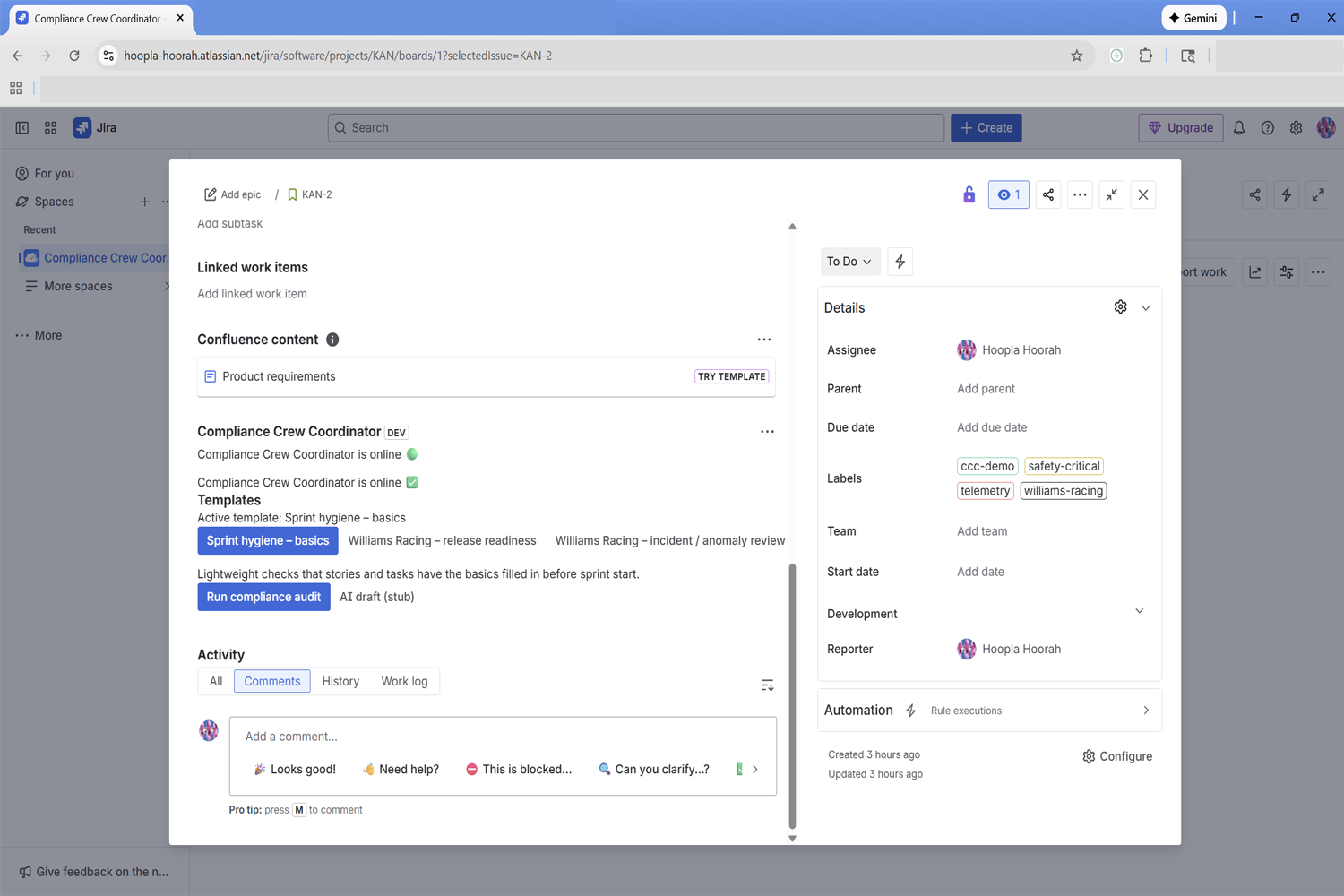
CCC panel on KAN-2 showing the Sprint hygiene – basics template ready to audit the FW47 story.
-
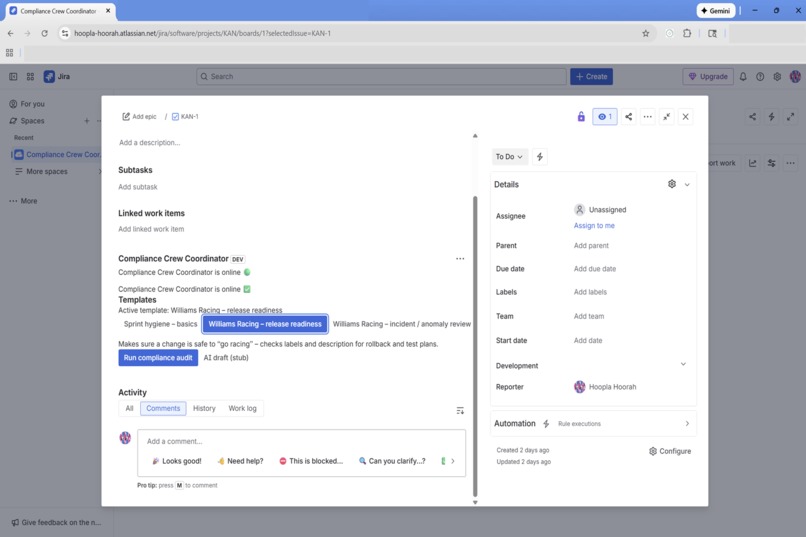
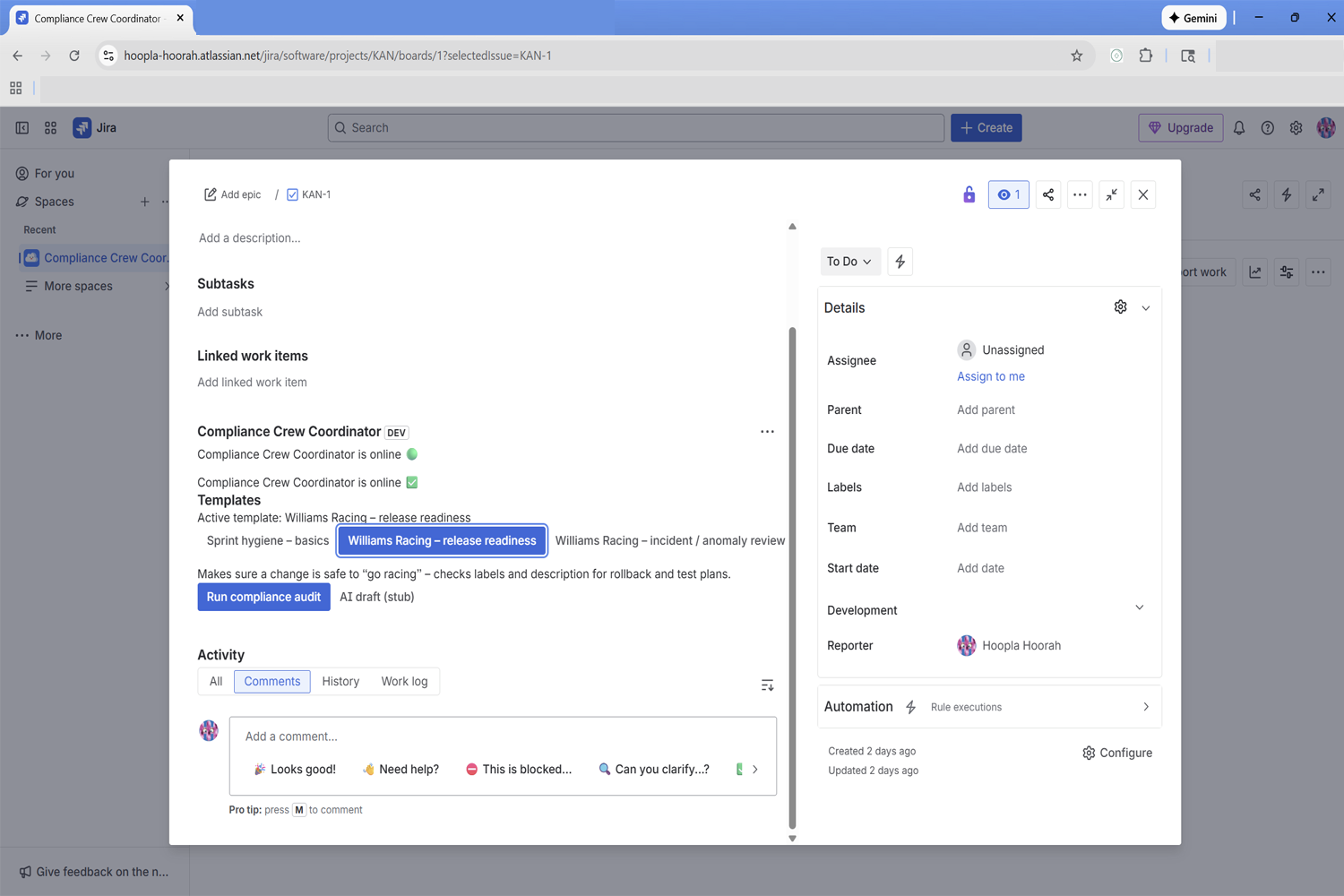
CCC panel on KAN-1 with the Williams Racing – release readiness template selected.
-
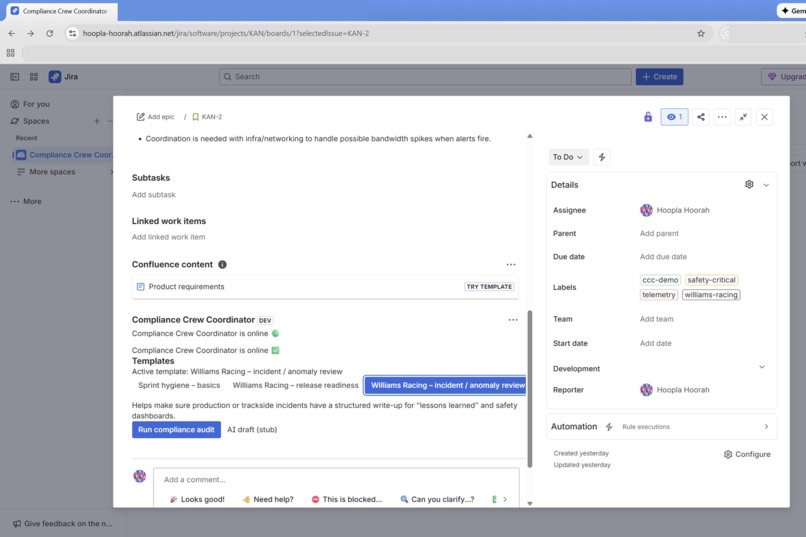
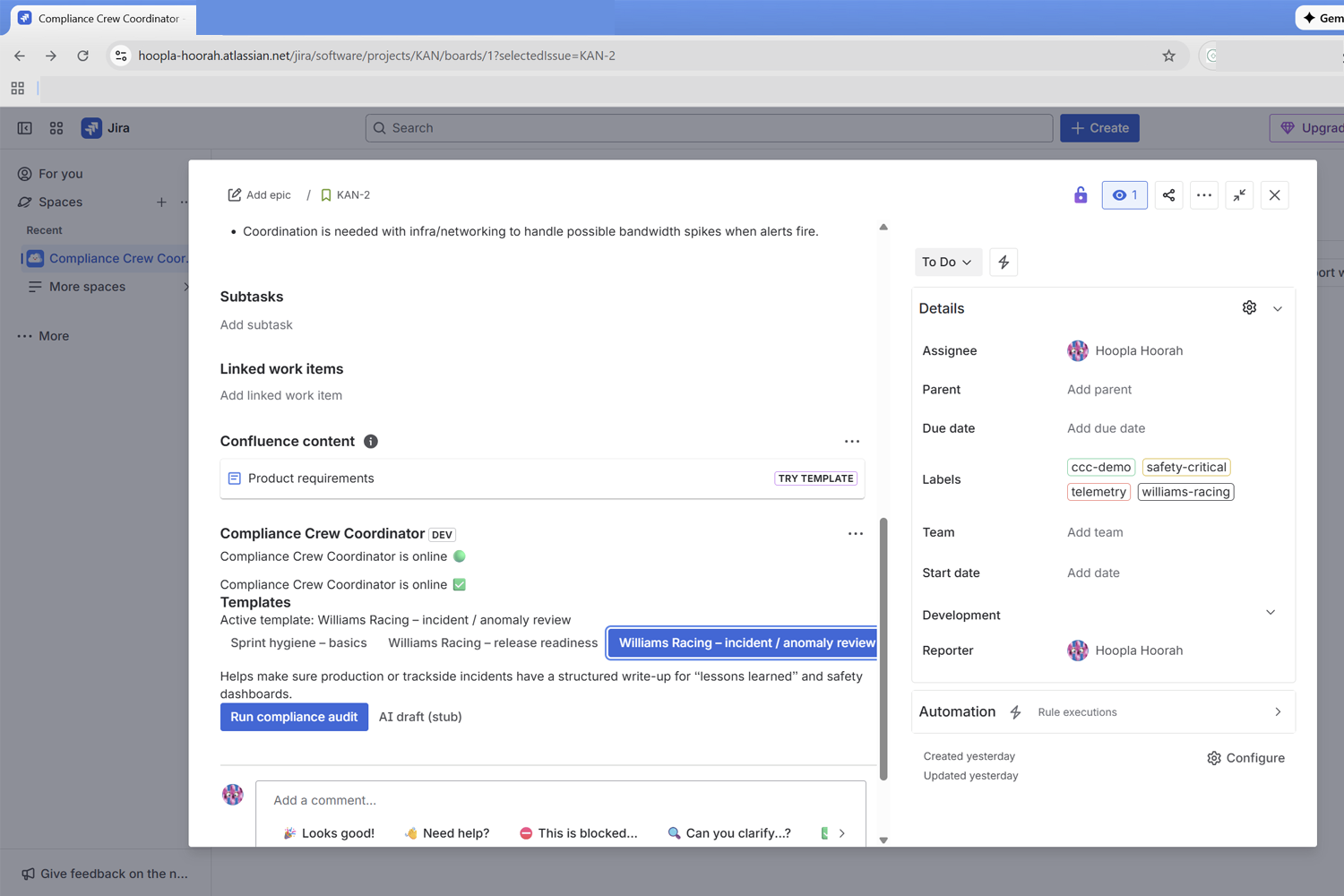
CCC panel on KAN-1 with the Williams Racing - incident/ anomoly review template selected
-
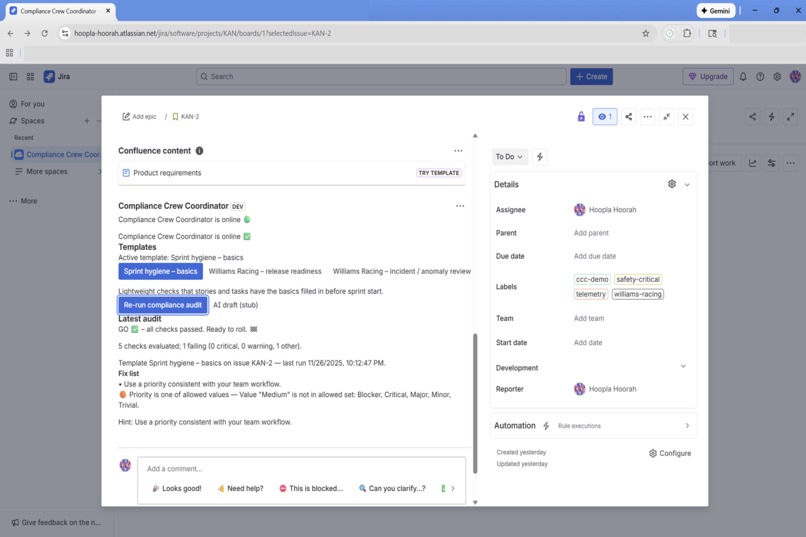
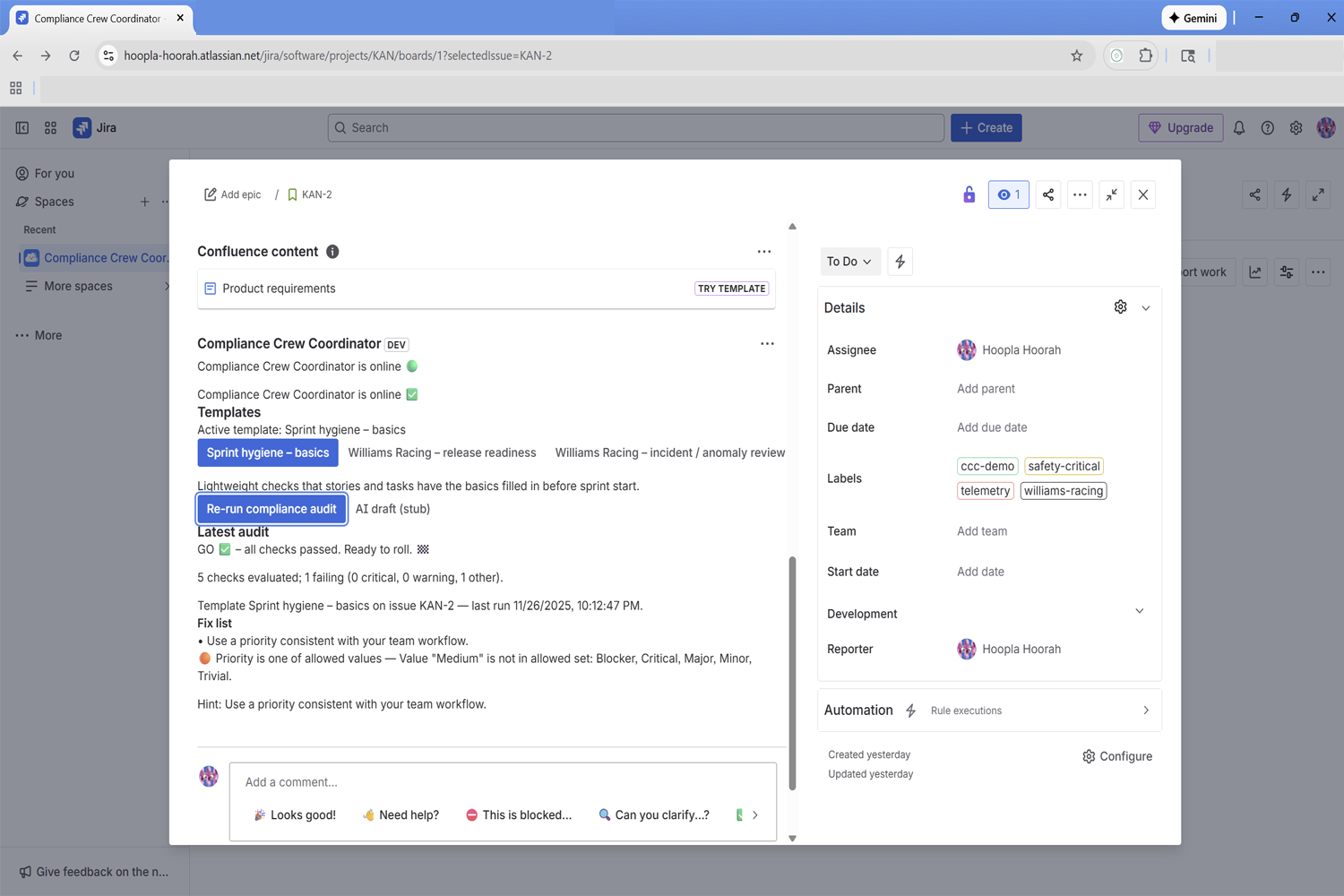
Sprint hygiene audit on KAN-2 returns "GO" with one minor priority hint in the Fix list.
-
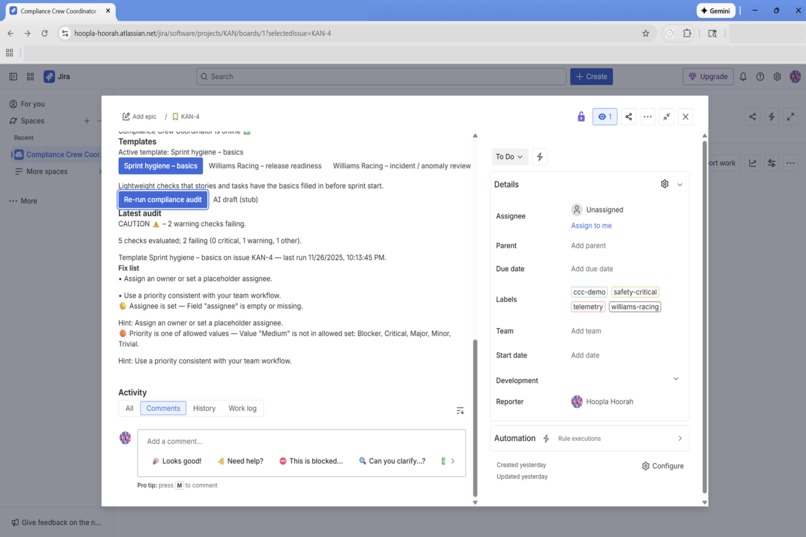
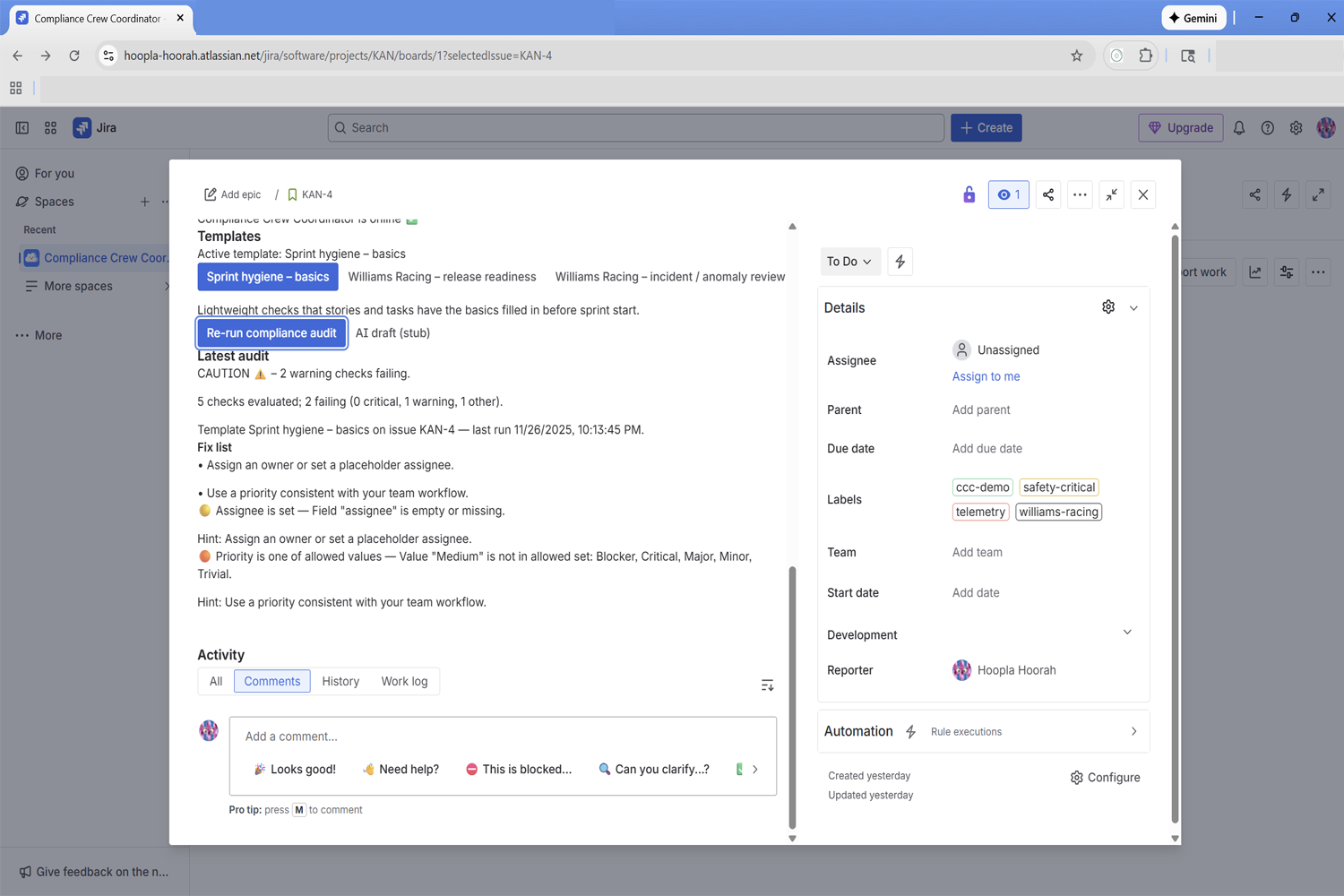
Sprint hygiene audit on KAN-4 returns "CAUTION" with warnings for assignee and priority.
-
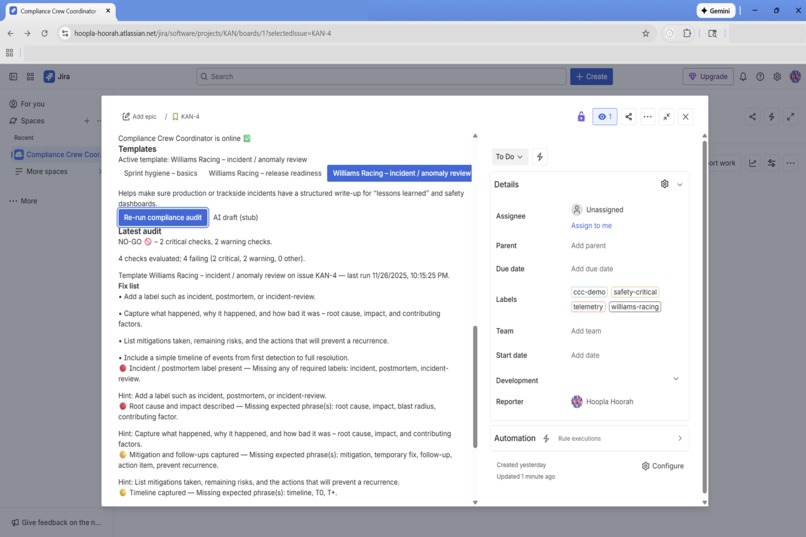
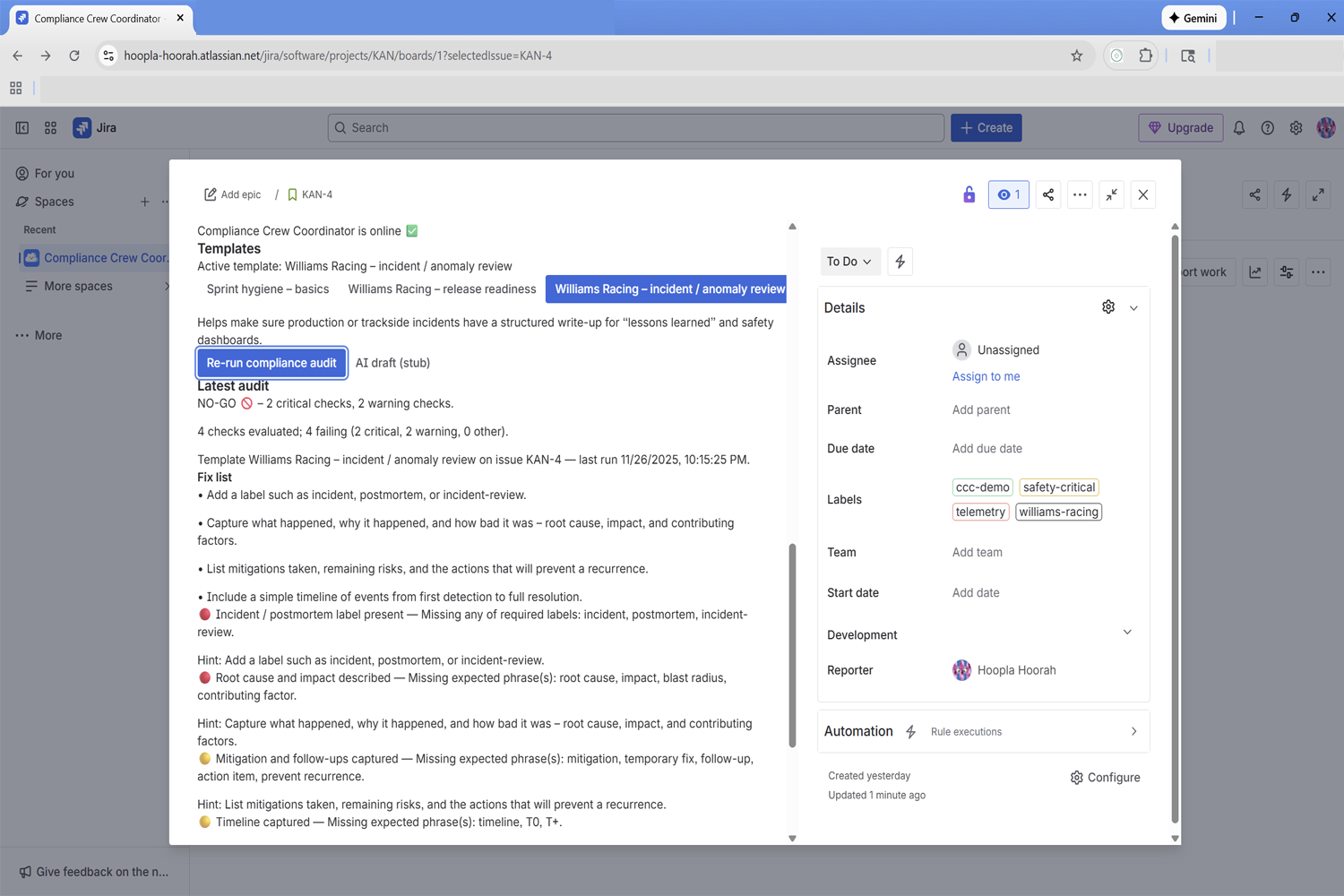
Williams Racing incident / anomaly review on KAN-4 returns "NO-GO" with multiple critical checks failing.
-
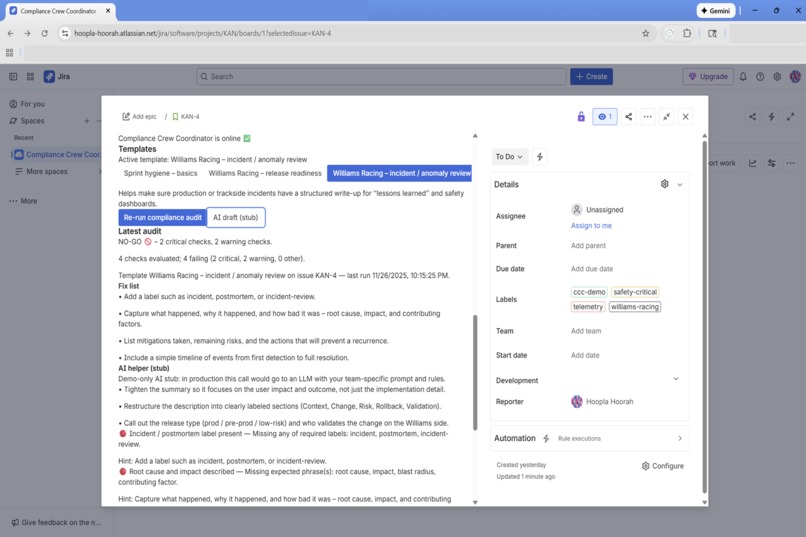
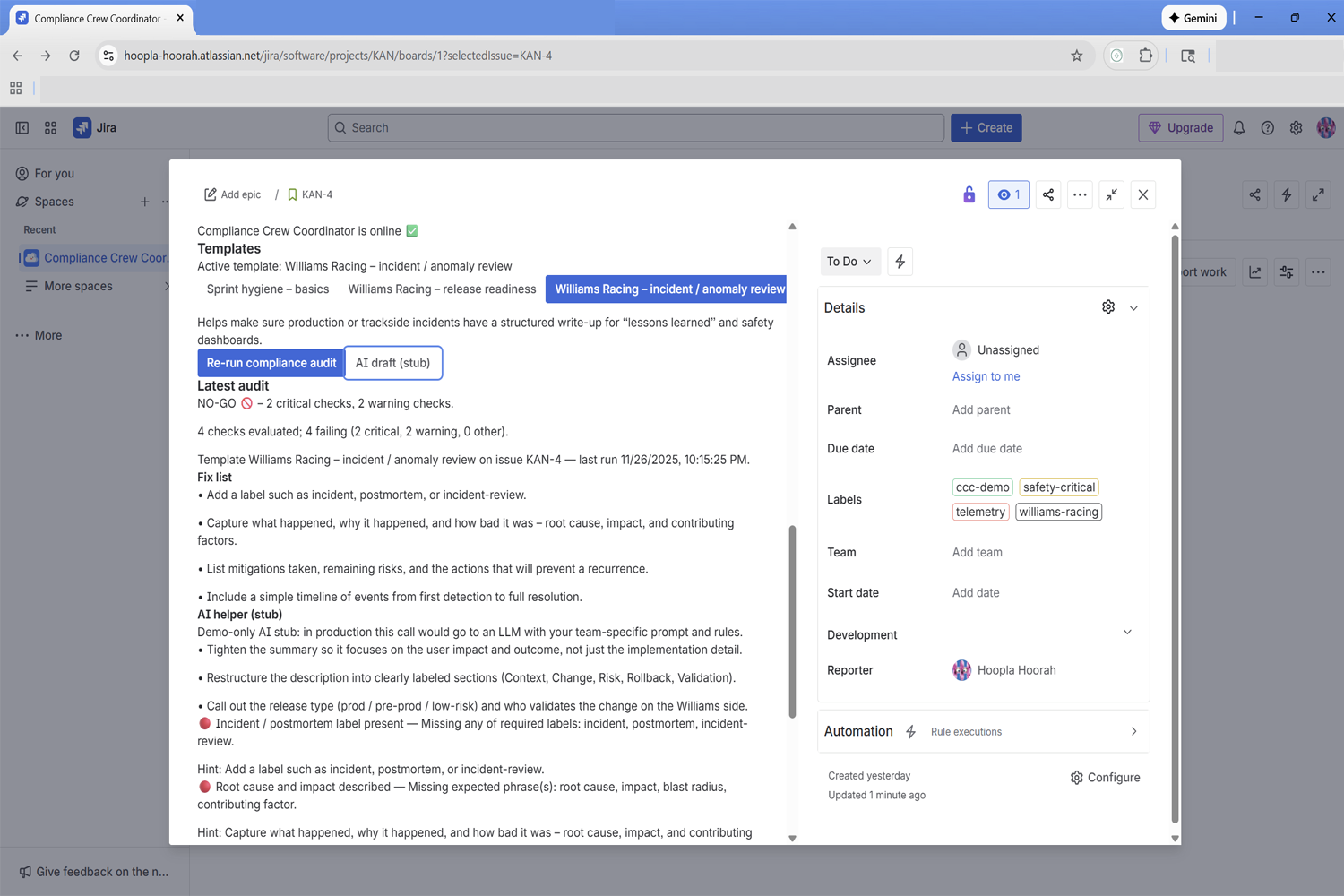
Same incident review NO-GO plus the AI draft (stub) section showing how an LLM could suggest improvements.
-
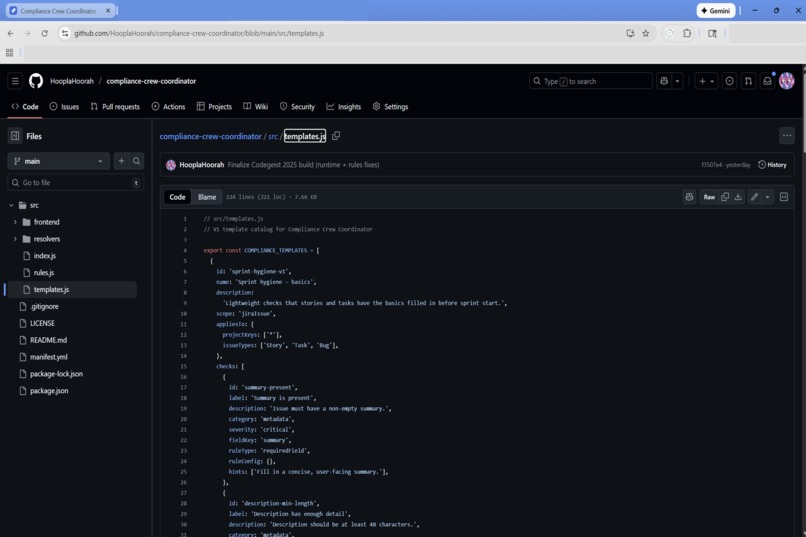
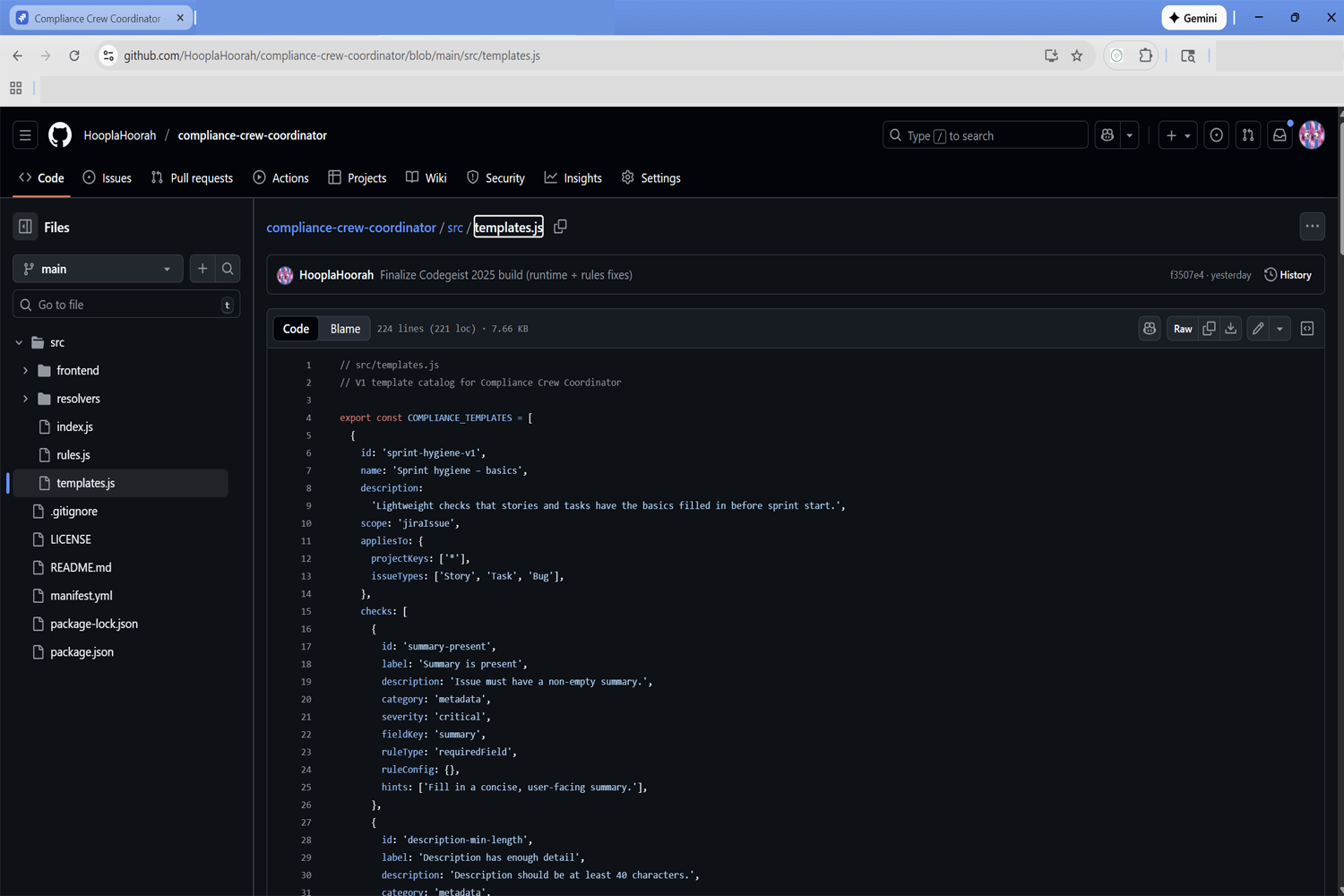
templates.js in GitHub – compliance templates and checks defined as code for the CCC engine.
-
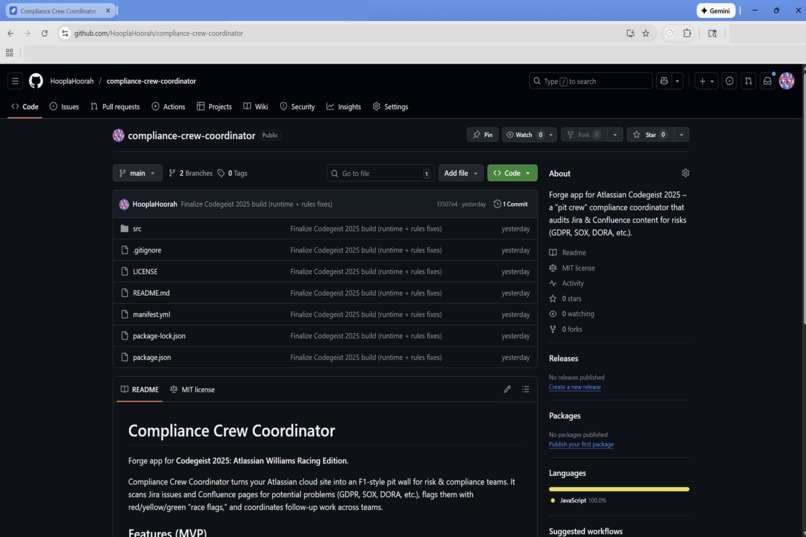
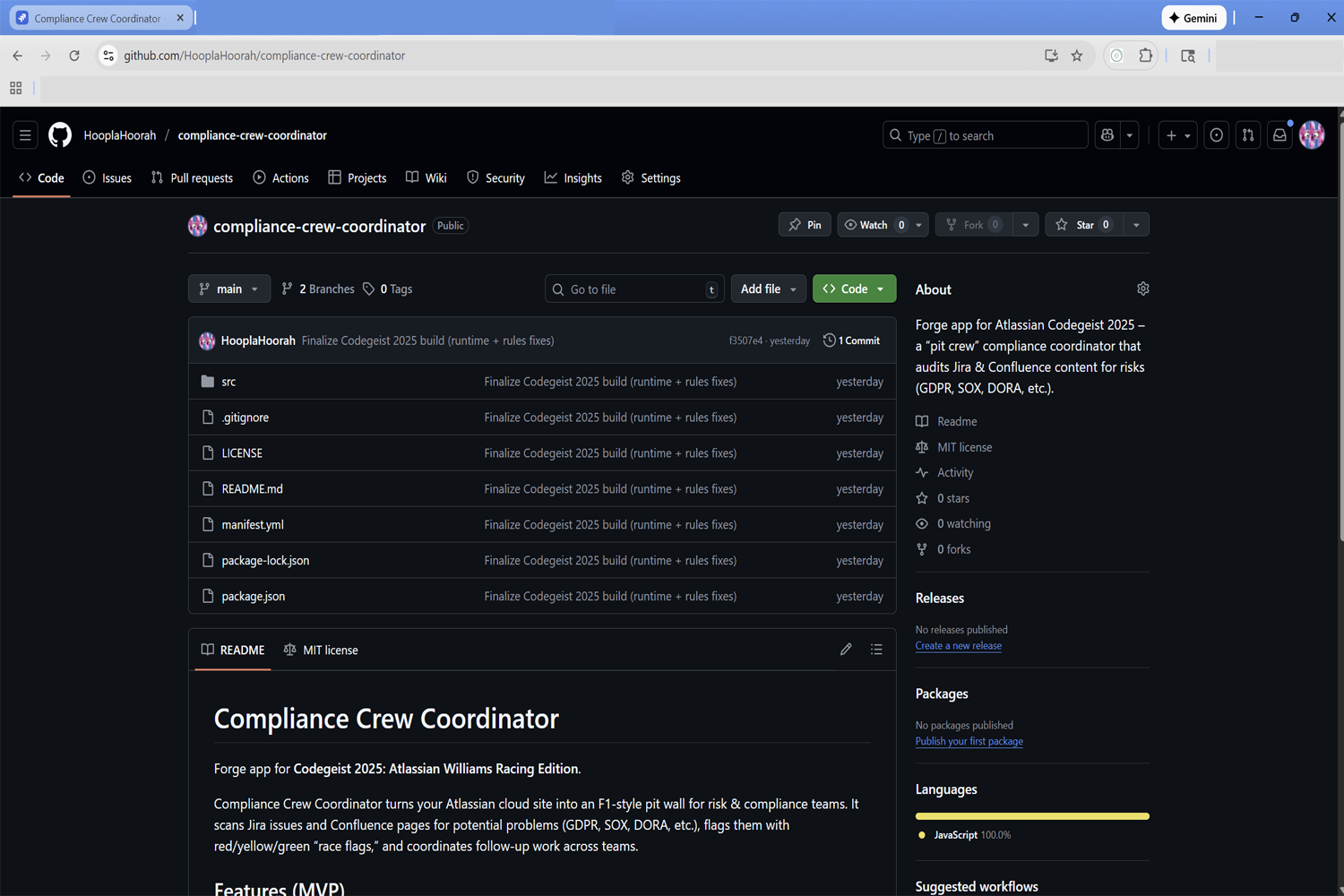
Public Compliance Crew Coordinator GitHub repo showing Forge app structure and project files.
-
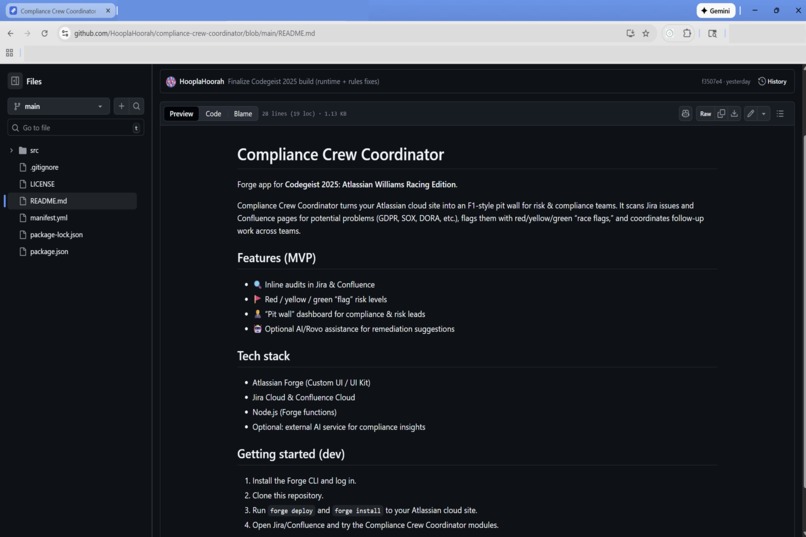
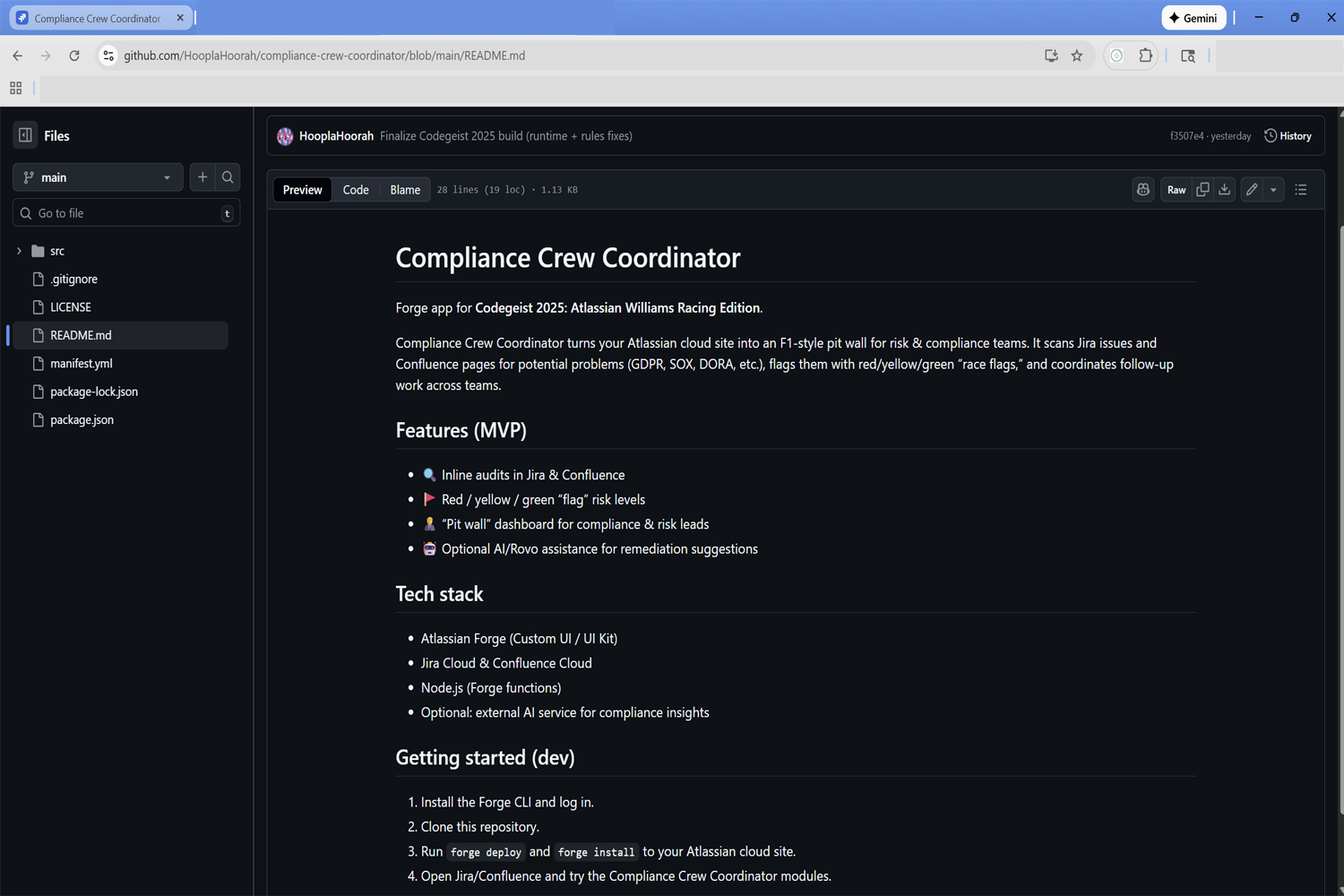
README overview describing Compliance Crew Coordinator features, tech stack, and Forge setup steps.
-
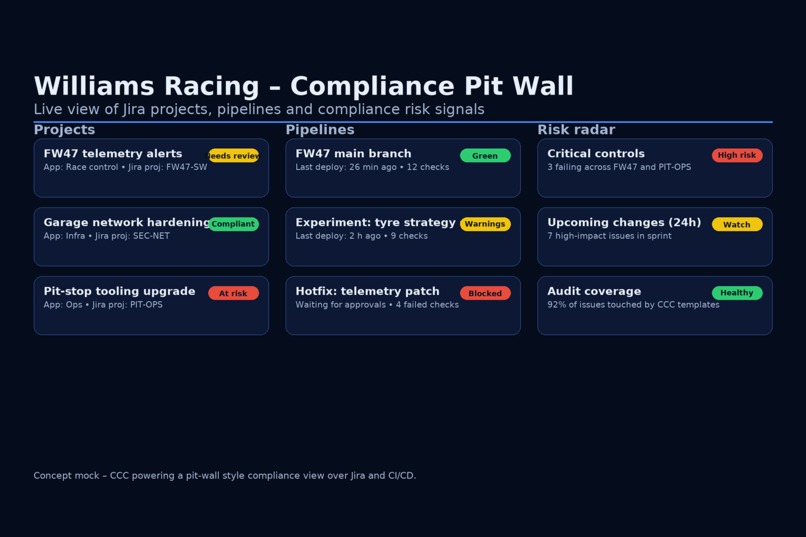
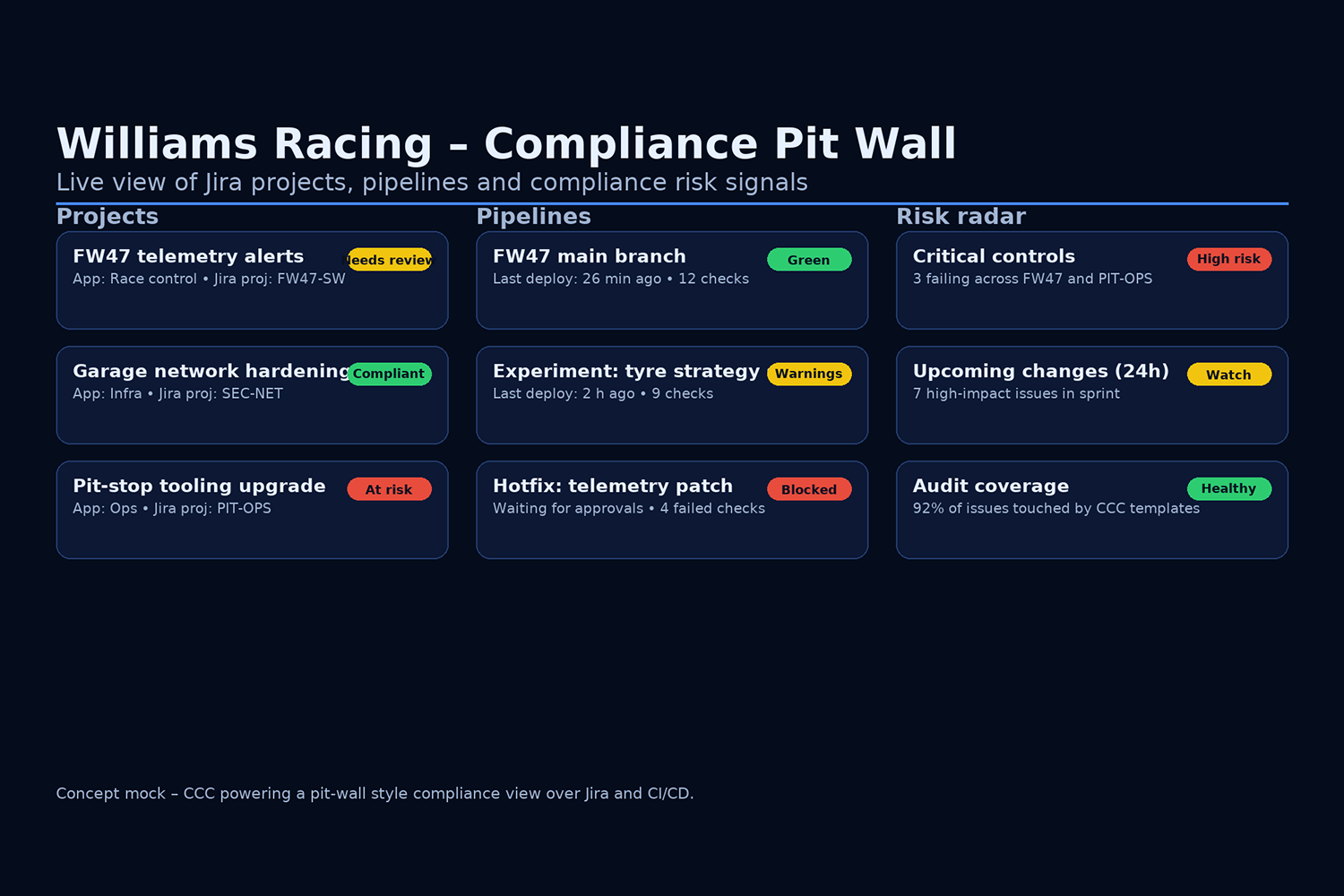
Williams Racing “Compliance Pit Wall” concept – live GO / CAUTION / NO-GO view of projects, pipelines, and risks.
Inspiration
We love the precision and high-stakes environment of Formula 1 pit crews. Software delivery can feel just as frantic and unforgiving, especially when compliance and safety are on the line. Too often, Jira issues and Confluence pages slip through sprints without key details, leading to missed requirements, production rollbacks, and regulatory gaps.
What it does
Compliance Crew Coordinator is a Forge app that turns your Atlassian cloud site into a “pit wall” for risk and compliance. It runs pre‑flight checks on Jira issues (and Confluence pages in the future) using reusable templates that encode your team’s standards:
- Sprint hygiene – basics: makes sure stories and tasks have the basics filled in before sprint start.
- Williams Racing – release readiness: ensures a change is safe to “go racing”, checking for risk, rollback, test plan, and release labels.
- Williams Racing – incident / anomaly review: guides post‑incident reviews with checks for root cause, impact, mitigation/follow‑ups, and timeline.
The engine evaluates each template rule and flags missing or insufficient information with red/yellow/green race lights. A decision line (GO 🔷, CAUTION 🔸, NO‑GO 🔴) and a summary line (4 checks evaluated; 3 failing (1 critical, 2 warning)) tell you at a glance how ready you are. For each failing check, the panel builds a fix list with hints. There’s also an AI stub that, in production, would call your team’s LLM prompt to draft a better summary and description.
How we built it
We built the app on Atlassian Forge. The backend is Node.js and the Forge API for Jira Cloud. A simple rule engine powers the templates, and the frontend is React. All data stays in Atlassian – there’s no external infrastructure to maintain. We added a summary layer to aggregate results and used race‑inspired microcopy to make the UI fun.
What’s next
We plan to add Confluence modules, a global “pit wall” dashboard, and true AI integration via Rovo/OpenAI. For now, it’s an easy‑to install Forge app that helps teams ship with F1 precision.
Built With
- atlassian-forge
- confluence
- jira
- node.js
- react


Log in or sign up for Devpost to join the conversation.