Inspiration
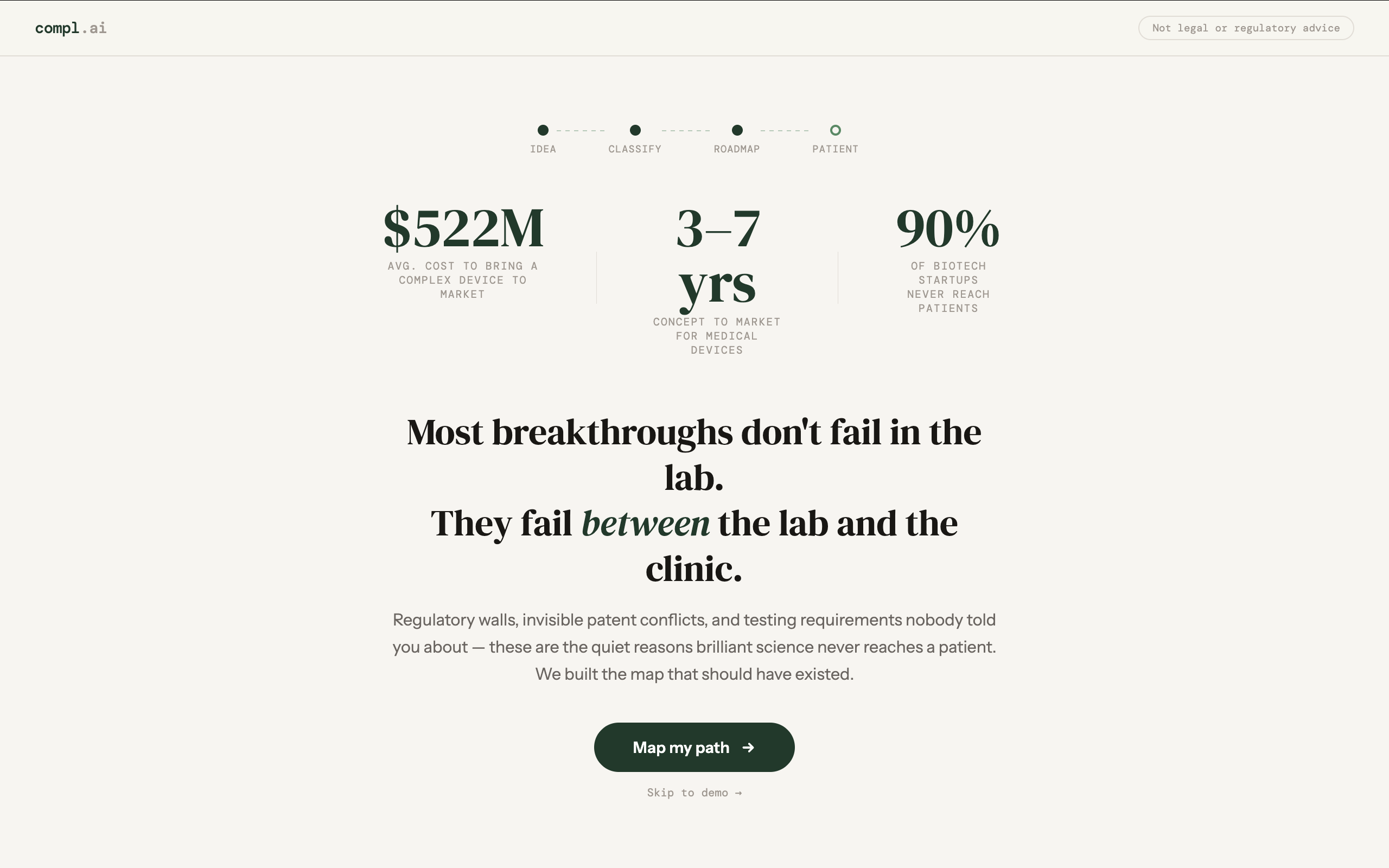
We set out to solve a problem we kept running into in the biotech world: the science is never the hardest part. The hardest part is everything that comes after. Regulatory pathways that take years to navigate. Biocompatibility testing requirements are buried in 200-page FDA guidance documents. Patent landscapes that can invalidate your entire approach before you've run a single trial. And no map. No single place where a scientist or a founder can go and say, "Here's what I'm building, what do I actually need to do?"
We split the problem cleanly. One of us brought the domain knowledge: the regulatory logic, the biocompatibility decision trees, the IP risk framework, and the materials tradeoffs. The other brought the engineering. In one night, we built a full modular backend in Python — four systems running in parallel, hitting live FDA and USPTO APIs, deployed on Render with a fallback so the demo never dies. On the other side, we designed the product, the UX, the chat interface, and the visual roadmap.
How we built it
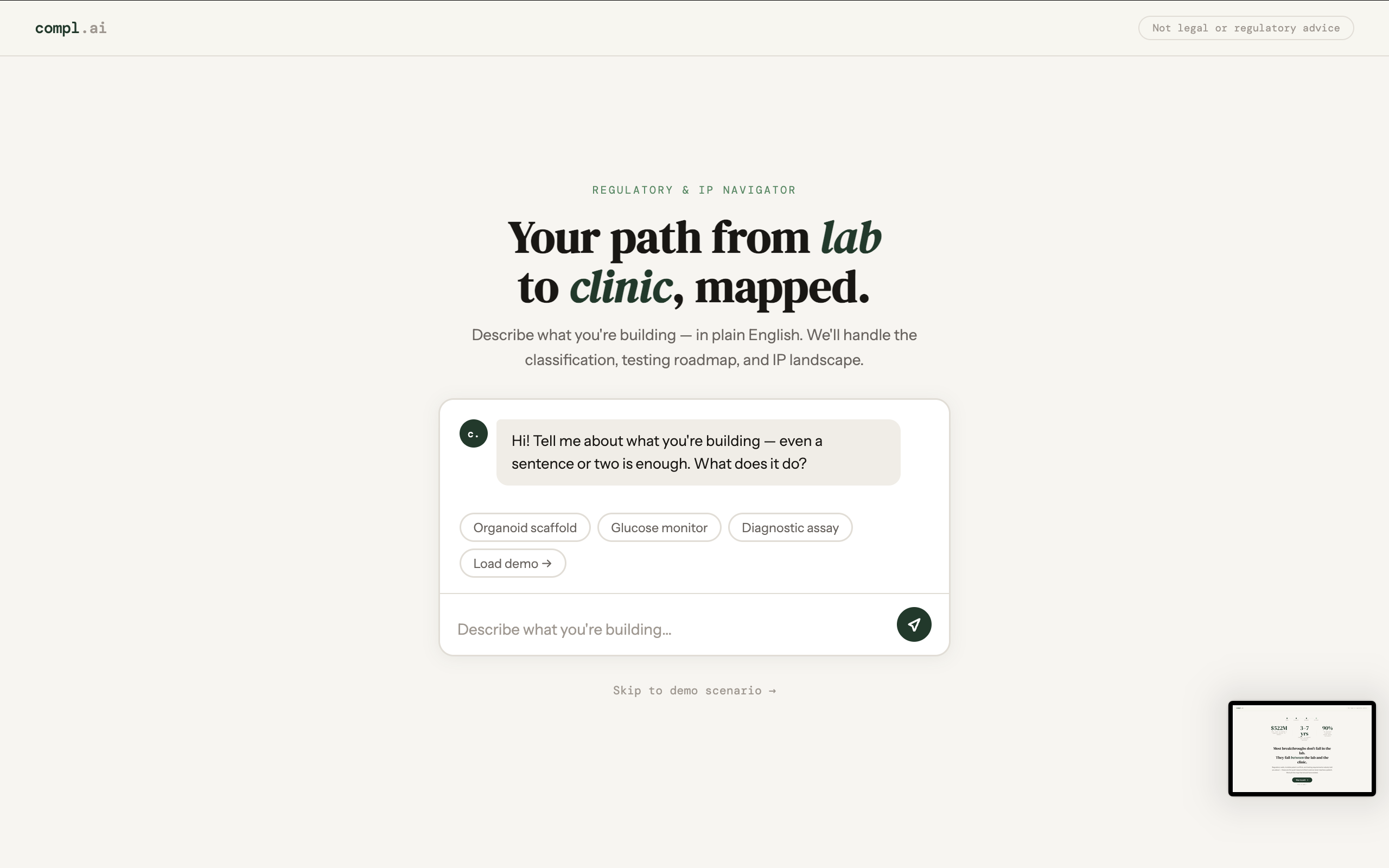
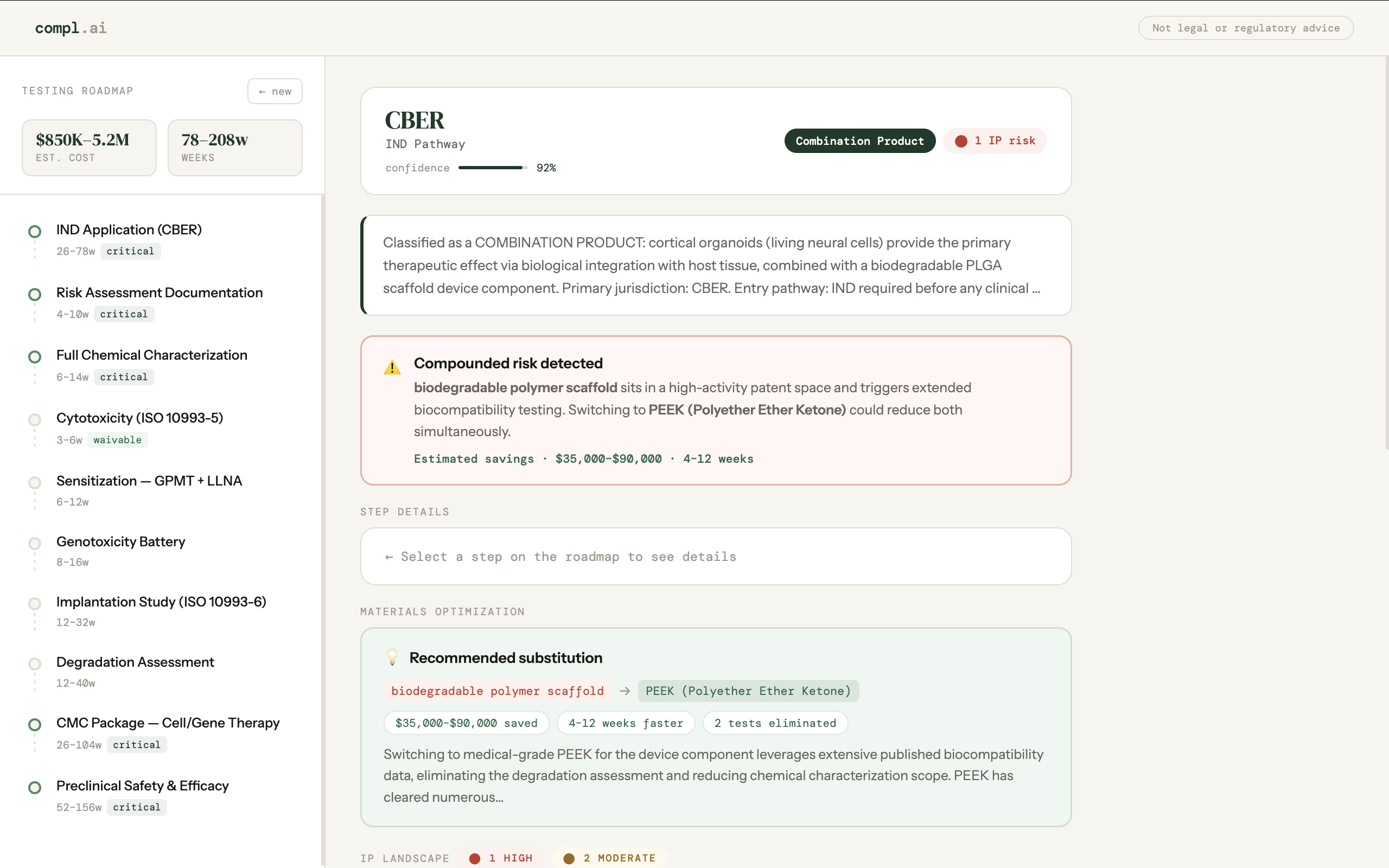
The backend is a Python FastAPI server built as a modular pipeline — four systems with clean inputs and outputs, feeding into a central layer that pulls everything together into a single response. The frontend is a conversational chat interface with a visual testing roadmap and a split-screen results layout. We made sure the demo always works, even if the backend has a moment — a mock fallback catches any failures gracefully. Deployed on Render, served via GitHub Pages.
Challenges we ran into
The hardest part wasn't the code. It was compression. Taking years of regulatory complexity and distilling it into something a founder with no compliance background could understand in 90 seconds. Building the logic for classifying innovations in the biotech world was also difficult, for eg, in cases when the AI had to ask a follow-up question and when there was enough context to map the path, and what would happen with a combination product, as is the norm with the FDA and such regulations. Making the output feel clear and trustworthy rather than overwhelming.
Accomplishments that we're proud of
We're very grateful that we were able to translate our combined thinking with the regulatory domain knowledge and the engineering into a real, viable product. It produces output that a regulatory professional would recognise as directionally correct. The classification engine routes combination products, cell therapies, IVDs, and medical devices to the right FDA centre and pathway. The roadmap encodes the actual 2023 biocompatibility guidance matrix. The materials optimiser finds real savings before a founder has committed to the wrong path. And it does all of that in 90 seconds. We're proud of that.
What's next for compl.ai
We'd love to partner with a university tech transfer office, offering free access to their spinouts in exchange for feedback and a case study. We want to expand the materials database from 7 to 50 materials, each with biocompatibility history, IP exposure rating, and a tested alternative. We're also building PDF export, so the roadmap becomes something a founder can actually hand to a consultant or investor. And further down the road, we've planned for CRO API integration, so cost estimates go from directional ranges to real, bindable quotes. The map becomes a procurement tool.

Log in or sign up for Devpost to join the conversation.