-
Compassionateconnect AI - AI supports care, not replaces it.
-
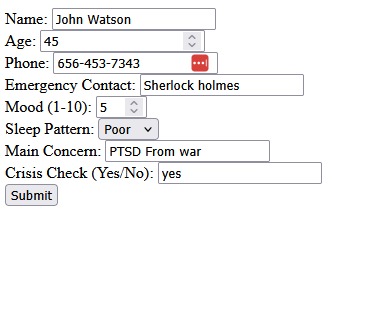
This is the intake_form

Inspiration
As someone seeking therapy, I was overwhelmed by paperwork, repeated questions, and intake forms that felt impersonal. I often found myself having to explain the same concerns to multiple people. I wondered: could AI reduce that friction — and actually make the first step feel more human? CompassionateConnect AI was born from that question.
What it does
CompassionateConnect AI is a Gemini-powered, multi-agent intake system for mental health clinics. It:
Asks patients for their name, mood, and concerns
Clarifies unclear answers using Gemini
Detects signs of crisis and flags them for staff
Summarizes responses in plain language
Offers ethical, non-diagnostic insights to therapists
Stores data securely in both Firestore and JSON for therapist dashboards
The system runs fully in a command-line interface, designed for clinics without web developers or complex infrastructure.
How I built it
I used Google Vertex AI’s Gemini 1.5 Flash model to build multiple agents in Python:
An IntakeAgent for asking questions and handling skipped inputs
A CrisisResponseAgent that detects risk language and logs high-priority patients
A SummaryGeneratorAgent that creates readable summaries of each intake
An InsightAgent that provides possible therapy approaches
A DataPersistenceAgent that stores everything in Firestore and JSON
I used Google Cloud SDK, Firestore, and local files to keep it lightweight and deployable from any terminal.
Challenges I ran into
Debugging Gemini API errors and authentication scopes
Designing a CLI-based multi-agent system with ethical guardrails
Making the Firestore sync bidirectional and safe
Writing a summary pipeline that was actually helpful without overstepping into diagnosis
Accomplishments that I am proud of
Fully functional multi-agent pipeline with Gemini 1.5 Flash
Working CLI interface for intake and therapist dashboard
Crisis detection and ethical insight generation
Clean architecture, clean voiceover demo, and Notion documentation
Personalized — and born from real experience
IMPORTANT:
Currently, CompassionateConnect AI runs on a Render platform for the onboarding_process intake form and the therapist_dashboard primarily via a command-line interface (CLI) that guides you through the intake process. T
What I learned
How to design AI systems with real human stakes in mind
How to use Vertex AI + Firestore + Python to build fast prototypes
The importance of data clarity and trust when working in mental health
That a CLI can still feel compassionate if designed with care
open source contribution:
-Identified and reported a reproducible bug in google/adk-python (Issue #1331), contributing to the Google ADK open source project.
What's next for CompassionateConnect AI
Add a lightweight web-based interface (for clinics without technical staff)
Enable follow-up agent automation and scheduling integrations
Train Gemini prompts on clinic-specific language
Expand insight generation into client preparation tools
Partner with therapists or nonprofits for real-world pilots

Log in or sign up for Devpost to join the conversation.