About the Project — Compass
Inspiration
Millions of Californians (and ~40 million Americans nationwide) qualify for aid yet never finish the paperwork. Surveys show 47% find government applications “overly complex,” and >$140 B in benefits go unclaimed every year.¹
We watched friends juggle five portals, print 30-page PDFs, and re-type the same SSN half a dozen times. Compass was born to shrink that gap: one friendly conversation that figures out every program you qualify for and hands you finished applications—no clipboard, no jargon, no wait-list.
What It Does
Compass is a voice-first digital case-worker for public benefits (CalFresh, Medi-Cal, Alameda County IHSS today). Right now, we focus on public benefits assistance programs for those in need, helping low-income families, the elderly, college students, and more figure out which assistance programs they qualify for and quickly complete all of the applications at once.
- Conversational Agent (Vapi + Claude 4)
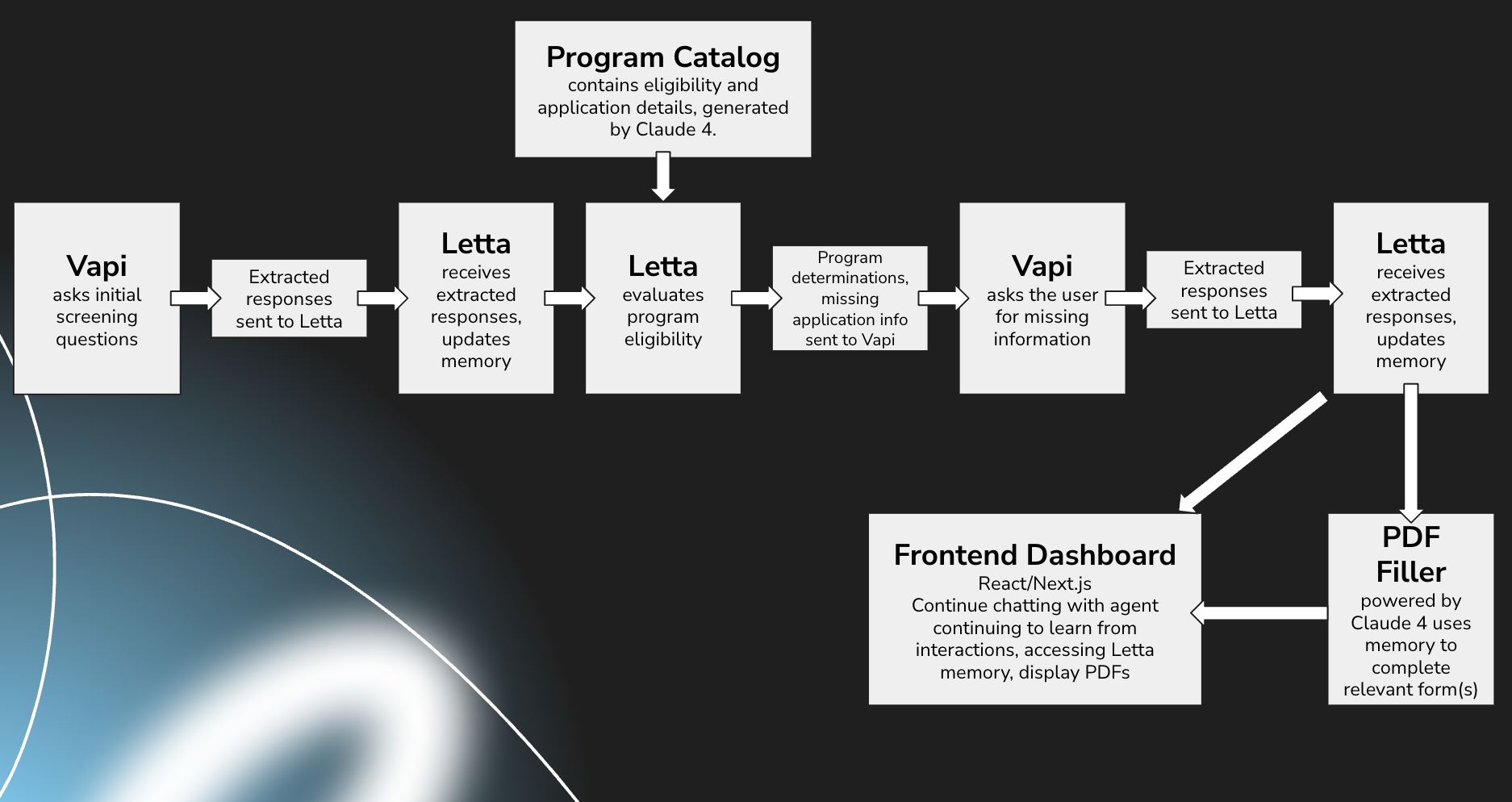
Greets the user, gains consent, and runs an adaptive screening interview. - Memory & Eligibility Agent (Letta)
Stores answers, matches them against a JSON rule catalog, returns eligible programs and any still-missing fields. Creative Use - Letta replaces Redis/Postgres, acting both as the long-term memory layer and short-term retrieval layer per person, updated automatically through conversation history and without schemas - Document-Filling Agent (Claude 4 PDF prompt)
Maps normalized field names → PDF / HTML IDs, fills every field (checkboxes included), and returns ready-to-submit files.
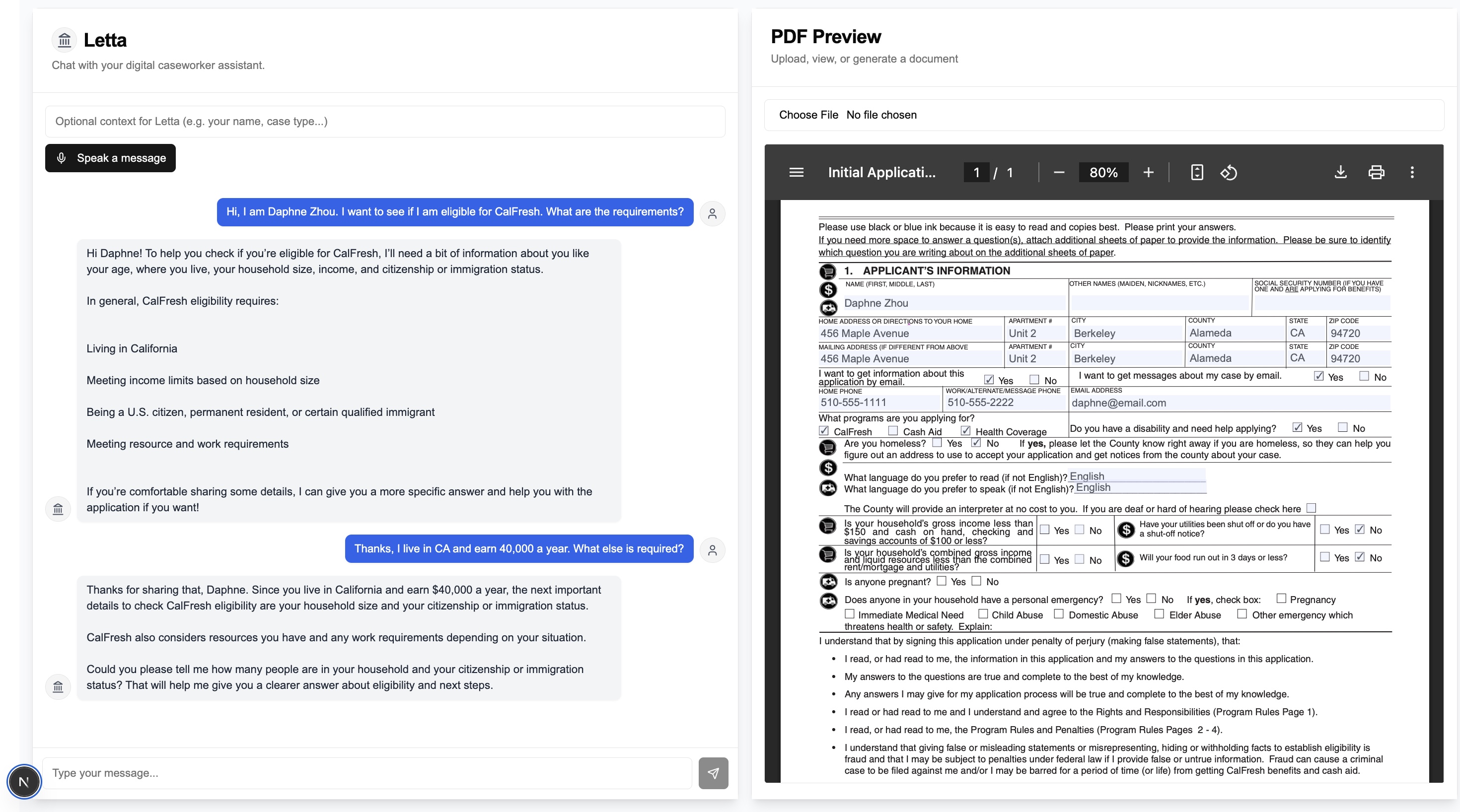
Result: Speak once → receive fully populated PDFs with zero duplicate questions even when multiple programs need the same data.
How We Built It
- Vapi orchestrates the conversation flow with multi-step nodes powered by Anthropic's Claude 4
- LLMs (Anthropic's Claude Opus 4) handle natural language + validation and guide Q&A; system prompts enforce accessible, welcoming tone.
- Letta parses the catalog’s eligibility requirements to return matching programs, determines what information we still need to complete relevant applications, and stores memory about the user.
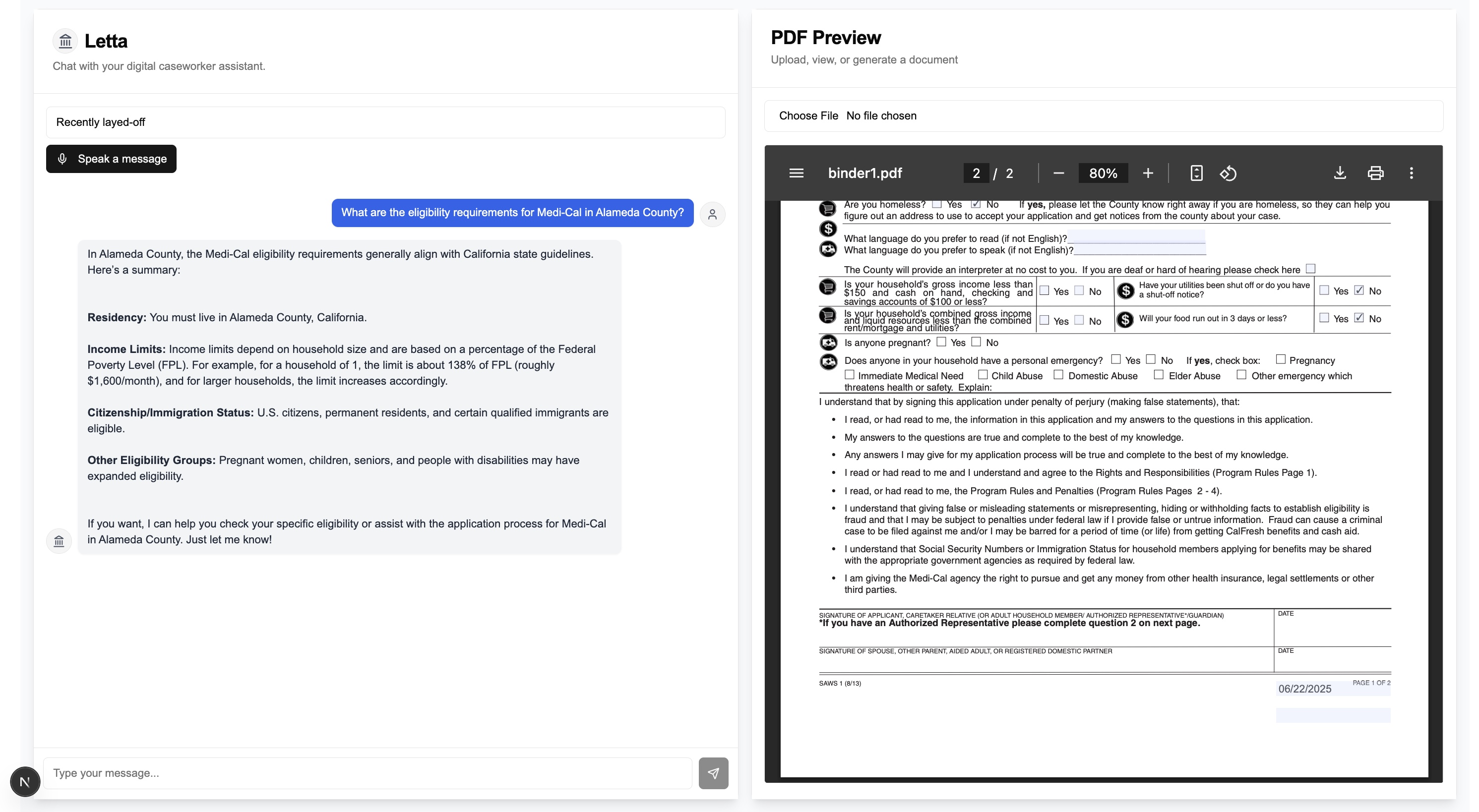
- Form filler uses Claude Opus 4 to automatically fill out PDF forms, matching user data to text and checkbox inputs.
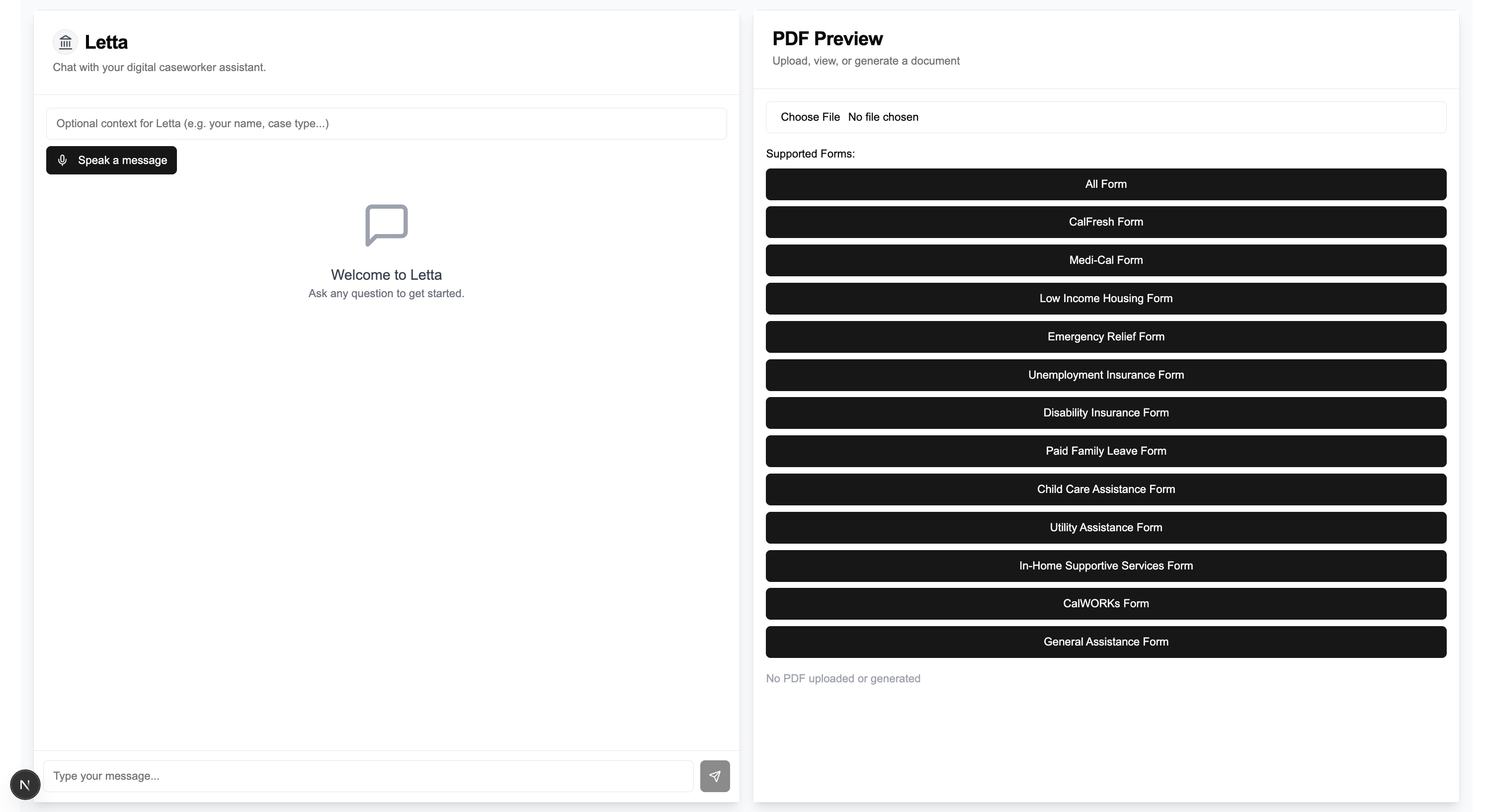
- Front-end Built in Next.js, using Vapi for real-time speech transcription. Dashboards for easy access and navigation. We built everything in less than 24 hours!! 🏃💨
Challenges We Faced
- Mapping 50+ form fields to conversation-friendly variable names without losing fidelity and without duplicating questions to the user.
- Validating ambiguous answers (“uh… maybe monthly?”) and re-asking the user politely.
- Cross-agent memory sync between Vapi and Letta.
- Checkbox hell: we spent two hours getting our form-filler to accurately interact with checkboxes!
- Rate-limits and exhausted credits at 4 am, forcing us to come up with creative ways to keep moving.
Accomplishments We’re Proud Of
- End-to-end demo: speak to Compass → instant, fully populated CalFresh PDF.
- Zero duplicate questions, even when multiple programs need the same data.
- Plug-and-play program catalogs (including program name, description, eligibility requirements, and application requirements) are stored in a JSON file after LLM processing/information extraction, so adding new programs is a single file change.
- Accessibility: works over a low-data phone call or web interface.
What We Learned
- Prompt design for structured extraction is half the battle, but still is super important for guiding LLM-enabled functionality.
- Users love hearing “let me fill that out for you” instead of “go to this portal”.
- PDFs are relics, but they’re not going away soon in government. Automation bridges this gap!
What’s Next
- Expand catalog to more assistance programs housing vouchers, LIHEAP, child-care subsidies, to more geographies (counties/states), to more domains (construction permitting, procurement contracting, etc.)
- Multilingual flows with automatic language detection to expand language access, particularly for immigrants where English may not be their first language
- SMS fallback for alternate ways to interact with the agent.
- Document upload & OCR to attach pay stubs or IDs.
- Caseworker dashboard so humans (whether a caseworker, secretary, or college student) can more easily override or approve submissions.
Built With
- agent
- agent-storm
- claude
- flask
- letta
- nextjs
- node.js
- prompt
- python
- typescript
- vapi


Log in or sign up for Devpost to join the conversation.