-
-

Logo
-
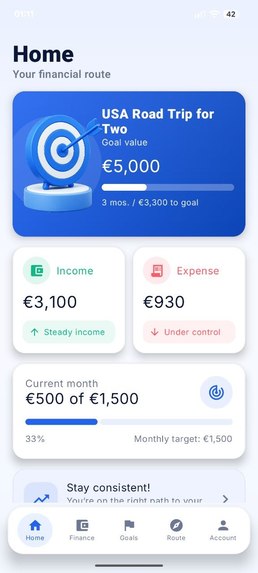
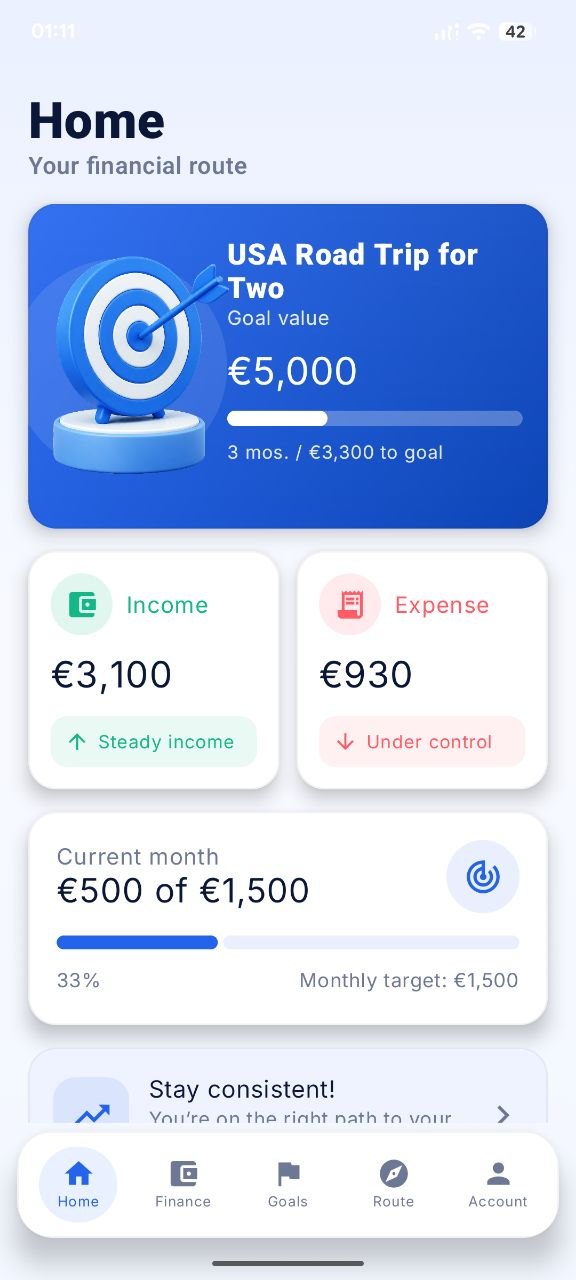
Main page
-
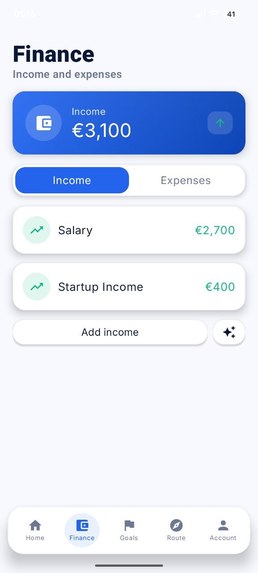
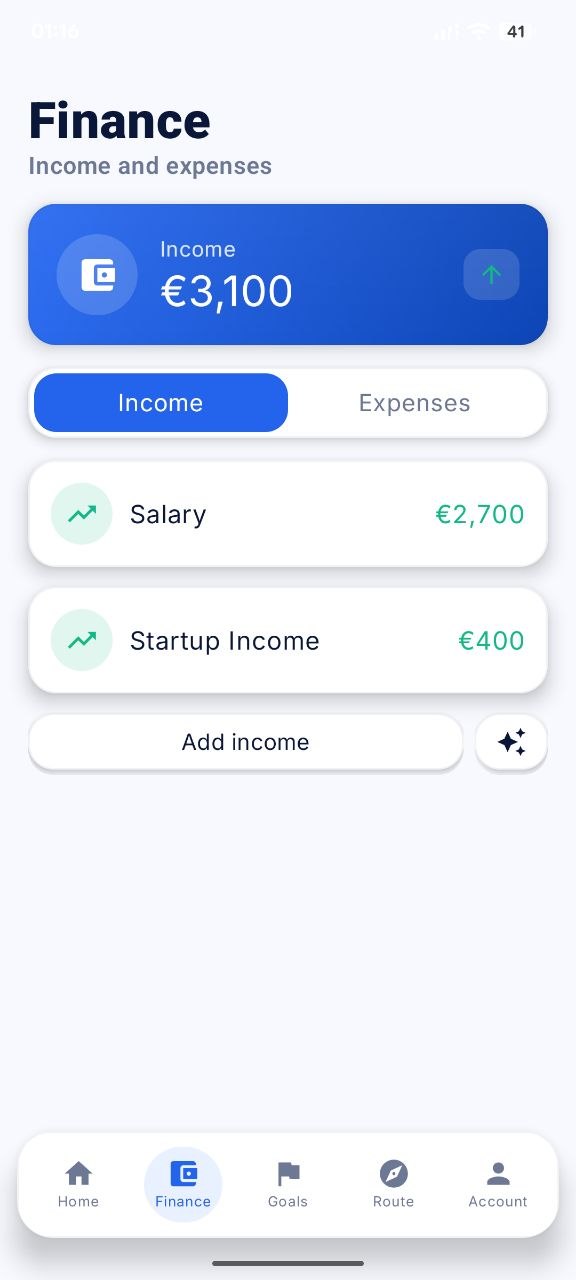
Finance page
-
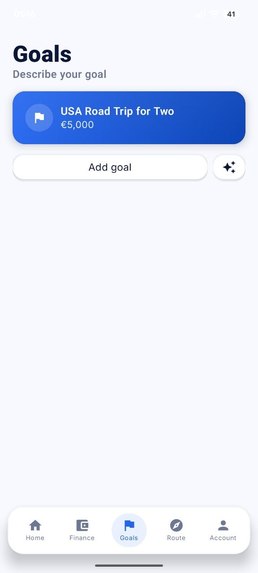
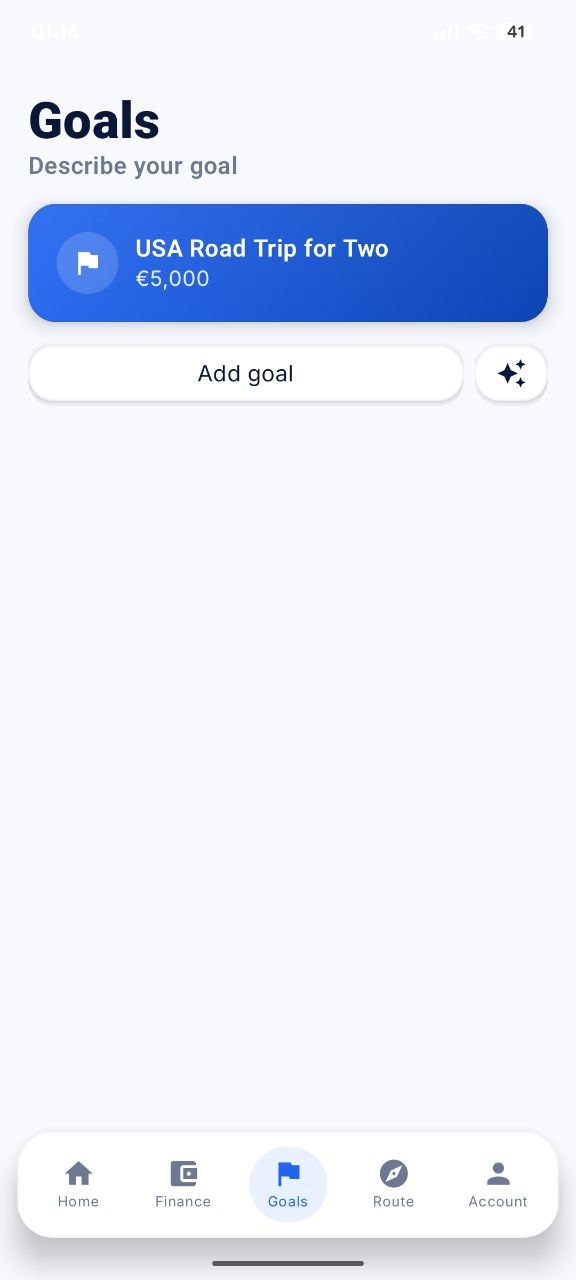
Goal page
-
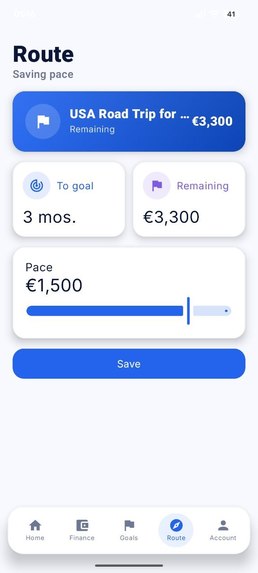
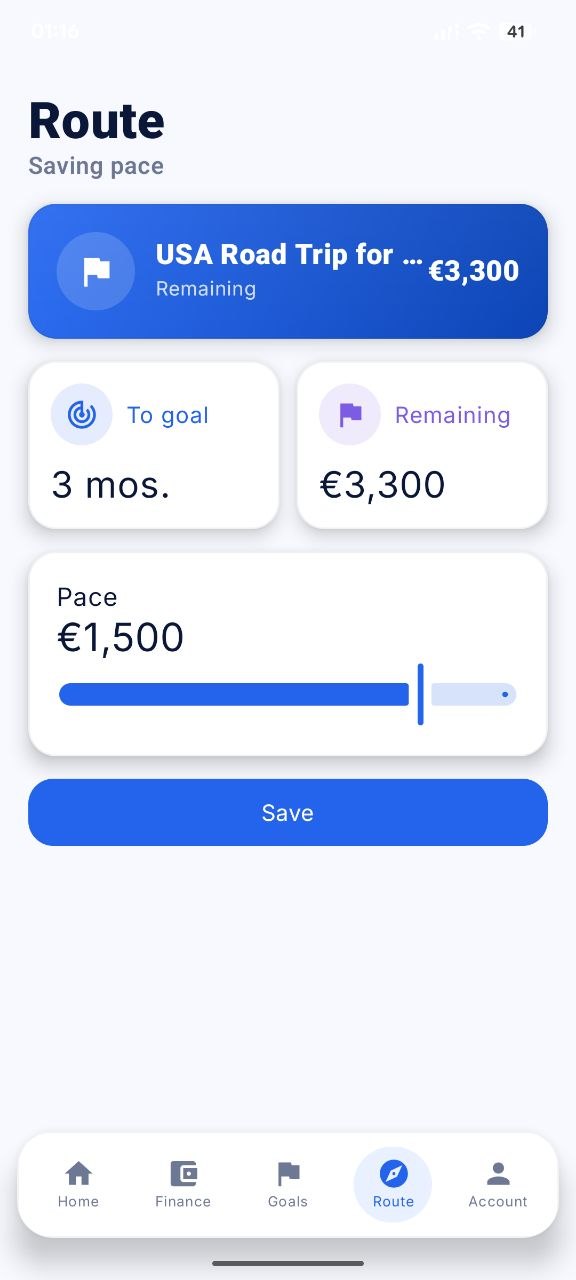
Route page
-
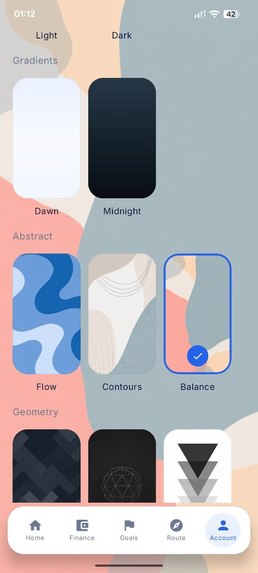
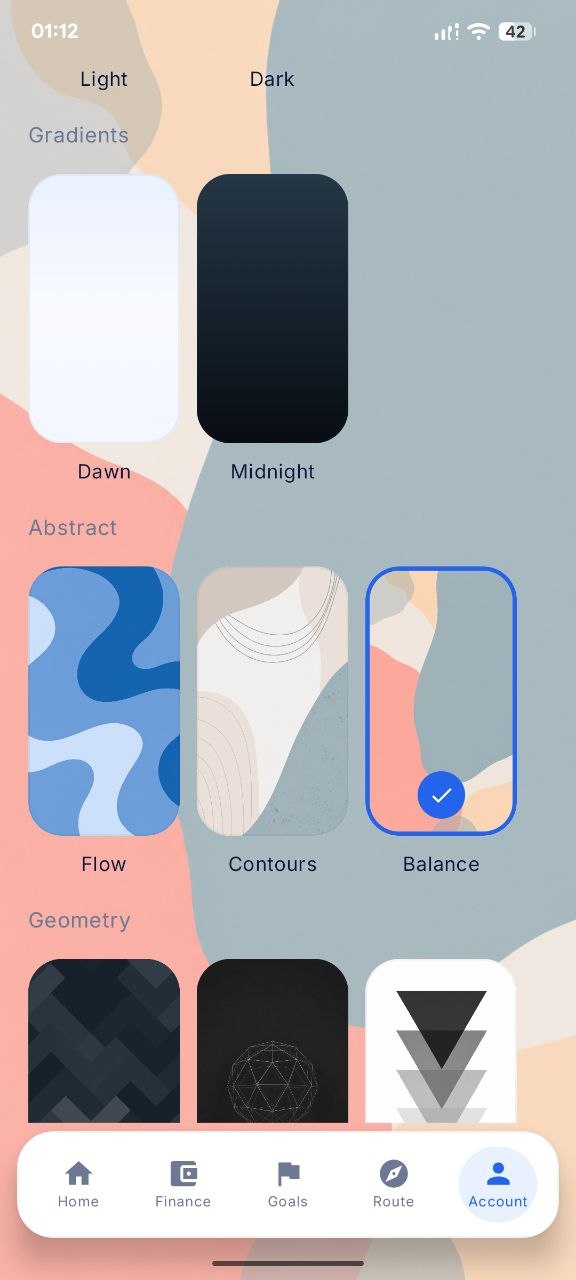
Appearance

Compass — Navigate Your Future
A goal-first AI financial navigator that turns financial ambitions into a clear, trackable route.
Most personal finance apps answer one question: “Where did my money go?”
Compass answers a different one:
“How can I reach my financial goal faster?”
Compass helps people turn goals such as buying an apartment, purchasing a car, paying for education, or building a safety fund into a practical savings plan. Instead of showing abstract budgets alone, it connects a monthly savings pace to the most valuable resource: time.
Inspiration
The project started with a simple personal question: how long do I need to save for an apartment?
Answering it turned out to be surprisingly difficult. Knowing the apartment price is not enough: the forecast also depends on current savings, income, recurring expenses, and how much a person can realistically save every month. Existing finance apps are good at recording past transactions, but they rarely show a clear path from today’s financial position to a future goal.
We wanted to build something more useful than another expense tracker. Compass became a personal financial navigator: a product that shows not only where money went, but where the user is going and what can bring the destination closer.
What It Does
The user goes through an onboarding flow powered by AI.
At this stage, they enter all the important information — from their regular income to their current savings.
Based on this information, Compass calculates the most suitable route and presents it in a way that is easy to understand. It also shows how much time it will take to reach the goal.
The user can add, remove, or change any financial parameter and immediately see the updated timeline.
The Main Feature
The user does not have to fill everything in the old-fashioned way by adding every income source manually.
A short text description of their regular income is enough for the AI to handle the rest.
Progress
Progress is the core idea of the app.
Compass shows the user:
- where they currently are;
- how much they have saved this month;
- how much is still left to reach their goal.
The user logs their savings, and every new entry moves them further along their route toward the goal.
How We Built It
Backend
Since our team mainly consists of backend developers, this was where we had the strongest expertise.
We focused on building a reliable foundation that would let us launch quickly, test the idea, and continue evolving the product later.
Android App
Compass’s primary client is a native Android application.
Since we did not have a dedicated Android developer or designer, AI played an important role in helping us build the interface, explore ideas, and iterate faster.
Landing Page
The landing page is Compass’s public entry point, where users can learn about the product and download the Android app.
We kept it simple and focused on making the product easy to understand and accessГкд.
Link: https://getcompass.dpdns.org
AI Usage
AI was part of every stage of the project:
- shaping and narrowing the original product idea;
- assisting with backend implementation, where we reviewed every change using our own expertise;
- helping build the Android application, where we had much less experience;
- supporting UI exploration and content creation;
- powering Compass features such as turning natural-language descriptions into structured income, expense, and goal data.
The level of trust varied by area. On the backend, AI worked as a fast engineering partner under close review. On Android, it acted more like a specialist teammate and helped us cross a knowledge gap that otherwise could have blocked the product.
Challenges We Ran Into
Building Mobile Without a Mobile Developer
We are backend engineers, but Compass clearly needed a mobile-first experience. Learning Android patterns, Compose state management, and mobile UX while building the product was one of our biggest challenges.
Time and Architectural Trade-offs
We wanted to deliver as quickly as possible. That forced us to make deliberate trade-offs in architecture, infrastructure, and scalability. The challenge was not to build the most sophisticated system, but to find the simplest design that could still support a credible, high-quality product.
Product Vision
We started with too many ideas: AI-generated goals, transaction imports, scenario simulation, coaching, recommendations, and long-term financial planning. Because there is no obvious direct equivalent to Compass on the market, there was no established product template to copy. At times, the possibilities blurred the core experience even for us.
We eventually centered the MVP around one question: what is the clearest next step that moves the user closer to their goal?
Accomplishments We’re Proud Of
- We delivered a working product in a very short timeframe.
- We built an end-to-end experience across backend, Android, and web.
- We created an Android app we genuinely find beautiful, despite having neither a dedicated designer nor an Android developer on the team.
- We turned a broad financial-planning idea into a focused, understandable user journey.
- We used AI not as a demo feature added at the end, but as both a product capability and a core part of our development workflow.
What We Learned
The first major lesson was that microservices are not automatically the right starting point. For a proof of concept, a well-structured monolith can provide excellent code quality, faster delivery, simpler operations, and enough room to scale through the product’s early stages.
The second lesson was how far AI-assisted engineering has progressed. AI is no longer useful only for boilerplate while a developer watches every line. Our Android application showed us that, with clear product direction and continuous validation, AI can help a team deliver surprisingly solid work in a domain where it has little prior expertise.
Finally, we learned that product focus is harder than technical implementation. The strongest version of Compass emerged only after we stopped trying to solve all of personal finance and committed to helping users navigate toward one concrete goal.
What’s Next for Compass
- collect feedback from our first users;
- add AI-powered expense optimization that connects a specific spending change to the number of months it can save on the route;
- add scenario simulation for changes such as a salary increase, lower expenses, a bonus, or an unexpected purchase;
- publish the Android application on Google Play;
- build an iOS application and release it on the App Store;
- continue developing the product and explore investment opportunities;
- expand financial integrations without losing the goal-first experience.
- evolve Compass into an AI-powered financial coach that helps users make better decisions and stay on track toward their goals.
Our Vision
Compass is not about judging how people spend their money. It is about making trade-offs visible.
We want every user to understand what their goal requires, choose a route that fits their life, and see how today’s decisions affect tomorrow’s arrival date.
Do not just track your money. Track your time. Navigate your future.
Built With
- android
- backend
- chatgpt-5.6
- java
- javascript
- jetpackcompose
- kotlin
- postresql
- spring


Log in or sign up for Devpost to join the conversation.