-
-
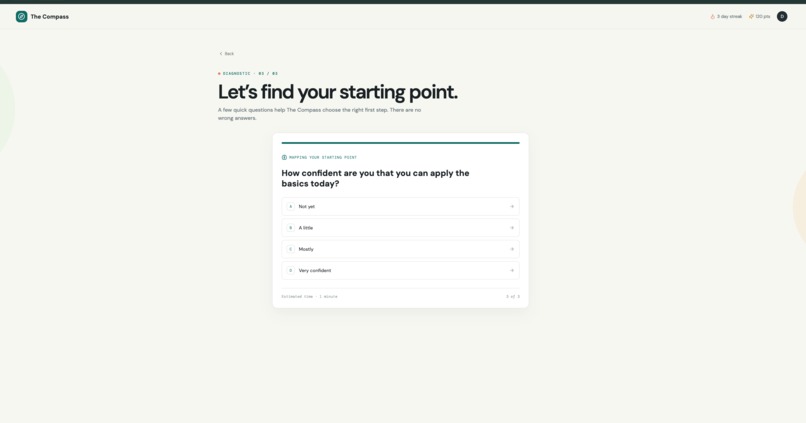
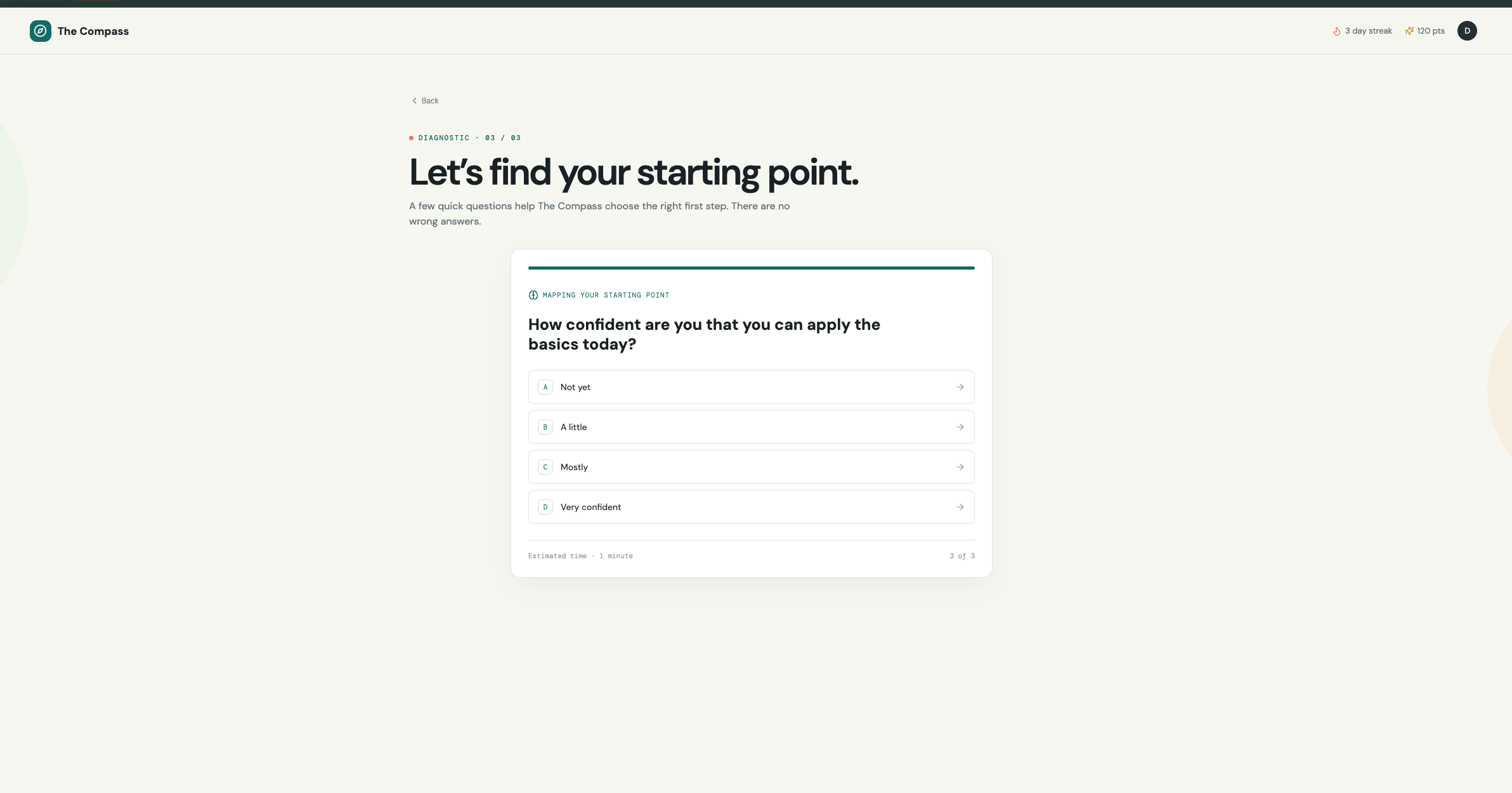
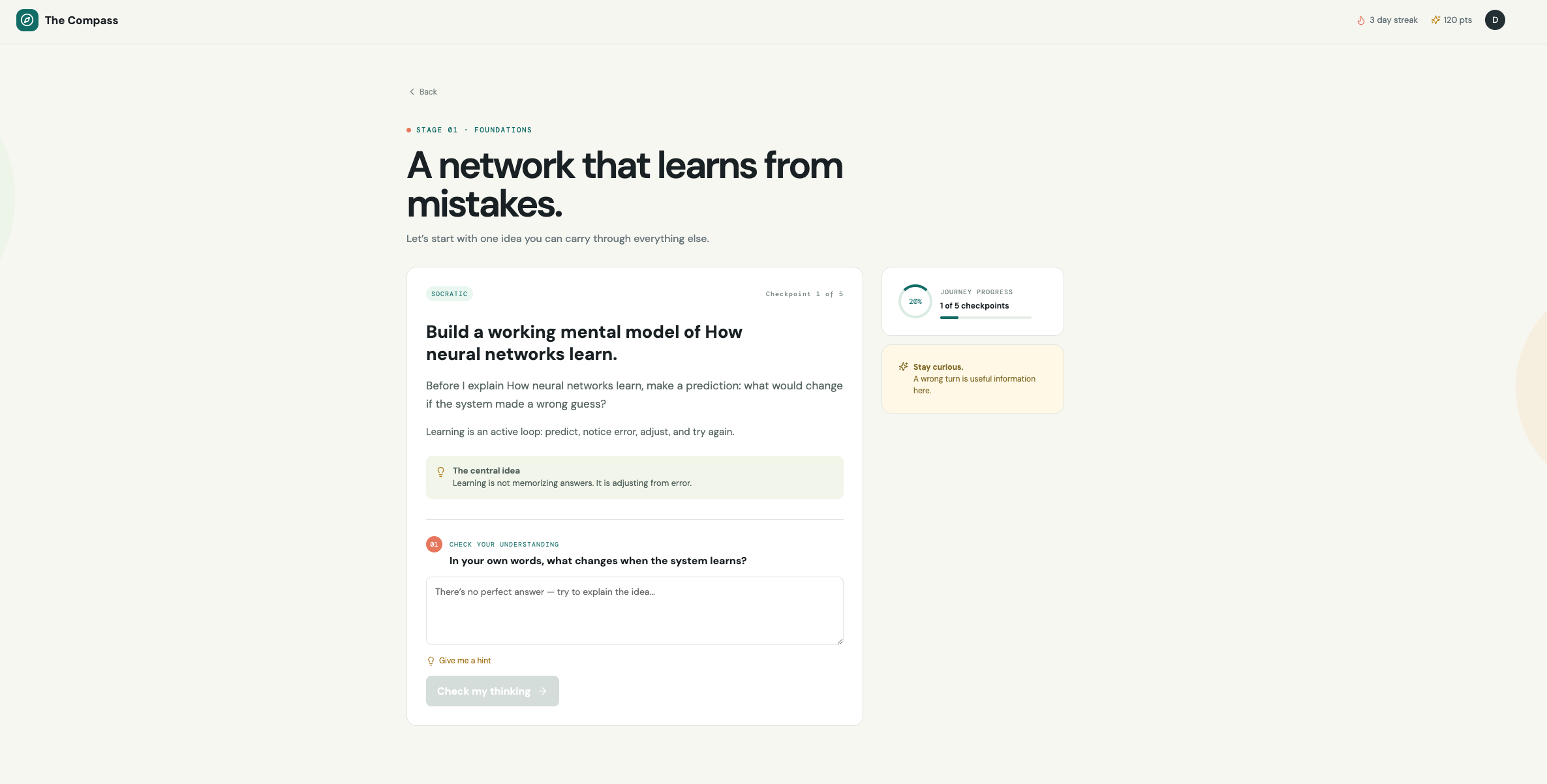
Let’s find your starting point.
-
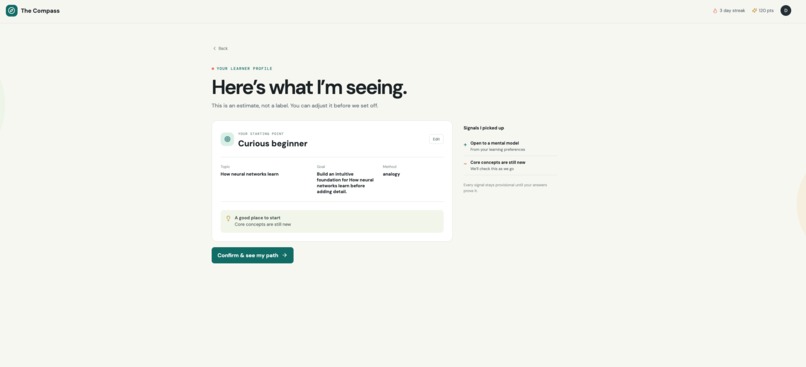
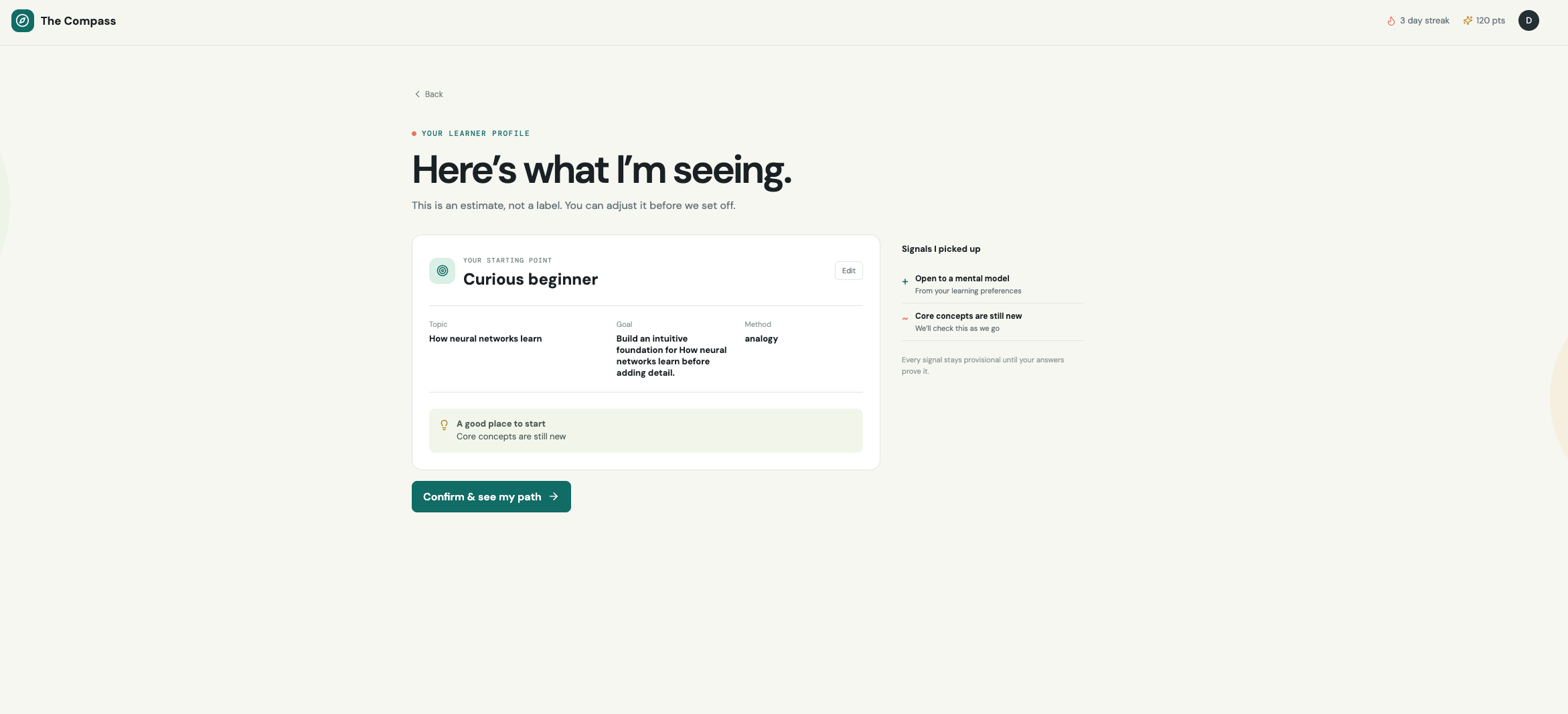
YOUR LEARNER PROFILE
-
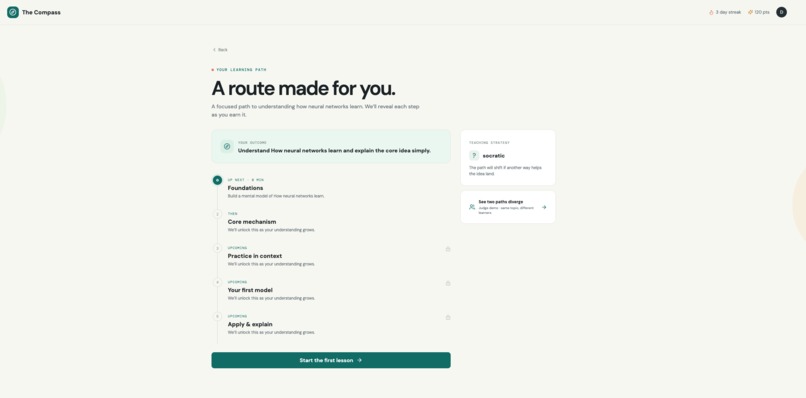
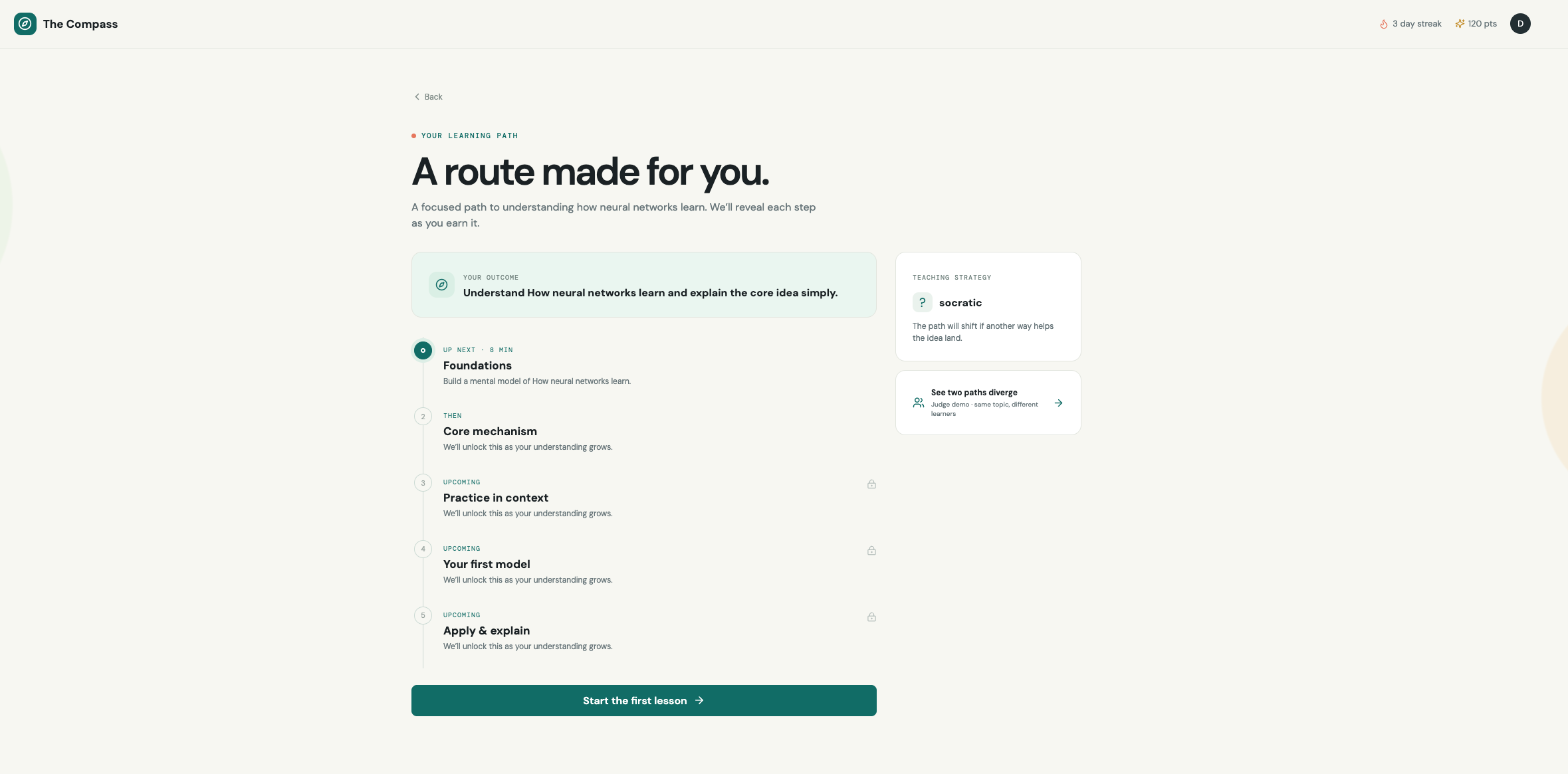
YOUR LEARNING PATH. A route made for you.
-
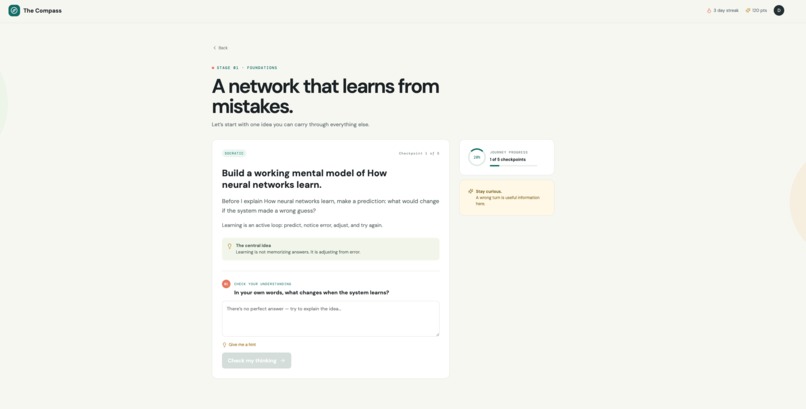
JOURNEY PROGRESS with Checkpoints
-
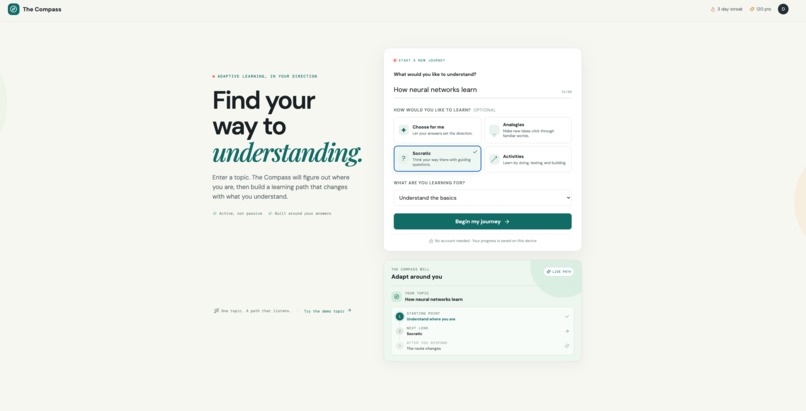
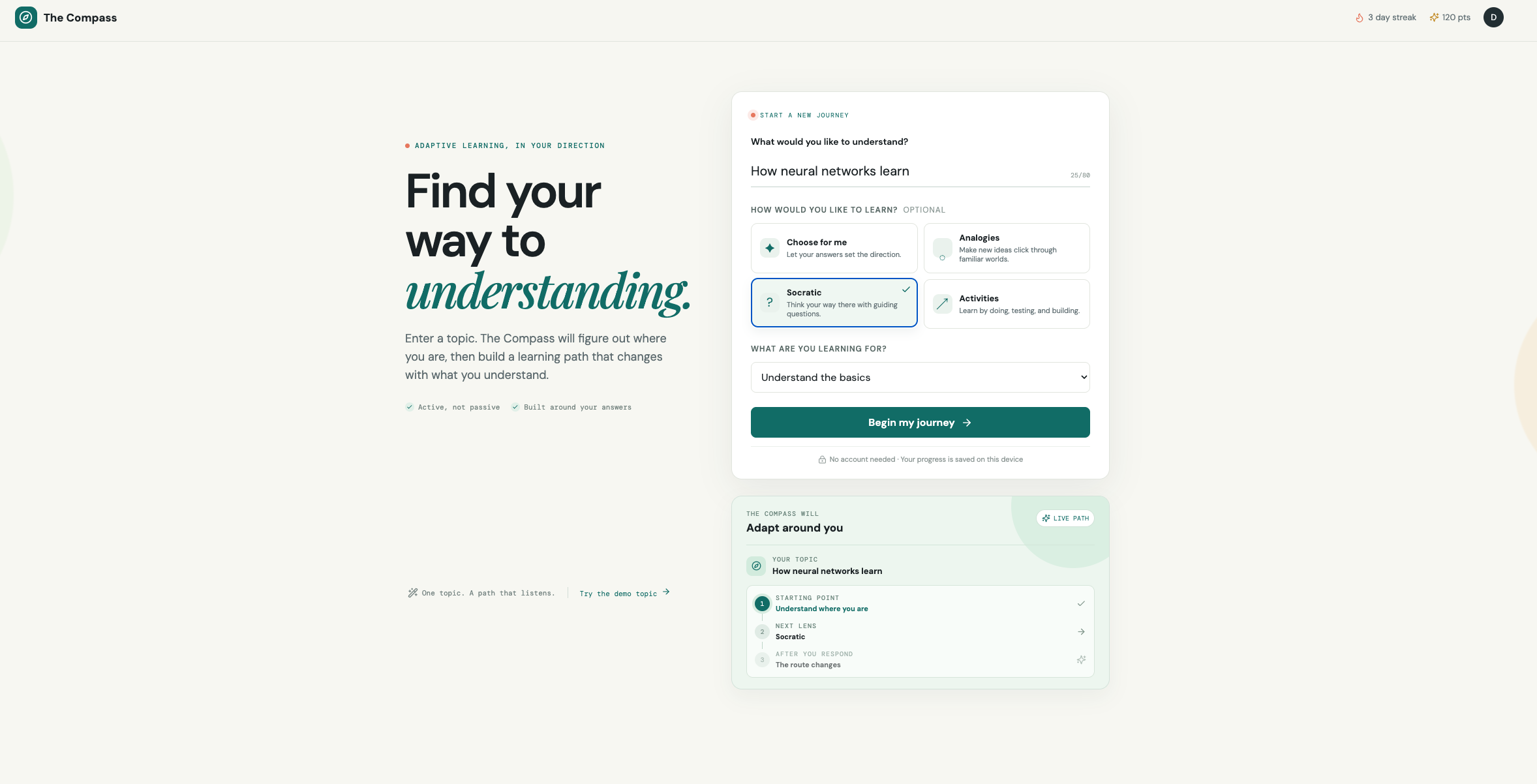
Enter a topic. The Compass will figure out where you are, then build a learning path that changes with what you understand.
Inspiration
Most learning platforms treat every learner the same.
They provide the same videos, explanations, exercises, and sequence regardless of what a learner already knows, where they are struggling, or how they understand information best.
But people do not learn in the same way. One learner may understand a concept through an analogy, another through guided questions, and another only after completing a practical activity.
We were inspired by a simple question:
What if an AI learning system could decide not only what a person should learn next, but also how they should learn it?
That question became The Compass—an adaptive learning system designed to guide each learner through a different path based on their goal, existing knowledge, responses, misconceptions, and demonstrated progress.
Just as a compass changes direction based on your current position and destination, The Compass continuously adjusts the learning journey based on where the learner is and where they want to go.
What it does
The Compass transforms any topic into a personalized, interactive learning journey.
The learner begins by entering a topic. They may optionally choose a preferred learning method:
- analogy-based learning;
- Socratic, question-led learning;
- activity-based learning;
- or “Choose for me,” allowing the system to recommend an approach.
The Compass then conducts a short diagnostic to estimate the learner’s existing knowledge, goal, strengths, gaps, and appropriate starting point.
From that information, it creates a personalized roadmap and begins teaching one concept at a time.
Each learning step may contain:
- concise theory;
- simple explanations;
- analogies;
- practical examples;
- guided questions;
- interactive activities;
- hints;
- knowledge checks;
- reflection;
- immediate feedback.
The learner is actively engaged throughout the journey rather than passively reading a long AI-generated lesson.
After every meaningful response, The Compass evaluates the learner’s:
- factual understanding;
- conceptual understanding;
- reasoning;
- practical application;
- confidence;
- possible misconceptions.
It then selects the most useful next action, such as:
- continuing to the next concept;
- simplifying the explanation;
- increasing the difficulty;
- presenting another example;
- switching learning methods;
- revisiting a prerequisite;
- inserting a corrective micro-lesson;
- or providing a practical exercise.
Most importantly, The Compass explains why the learning path changed.
For example:
You understand the definition, but your response suggests difficulty applying it in a real scenario. Your next step will use an interactive activity instead of additional theory.
This visible course correction is the core of the product.
Traditional courses give everyone the same route. The Compass changes direction based on what each learner actually understands.
How we built it in 2-hours using Codex GPT-5.6
We designed The Compass as an adaptive learning system rather than a general-purpose educational chatbot.
The application is being built as a responsive web platform using:
- Next.js;
- React;
- TypeScript;
- Tailwind CSS;
- PostgreSQL;
- Prisma;
- Supabase;
- OpenAI APIs;
- Vercel.
The system uses several focused AI modules with clearly separated responsibilities:
Diagnostic Planner
Generates a short topic-specific diagnostic to determine the learner’s current level, goal, and likely knowledge gaps.
Learner Profiler
Converts diagnostic responses into a structured learner profile containing estimated level, strengths, gaps, prerequisites, and recommended learning method.
Curriculum Planner
Creates a concise roadmap with ordered stages, concepts, learning objectives, and an appropriate starting point.
Lesson Generator
Generates a lesson using the active teaching method: analogy-based, Socratic, or activity-based.
Response Evaluator
Evaluates the learner’s answer against a structured rubric. It considers correctness, reasoning, conceptual understanding, and practical application rather than relying only on keyword matching.
Misconception Detector
Identifies possible misunderstandings, missing prerequisites, or difficulties applying the concept.
Adaptation Engine
Combines model recommendations with controlled server-side rules to decide what learning experience should happen next.
Instead of depending on a long conversation history, The Compass maintains structured learner state, including:
- current topic and goal;
- estimated level;
- roadmap position;
- concept mastery;
- recent assessment evidence;
- learning-method preference;
- active misconceptions;
- adaptation history.
AI responses are generated using structured output schemas and validated before being stored or applied. The final adaptation is controlled by application logic so the learning path does not change randomly.
The main learning loop is:
Topic → Diagnostic → Learner profile → Roadmap → Lesson → Interaction → Evaluation → Adaptation → Next lesson
For the hackathon demonstration, we are also creating a comparison experience in which two learners study the same topic but receive different lessons and next steps based on their profiles and responses.
Challenges we ran into
Making the product more than an AI course generator
The first major challenge was differentiation.
Generating a course, explanation, or quiz with AI is no longer enough. We needed the product to demonstrate actual learner awareness and adaptation.
We addressed this by making the learner model, assessment evidence, misconception detection, and course-correction explanation central to the experience.
Evaluating understanding reliably
Learners can express correct ideas using many different words. Exact-answer matching would reject valid responses, while unrestricted AI evaluation could produce inconsistent results.
We designed rubric-based evaluation across multiple dimensions and added explicit uncertainty handling. Partially correct answers can receive partial credit, while uncertain evaluations trigger clarification instead of aggressive changes to the roadmap.
Preventing random adaptation
An AI model can recommend a next step, but accepting every recommendation directly would make the learning journey unpredictable.
We introduced a controlled adaptation policy. Model recommendations are checked against deterministic rules, confidence thresholds, recent learner evidence, supported methods, and valid roadmap concepts before being applied.
Supporting any topic without becoming too broad
The vision is to support any learning topic, but the MVP still needs a focused and reliable experience.
We addressed this by keeping the learning workflow topic-independent while using a carefully prepared demonstration topic and fallback content for the main hackathon experience.
Balancing personalization with simplicity
Deep personalization can require long onboarding questionnaires, but that would increase friction.
The Compass uses only a topic, an optional learning-method choice, a learning goal, and a short diagnostic. The rest of the learner profile develops through actual interaction.
Creating meaningful gamification
We did not want to reward learners simply for clicking through content.
The product instead connects progress and rewards to meaningful actions such as demonstrating understanding, correcting a misconception, completing a checkpoint, and maintaining consistency.
Accomplishments that we're proud of
We are proud that The Compass has a focused identity beyond being another AI tutor.
Its central innovation is a visible adaptive-learning loop that connects:
- learner evidence;
- structured evaluation;
- misconception detection;
- controlled course correction;
- transparent explanations.
We are also proud of the decision to treat every learner response as evidence that updates an explicit learner model.
The strongest product moment is the ability to show two people learning the same topic through completely different journeys.
One learner may receive an analogy and a visual explanation. Another may receive a practical debugging challenge. Both paths are generated from the same topic but reflect different goals, knowledge levels, responses, and weaknesses.
Other accomplishments include:
- supporting three structurally different learning methods;
- designing short diagnostics instead of lengthy onboarding;
- evaluating partial understanding rather than only right or wrong answers;
- explaining every meaningful learning-path adjustment;
- separating AI recommendations from server-controlled adaptation;
- designing a minimal, low-distraction interface;
- creating a reusable architecture that can later support teachers, schools, companies, and multiple subject areas.
Most importantly, we transformed a broad ambition—changing how people learn—into a focused, demonstrable product.
What we learned
We learned that personalization is not simply changing the wording of an explanation.
Real personalization requires the system to understand:
- what the learner already knows;
- what they misunderstood;
- what evidence supports that conclusion;
- what teaching approach was used;
- whether that approach worked;
- what experience should happen next.
We also learned that an AI-generated answer is not the product. The product is the decision loop around that answer.
The most valuable part of The Compass is not lesson generation. It is the repeated question:
What does this learner understand now, and what is the best learning experience to give them next?
We learned that transparency is essential for trust. Learners should not feel that an invisible algorithm is randomly changing their curriculum. They should be able to understand what the system observed and why it changed direction.
We also learned that smaller, focused AI workflows are more controllable than one large autonomous agent. Separate modules, structured outputs, evaluation rubrics, and deterministic policies make the system easier to test, debug, and explain.
Finally, we learned that meaningful educational gamification should reward learning—not attention, time spent, or repeated clicking.
What's next for The Compass
The next step is to improve The Compass from a single-session adaptive learning experience into a long-term learning operating system.
Source-grounded learning
The Compass will be able to build journeys from:
- trusted educational sources;
- teacher-provided materials;
- uploaded books and documents;
- company knowledge bases;
- approved curricula.
Lessons will include citations and source-aware factuality checks.
Long-term learner memory
The system will maintain a learner’s evolving knowledge across topics and sessions.
This may include:
- a personal knowledge graph;
- prerequisite relationships;
- long-term mastery evidence;
- recurring knowledge checks;
- spaced repetition;
- forgotten-concept detection;
- cross-topic skill connections.
Multimodal learning
Future learning journeys may include:
- generated diagrams;
- interactive visualizations;
- voice conversations;
- audio explanations;
- image-based activities;
- learner sketches;
- simulations;
- code execution;
- hands-on projects.
Teacher tools
Teachers will be able to define learning outcomes, approve sources, create class journeys, review misconceptions, and identify students who may need intervention.
The Compass is not intended to replace teachers. It can give teachers a clearer view of how each learner is progressing and where support is needed.
Professional and organizational learning
Companies could use The Compass for:
- employee onboarding;
- technical upskilling;
- compliance education;
- product training;
- role-based learning paths;
- internal knowledge transfer.
Accessibility and language support
Future versions will provide:
- multilingual learning;
- voice-first navigation;
- adjustable reading complexity;
- accessibility preferences;
- alternative content formats;
- culturally relevant examples and analogies.
Collaborative learning
Learners may eventually:
- explain concepts to peers;
- complete group challenges;
- compare reasoning;
- receive peer feedback;
- work through shared projects.
Our long-term vision is for The Compass to become a learning layer that can guide any person from their current understanding toward a meaningful destination—without forcing every learner to follow the same route.
Built With
- nextjs
- openai
- supabase
- tailwind
- typescript
- vercel

Log in or sign up for Devpost to join the conversation.