-
-
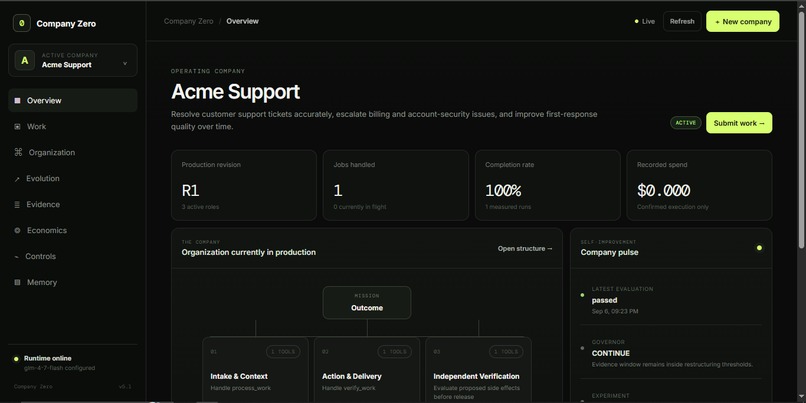
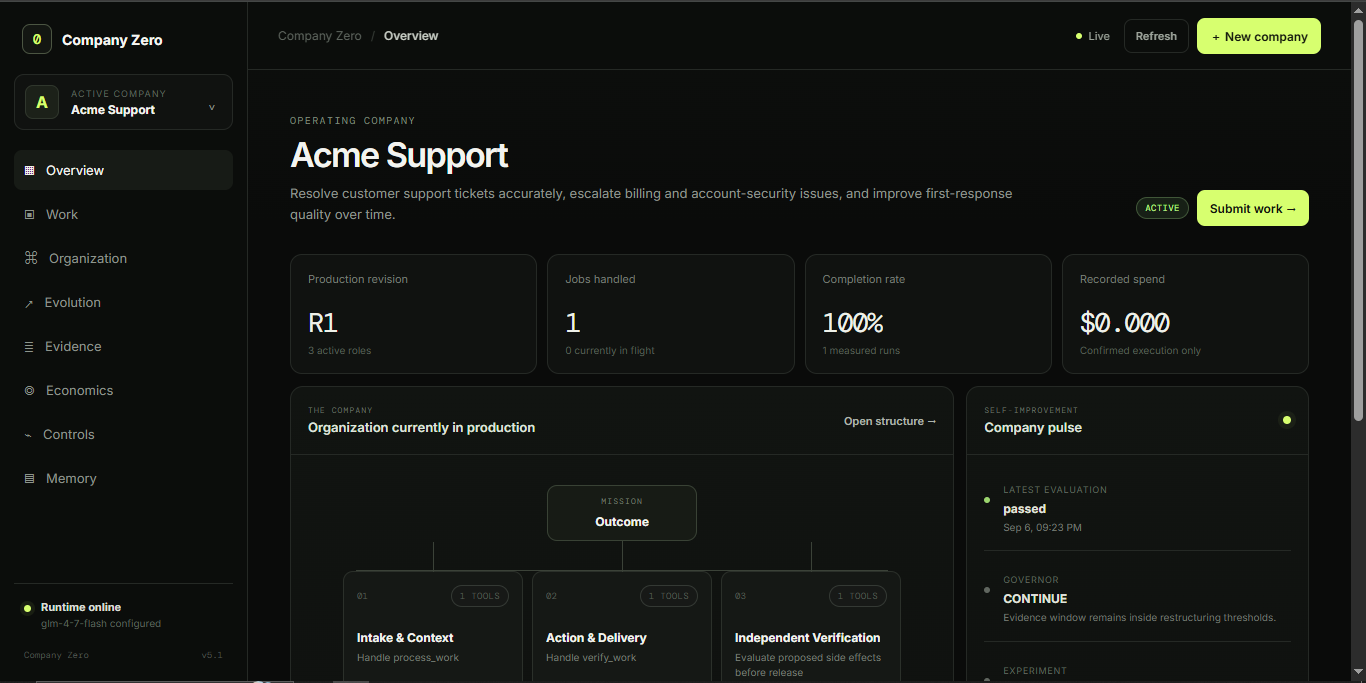
Overview
-
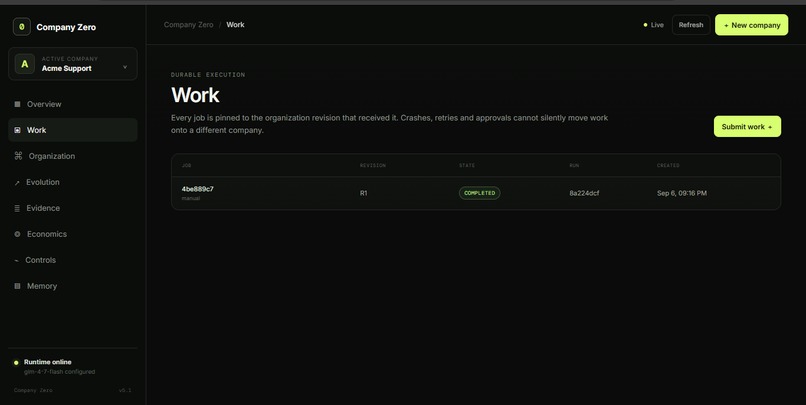
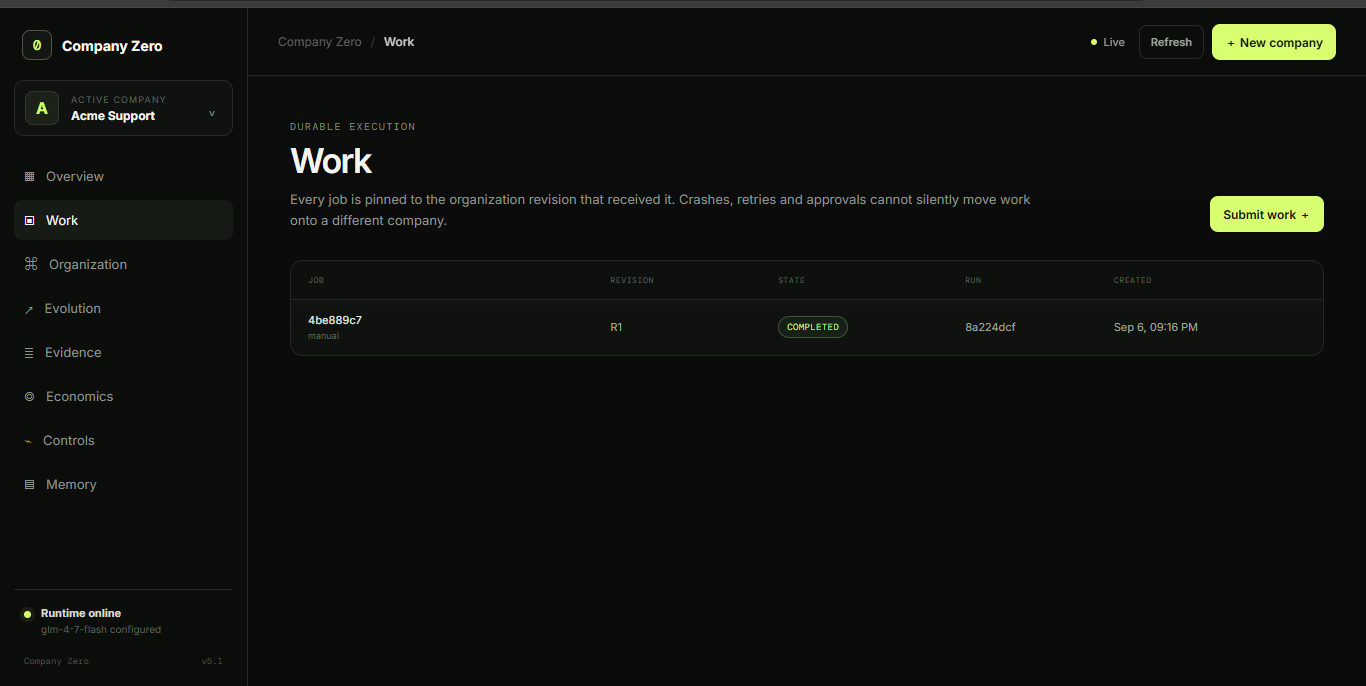
Work
-
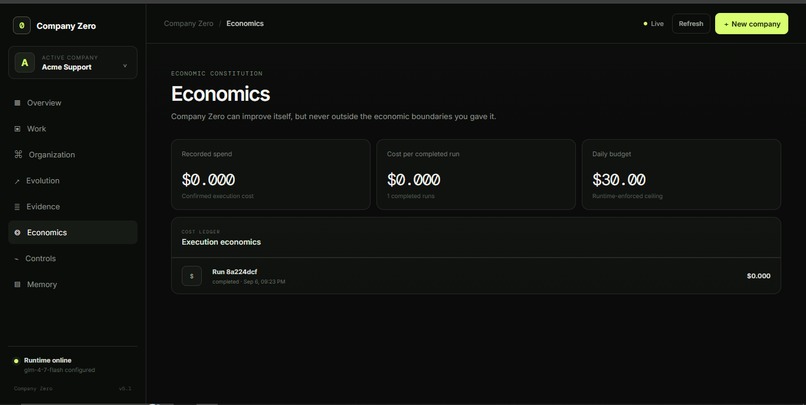
Economics
-
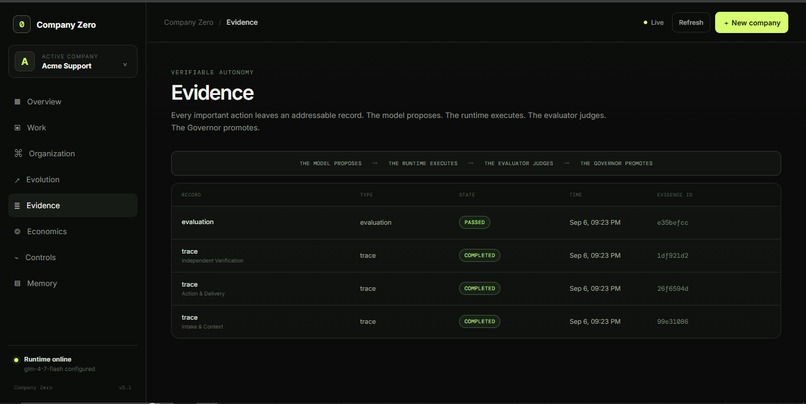
Evidenc
-
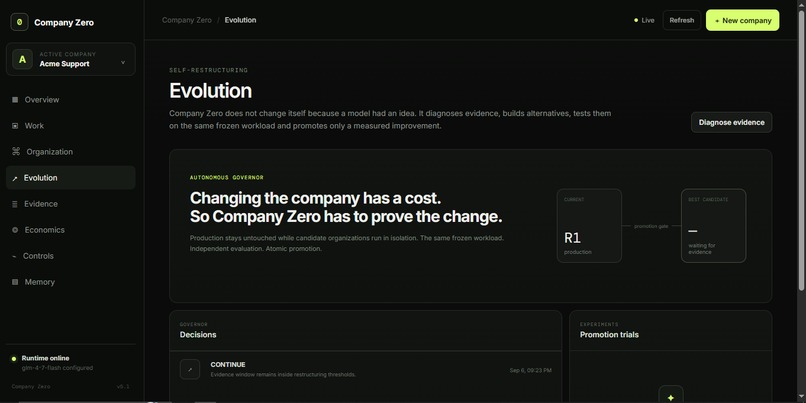
Evolution
-
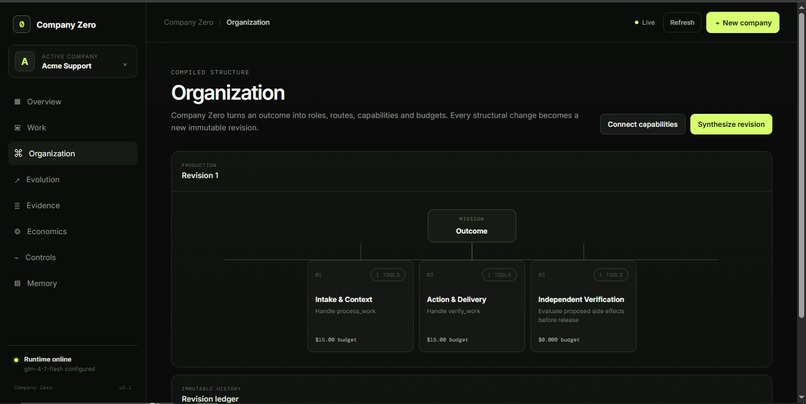
Organization
Inspiration
Most agent systems begin with a fixed team and try to improve the agents inside it.
Company Zero asks a different question:
What if the organization itself could learn when its structure is wrong?
What it does
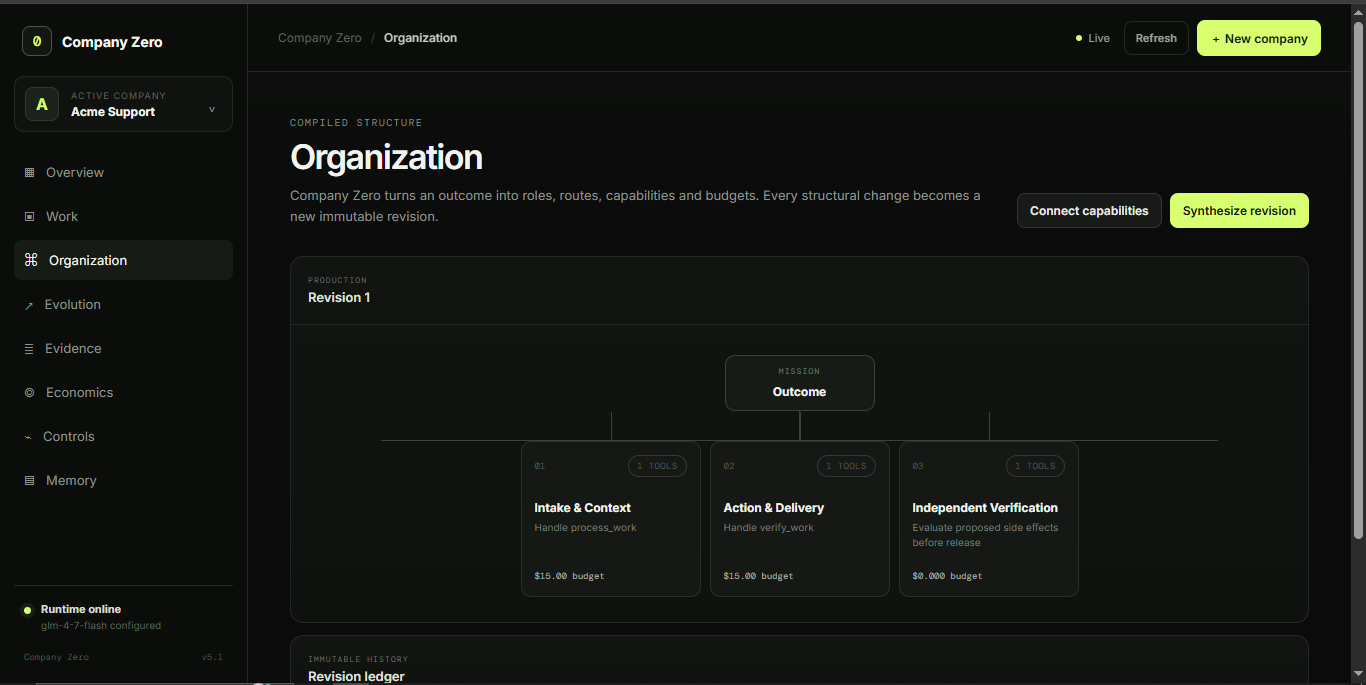
Give Company Zero an outcome, a budget and a set of capabilities.
It designs an AI organization, sends real work through it and evaluates every result against a clear operating contract.
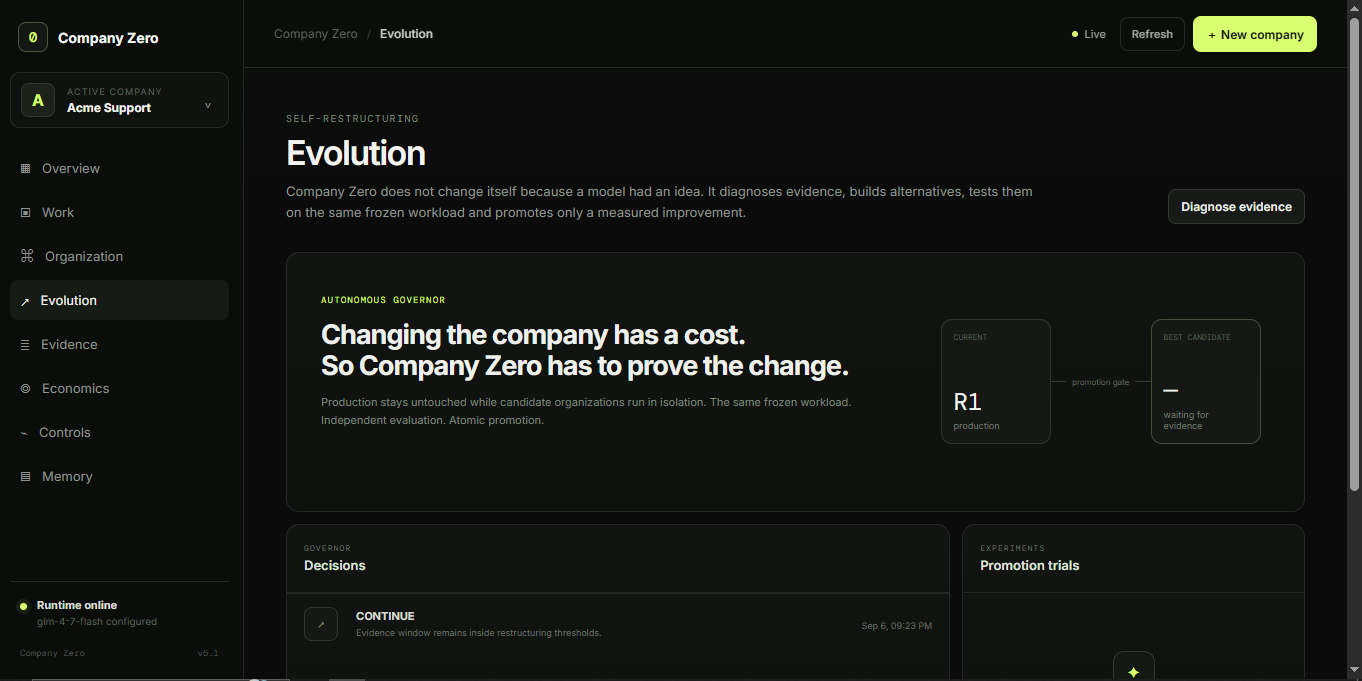
When failures become repeated rather than accidental, Company Zero:
- freezes the workload that exposed the problem
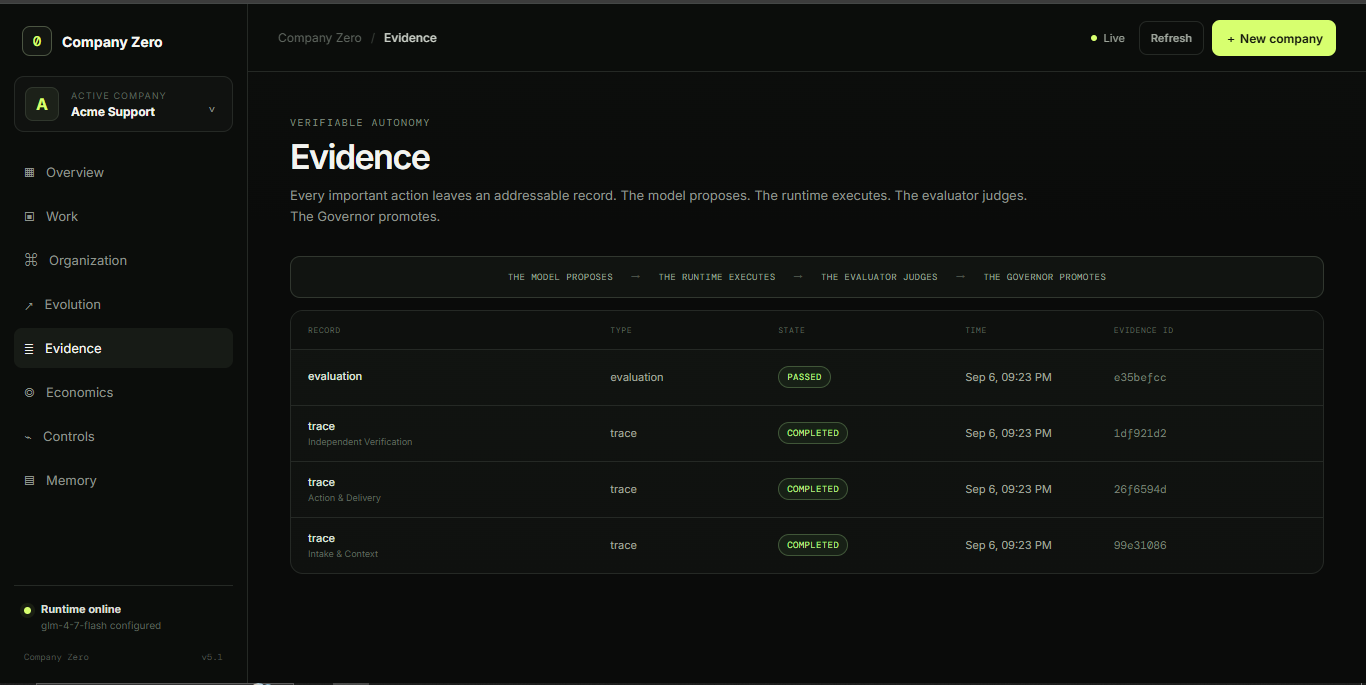
- diagnoses the failure from persisted evidence
- creates three alternative organizations
- tests every candidate against the same cases
- compares quality, cost, latency and reliability
- promotes a candidate only when the evidence proves it is better
The next production job automatically uses the improved organization.
The result
In our end-to-end test, the original organization failed all three production cases.
The Governor detected the pattern and tested three alternatives. The winning candidate added independent verification and improved quality from:
0/3 → 3/3
That is a 100-point quality improvement with no increase in cost.
Only then was the candidate promoted to production.
How we built it
Company Zero is backed by a durable Node.js control plane.
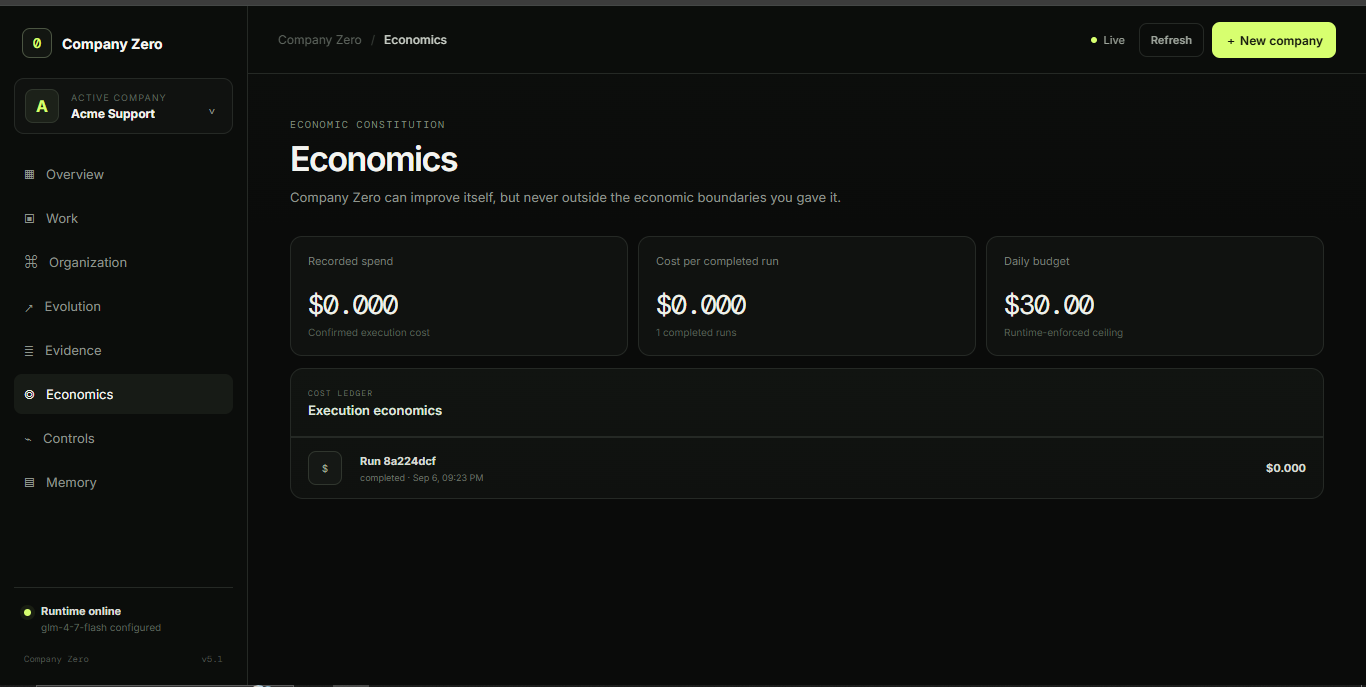
It includes revision-pinned jobs, leased workers, crash recovery, frozen experiment datasets, transactional budgets, resumable human approval, append-only rollback and atomic promotion.
The central rule is:
The model proposes. The runtime executes. The evaluator judges. The Governor promotes.
A model cannot simply claim that its new organization is better.
How AO was used
AO was used throughout the hackathon to design, implement, test and strengthen Company Zero.
I split the work into focused AO sessions covering architecture, durable execution, approval safety, experiments, promotion correctness, adversarial testing and product usability.
During final verification, AO helped uncover nondeterministic capability ordering. We fixed the underlying cause and verified the complete autonomous lifecycle through 20 consecutive runs.
AO sessions used
The demo shows the AO dashboard, session history and the working product from failure detection through production promotion.
Challenges
The hardest part was making self-improvement real instead of scripted.
We had to handle concurrent workers, duplicate remediation, failed leases, budget races, approval pauses, uncertain external writes and competing promotion attempts.
Each failure mode became an invariant and an acceptance test.
What we learned
Useful autonomy is not unlimited model freedom.
It is the ability to adapt inside clear, durable and measurable boundaries.
What’s next
Next, we want to connect more real capability providers and operate longer-running companies against changing workloads.
Built With
- agents
- ai
- ao
- api
- mcp
- neatlogs
- next.js
- node.js
- postgresql
- react
- rest
- supabase
- tensormux
- typescript
- vercel

Log in or sign up for Devpost to join the conversation.