Companion: "Agentic" Mental Health Support System
Because getting help shouldn't be harder than ordering a taxi.
# Inspiration
We live in a world where you can summon a car or order food in 30 seconds, but finding a therapist during a mental health crisis takes weeks of phone tag, broken directories, and "out of network" voicemails.
The "Administrative Wall" of Mental Health: For many—whether they are stressed students or burnt-out professionals—the barrier to help isn't just stigma; it's logistical exhaustion. When you are already drowning in anxiety, the executive function required to find, vet, and book a doctor is simply not there.
I wanted to flip the model from Reactive (waiting for you to crash) to Proactive. I didn't have a co-founder, so I built a team of three AI agents to do the heavy lifting: Echo, Spark, and Anchor. They act like that one friend who doesn't just ask "Are you okay?" but actually says "I found you a doctor, and I booked the appointment for Tuesday."
What it does
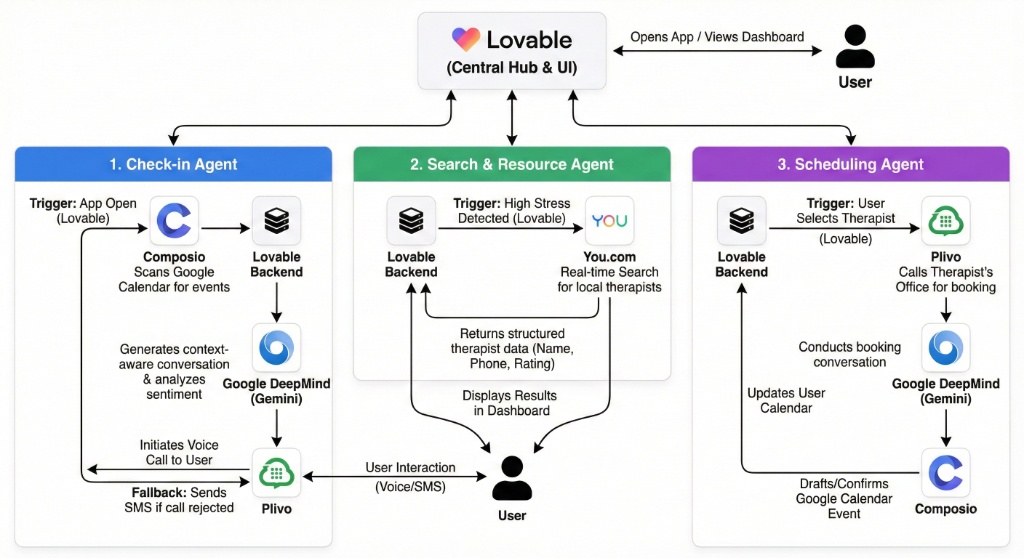
Ember is a unified system of three specialized AI agents that work 24/7 to manage your mental well-being:
1. Echo (The Check-In Agent)
- Proactive Detection: Echo doesn't wait for you to log in. It uses Composio to scan your Google Calendar for "high-stress patterns" (like back-to-back meetings or exam weeks).
- Empathetic Voice: When stress is detected, Echo triggers a Plivo voice call to check in on you. It’s not a chatbot; it’s a warm voice asking how you’re feeling.
- Sentiment Analysis: Your conversation is analyzed by Google Gemini to detect burnout or crisis markers, creating a "Mood Summary" without you needing to journal.
2. Spark (The Research Agent)
- Instant Discovery: If Echo detects a need for professional help, Spark activates.
- Deep Search: Using You.com’s API, Spark scours the live web for local therapists, filtering by availability, rating, and specialization.
- No More Doom-Scrolling: Instead of 500 blue links, Spark presents you with the top 3 verified options that actually match your needs.
3. Anchor (The Scheduling Agent)
- The "Closer": Once you select a provider, Anchor takes over.
- Autonomous Booking: Anchor uses Plivo to physically call the clinic’s front desk. It speaks with the receptionist, negotiates a time that fits your schedule, and confirms the booking.
- Calendar Sync: Once confirmed, Anchor uses Composio to instantly lock the appointment into your Google Calendar.
How we built it
Ember was built by a solo developer using Lovable to orchestrate a complex multi-agent system. I treated my agents as my engineering team:
- Echo (Check-In Logic): Built using Plivo's AI Voice Platform. I designed Echo's personality to be warm and non-intrusive. It uses Composio triggers to "watch" the Google Calendar for stress signals.
- Spark (Research Logic): Built using You.com API. Spark is designed to ignore SEO-spam and find verified health data. It feeds structured JSON data back to the Lovable dashboard.
- Anchor (Booking Logic): The most complex agent. Anchor uses Google Gemini (DeepMind) to generate real-time conversational responses during the phone call. It uses Plivo to make the call and Composio to write the final event to the user's calendar.
- The Orchestrator: The entire dashboard and backend logic were generated via Lovable, allowing me to connect these disparate APIs (Voice, Calendar, Search, LLM) without writing boilerplate code.
Challenges we ran into
- The "Solo" Factor: Building a full-stack, multi-agent app alone in a hackathon is daunting. I had to rely heavily on Lovable's speed to iterate on the UI/UX.
- Voice Latency: Making the AI conversation feel natural (and not robotic) was tough. We had to optimize the Plivo and Gemini handshakes to ensure the agents responded instantly.
- The "Phone Tag" Logic: Teaching the Anchor agent how to handle a receptionist saying "no availability" required complex prompt engineering. We had to give it "negotiation skills" rather than just a script.
Accomplishments that we're proud of
- Agent Specialization: Instead of one generic AI, creating three distinct "personalities" (Echo, Spark, Anchor) that work together seamlessly.
What we learned
- AI Needs "Tools": An LLM is smart, but an LLM with Composio and Plivo is powerful. Giving agents the ability to "do" things (call, book, search) changes the game.
- Context is King: The most valuable data for mental health isn't what the user says, but what their schedule looks like.
- Lovable is a Force Multiplier: I built what looks like a 4-person team project by myself because Lovable handled the glue code.
What's next for Ember
- Insurance Verification: Adding a step for Spark to call insurance providers and verify coverage before suggesting a doctor.
Built With
- composio
- lovable
- plivo
- you

Log in or sign up for Devpost to join the conversation.