Inspiration
Thinking about the theme of “vacation,” we realized how often people lose crucial items like keys, phones, or wallets during travel. This led us to create a solution: a compact GPS tracker that ensures peace of mind on the go.
What it does
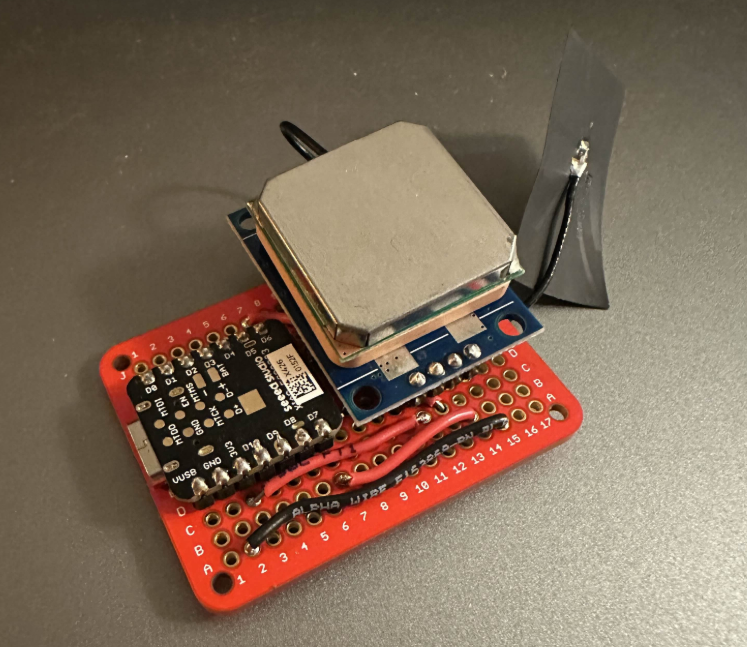
Our device transmits its own GPS coordinates to a local web server which can be viewed by any device connected to the same network on a webpage. The webpage displays a map with a pin showing the device's GPS coordinates.
How we built it
With a clear goal, we broke the project into manageable tasks. First was hardware selection: after researching GPS modules and microcontrollers, we chose the XIAO Esp32S3 for its small size and the NEO-6M GPS module for its accuracy within our budget. Second was coding: we programmed the tracker to display GPS data on a mobile app. Challenges included optimizing power consumption and understanding the libraries used. Lastly, assembly: We soldered the components and plan to design a 3D-printed compact enclosure to house the device. Each stage presented challenges, from selecting components amidst numerous options to debugging the software and ensuring reliability. Research, persistence, and teamwork were key to overcoming these hurdles.
Challenges we ran into
As a team of first-time project builders, we were both excited and overwhelmed by the freedom to choose our project. With backgrounds in electrical, mechanical, and computer science engineering, none of us had prior experience working across disciplines. At first, we struggled with what we didn’t know—deciding what was achievable, what tools to use, and how to merge our skills. But as we researched and sought guidance, we gained more traction and confidence
Accomplishments that we're proud of
We're proud of the fact that we kept the team alive and persevered throughout the quarter as course exams and other commitments stacked up. We made sure the GPS module hardware we purchased worked properly, and that the right wire connections were made, by printing out the GPS coordinates to Serial. Next was integrating the WiFi capabilities of the Xiao ESP32S3 in order to display the coordinates on a local webserver, and finally, using a map API to display a pin. Overall, we're satisfied with what we were able to do.
What we learned
We learned about UART communication, which is how our NEO-6M GPS module communicates with our ESP32S3 in order to send and receive data. In addition, we learned about how to make use of external libraries in our code to parse the GPS data from the module, to send that data to a web page, and to visually display it as a pin on a map.
What's next
We will look forward to doing some finishing touches, such as modeling a case, as we had changed the configuration of our hardware parts several times throughout the design stage and were not able to get to that yet. In addition, we could consider designing a PCB so that we can eliminate the need for physically wiring, and also to create holes in the board that allow the WiFi and GPS antenna wires to slot through to the other side.


Log in or sign up for Devpost to join the conversation.