-
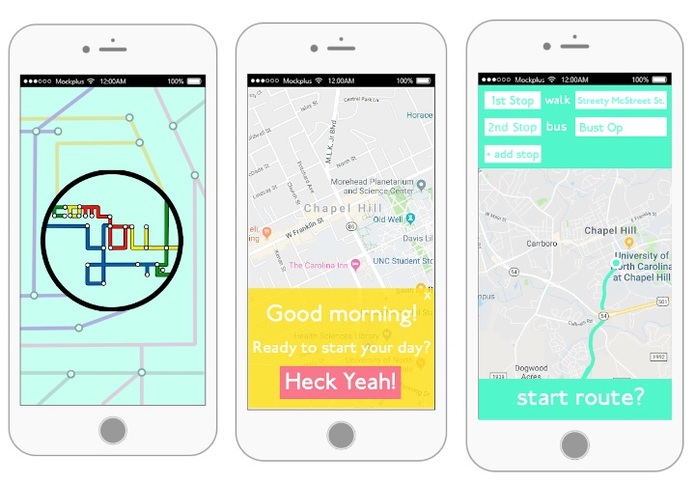
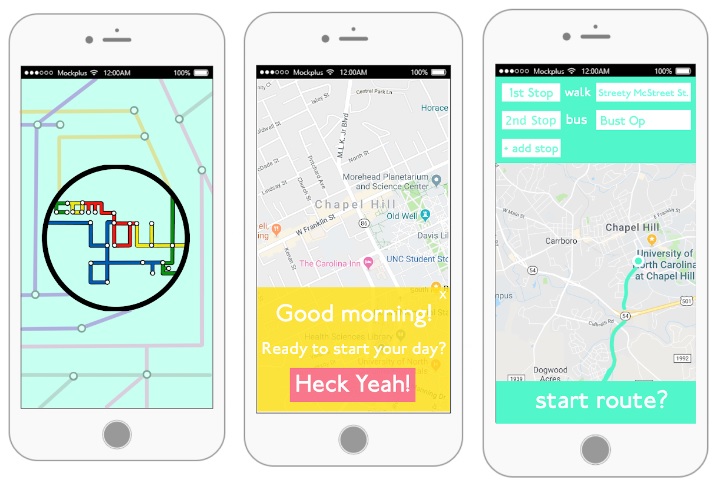
Wireframe for a mobile app version
Inspiration
It’s a well-known fact that public transit in the US is at best inconvenient and at worst, underserviced or nonexistent. In fact, the American Society of Civil Engineers has given the US a D+ in infrastructure, with transit being the main culprit for the low score. As commuters ourselves, we know these struggles firsthand: long, unsafe walks to bus stops; buses not arriving frequently enough ; disproportionately long travel times… the list goes on. These inconveniences compound into larger problems for people who rely on transit, and these problems create real barriers for vulnerable groups. A study done at Harvard University discovered that access to transit is the strongest factor in determining upward mobility for low-income families ; long, tedious commutes limit job opportunities and the cost of automobile upkeep is sometimes prohibitive for those who need access the most (Chetty and Hendren, 2015). As a society, we are also becoming increasingly aware of the negative effects that car dependency is having on our health and happiness. Work commutes are getting longer, averaging around 26.9 minutes by car (American Community Survey 2017, Census Bureau). Extended periods of time stuck sitting in cars is giving us back pain, mental stress, and contributing to a sedentary lifestyle. The environment also suffers with us, as carbon emissions continue to rise and warm up our planet. Transit is a vital part of communities and a solution to a variety of challenges that we face today as a society, yet many people cannot realistically use it because of issues with accessibility, frequency, travel time, and convenience. Public officials and transportation departments need to be aware of the problems that people in their communities are facing everyday so that targeted, efficient improvements can be made.
What it does
ComYOUte is a website that allows users to score their commutes based on factors of accessibility, frequency, travel time, and convenience. Users input their starting location and destination into a Google Map embedded in-site. The map calculates suggested routes and users can use that information to answer some questions we have devised about the route they take. The initial score is 4, meaning that the commute was commuter-friendly and there were no major problems. If the user had to walk more than 0.25 miles to or from a bus stop, one point is subtracted from the score. If the arrival time for the next bus (in case the first one is missed) is over 15 minutes, another point is subtracted. For longer commutes, if the bus travel time is 1 and a half times longer (or more) than the car travel time (above 20 minutes), another point is subtracted. Finally, if there is more than one transfer to another bus in the route, another point is subtracted. The final score is displayed, allowing the user to feel validated about the problems they faced in their commute and learn more specifically about the service standards that transit agencies should be following. A score of 3 means that the commute was “good”, though there was one major problem. A score of 2 indicates that the commute was “fair”, but not that good. A score of 1 indicates that the commute was “poor” and there were multiple problems. A score of 0 should be a major red flag for that route.
How we built it
We used a combination of HTML, CSS, and Javascript.
Challenges we ran into
Using the direction matrix for the Google Maps API was very difficult, as it was our first time using anything like this. We originally wanted to utilize Google’s navigation system not just for calculating the transits, but also the time traveled.
Accomplishments that we’re proud of
We can proudly say that we have a functional website, a visually appealing logo, and a plan for expanding on this project in the coming months. We were able to embed google maps into our website such that the user can enter a start and end address and see the public transit route between them.
What we learned
We became way more comfortable using js, HTML, css, sketchbook, and APIs.
What's next for CommYOUte
While we started off with a website, we want to let commuters take comYOUte wherever they go. We plan to use the existing platform to create a mobile app which can track commuters as they commute. For now, the app will be external.

Log in or sign up for Devpost to join the conversation.