-
Dashboard
CommunityShield: Pre-Disaster AI Community Coordination System** WeatherWise Hack 2026 · Disaster Response Track · AI and Data Innovation Track
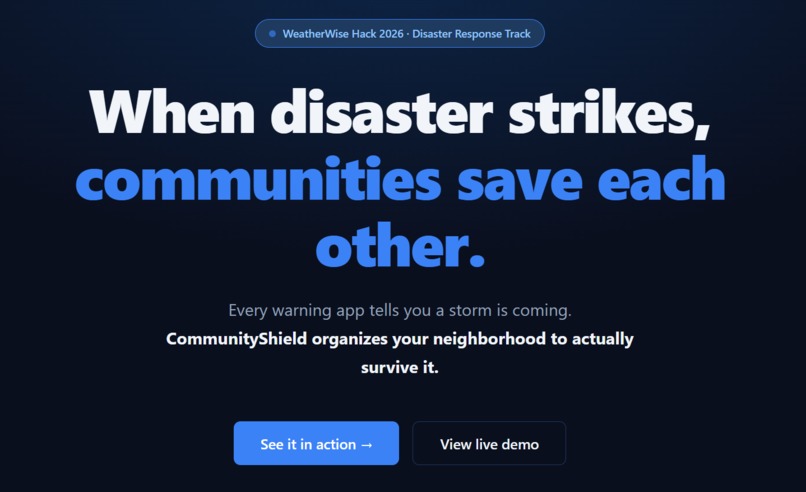
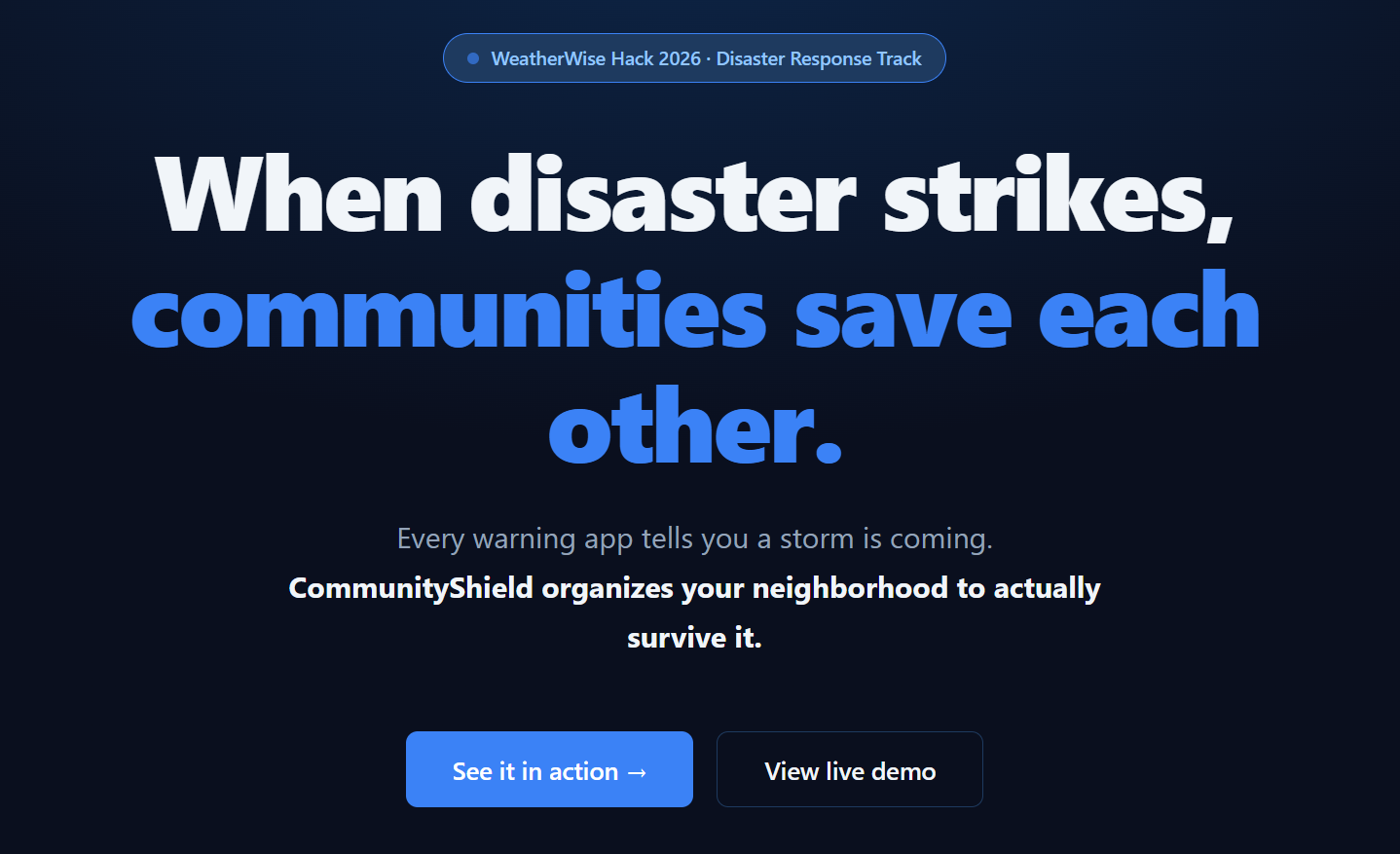
Warning apps tell you the storm is coming. None tell your neighbor you can't walk. CommunityShield uses AI to assign every neighbor a task before disaster strikes.
Inspiration
We didn't start by thinking about weather. We started by reading a news report.
In August 2003, Western Europe experienced its deadliest heatwave in recorded history. Over 70,000 people died in two weeks. Hospitals were overwhelmed. Morgues ran out of space. France alone lost 14,802 people. But here is the detail that stayed with us: the majority of deaths were elderly men and women who lived alone. Their neighbors didn't know they were in danger. Nobody knocked on the door. The information about the heatwave existed. The weather forecast was accurate. The warning systems worked.
The coordination didn't.
"People don't die from storms. They die from the absence of someone who knew to check on them."
That is the problem CommunityShield was built to solve. Not better alerts. Better action.
TheProblem
Natural disasters are accelerating at a pace the world has never seen before. According to the United Nations Office for Disaster Risk Reduction (UNDRR), the number of recorded disasters has increased fivefold over the last 50 years, driven by climate change, population growth, and urbanization. The human cost is staggering.
The numbers that matter:
- 2 billion+ people were affected by disasters in the last decade alone
- $2.9 trillion in economic losses from disasters between 2000 and 2019 (UNDRR)
- 70,000 people died in the 2003 European heatwave, most of them alone and uncoordinated
- 90% of all disaster deaths occur in low and middle-income countries (WHO, 2023)
- 80% of first disaster response is carried out at the community level, by neighbors, not governments (IFRC, 2022)
- Community-based early warning systems can reduce disaster mortality by up to 40%, yet almost no technology exists to facilitate this at neighborhood level (UNDRR, 2022)
- 1 in 3 elderly people in developing urban areas live alone with no designated emergency contact in their neighborhood
- Average formal emergency response time in sub-Saharan Africa ranges from 7 to 45 minutes. In a flash flood, that window is often already gone.
The gap nobody is filling: There are over 1,000 weather alert apps. There are zero apps that coordinate which specific neighbor checks on which specific vulnerable person before the storm arrives. CommunityShield is the first.
Solution
CommunityShield is an AI-powered pre-disaster community coordination system. When a severe weather event is forecast, it doesn't just push a notification. It generates a personalized action plan for every registered community member: specific tasks, specific people, specific deadlines.
The core insight is simple but powerful. The resources to save lives already exist inside every community. People have cars, medical skills, generators, and spare rooms. Vulnerable neighbors need transport, welfare checks, medication access, and shelter. CommunityShield's AI matches them automatically, before the disaster hits.
Not "a storm is coming." But: "Amara, pick up Mrs. Bello at 7 River Road by 3pm. She can't walk and needs insulin. Confirm when done."
HowItWorks
Step 1: Register your neighborhood Neighbors register in under 2 minutes via the web app. Each profile captures two things: capabilities (vehicle, first aid, generator, spare room, medical profession) and needs (elderly, mobility-impaired, no transport, requires medication, infant in household). No technical knowledge required.
Step 2: AI monitors the weather CommunityShield integrates with the OpenWeatherMap API to monitor 48-hour forecasts in real time. The moment a threshold is crossed (wind speed, rainfall intensity, storm category), the AI matching engine activates automatically.
Step 3: AI generates task assignments The matching algorithm runs a multi-priority coordination protocol:
- Medical professionals are matched first to neighbors requiring medication or with medical conditions
- Volunteers with vehicles are matched to neighbors with no transport, with wheelchair users and families with infants prioritized
- Welfare checks are distributed among remaining volunteers based on load-balancing
- Generator owners are matched to neighbors whose medical equipment requires power
Step 4: Confirm, track, and escalate Each volunteer receives a task card with the person's name, address, specific need, and a deadline. They confirm with one tap. A coordinator dashboard tracks progress in real time. Unconfirmed tasks escalate to the next available volunteer automatically.
WhatMakesItUnique
CommunityShield is not a new type of weather app. It is an entirely new category of tool.
| Feature | Existing Alert Apps | CommunityShield |
|---|---|---|
| Real-time weather alerts | Yes | Yes |
| Knows who is vulnerable in your area | No | Yes |
| Assigns specific tasks to specific people | No | Yes |
| Matches volunteers to vulnerable neighbors | No | Yes |
| Tracks task completion in real time | No | Yes |
| Escalates unconfirmed tasks automatically | No | Yes |
| Works before the disaster, not just during | No | Yes |
| Zero reliance on government infrastructure | Partial | Yes |
TechStack
CommunityShield ships as a single HTML file. Zero setup, zero installation, opens instantly in any browser. In disaster scenarios, complex deployment is a liability. This was a deliberate design choice.
- React 18 for component architecture across all four views: Landing, Dashboard, Alert Mode, and Registration
- OpenWeatherMap API for live 48-hour weather forecasts with severity threshold detection
- Custom AI Matching Engine built with a rule-based priority algorithm covering medical, transport, welfare, and power coordination
- Glassmorphism UI using backdrop-filter blur, animated gradient orbs, and glow states that intensify during emergency alerts
- JetBrains Mono for countdown timers and data displays, giving the interface a mission-control feel
- Babel Standalone for in-browser JSX transpilation, enabling single-file deployment with no build step
Impact
Impact was never an afterthought in CommunityShield. It was the starting point. Every design and engineering decision was made by asking: will this save a life?
Who CommunityShield is built for:
- Elderly and mobility-impaired people who cannot self-evacuate and have no guarantee of rescue
- Families in low-lying flood zones without personal transport
- People managing chronic conditions (diabetes, heart disease, asthma) who lose medication access during disasters
- Community coordinators who currently have no tool to organize pre-disaster response
- Local government emergency managers who need visibility into community preparedness without requiring complex infrastructure
CommunityShield's demo is set in Riverside District, Lagos. But the system works for any neighborhood in the world. From coastal Bangladesh to rural Mozambique to urban flood zones in Nigeria, India, or the Philippines: anywhere communities face disasters without coordination infrastructure, CommunityShield fills the gap.
Challenges
The hardest part was the matching algorithm. A naive approach wastes critical resources. Medical professionals shouldn't be assigned welfare checks when someone needs insulin. A volunteer with a car shouldn't be checking windows when a wheelchair user needs evacuation. We designed a priority-aware, load-balanced matching system that respects the urgency hierarchy of needs while ensuring no single volunteer carries an impossible task load.
The second challenge was UX under pressure. Disaster apps are often used by people who are scared, in poor lighting, on low battery, with shaking hands. We chose large tap targets, high contrast, clear action language, and a single confirmation step. Every extra second of UI friction is a second that matters in a real emergency.
Accomplishments
I am proud of what CommunityShield became in the time we had.
- I built a genuinely novel product: not an improvement on an existing tool, but a category that did not exist before
- The AI matching engine generates contextually accurate, prioritized task assignments across real community profiles in real time
- The entire application ships as a single HTML file with no servers, no deployment, and no installation required
- The cinematic Alert Mode (live countdown, AI analysis animation, staggered task card reveals) communicates urgency through design, not just words
- I built for the people most likely to be left behind. They were the first user we designed for, not the last.
WhatILearned
The most important thing we learned: the best disaster technology is not the most technically complex. It is the one that works when the power grid is shaky, when the person using it is afraid, and when the stakes are a human life.
I also learned that coordination, not information, is the missing layer in disaster response. The data already exists. The alerts already exist. The first responders already exist. What doesn't exist is a system that connects Mrs. Bello's need for insulin with Dr. Eze's ability to help, automatically, 18 hours before the storm arrives.
TheRoadmap
CommunityShield is a working prototype today. The vision is much larger.
Phase 1 (Now): Web app with full AI task matching, live weather integration, real-time task confirmation, and coordinator dashboard.
Phase 2 (3 months):
- SMS integration via Twilio: alerts and task assignments delivered to feature phones, reaching the 60%+ of sub-Saharan Africa that communicates via SMS
- WhatsApp Business API: task cards delivered directly into the app 2.7 billion people already use
- Offline-first Progressive Web App using IndexedDB and service workers
- Multi-language support: Swahili, Hausa, Hindi, Tagalog, and Portuguese
Phase 3 (6 months):
- Official alert feed integration from FEMA, NDMA Nigeria, NDMA India, and national meteorological services
- Low-cost flood sensor and IoT device support for ground-truth data
- Analytics dashboard for local governments: preparedness scores, task completion rates, vulnerability hotspot mapping
Phase 4 (12 months):
- Partnership with Red Cross, UN OCHA, and national civil defense agencies as the coordination layer for community first response programs
- Expansion into non-weather emergencies: pandemics, industrial accidents, civil unrest
- Open API for local NGOs, community health workers, and neighborhood associations worldwide
BuiltWith
React · JavaScript · OpenWeatherMap API · CSS · HTML · Babel · JetBrains Mono · Inter · Custom AI Matching Algorithm and deployed on netlify
Every warning app informs. CommunityShield coordinates. Because knowing a storm is coming means nothing if nobody knows you can't walk.
#CommunityShield #WeatherWiseHack2026 #DisasterResponse #AIForGood #SaveLives #BuildForGood #HackForHumanity
Built With
- ai
- api
- babel
- css
- custom
- html
- inter
- javascript
- jetbrains
- matching
- mono
- netlify
- openweathermap
- react

Log in or sign up for Devpost to join the conversation.