Inspiration
Finding help shouldn't be complicated. Many people, including veterans, students, and families facing financial difficulties, don't always know where to find the resources available in their communities.
We wanted to create something that could make that process easier. Instead of searching through multiple websites, people could simply describe what they need and receive information about organizations that may be able to help.
That's how CommunityConnect AI started. Our idea was to use AI to connect people with community resources in a simple and accessible way.
What It Does
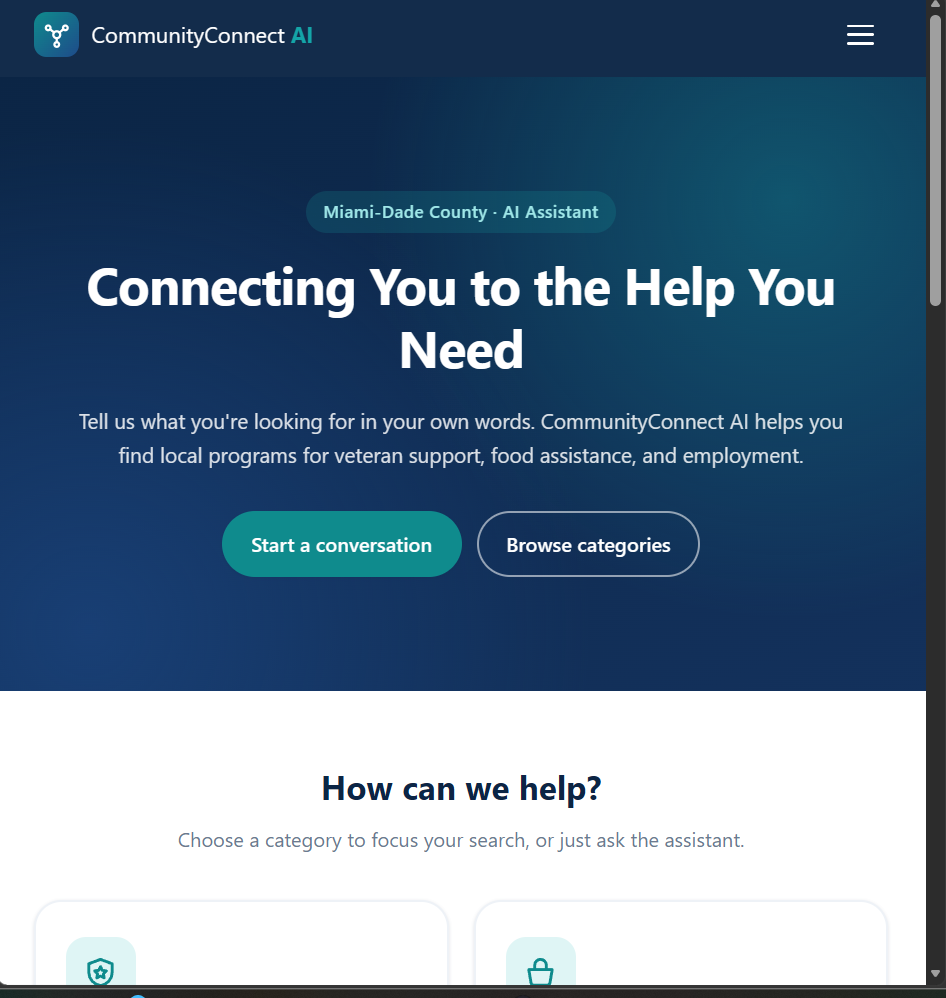
CommunityConnect AI is a web application designed to help people discover local assistance programs based on their needs.
Our initial focus is Miami-Dade County, with three main categories:
- Veteran Support: Helping veterans discover available assistance programs.
- Food Assistance: Connecting individuals and families with food support resources.
- Employment: Helping people find organizations that offer job assistance and career services.
Users can interact with a chatbot, describe their situation, and explore resource recommendations through organized cards.
Our current prototype includes a working demo mode. We're developing the Snowflake-powered backend to provide recommendations based on real community organization data.
How We Built It
We divided the project into two main parts: frontend development and backend AI integration.
For the frontend, we used HTML, CSS, and JavaScript to build a responsive website. We created an interactive chatbot, assistance categories, and resource cards that can display organization names, descriptions, locations, and contact information.
We also implemented a demo mode so we could test the website before connecting the AI backend.
For the backend, we chose Python and Flask to handle communication between the website and Snowflake.
Our planned AI architecture uses Snowflake Cortex Search to retrieve community resources and Snowflake Cortex AI to generate responses based on the retrieved information.
We used VS Code, Snowflake CoCo CLI, and GitHub to organize our development and collaborate as a team.
Challenges We Faced
One of our biggest challenges was developing different parts of the application at the same time while keeping everything compatible.
Since we divided the work between frontend and backend, we needed to agree on how information would move between them.
We addressed this by defining a shared API format and building a separate JavaScript file to manage communication with Flask.
We also faced some challenges with GitHub branches, merging changes, and testing the chatbot before the real backend was available.
Creating a demo mode helped us continue developing and testing the interface without depending on the completion of the AI integration.
What We Learned
This project gave us the opportunity to practice building a real web application as a team.
We learned more about:
- Creating responsive websites with HTML, CSS, and JavaScript.
- Designing chatbot interfaces and displaying structured data.
- Preparing frontend applications to communicate with REST APIs.
- Using Git and GitHub to collaborate through branches and pull requests.
- Handling errors and testing applications with mock API responses.
- Planning how Snowflake Cortex AI and Retrieval-Augmented Generation (RAG) can support a real-world application.
Most importantly, we learned how to divide a larger project into smaller tasks and work toward a shared goal.
What We're Proud Of
We're proud that we were able to turn an idea into a working interactive prototype.
Our website already allows users to explore different assistance categories, interact with a demo chatbot, and view example resource cards.
We also built the frontend in a way that makes it easier to connect the real AI backend without rebuilding the application.
What's Next
Our next step is to complete the Snowflake integration and connect the chatbot to a database of verified community organizations.
We also want to expand the project beyond Miami-Dade County, add more assistance categories, and support both English and Spanish.
Our long-term goal is simple: make it easier for people to find help when they need it.
