Inspiration
As a community manager for a small business, I spent 8+ hours weekly on repetitive tasks—sending welcome messages, chasing inactive members, and moderating content. I saw peers in creator and enterprise spaces struggling with the same pain points: great communities deserve focus, not busywork. That’s why I built CommunityAgent—to put AI to work on the routine, so community leaders can focus on connection.
What it does
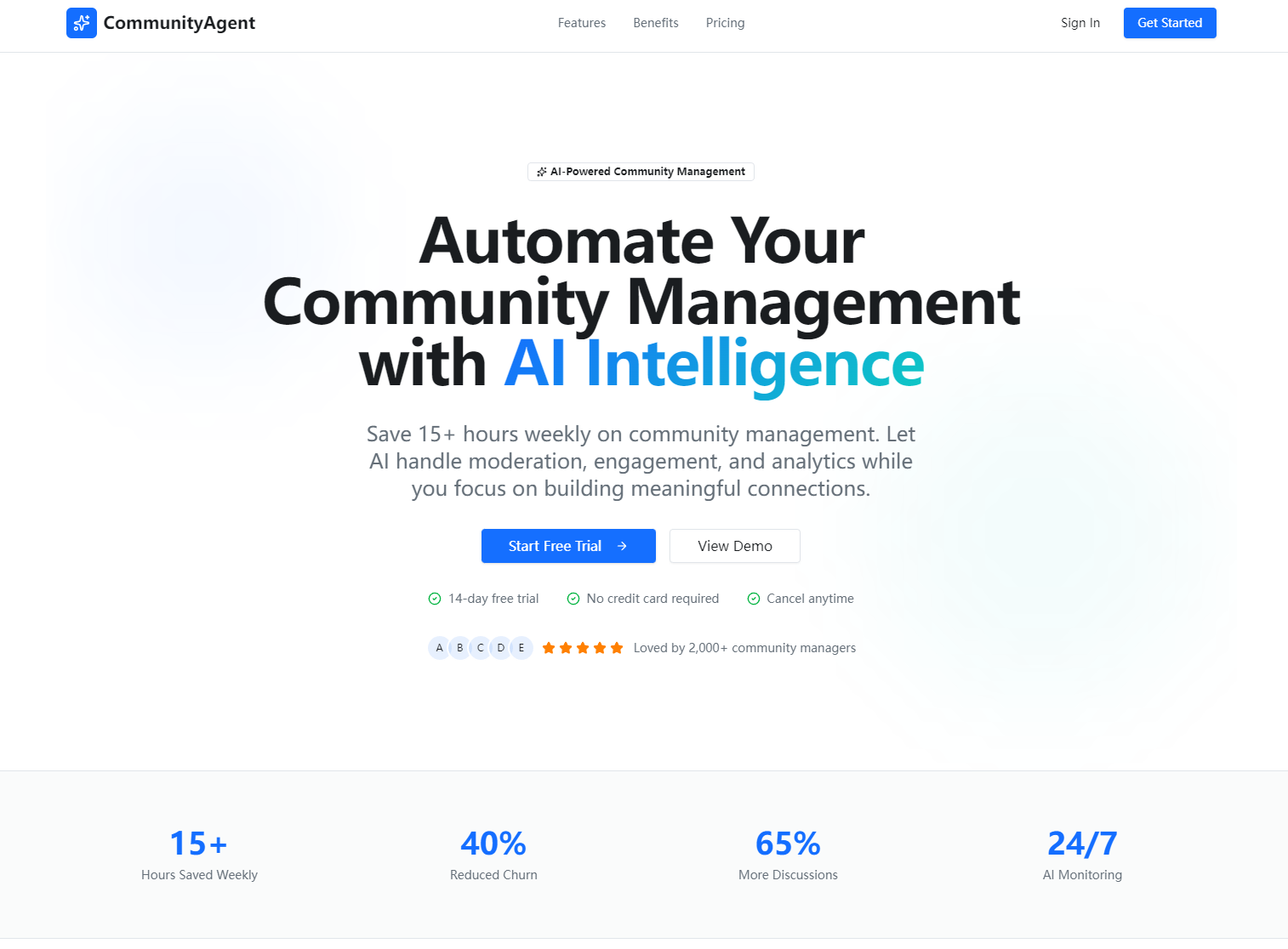
CommunityAgent automates core community management workflows: AI-generated welcome sequences for new members, silent member identification with re-engagement campaigns, real-time content moderation, and data-driven health reports. It works across Discord, Slack, Circle, and Mighty Networks, unifying insights in a single dashboard.
How we built it
I started by mapping core user workflows (onboarding, moderation, analytics) and integrating with major community platform APIs via OAuth 2.0 for secure data access. I built the frontend with React for responsive design, backend with Python/Node.js, and leveraged OpenAI’s API to train AI on niche-specific topic generation and personalized messaging. AWS hosted the infrastructure, with PostgreSQL for data storage and Chart.js for real-time analytics visualization. Stripe API handled subscription billing and plan management.
Challenges we ran into
The biggest hurdle was syncing real-time data across four distinct platform APIs—each had unique rate limits and data structures. I also struggled with balancing AI automation and human control: moderation rules needed to be flexible enough for niche communities but clear enough to avoid over-automation. Early on, AI-generated welcome messages felt generic; refining dynamic variables (member join date, niche interests) fixed this.
Accomplishments that we're proud of
We built a tool that cuts community management time by 60% for beta users—one creator went from 10 hours/week to 4, reallocating time to creating community events. The moderation system reduced flagged content response time from hours to minutes, and the AI topic generator boosted engagement by 30% for test communities. Most importantly, the platform is fully responsive (critical for on-the-go managers) and accessible across all target platforms.
What we learned
I learned the value of user-centric iteration: early beta testers pushed for more control over AI outputs, so we added custom topic banks and moderation rule editors. API integration taught me to build for resilience—adding retry logic and error handling for platform outages was non-negotiable. Most importantly, I realized community tools succeed when they augment, not replace, human connection.
What's next for this project
First, we’ll add advanced sentiment analysis to better gauge community mood and tailor engagement. We’re also building white-label support for agencies and expanding API access for third-party developers. Long-term, we want to integrate event management automation and multi-language support to serve global communities—all while keeping the focus on making community management human-first, AI-powered.
Built With
- amazon-web-services
- discord-api
- node.js
- postgresql
- python
- react
- slack-api

Log in or sign up for Devpost to join the conversation.