-
-
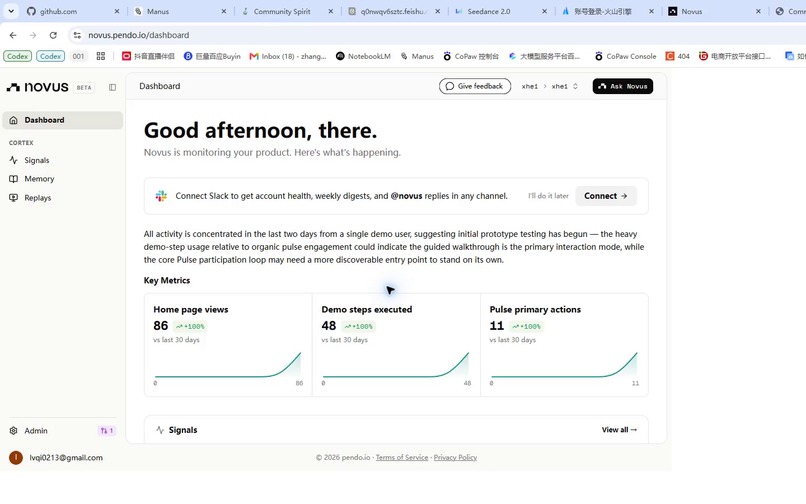
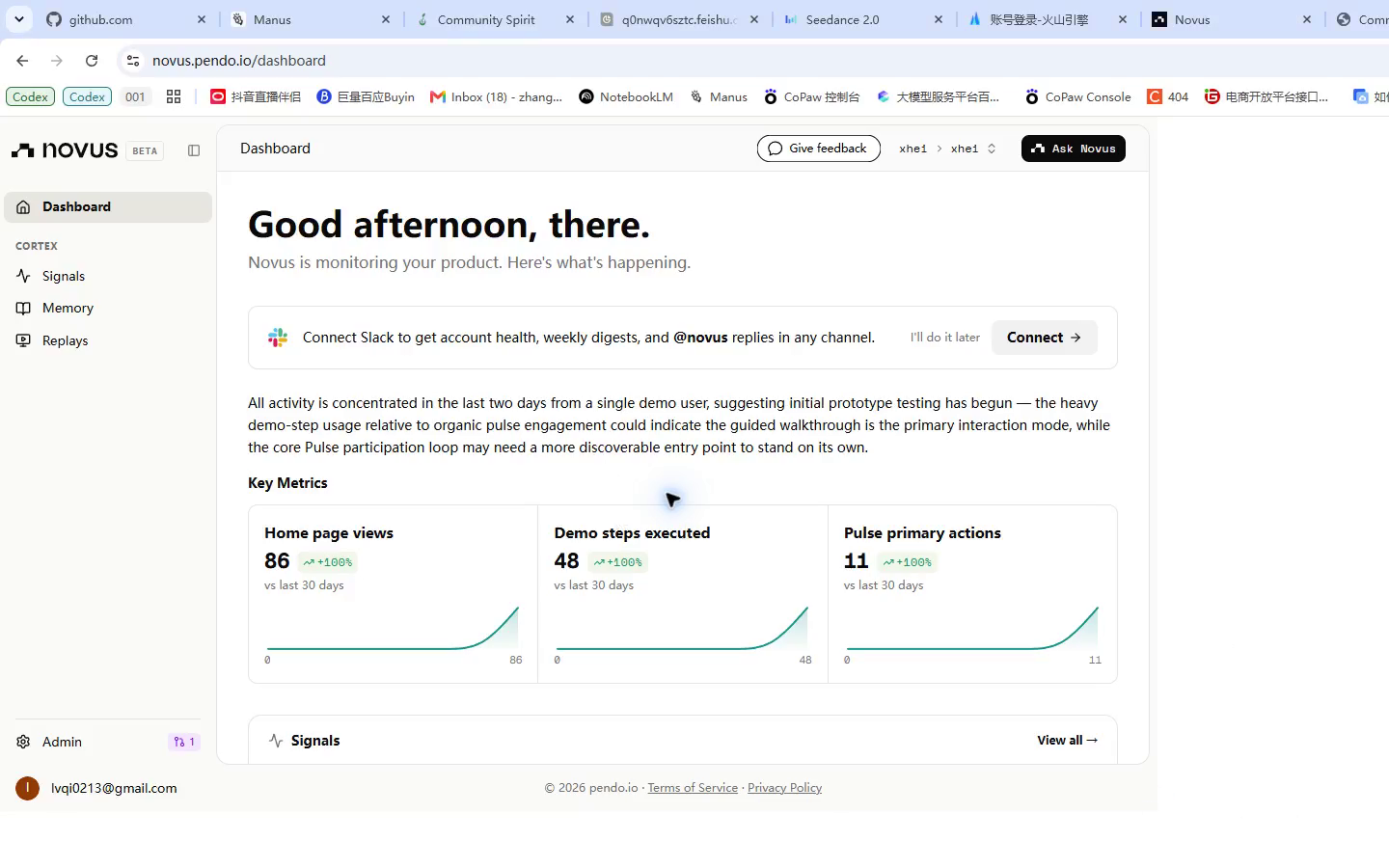
Novus.ai dashboard proof showing live product metrics and Signals for the deployed Community Spirit demo.
-
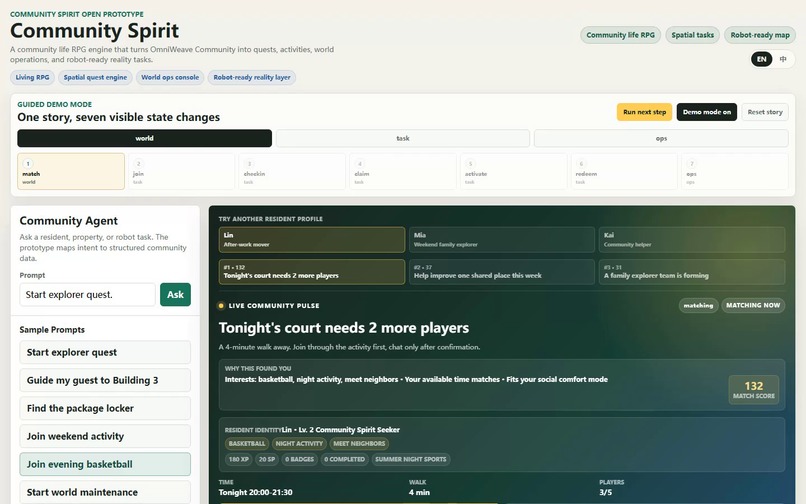
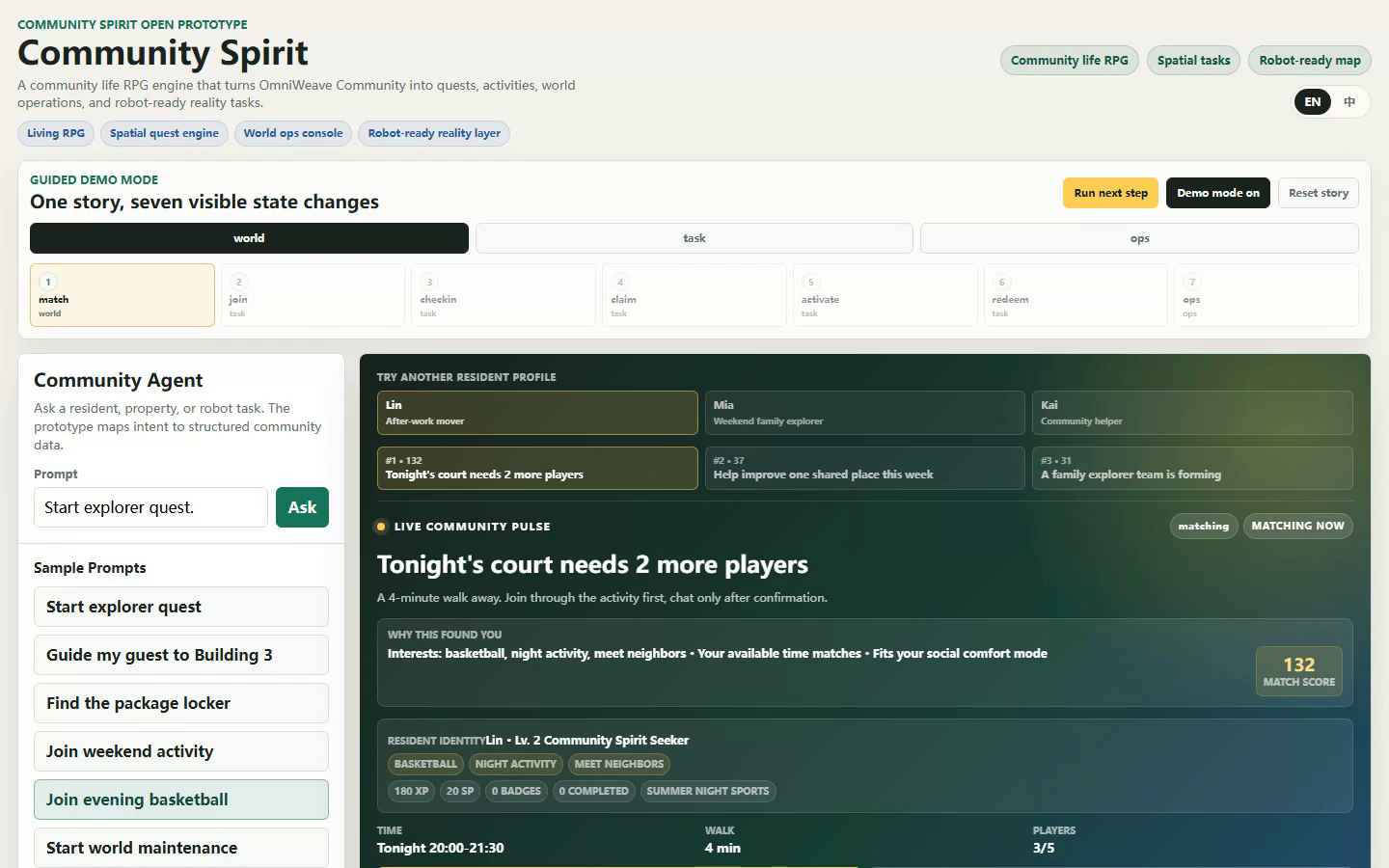
Community Spirit product flow: a community life RPG with Pulse recommendations, CACP task contracts, and World Ops.
Inspiration
Community life often fails at the last mile. Activities disappear into noisy chat groups, residents lack a personalized reason to participate, underused spaces stay quiet, and operators cannot connect recommendations to arrival, repeat participation, or benefit conversion.
At the same time, physical AI is moving closer to daily life. Future robots will need more than maps and action planning. They will need a social contract for where they can act, who approved the task, what data is off-limits, who takes over when uncertainty appears, and how trust is measured. Community Spirit started from that gap.
What it does
Community Spirit is a working community life RPG and physical-AI social layer. It uses synthetic community data to turn underused shared spaces into low-pressure quests, resident growth, benefits, retention loops, World Ops metrics, and CACP task contracts for future AI agents and robots.
The resident side gives people gentle reasons to show up, join a small activity, help a neighbor, walk to a place, or activate a shared space. Community Pulse recommendations match interests, availability, social comfort, and walking distance, then turn that recommendation into a route, check-in, XP, Spirit Points, badges, benefits, and a shared community goal.
The operator side sees the same story as World Ops: conversion, lifecycle state, space activation, retention, commerce, workflow handoff, and risk review.
How we built it
The prototype is a React/Vite app backed by structured JSON data. The synthetic community model includes POIs, routes, tasks, activities, Community Pulses, resident profiles, seasons, benefits, and CACP task contracts.
CACP, the Community AI Collaboration Protocol, is implemented as a proposed task-contract layer for physical AI in shared community spaces. Before an AI agent or future robot acts in a physical place, the community needs a clear contract: intent, place, interaction mode, permission, privacy boundary, fallback owner, feedback, and human handoff.
Automated validation checks data references, pulse lifecycle rules, retention metrics, CACP contract examples, build output, and submission assets with npm run check.
Challenges
The hardest part was keeping the project from collapsing into a generic smart-community dashboard. Community Spirit is not about surveillance, access control, or operational monitoring. It is about low-pressure participation, community vitality, and the social layer physical AI will need before it enters everyday shared spaces.
Another challenge was explaining CACP clearly because it is a proposed protocol direction, not an existing standard judges already know.
What we learned
Physical AI readiness is not only about robots executing tasks. It is about social acceptance, permission, privacy, fallback, and measurable trust. Residents need low-pressure ways to participate. Operators need measurable loops. Future AI agents and robots need explicit community task contracts before they enter everyday shared spaces.
MCP connects models to tools and resources. A2A connects agents to agents. CACP connects people, places, operators, AI agents, and robots through community task contracts.
Current data boundary and next step
This submission uses a synthetic dataset because Community Spirit is currently an early prototype that I built independently. In parallel, I am also developing CACP, the Community AI Collaboration Protocol, as the task-contract layer behind the product direction. The goal is not to stay synthetic forever. I hope to work with like-minded developers, data-collection partners, communities, campuses, property operators, and robot companies to collect real participation and place-operation data with consent, clear permissions, privacy boundaries, audit logs, and human oversight. That real-world validation is the next step for pushing Community Spirit and CACP toward practical deployment.
Built With
- cacp
- css
- draft
- github
- github-actions
- javascript
- novus.ai
- pendo-web-sdk
- react
- structured-json-data
- svg-map-rendering
- vite


Log in or sign up for Devpost to join the conversation.