Inspiration
Access to additional electricity capacity is often decided far from the neighbourhoods affected by it. Meanwhile, EV chargers, rooftop solar, wind farms, and data centres compete for limited grid capacity.
We wanted to explore how residents could understand their street's electricity constraints, decide collectively what additional capacity to request, and verify how their proposal was handled.
What It Does
Street Power simulates a street of 12 homes, including six with EVs and five with rooftop solar, sharing a substation with a wind farm and a data centre.
Residents can view electricity demand against their feeder limit and propose a request for additional capacity. Each home receives one vote, and a majority sends the proposal to the station operator.
The operator receives a recommendation based on available capacity after a safety reserve, including an option for the data centre to defer flexible electricity demand.
The application records proposals, votes, and decisions in a hash-chained ledger. Daily meter readings can be anchored using a Merkle root, allowing an individual reading to be verified without revealing the others. A tamper demonstration shows how verification can identify a modified record.
How We Built It
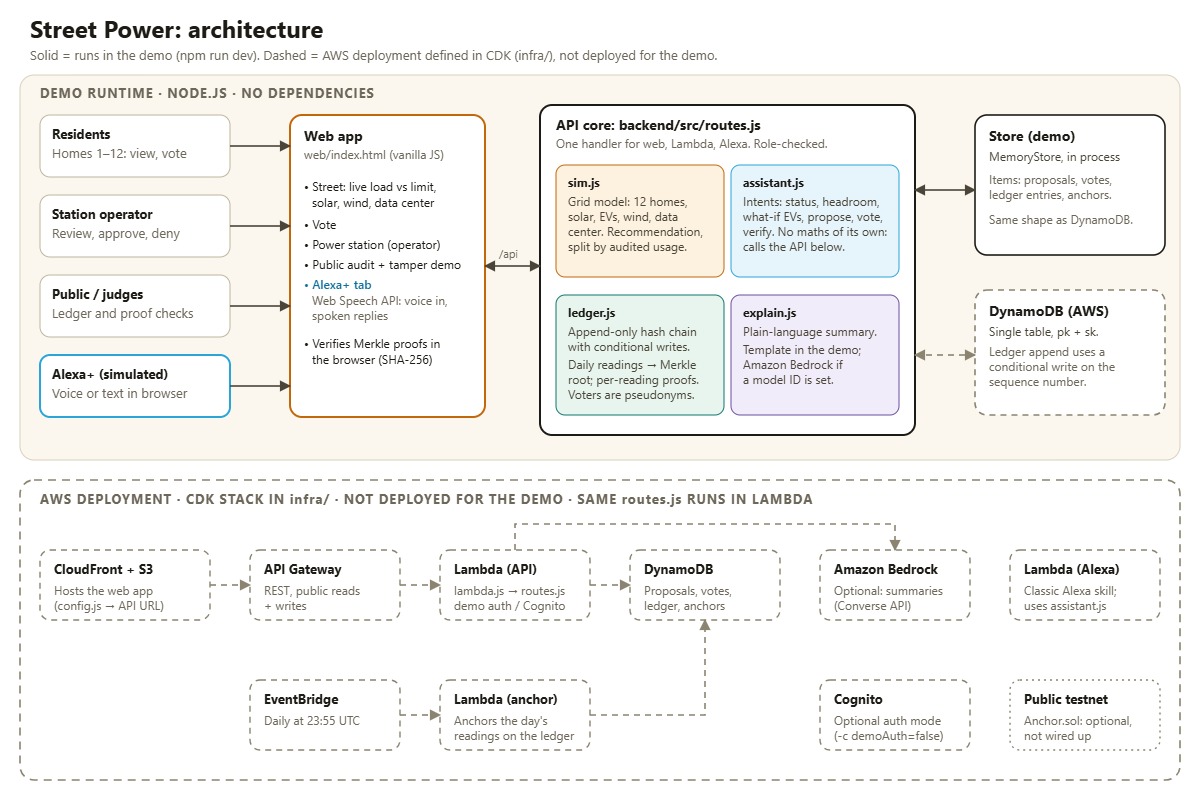
The project uses Node.js, JavaScript, and a lightweight web interface. Its core components include:
- A deterministic electricity-grid simulation
- A hash-chained ledger
- Merkle proofs
- A shared API
- A rule-based conversational assistant
The project also includes AWS CDK infrastructure code for a potential AWS deployment.
Challenges
Key challenges included handling concurrent ledger writes, protecting household identities in a publicly verifiable audit trail, and designing a grid scenario in which wind generation and data-centre flexibility affect the station operator's decision.
Accomplishments that we're proud of
Exploring a conversational voice-assistant experience for neighbourhood energy decisions.
What I learned
- Node.js
- JavaScript
- HTML and CSS
- Web Speech API
- SHA-256
- Merkle trees
What's Next
Future improvements include:
- Real smart-meter ingestion
- Anchoring Merkle roots to a public blockchain
- Accommodating households with critical medical equipment
- Exploring integration through a real Alexa+ Agent Skill or MCP server
- Completing and validating the AWS deployment

Log in or sign up for Devpost to join the conversation.