Inspiration
In fast-growing cities like Ibadan, vulnerable individuals often struggle to find immediate, trustworthy public assistance during sudden food or housing insecurity. Existing information is fragmented, and public administrators lack real-time visibility into shifting local supply gaps. We wanted to create a solution that bridges this communication gap, specifically localized for the unique needs of Oyo State.
What it does
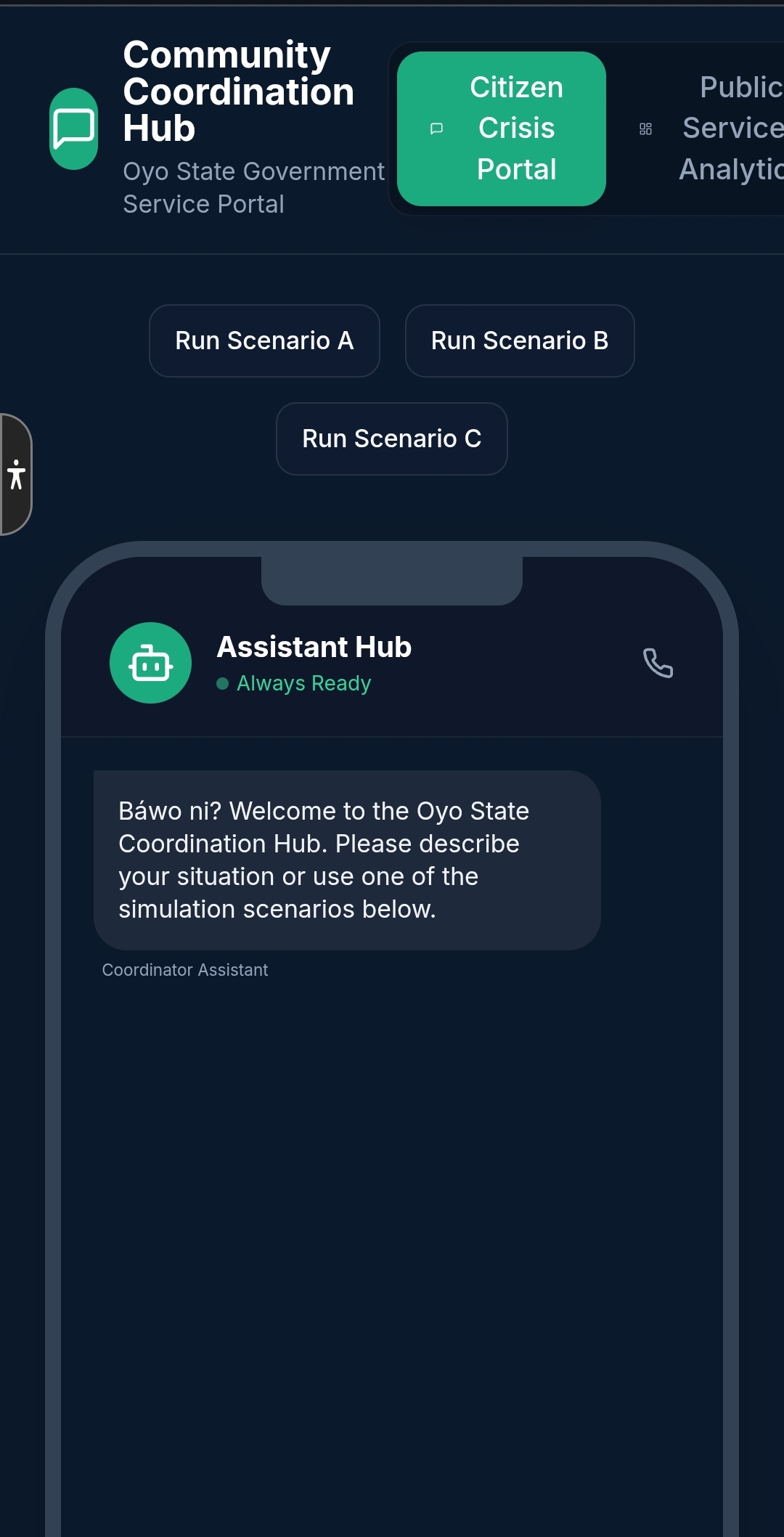
The Community Coordination Hub is a dual-portal application. The Citizen Portal is a mobile-friendly chat interface designed for low-data environments that allows individuals to quickly trigger pre-set local crisis scenarios (such as food assistance or eviction notices) in specific LGAs like Ibadan North or Oluyole. It handles real-time filtering from a pre-vetted database, completely bypassing AI hallucinations. Meanwhile, the Admin Dashboard is a live-streaming performance console for Oyo State administrators that automatically tallies incoming request counters and logs timestamped tracking metrics. If a user inputs critical distress signals (like feeling unsafe), a Responsible AI Failsafe engages a human-in-the-loop override, alerts administrators via a flashing banner, and transfers the citizen directly to a caseworker.
How we built it
The application was prototyped using modern frontend frameworks including React, Tailwind CSS for clean readability, and Lucide React vector icons. The backend telemetry tracking loops and natural language processing layers were engineered within the Firebase Studio cloud workspace sandbox powered by Gemini.
Challenges we ran into
Navigating the complexities of layout rendering when combining separate citizen-facing viewports and administrative telemetry tools on a single-page setup was a challenge. We also had to refine the natural language parsing rules to ensure specific local terms and abbreviations mapped accurately to the pre-vetted state programs.
Accomplishments that we're proud of
We successfully built a functional, live-updating prototype tailored to a local Nigerian context that solves a massive human problem while proving that AI tools can successfully implement strict ethical guardrails via human-in-the-loop overrides.
What we learned
We learned the profound importance of matching technical design directly with local operational infrastructure. Ensuring that database lookups require practical parameters—like National Identification Numbers (NIN)—is absolutely vital for making civic tech workable in the real world.
What's next for Community Coordination Hub
- WhatsApp & USSD Integration: Deploy a fallback SMS/USSD gateway so citizens without smartphones or internet access can route crisis requests, alongside an automated WhatsApp Business assistant.
- Multi-Language Support: Implement speech-to-text models trained on local Yoruba dialects so users can easily articulate high-stress situations in their native language.
- Live NIN Validation: Connect the platform directly to the NIMC database via API to verify National Identification Numbers instantly, reducing spam and securing public resource routing.
- Geospatial Heatmaps: Integrate interactive mapping tools for Oyo State administrators to transform text logs into live geographic data maps, highlighting layout trends across key LGAs.
Built With
- firebase
- gemini
- javascript
- lucide-icons
- react
- tailwind-css

Log in or sign up for Devpost to join the conversation.