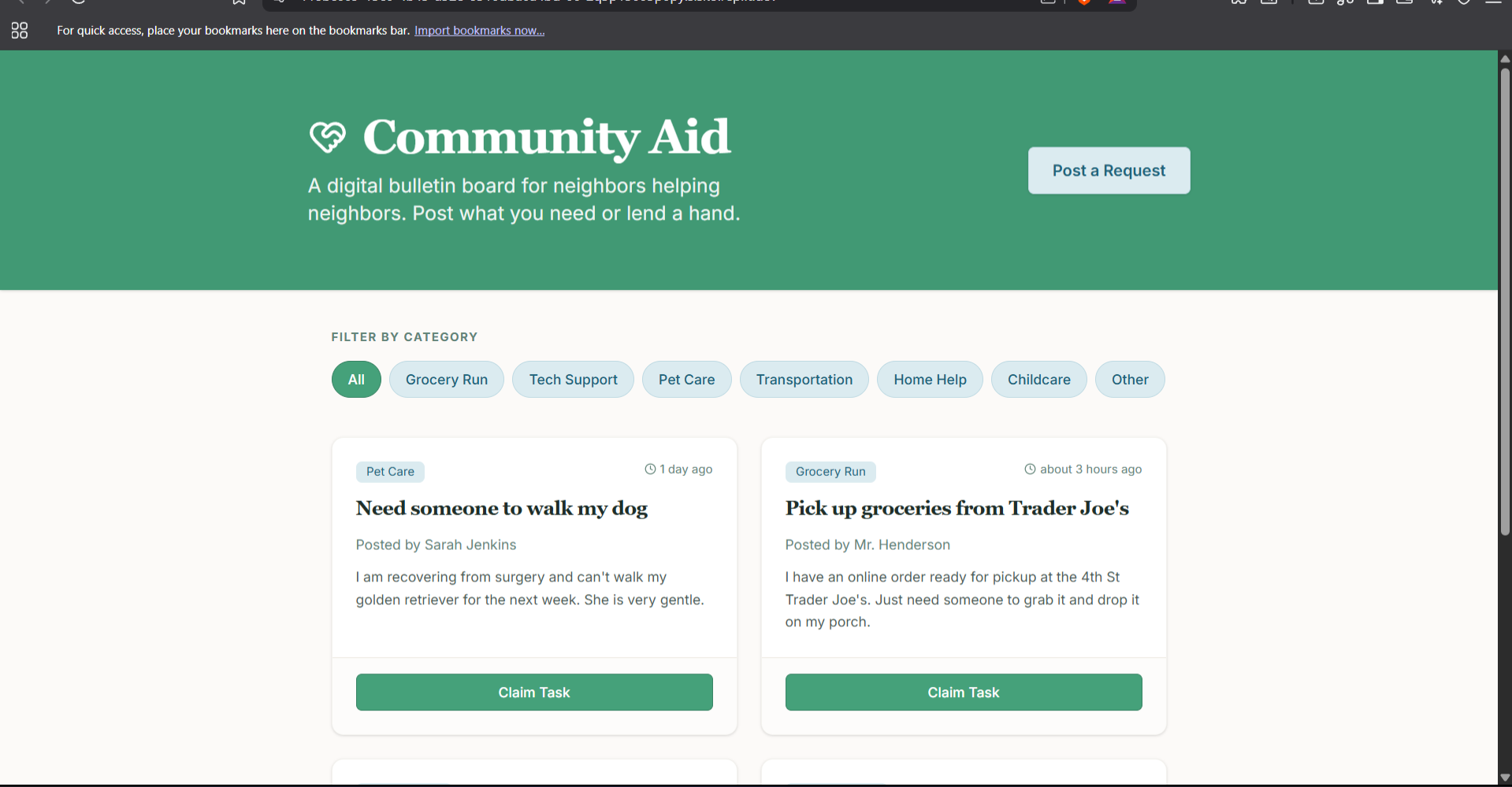
Inspiration Community aid efforts often suffer from information fragmentation, relying on chaotic chat threads and manual spreadsheets. We were inspired to build a centralized platform that removes the friction of coordinating resources, ensuring that neighborhood needs are met efficiently and transparently.
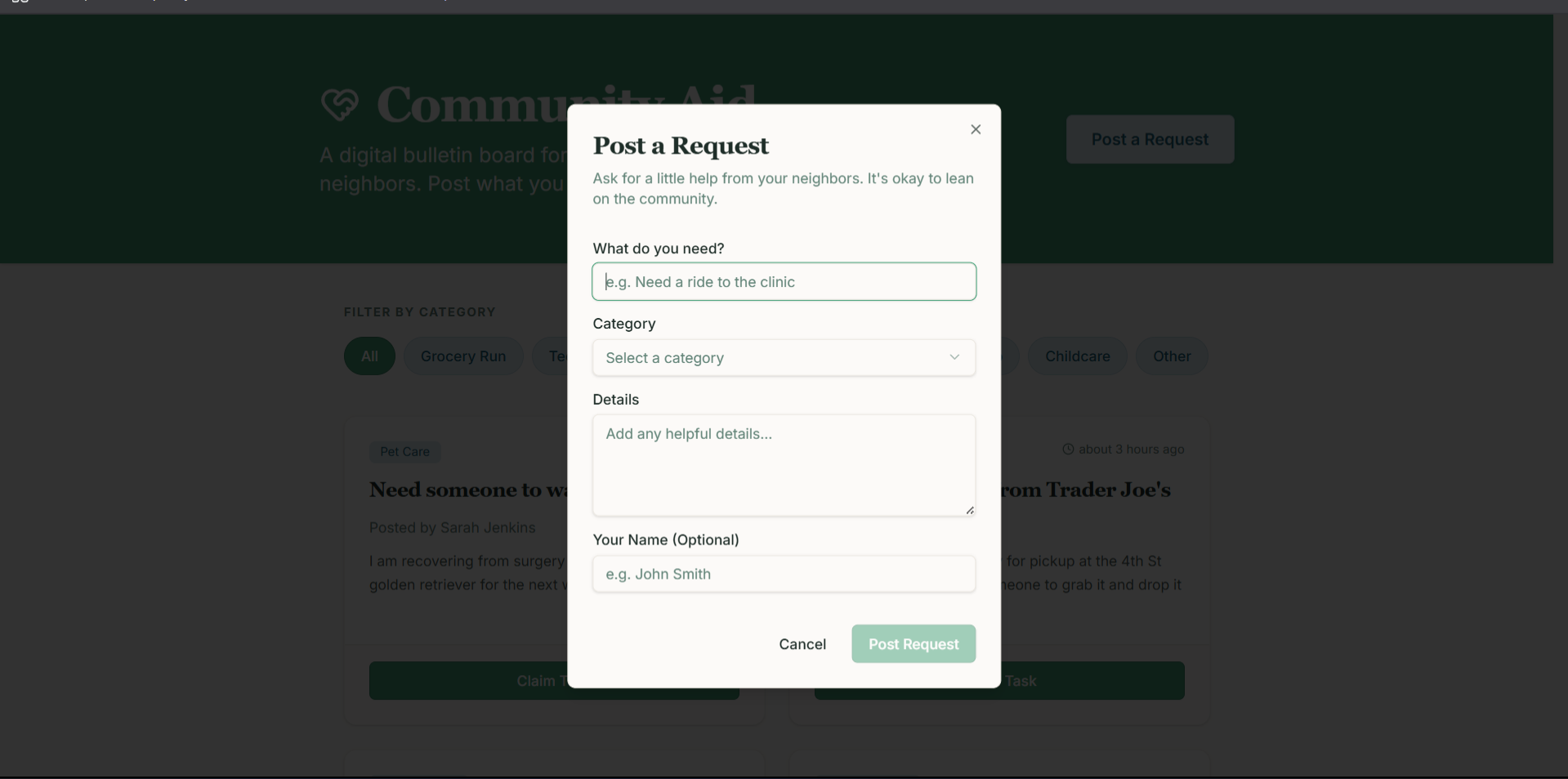
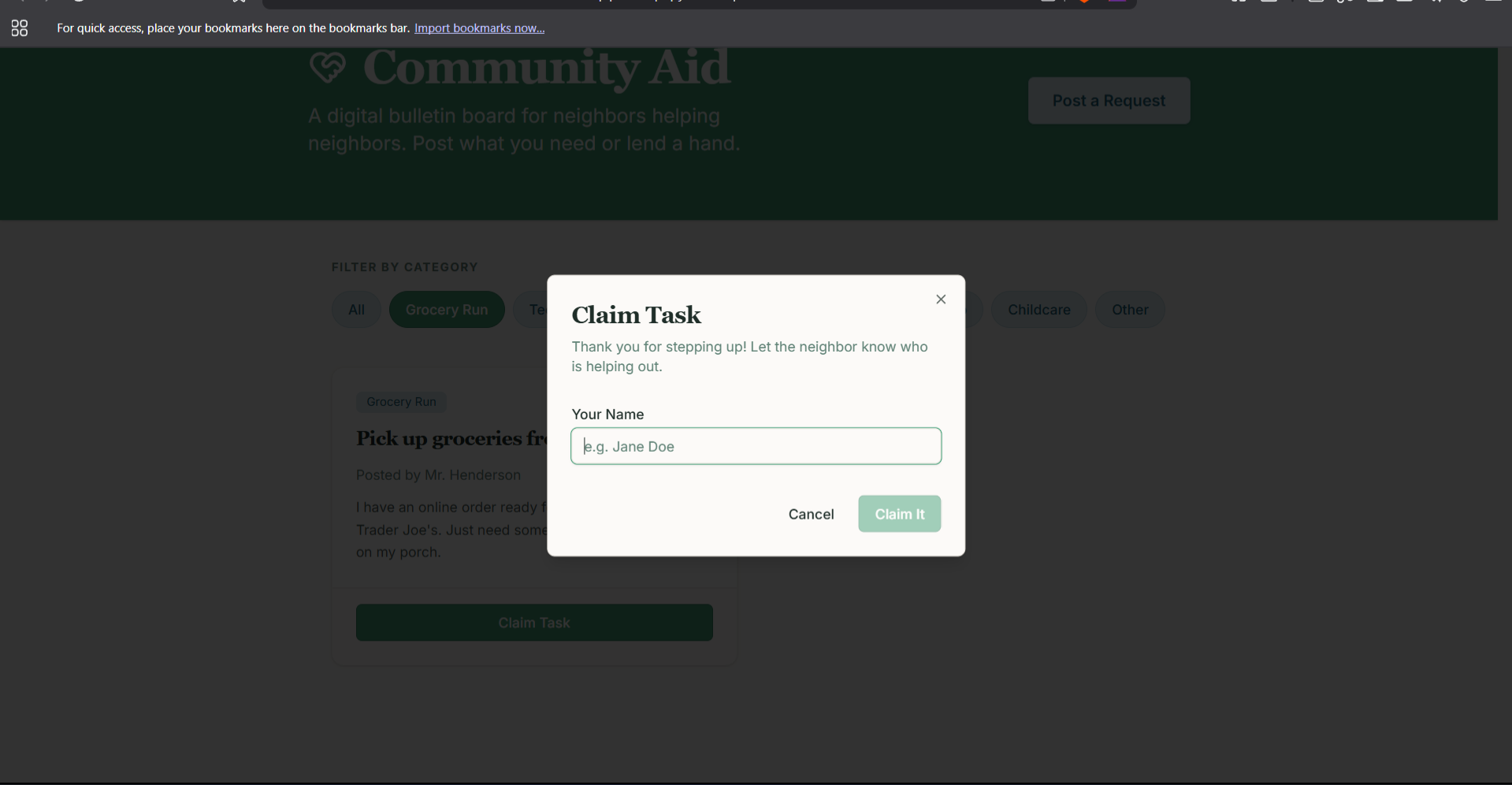
What it does Community Aid Hub is a real-time platform that aggregates local aid requests. It provides a simple, responsive interface where users can broadcast specific needs (e.g., food, transport, supplies) and volunteers can instantly claim them, turning unorganized requests into actionable tasks.
How we built itWe utilized a modern web stack optimized for rapid development, using React and Vite for a high-performance UI, Tailwind CSS for a responsive design, and GitHub Codespaces to maintain a stable cloud-based development environment. We optimized our request-to-action workflow to maximize the impact coefficient ($E$), defined by the relationship between fulfilled requests and total coordination time:$$E = \frac{\sum \text{Fulfilled Requests}}{\text{Total Coordination Time}}$$
Challenges we ran into We encountered significant hurdles with environment configuration, specifically involving dependency management conflicts within monorepo structures. Navigating these constraints under pressure required us to quickly pivot to cloud-based development, forcing us to prioritize the stability of our build over adding complex, non-essential features.
Accomplishments that we're proud of We are most proud of our ability to execute a rapid pivot in our development strategy, successfully migrating to a cloud environment to overcome critical blockers. Delivering a clean, functional MVP that solves the core problem of coordination within such a tight timeframe demonstrates our ability to maintain focus and prioritize high-impact development.
What we learned This project taught us that environment troubleshooting is a vital skill that is just as important as writing application code. We learned that a refined, functional MVP is significantly more valuable than an over-engineered app, confirming that the most effective solutions are those that lower the barrier to human interaction rather than adding technical complexity.
What's next for Community Aid Hub Our future roadmap includes implementing user authentication to verify participation, adding geolocation services to filter requests by neighborhood radius, and integrating a live backend database to enable persistent, real-time data synchronization across all users.
Built With
- css
- html
- replits
- typescript


Log in or sign up for Devpost to join the conversation.