-
-
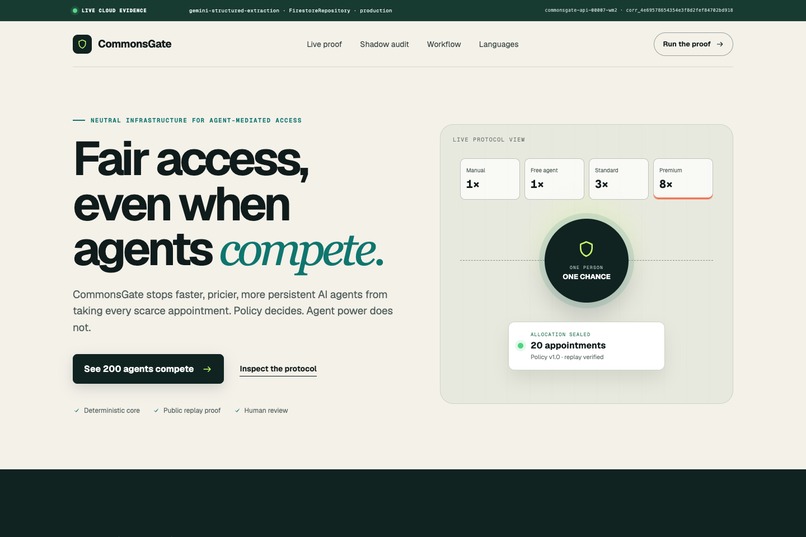
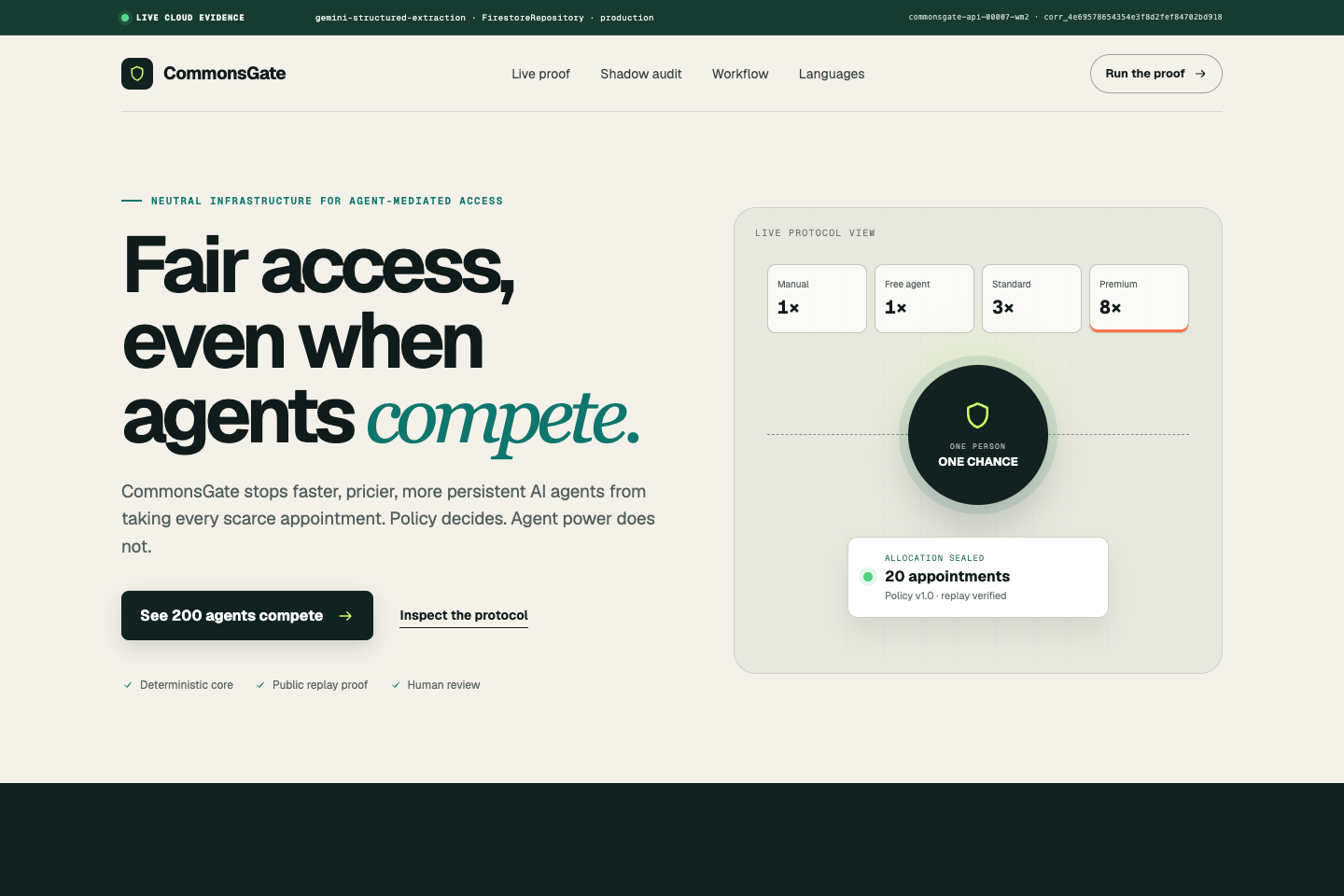
CommonsGate live on Google Cloud: one person, one chance, regardless of the agent representing them.
-
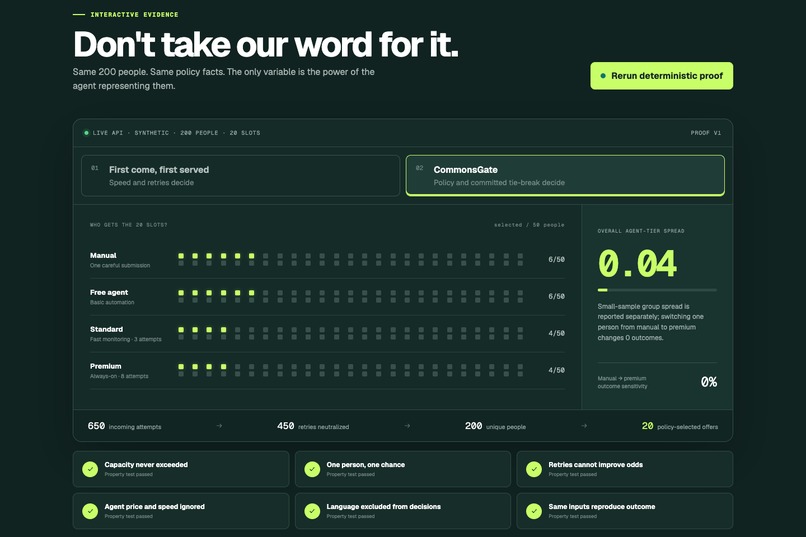
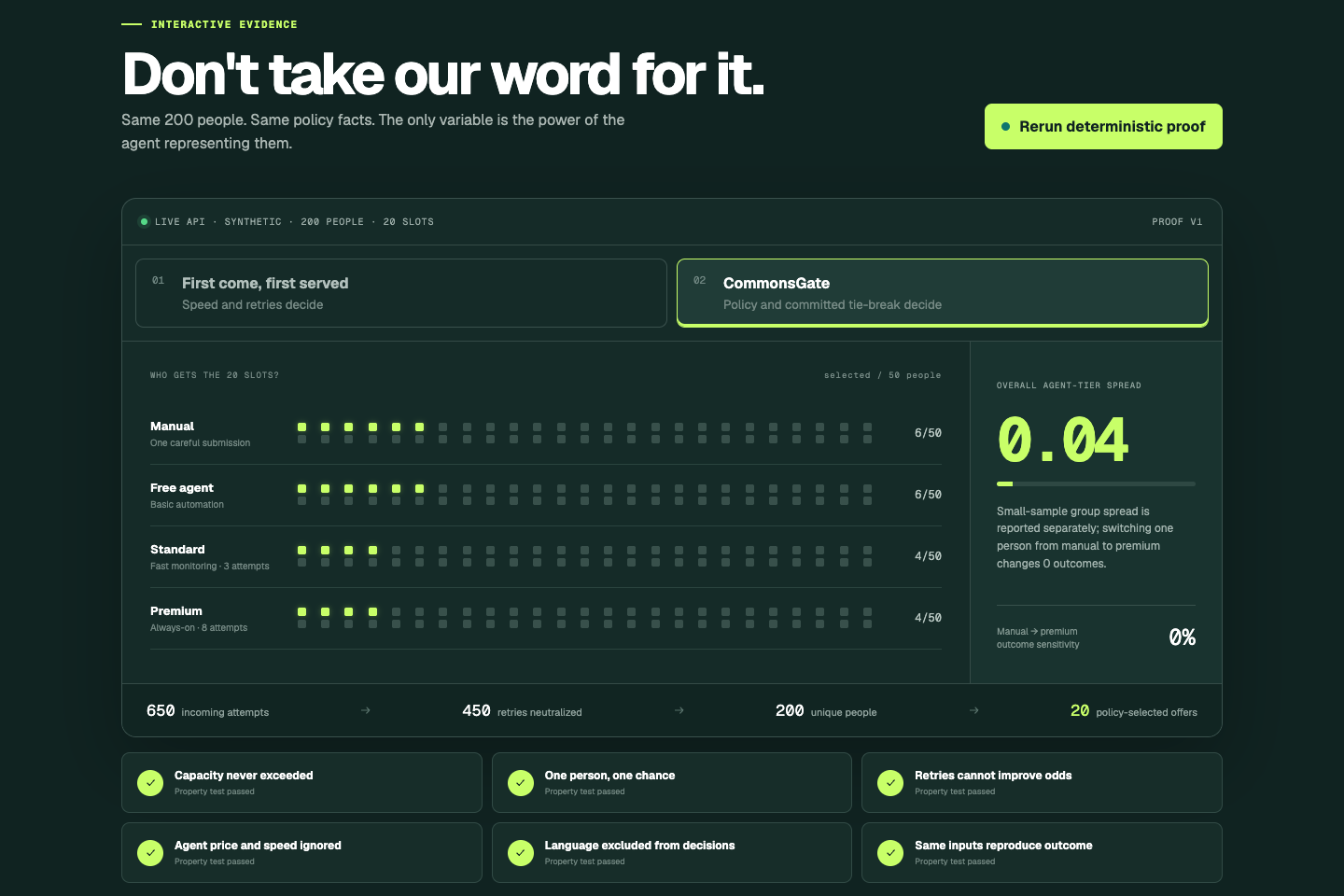
Live proof: 650 attempts become 200 people and 20 policy-selected offers, with 450 retries neutralized.
-
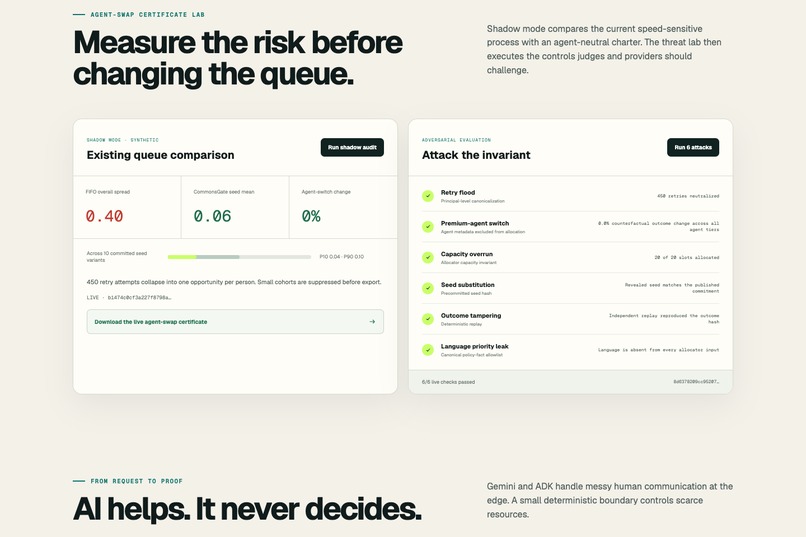
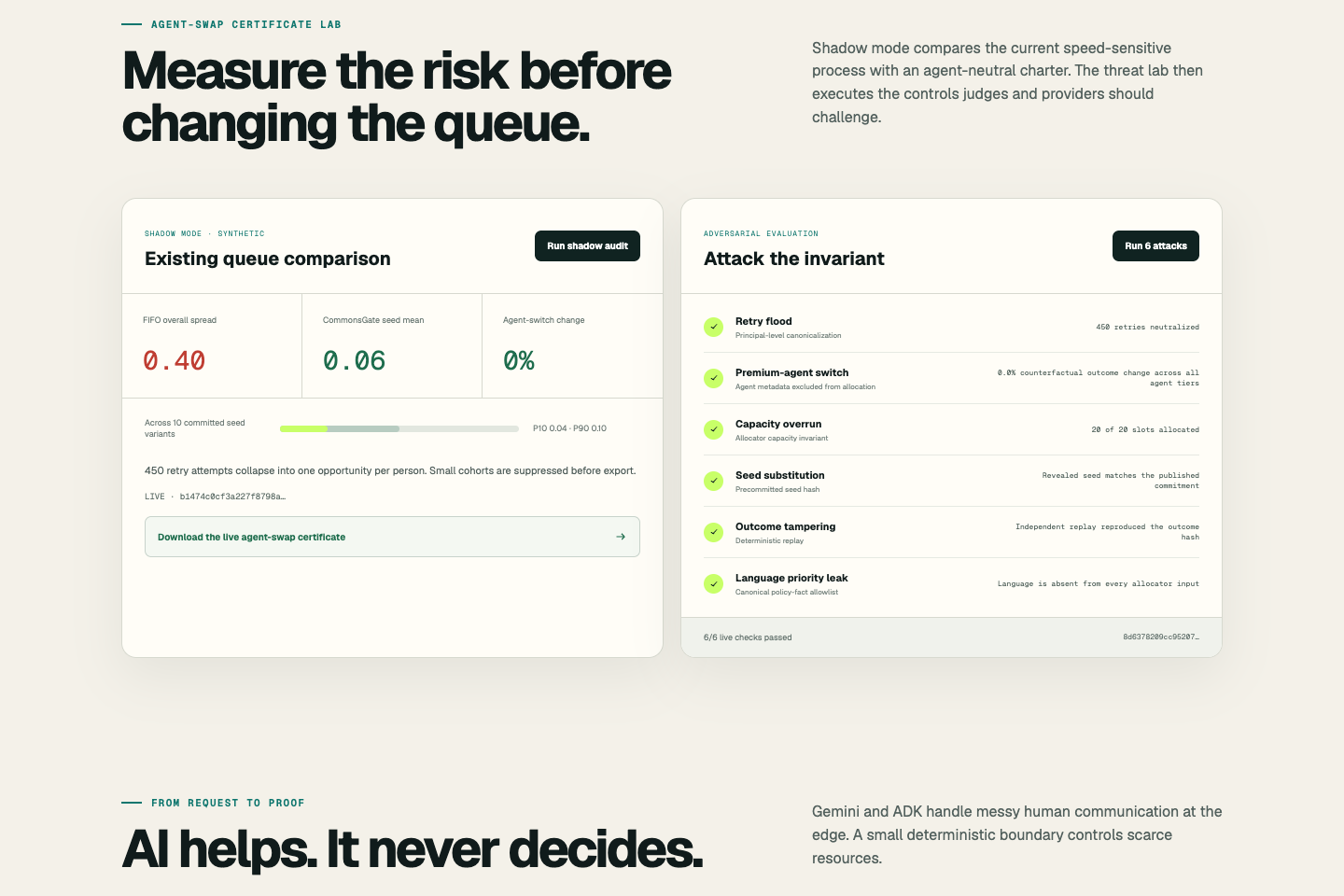
Shadow audit and six attacks test agent switching, capacity, seed integrity, replay, retries, and language leakage.
-
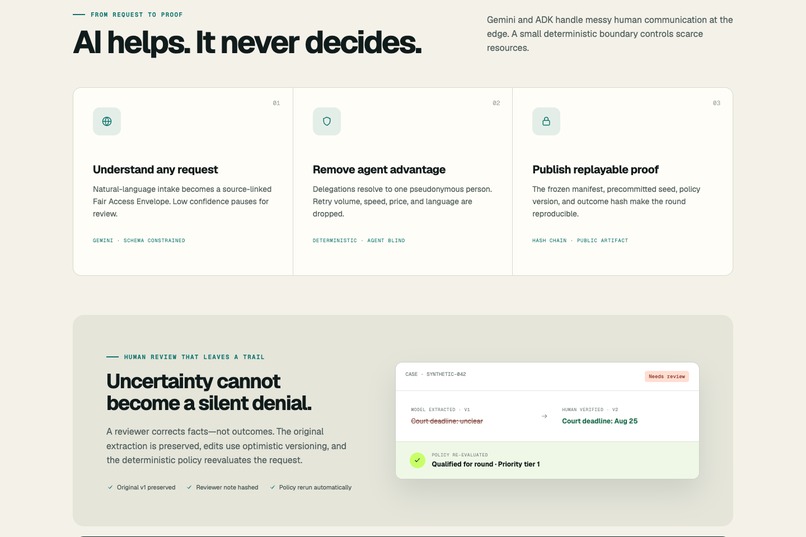
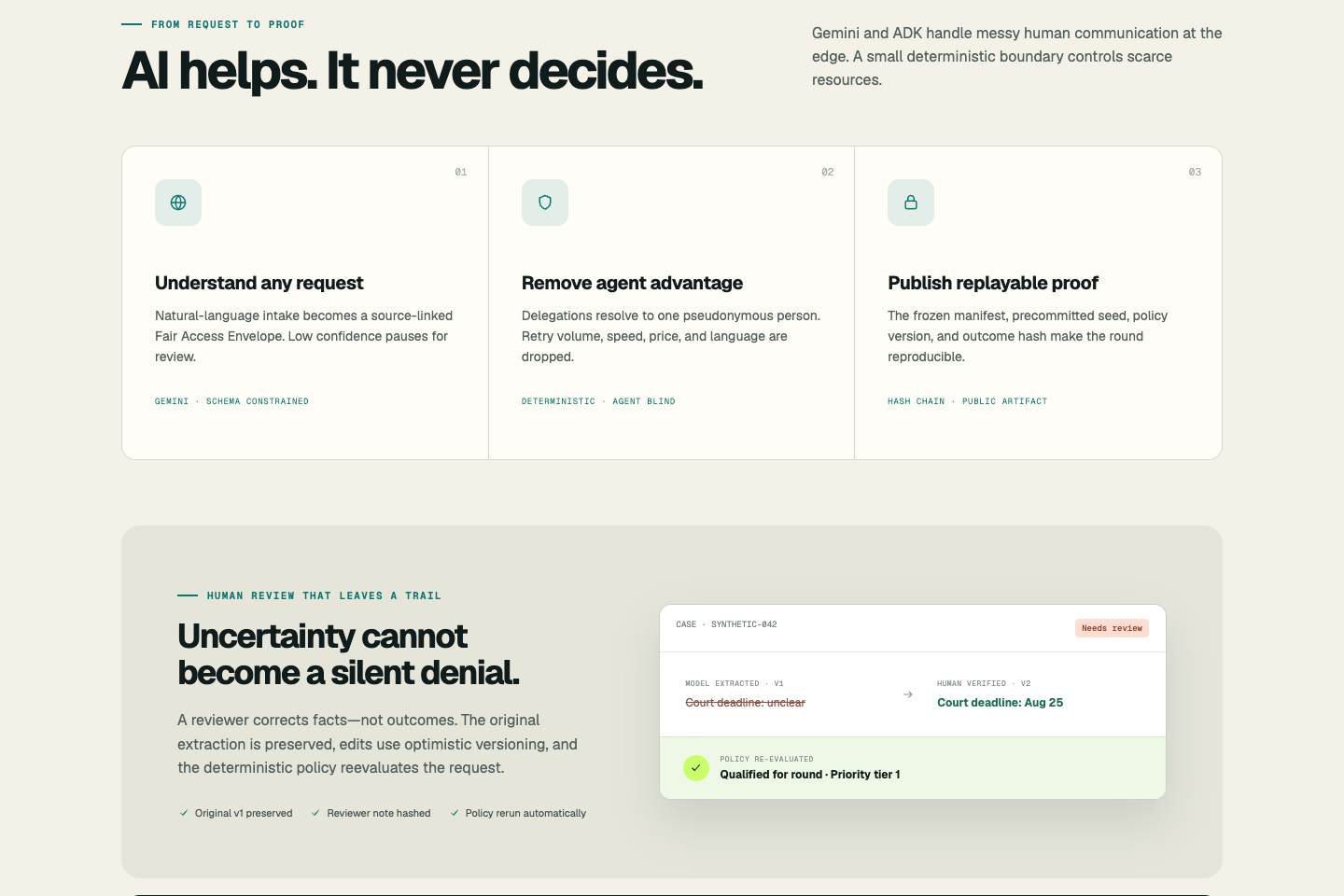
Gemini and ADK handle communication and workflow; deterministic policy alone controls scarce capacity.
-
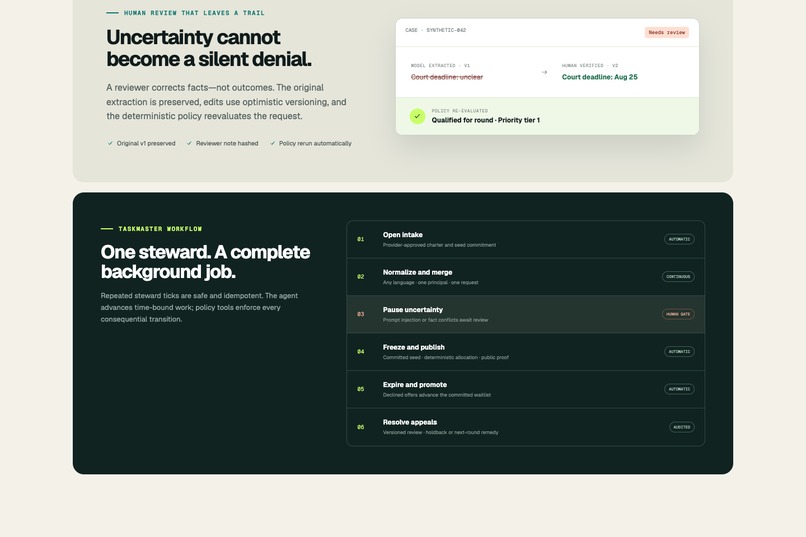
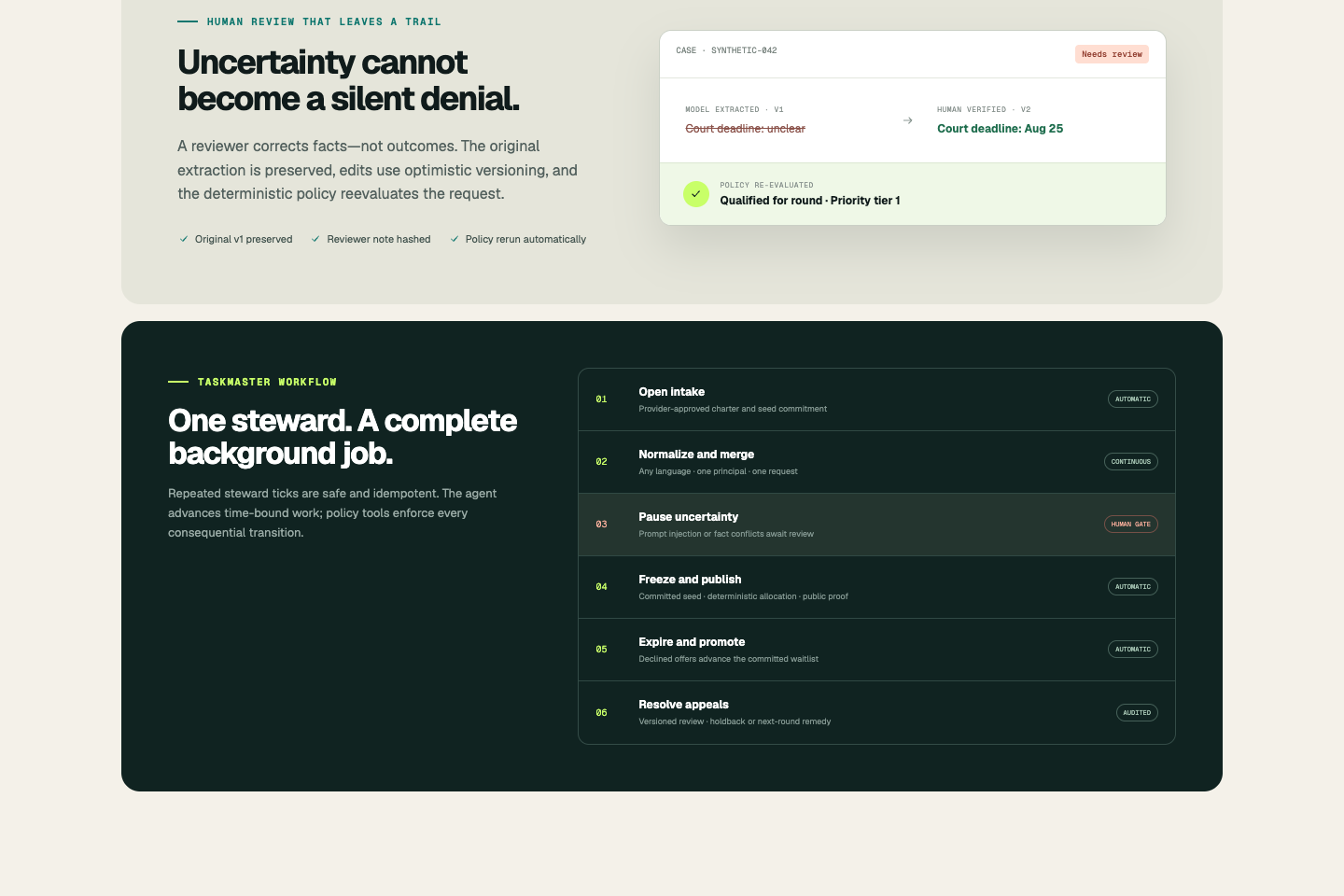
Human review corrects uncertain facts while the ADK steward safely advances the complete background workflow.
-
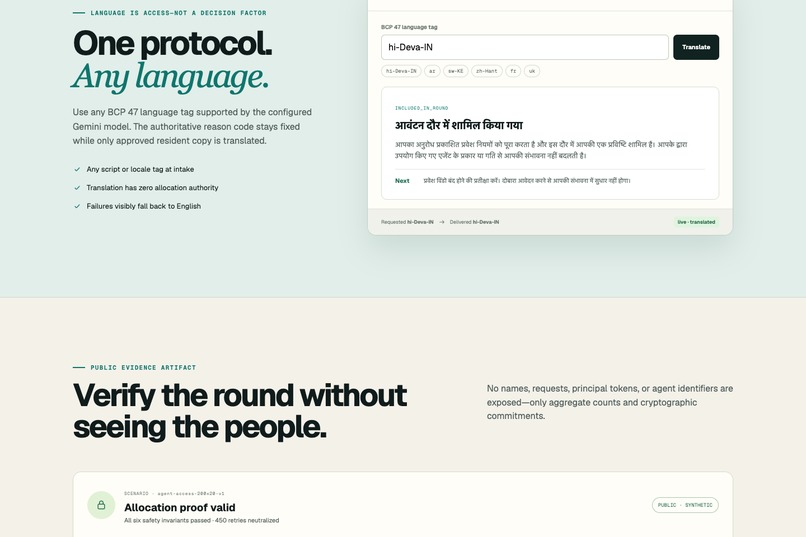
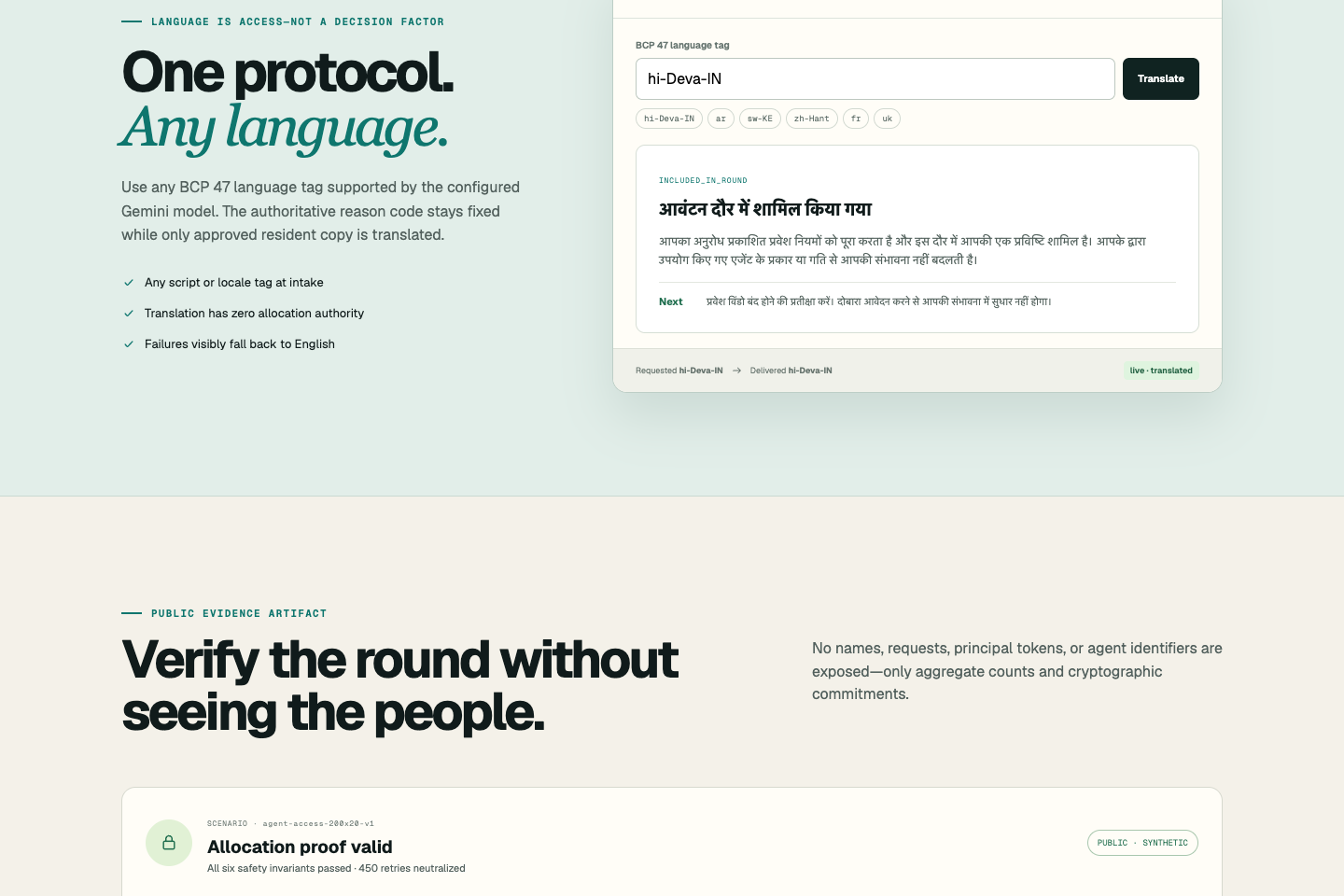
Gemini translates approved explanations while reason codes and allocation facts remain locked.
-
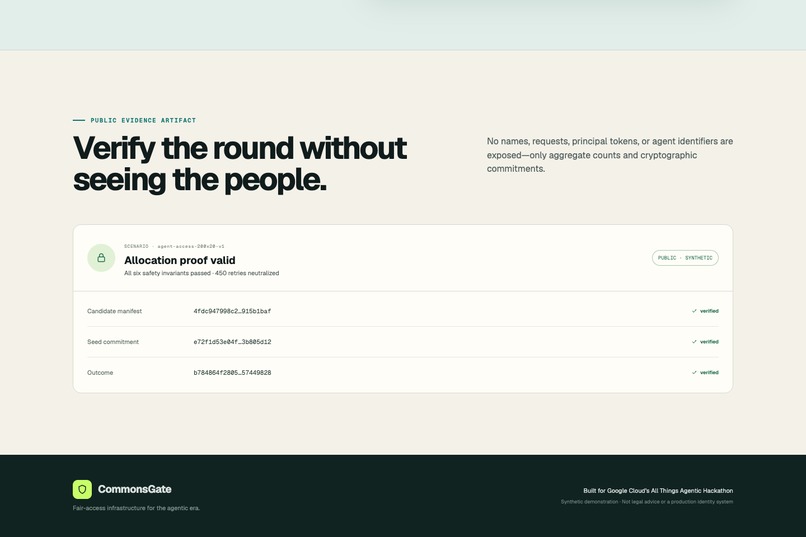
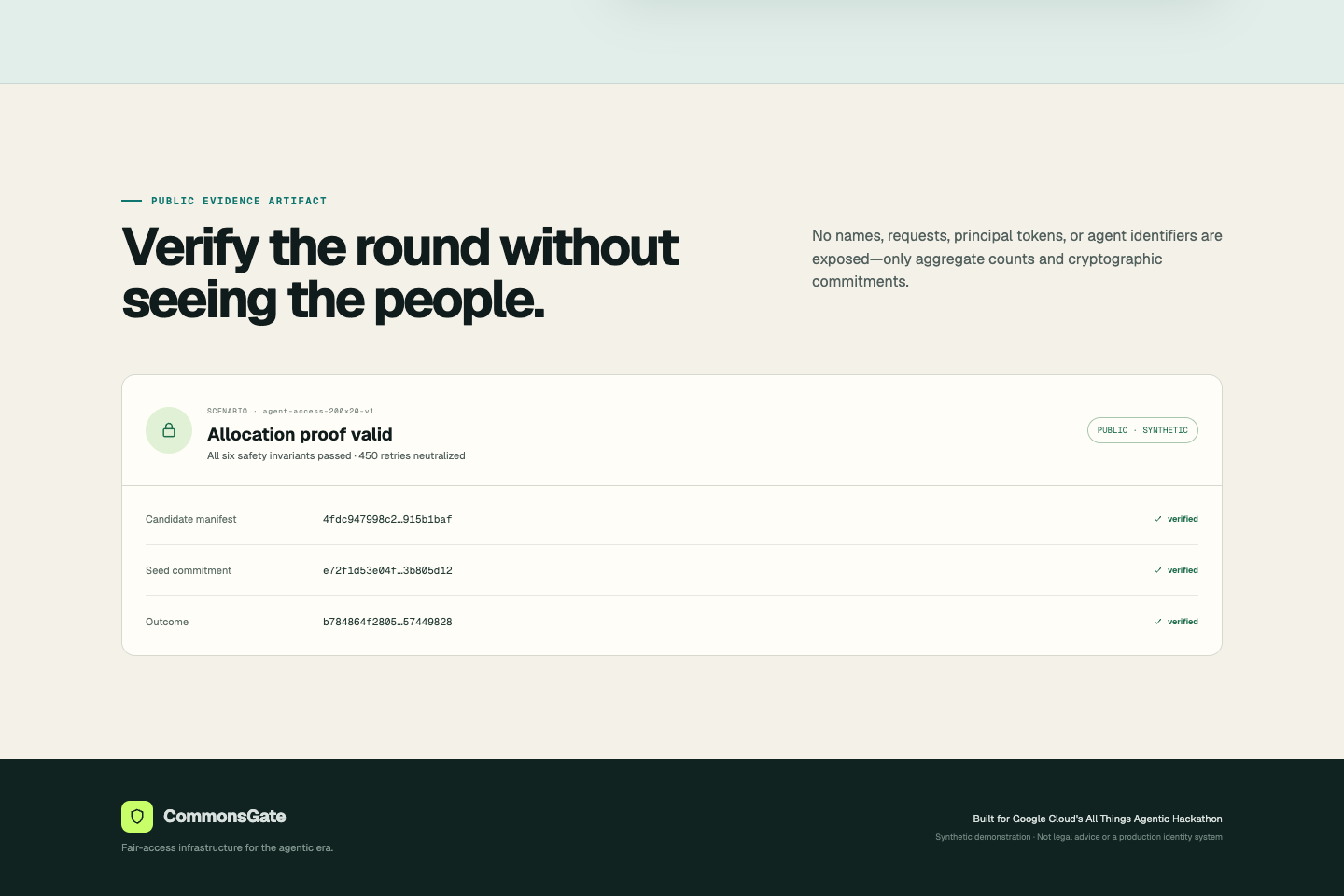
ublic commitments verify the round without revealing people, requests, principal tokens, or agent identities.
Inspiration
AI agents are becoming capable of completing forms, monitoring openings, retrying failed requests, and acting continuously on a person’s behalf. That is useful—but it creates a new access problem.
When appointments or other community resources are scarce, people with faster, premium, always-on agents can submit earlier and more frequently than people using free tools or applying manually. Conventional waiting rooms manage traffic, but they do not prove that changing the software representing a person leaves that person’s opportunity unchanged.
CommonsGate began with one product question:
How can providers accept legitimate AI delegates without turning agent speed, price, language, or retry volume into priority?
Our answer is an agent-neutral trust layer between AI delegates and scarce community capacity.
What it does
CommonsGate autonomously manages the workflow from unstructured intake to a replayable allocation result:
- A person or authorized AI delegate submits a request.
- Gemini 3.5 Flash extracts only explicitly stated facts, with source quotes and confidence.
- CommonsGate verifies the delegation and merges retries or multiple delegates into one pseudonymous principal.
- Conflicting, incomplete, low-confidence, or potentially manipulated submissions pause for versioned human review.
- The system freezes a canonical, agent-blind candidate manifest.
- A deterministic policy engine applies provider-published priority rules, capacity reservations, and a precommitted tie-break.
- A Google ADK Round Steward advances the workflow asynchronously.
- Unanswered offers expire, the deterministic waitlist is promoted, and appeals receive auditable remedies.
- CommonsGate publishes privacy-safe commitments, replay verification, threat tests, and an Agent-Swap Certificate.
Gemini and the ADK agent never decide who receives a slot. They cannot change capacity, priority, policy, the committed seed, or the selected principals.
Agent-Swap Certificate
CommonsGate asks a counterfactual question that ordinary queues do not:
If every decision-relevant fact remains fixed and only the representing agent changes, does the result change?
The certificate independently replays the same applicants through manual, free, standard, and premium agent representations. All four must produce identical manifest and outcome hashes.
In the deployed demonstration, the maximum measured outcome change is 0%.
How we built it
CommonsGate uses a deliberately separated architecture:
- Gemini 3.5 Flash through Vertex AI performs schema-constrained fact extraction and reason-locked translation.
- Google Agent Development Kit 2.x powers the autonomous Round Steward.
- FastAPI and Pydantic enforce typed intake, review, allocation, appeal, and proof contracts.
- Firestore stores authoritative requests, rounds, reviews, appeals, audit events, idempotency records, nonces, and steward leases.
- Cloud Run hosts independently permissioned web, API, agent, and background-job workloads.
- Cloud Scheduler invokes a bounded, retryable Cloud Run Job.
- Secret Manager protects delegation and provider credentials.
- Cloud Logging, Cloud Trace, and OpenTelemetry provide privacy-safe execution evidence.
- Next.js, React, and TypeScript power the public verification dashboard.
- Docker, Cloud Build, and GitHub Actions provide reproducible builds and automated verification.
The Fair Access Envelope intentionally excludes agent tier, raw wording, arrival speed, retry count, raw intake text, and submission timestamp from allocation inputs.
Challenges we ran into
Separating autonomous action from decision authority
The agent needed enough authority to complete a real workflow without receiving the power to choose winners. We solved this with narrow tools that expose safe lifecycle transitions rather than raw allocation controls.
Handling repeated background delivery
Cloud schedulers may deliver more than once. Every lifecycle transition therefore had to be idempotent, and overlapping workers required a durable Firestore lease.
Proving neutrality instead of displaying a fairness claim
A dashboard saying “fair” is not evidence. We implemented canonical manifests, seed commitments, deterministic replay, hash-chained audit events, adversarial tests, and the downloadable Agent-Swap Certificate.
Keeping human review meaningful
A review warning is ineffective if automation continues anyway. CommonsGate stops the round when unresolved conflicts or prompt-injection signals exist. The ADK agent has no review-bypass tool.
Supporting language without changing decisions
Translation happens only after the decision, using approved reason templates. Status, reason code, and allocation facts remain locked, and failures visibly fall back to approved English.
Accomplishments that we're proud of
- Built and deployed the complete intake-to-proof workflow on Google Cloud.
- Demonstrated Gemini 3.5 Flash extraction and translation through Vertex AI.
- Deployed separate web, API, private ADK/A2A agent, and scheduled-job workloads.
- Verified Firestore persistence across multiple Cloud Run revisions.
- Demonstrated an autonomous run that paused for three human reviews before freezing and publishing the round.
- Built six executable adversarial checks covering retries, agent switching, capacity, seed integrity, replay, and language leakage.
- Created a downloadable certificate showing identical results across four agent representations.
- Passed 39 backend tests, Python linting and type checking, TypeScript validation, production Next.js builds, and dependency security audits.
Our synthetic fairness study models 650 attempts from 200 people competing for 20 appointments. Naive FIFO produces an Agent Advantage Index of 0.40. CommonsGate neutralizes 450 duplicate attempts and produces an exact 0% counterfactual outcome change when only the agent representation changes.
What we learned
- Models add the most value at the evidence boundary, not the final decision boundary.
- Autonomous systems become safer when tools expose bounded state transitions instead of unrestricted internal controls.
- Determinism is not sufficient unless the decision manifest also excludes agent-derived advantages.
- Hashes are meaningful only when canonicalization and replay behavior are publicly defined.
- Human oversight must be an enforced state transition, not decorative approval UI.
- Agent neutrality is stronger as an executable counterfactual test than as a policy statement.
What's next for CommonsGate
The next product layer is an Agent Access Neutrality Observatory. Providers will be able to submit de-identified shadow-run manifests and receive independently verifiable neutrality certificates without changing live outcomes.
The production roadmap also includes:
- Cloud KMS-signed certificates and a provider-independent verifier
- Approved asymmetric identity issuers and revocation
- Service-to-service Cloud Run identity and distributed abuse controls
- Authenticated provider and reviewer workspaces
- Accessibility, retention, deletion, and recovery workflows
- Validation with community-service intake teams
- Governed multi-provider overflow and referral coordination
The current public deployment uses entirely synthetic identities, rules, and evidence. CommonsGate allocates intake opportunities—not legal representation, benefits, housing, healthcare, or emergency services.
Built With
- a2a
- cloud-build
- cloud-logging
- cloud-run
- cloud-scheduler
- cloud-trace
- docker
- fastapi
- firestore
- gemini-3.5-flash
- github-actions
- google-adk
- google-cloud
- next.js
- opentelemetry
- pydantic
- python
- react
- secret-manager
- typescript
- vertex-ai


Log in or sign up for Devpost to join the conversation.