Inspiration
We watched agents fail in a way no one had a word for yet.
An agent would spend forty minutes learning the auth quirks of our codebase, then start tomorrow knowing nothing. That's the failure everyone talks about — lost context. But the one nobody talked about was worse: the agent that did real work, produced a flood of events, and no human ever found out. When it finally needed a decision — "should I deploy this?" — it had no channel that carried enough context for a person to answer well, and no way to remember the answer next time.
We noticed both failures are actually one failure. If the memory is genuinely shared between humans and agents, then the human's decision isn't an interrupt — it's just another memory the agent recalls next time. Every product we'd seen treated memory as a bolt-on: a vector store next to an app, a RAG wrapper, a session cache. The hackathon challenge — agents that think, act, and remember, reliably, globally, at any scale — was exactly the problem we wanted to build for: memory as the product, not an afterthought.
What it does
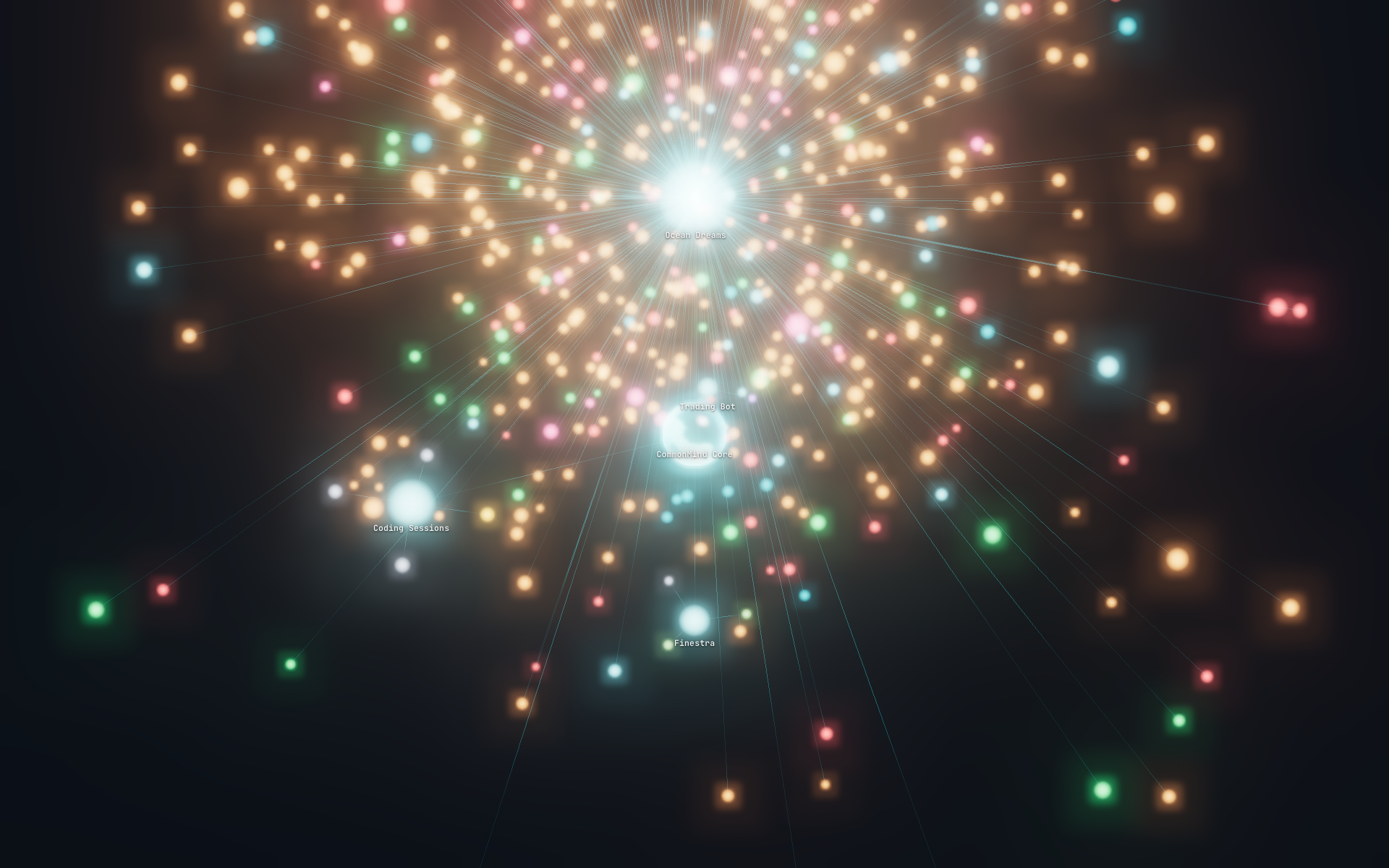
CommonMind is shared memory for humans and agents — transactional, distributed, and engineered not to go down. One memory core, four unrelated products prove it isn't a feature.
The core loop today is capture → recall → act, with human approval:
- Capture — an agent or person records what happened. The row and its embedding commit in one CockroachDB transaction.
- Recall — semantic search over everything captured, via CockroachDB's C-SPANN vector index. Milliseconds, in-database.
- Act — CommonMind doesn't act; the connected agent or app does, and most of what it does — including consequential moves like executing a trade — happens autonomously and is captured as memory automatically, no human required. The exception is the genuinely risky call: there, the agent requests approval through the same MCP/CLI surface it captures and recalls through, and waits for a human to approve, edit, or deny before proceeding. Either way — autonomous action or human decision — what happened commits as memory the agent recalls next time.
A fourth step, improve — a background worker that scores novelty and reorganises memory so recall keeps getting better over time — is designed into the schema as the next layer. It isn't running yet; see What's Next.
Concretely, on a Solana trading bot running on a Raspberry Pi over Tailscale, CommonMind records every trade's rationale, answers "why did we buy this in March?" in milliseconds, stops to get explicit approval before a risky entry instead of acting alone, and keeps its context when a database node is killed on camera.
What it is not
A RAG wrapper— not a vector store bolted onto a chat appA notification service— not a pager with a database in front of itA cache— CockroachDB is the system of record, not a cache in front of one
How we built it
The invariant that held everything together: a memory record and its embedding commit in the same transaction. Every design decision defers to it:
$$ \text{txn} \left( \text{INSERT } \texttt{memory_records};\; \text{INSERT } \texttt{memory_embeddings} \right) \Rightarrow \text{atomic} \wedge \text{retrievable} $$
There is no window where something happened but isn't yet retrievable. No consumer — consolidation worker, CDC pipeline, human — can observe a half-written memory. A PR that splits these writes is wrong regardless of how fast it is.
The stack, chosen to remove infrastructure rather than add it
| Layer | Choice | Why |
|---|---|---|
| Memory | CockroachDB (serverless, on AWS) | Global, always-on, transactional and vector in one store |
| Recall | C-SPANN over VECTOR(1024) |
New vectors searchable immediately — no rebuild, no HNSW graph to shard |
| Embeddings | Amazon Bedrock — Titan Text Embeddings V2 | Retrieval-optimised, $0.02 / M input tokens — live |
| Compute | AWS Lambda + Function URLs | Serverless agent execution, scales to zero |
| Event source | CockroachDB changefeed → SNS → SQS + DLQ | The commit is the event — no outbox, no dual-write bug. SNS/SQS/DLQ are provisioned in us-east-2 today; the changefeed and Lambda bridge that put live traffic through them are next |
| Artifacts | Amazon S3 | Snapshots and runbook sources off the hot path |
Request paths
| Path | Flow |
|---|---|
| Capture | agent → Lambda → Bedrock (embed) → CockroachDB (one txn) — live → changefeed → SNS → SQS → Lambda fanout → push — wired, not yet carrying traffic |
| Recall | agent → Lambda → Bedrock (embed query) → C-SPANN search → joined rows → agent — live |
| Approve | agent requests → decision row commits → human approves, edits, or denies via CLI/MCP — live → decision commits as new memory → agent resumes with it. (Push notification for this step ships once the event pipeline above goes live.) |
Challenges we ran into
- CockroachDB is not Postgres. Our first vector index used
USING hnsw (...). It failed — CockroachDB doesn't implement HNSW at all; it uses C-SPANN and wantsCREATE VECTOR INDEX ... USING vector_cosine_ops. "It's Postgres compatible" made the wrong answer look right. We wrote the rule down: Postgres is a useful prior, never an authority. The CockroachDB doc wins. - The vector dimension was wrong. The schema originally said
VECTOR(768)— a dimension no Bedrock model actually emits. We moved to Titan v2's native 1024, and it changed downstream: index size, cost math, embedding calls. - Sequential PKs are a hotspot.
memory_eventsis our hottest write path;BIGSERIALfunnels every insert into one range. We useunique_rowid()so the load shards across ranges — a system that only claims to scale isn't the same as one that does. - The database is the event source. The temptation was a queue-first design. We rejected it: publishing to a queue from app code reintroduces the dual-write problem. CDC off the committed row makes that bug class unrepresentable — the reasoning that shaped the event-source layer above, even ahead of the changefeed itself going live.
- SNS alone loses pushes. A Lambda subscribed directly to SNS has no retry buffer — one failed push becomes a permanently lost notification. SQS + DLQ between them was non-negotiable, provisioned from day one alongside SNS.
- It passed on every machine — except the one that mattered.
npm testwas green on our Node 22 dev machines but silently failed on Node 20:node --testwith a quoted glob can't expand the pattern, and glob support only landed in Node 21/22. Meanwhilepackage.jsondeclared"node": ">=20", so a Node 20 user was told their environment was supported when it wasn't. The fix was one line — unquote the glob so the shell expands it, which works on both versions without forcing anyone to upgrade. It taught us why the "passes on a clean clone" checklist item exists: an environment difference isn't a bug in the user's setup, it's a bug in your claim about your own project.
Accomplishments that we're proud of
- [x] The atomic-write invariant, stated as a hard rule every PR is judged against
- [x] One shared memory, four working products — a Solana trading bot on real Raspberry Pi hardware, Finestra (an AI agent on a second real Raspberry Pi), our own dev-team's coding sessions, and a game where the creature remembers you
- [x] A decision that's also memory. Every agent request for approval, and the human's answer, commits transactionally to the same memory layer as everything else — attributable, auditable, replayable, over CLI/MCP today. The three-tier alert model (Silent, Alert, Priority) is designed and ready for the push layer that ships next
- [x] Honest resilience. Every range is replicated 3× and coordinated by Raft — lose the leaseholder and the cluster re-elects in seconds, no operator
- [x] Zero idle cost. Bedrock + Lambda + SNS/SQS + S3 + CockroachDB all scale to zero
What we learned
term : The human is not a failure mode A decision isn't an interrupt to be handled — it's data to be remembered. The exchange becomes memory the agent recalls next time.
term : Failing closed beats failing stale An agent told "memory unavailable" is safer than one told something that was true ten minutes ago. We would rather error than mislead. ^[Stale memory acted on with full confidence is worse than an error — the README's "why this database" section spells this out.]
term : Durability must never depend on the delivery path A push can fail, retry, or dead-letter and the memory is still correct — it was committed before anything downstream knew it existed.
term : One measured number beats five aspirational ones A claim a judge can't reproduce on demand is a claim a judge can dismantle. ==Performance figures get benchmarked or cut.==
The resilience math, stated precisely
"Never goes down" is marketing. This is the engineering:
| Property | Guarantee |
|---|---|
| Replication | every range replicated 3× by default |
| Consensus | Raft — a write commits once a majority of replicas acknowledge |
| Survivable failures | (RF − 1) ÷ 2 → 3× survives one node; 5× survives two |
| Under partition | CP — below quorum, a range goes unavailable rather than serving stale data |
| Isolation | Serializable by default |
Replication factor three means a single node loss leaves a live quorum:
$$ \text{quorum}(RF{=}3) = \left\lfloor \tfrac{3}{2} \right\rfloor + 1 = 2 \quad\Rightarrow\quad \text{kill 1 node} \Rightarrow \text{memory survives} $$
Vector recall is cosine similarity over the embedding: the recall rank is the same whether you measure in the database or end-to-end, but the latency differs:
$$ \text{similarity}(a, b) = \frac{a \cdot b}{\lVert a \rVert_2 \cdot \lVert b \rVert_2} \in [-1, 1] $$
We picked Titan v2 at 1024-dim over the alternatives:
| Model | Dims | Verdict |
|---|---|---|
| Titan v2 (default) | 1024 | ✅ retrieval-optimised; $0.02 / M input tokens |
| Titan v2 (reduced) | 512 / 256 | Matryoshka truncations ~99% / ~97% recall — after submission |
| Titan v1 | 1536 | ❌ 5× the token price, ~33% larger index |
What's next
The AWS event pipeline is provisioned but not carrying traffic yet: the CockroachDB CREATE CHANGEFEED and the Lambda bridge that would push committed decisions out to a phone in real time are the last mile on top of the CLI/MCP approval flow that's live today. After that: the consolidation worker that closes the loop's fourth step, improve.
Links
- Source code: https://github.com/LandCruiserWorld/commonmind
- Live demo: https://commonmind.agent9.dev
- Architecture diagram:
assets/images/aws-serverless-architecture.svgin the repo - License: Apache-2.0
Built With
- agent-skills
- amazon-bedrock
- amazon-sns
- amazon-sqs
- amazon-web-services
- aws-lambda
- c-spann
- ccloud-cli
- claude-code
- cockroachdb
- cockroachdb-cloud
- codex
- coffee
- cursor
- distributed-vector-indexing
- mcp-(model-context-protocol)
- node.js
- opencode
- pgvector-wire-compat
- raspberry-pi
- react
- tailscale
- three.js
- typescript
- vector-search


Log in or sign up for Devpost to join the conversation.