Inspiration
Deciding what to do as a group sounds simple until everyone's tastes are different.
One friend loves independent films, another is passionate about electronic music, and someone else would rather discover a great restaurant or explore a new place. Group decisions often become a compromise, a long discussion, or a choice based on whoever speaks the loudest.
We wanted to explore a different approach: What if a group's different cultural interests could become the starting point for discovering something everyone might enjoy?
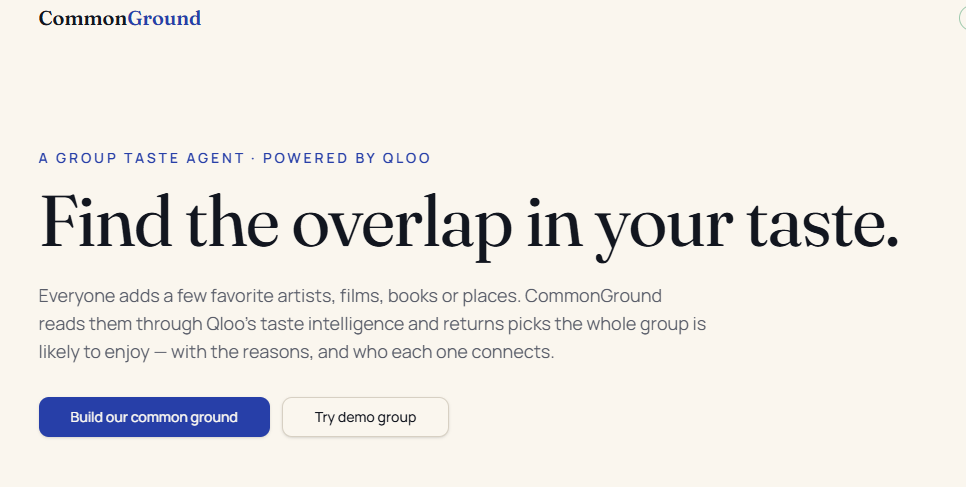
That idea inspired CommonGround. We set out to build a tool that finds meaningful connections between individual preferences and turns them into shared cultural discoveries using Qloo's taste intelligence.
What it does
CommonGround is a group cultural discovery agent for friends, couples, families, and teams.
Users create a group of 2–5 participants. Each person adds a few favorite artists, musicians, films, books, restaurants, places, brands, or video games. The group can also specify a city and the kind of experience they are looking for.
CommonGround then:
- Resolves individual favorites into Qloo entities.
- Combines the resolved entities into group-level taste signals.
- Uses Qloo Insights to discover recommendations across relevant categories.
- Ranks recommendations using returned affinity and explainability information where available.
- Shows which participants' interests connect to each recommendation.
- Creates a lightweight mini-plan from the resulting recommendations.
The application also provides a transparent activity trace so users can follow the main stages of the discovery process.
How we built it
We built CommonGround with Lovable, using React, TypeScript, TanStack Start, Vite, and Tailwind CSS.
Qloo is the core intelligence layer of the application. We use two primary API endpoints:
- Qloo Search API (
/search): Resolves free-text favorites into Qloo entity IDs. - Qloo Insights API (
/v2/insights): Uses the resolved entities throughsignal.interests.entitiesto retrieve recommendations across relevant categories.
The server-side TypeScript workflow coordinates the process:
Resolve interests → Map group taste signals → Discover shared affinities → Rank recommendations → Compose a mini-plan.
We use Qloo's returned affinity and explainability information when available. A transparent group-coverage heuristic helps rank the recommendations, rather than claiming to calculate an exact measure of group consensus.
API credentials are stored as server-side Lovable secrets and are never embedded in frontend code.
We also implemented a deterministic demo mode with clearly labelled sample recommendations, allowing people to explore the experience without needing their own API credentials.
Challenges we ran into
One of the biggest challenges was translating different kinds of cultural preferences into a common recommendation process.
Music, films, books, places, brands, and games have different entity types and recommendation contexts. We needed to resolve those inputs correctly before combining them into group-level taste signals.
Another challenge was making recommendations understandable. Returning a list of entities is not enough; users need context about why a recommendation appeared and which interests may connect it to the group. We therefore incorporated Qloo's explainability data where available and made the ranking approach transparent.
We also had to handle API response differences, missing matches, rate limits, and credential configuration while keeping the experience usable. A clearly labelled demo mode and server-side API handling helped us address these practical requirements.
Accomplishments that we're proud of
We are proud to have turned a simple group-decision problem into a working Qloo-powered discovery experience.
Some of the accomplishments include:
- Building an interactive group preference builder for up to five participants.
- Supporting multiple cultural categories in one discovery workflow.
- Successfully testing real Qloo entity searches and Insights requests.
- Combining resolved entity IDs into group-level taste signals.
- Creating explainability-aware recommendation cards.
- Building an activity trace that makes the workflow understandable.
- Adding a mini-plan generated from recommendations.
- Providing a demo experience that does not misrepresent sample fixtures as live Qloo results.
- Publishing the application and making its source code publicly available under the MIT License.
Most importantly, we built the complete journey from individual preferences to a shared shortlist, rather than stopping at a static concept or landing page.
What we learned
This project helped us understand how cultural affinity data can be used across different domains to support more contextual recommendations.
We learned that entity resolution is an important first step: the quality of the downstream recommendation process depends on correctly identifying the interests users provide.
We also learned that explainability matters. People should have some context for why a recommendation appears, especially when a system is combining several people's preferences.
Another important lesson was that group recommendations require careful interpretation. An affinity score is not a guarantee that everyone will enjoy something. It is a signal that can support discovery, not replace human judgment.
Finally, we learned to keep API credentials server-side, design clear fallback behavior, and distinguish actual API responses from illustrative demo data.
What's next for CommonGround
CommonGround is a starting point for more intelligent group discovery.
Next, we would like to:
- Improve group preference aggregation and fairness across participants.
- Explore more Qloo-supported cultural categories and recommendation contexts.
- Add richer location-aware discovery and practical local experiences.
- Improve the explanation of how individual interests contribute to shared recommendations.
- Introduce collaborative group sessions where participants can contribute preferences together.
- Explore more contextual itinerary generation while keeping recommendations grounded in actual API results.
Our long-term goal is to make group discovery less about choosing what one person likes and more about finding the unexpected connections that bring everyone's interests together.
Built With
- qloo

