Inspiration
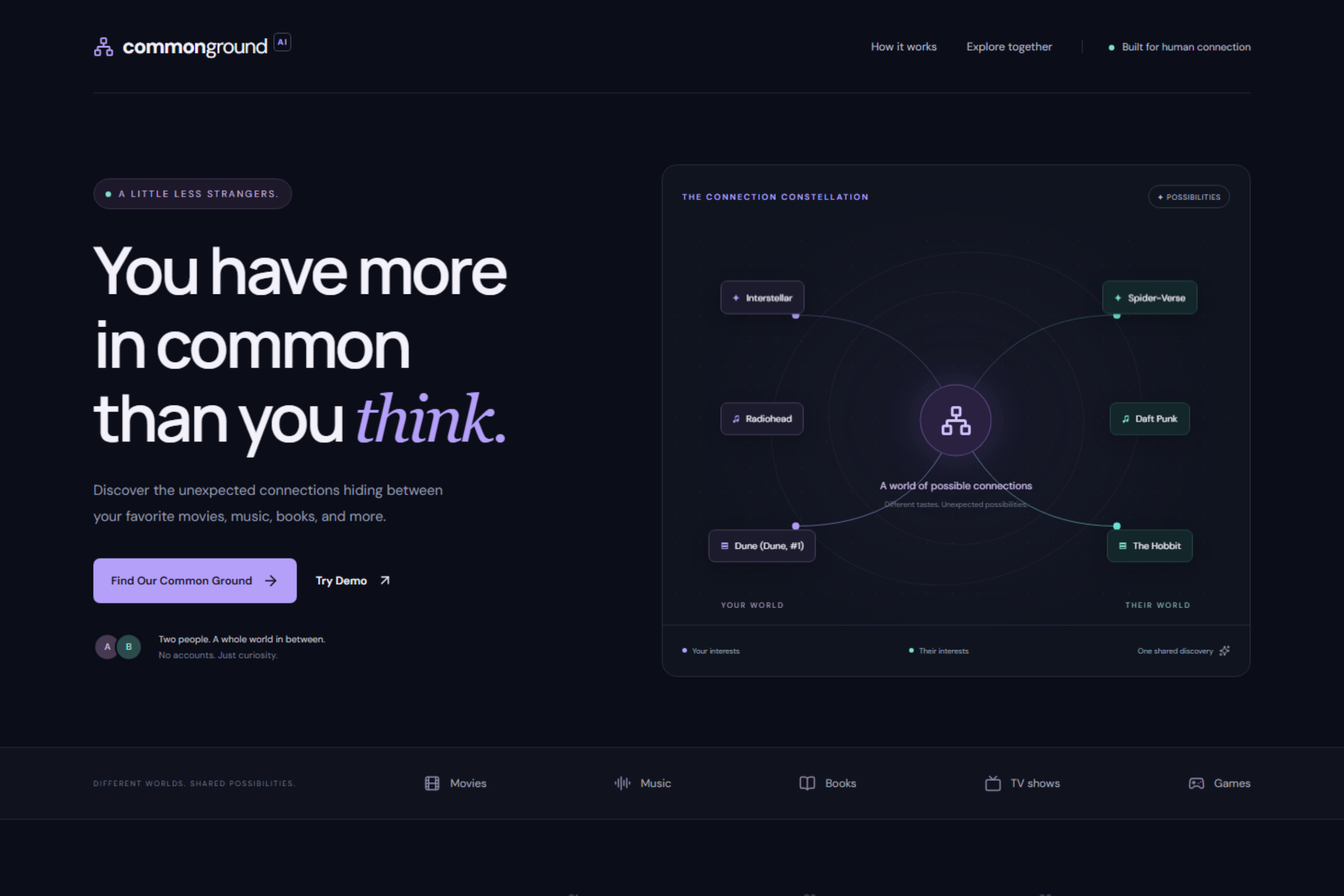
A meaningful connection often starts with something small: a song, a story, or a world someone loves.
But discovering that connection can take time. Especially when two people seem to have completely different tastes. Comparing favorite lists only tells us what already matches. We wanted to uncover what two people could discover together.
That became CommonGround AI: less time searching for common ground, more time connecting.
What it does
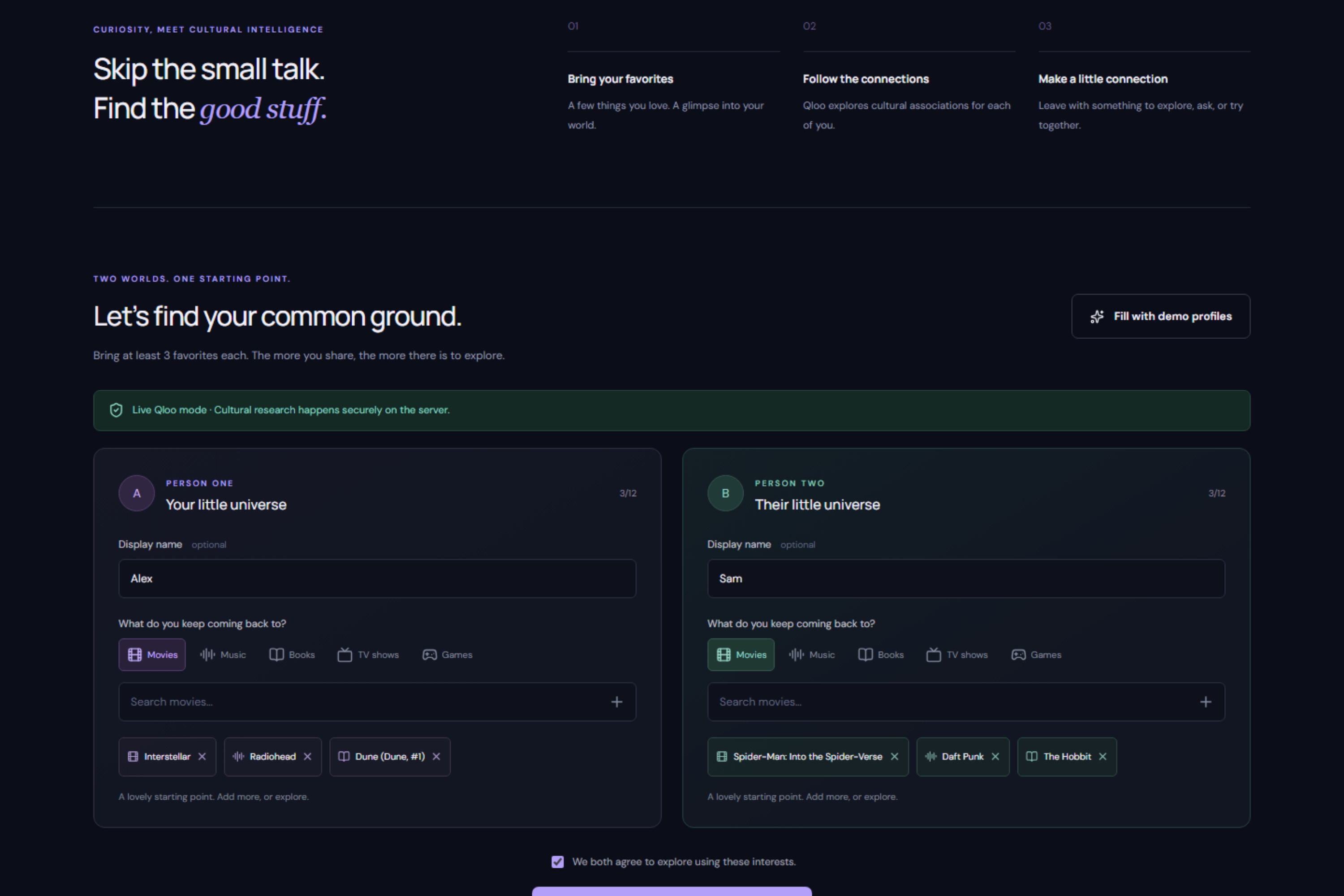
CommonGround AI helps two people turn their cultural interests into shared discoveries.
Each participant selects favorites across movies, music, books, TV shows, and video games. Our agent researches both profiles independently using Qloo, finds recommendations that appear in both result sets, and turns them into:
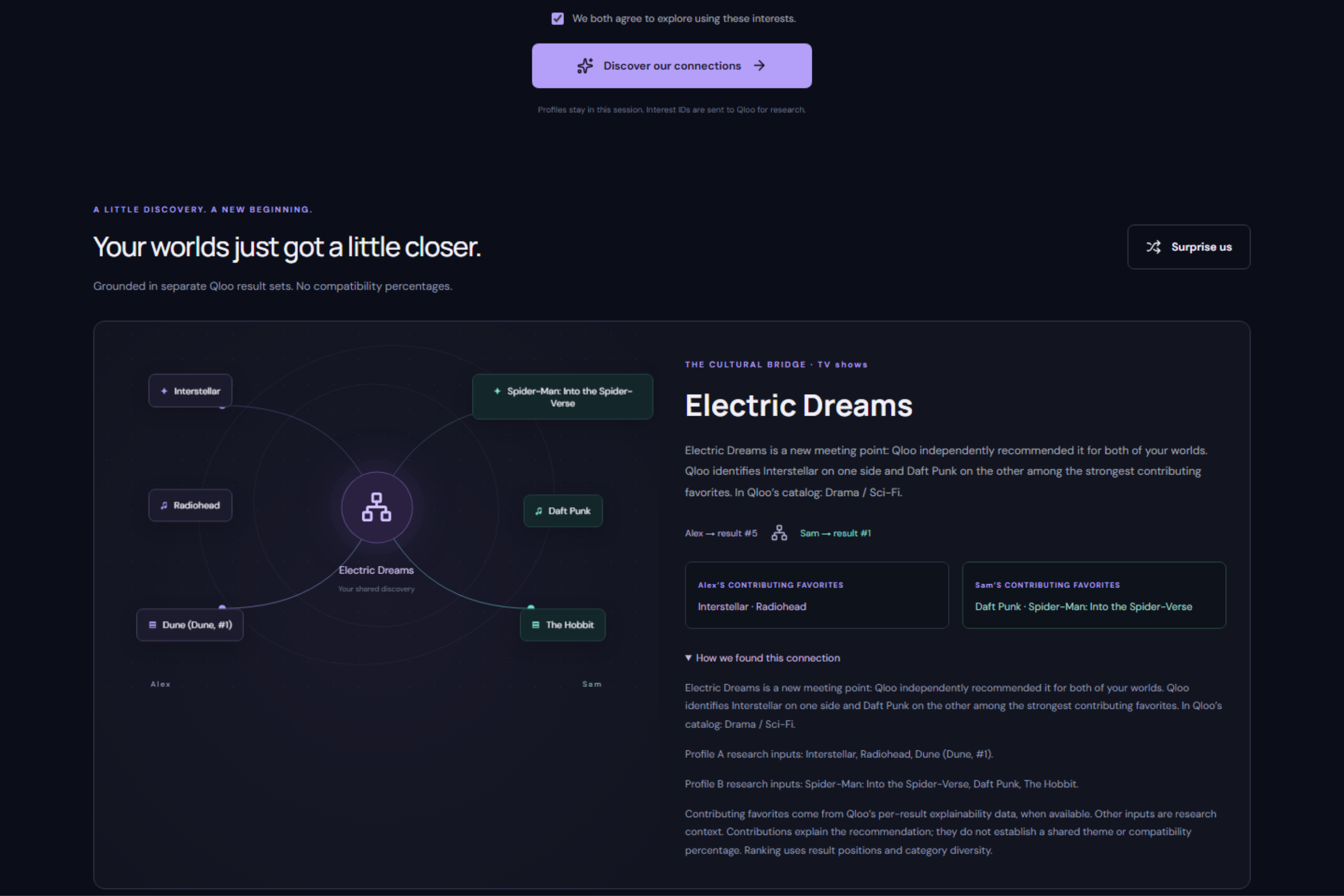
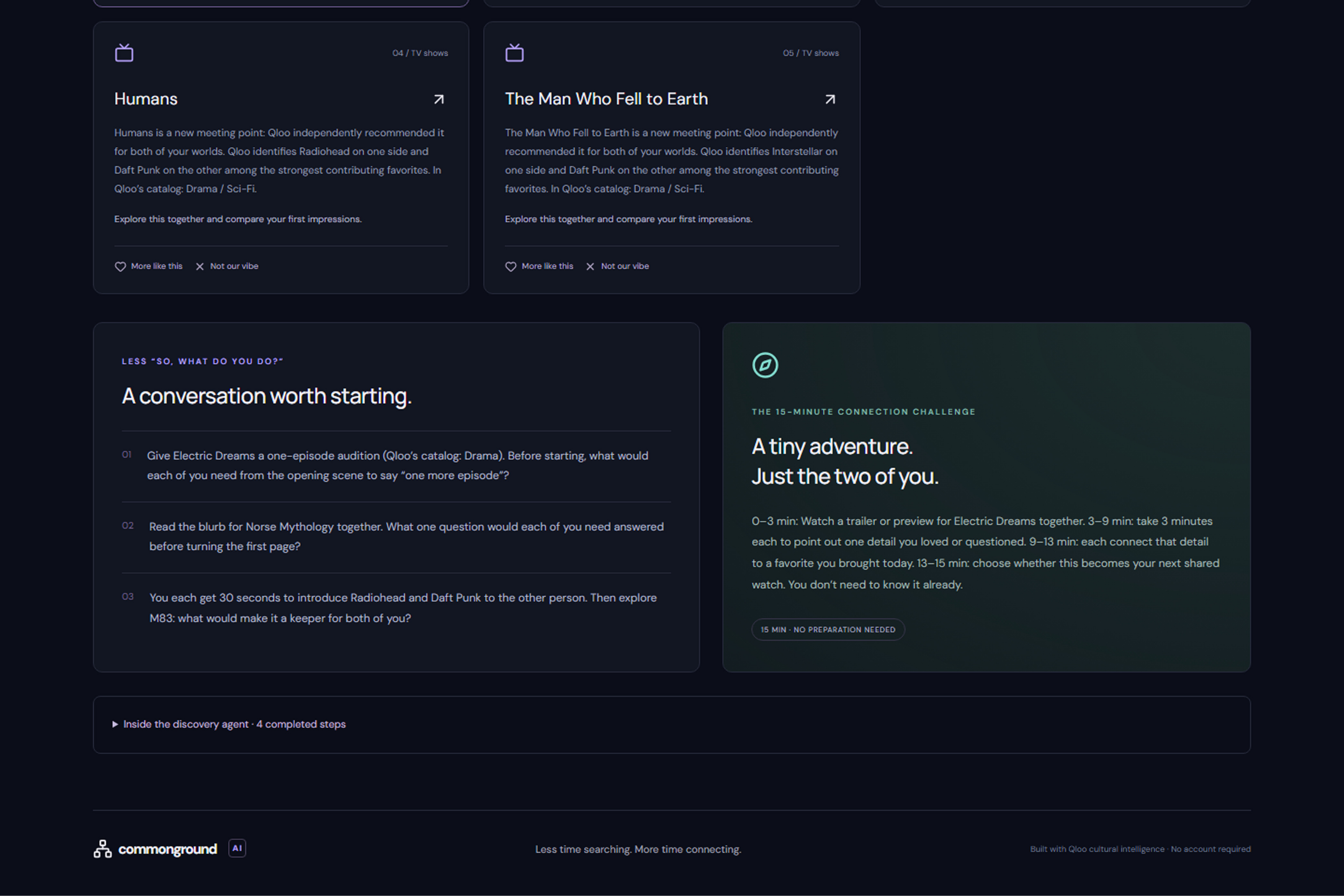
- A cultural bridge: a new discovery supported by both participants’ preferences.
- An interactive connection constellation: a visual meeting point between their cultural worlds.
- Explainable recommendations: contributing favorites from each person, when Qloo provides that evidence.
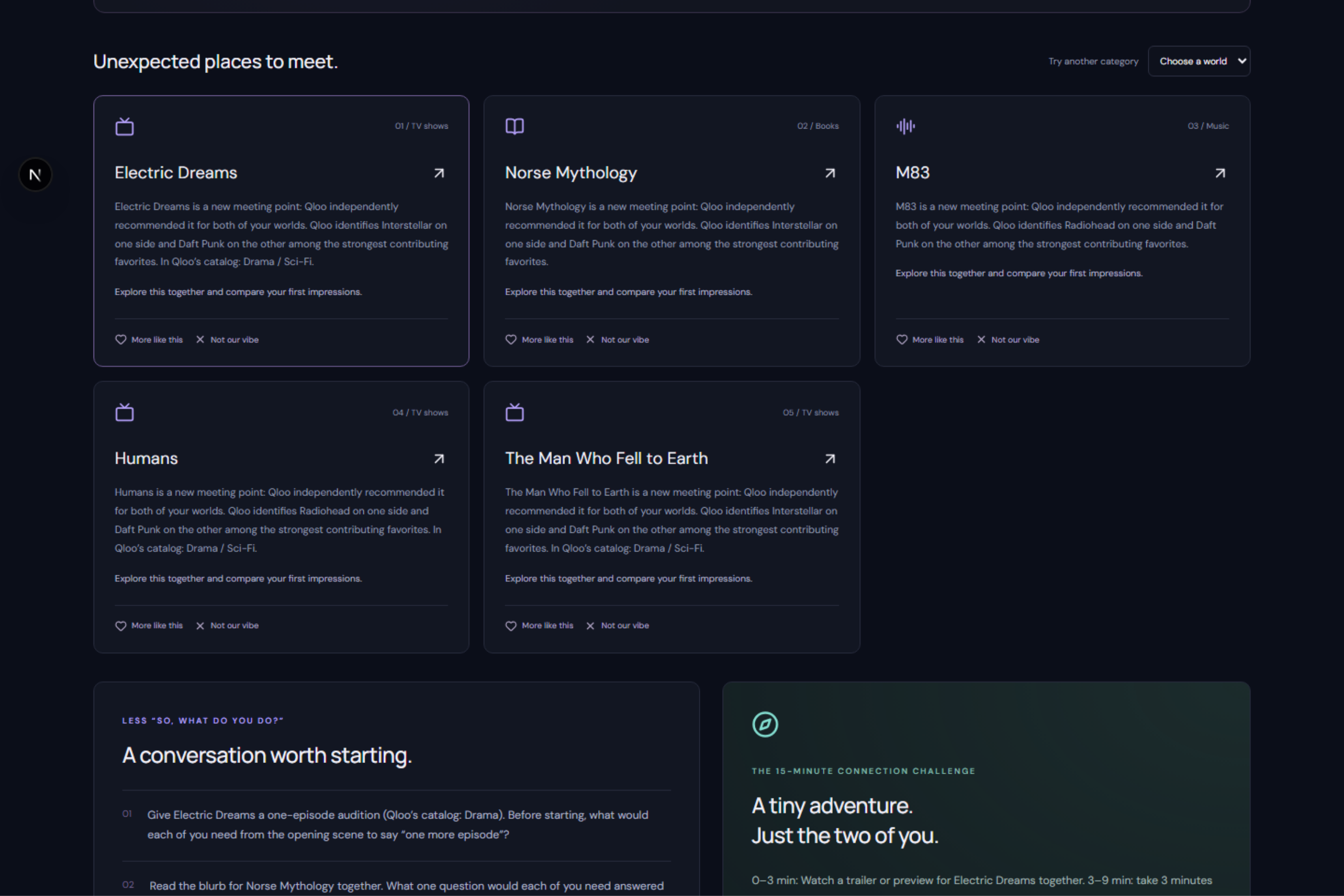
- Three conversation starters: specific invitations to explore the discoveries together.
- A 15-minute connection challenge: a small shared activity that turns a recommendation into an interaction.
No account is required. Both participants can complete the experience in the same browser.
How Qloo powers the experience
Qloo is central to the discovery process.
Its Search API resolves selected favorites to real cultural entity IDs. The Insights API then explores recommendations separately for each participant across five cultural categories.
Our agent compares those results to identify shared recommendations even when the original favorites have no overlap. Qloo’s per-result explainability data helps reveal which favorites contributed to each recommendation.
For example, our live demo profiles had zero identical favorites, yet produced shared discoveries including M83, Norse Mythology, and Electric Dreams.
We distinguish recommendation evidence from creative conversation prompts. We do not invent cultural relationships or present application rankings as compatibility percentages.
How we built it
We built CommonGround AI with Next.js, React, TypeScript, and server-side API routes, deployed on Vercel.
The agent follows a tool-driven workflow:
- Validate both profiles and their selected entities.
- Research each profile independently through Qloo.
- Discover overlapping recommendations.
- Rank candidates and prioritize category diversity.
- Create grounded explanations, conversation prompts, and a shared activity.
- Adapt the next research pass using participant feedback.
“More like this” adds a discovery to the research signals. “Not our vibe” excludes it. Participants can also explore another category or request unseen suggestions.
The constellation uses lightweight SVG. API credentials remain server-side, and temporary profiles do not require a database.
Challenges we ran into
The hardest challenge was making explanations useful without overstating the evidence.
A recommendation appearing for both profiles supports a shared discovery, but does not automatically prove a specific shared theme. We used Qloo’s contribution metadata where available and retained honest fallback explanations where it was not.
We also addressed differences between Search and Insights response formats, expiring entity verification across server instances, upstream failures, and mobile layout behavior.
Accomplishments we’re proud of
We completed an account-free discovery journey backed by real Qloo data, including explainable results and feedback-driven refinement.
We verified live discovery with different profiles, tested recommendation rejection, and checked the responsive browser experience. Our automated checks include 13 unit tests, two browser tests, TypeScript validation, and a successful production build.
What we learned
Cultural intelligence becomes more useful when people can understand and act on it.
A recommendation alone is a starting point. Showing the contributing favorites and giving two people a thoughtful question or small activity makes the discovery easier to explore together.
What’s next for CommonGround AI
We want to test the experience with consenting pairs in classrooms, teams, conferences, and community events.
Next steps include evaluating recommendation quality, improving discovery coverage, and exploring optional separate-device invitations with explicit consent.
Our goal remains simple: help people move from strangers to a shared conversation.
Built With
- css
- github
- lucide
- next.js
- node.js
- qloo
- react
- svg
- typescript
- vercel
- zod


Log in or sign up for Devpost to join the conversation.