-
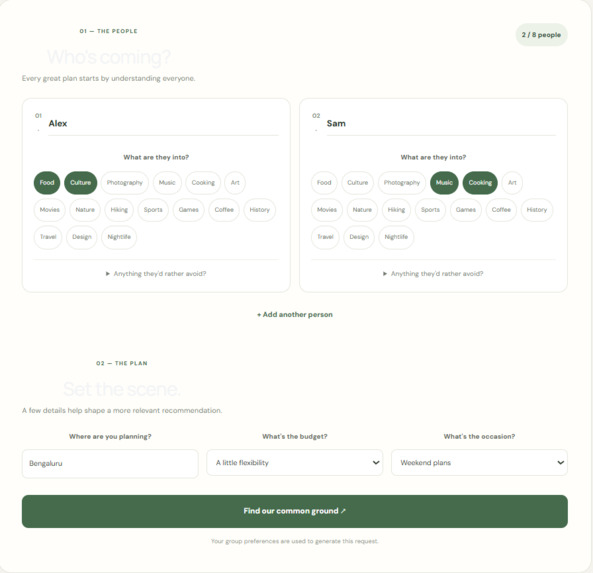
Define your group, select everyone's interests, and set the location, budget, and occasion.
-
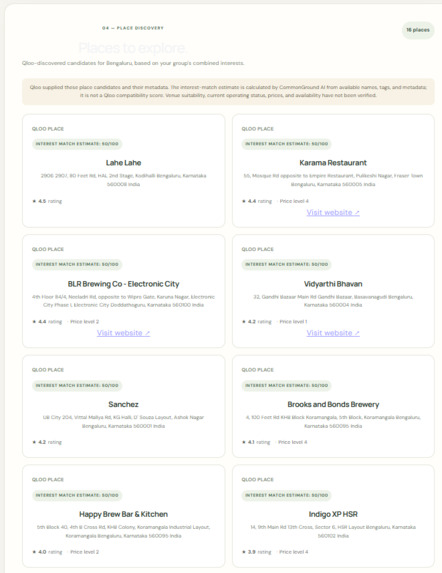
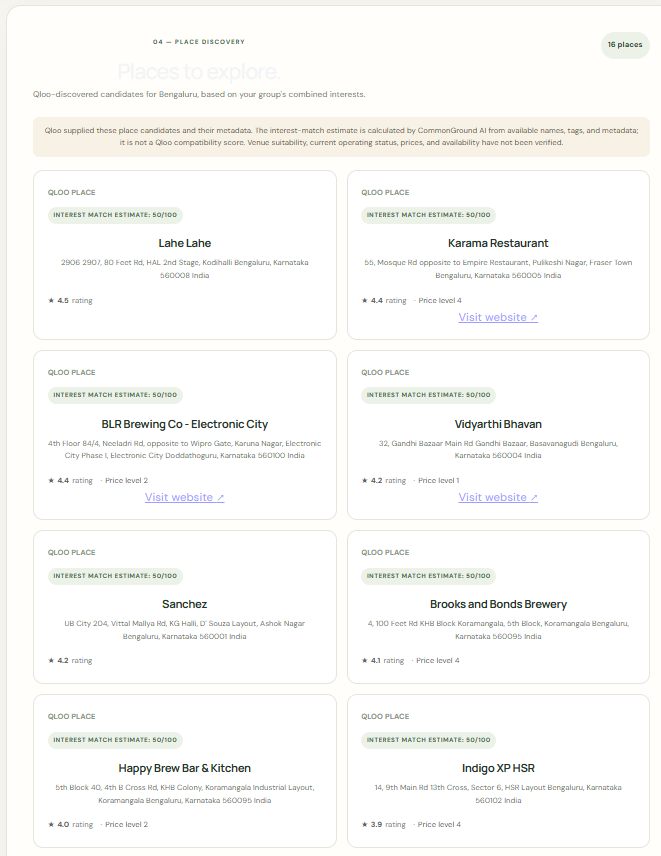
Discover Qloo-powered places based on shared interests, with location details and relevance estimates.
-
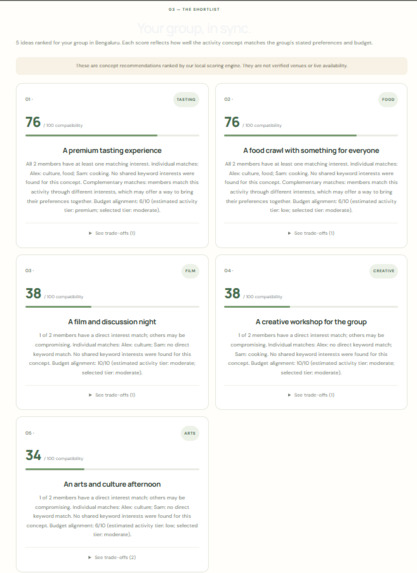
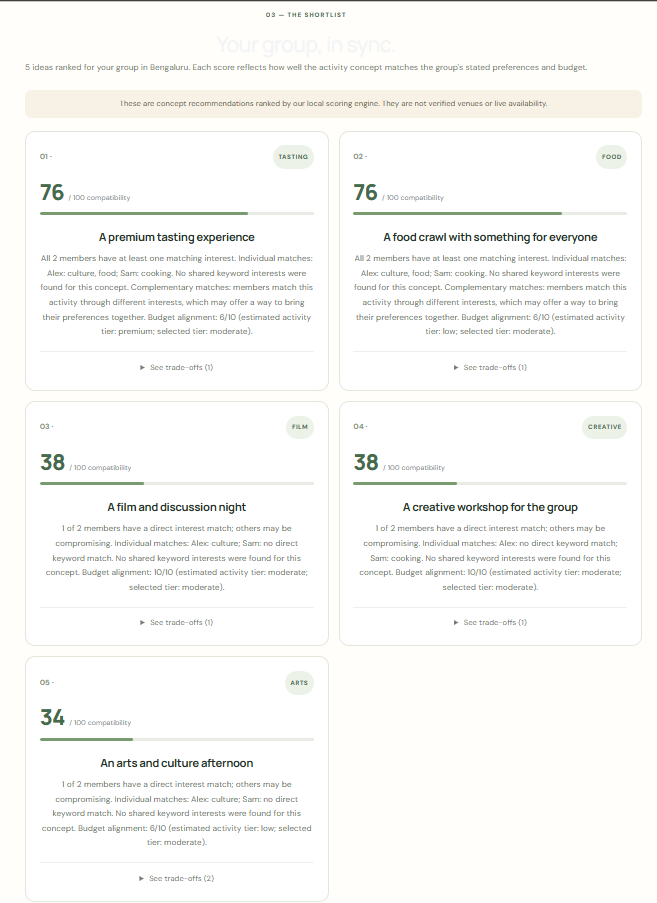
Explore ranked activities with compatibility scores, individual interest matches, and group trade-offs.
Inspiration
Group planning sounds simple until everyone has different tastes. One person wants to explore food, another enjoys music and culture, and someone else prefers a completely different experience. Existing recommendations often focus on individuals rather than helping a group find common ground.
We built CommonGround AI to make this decision easier. The idea is to turn different preferences into an opportunity for discovery, helping groups find activities and places that offer a meaningful starting point for a shared plan.
What It Does
CommonGround AI helps friends, couples, and teams explore experiences based on their interests, dislikes, location, budget, and occasion.
The application combines two complementary capabilities:
- Transparent activity recommendations: A local scoring engine ranks activity concepts and explains individual interest matches, compatibility scores, and trade-offs.
- Qloo-powered place discovery: The application uses Qloo's taste and cultural intelligence API to discover place candidates relevant to the group's interests.
Rather than presenting every recommendation as a perfect match, the interface explains where preferences align and where someone may need to compromise. It also distinguishes activity concepts from actual place candidates and clearly communicates the limitations of its estimates.
How We Built It
The frontend is built with React and Vite, while the backend uses Python and FastAPI. The application is deployed on Vercel and Render, and Qloo provides the external taste-intelligence data used for place discovery.
The local recommendation engine calculates transparent compatibility scores from group preferences and budget alignment. Separately, the Qloo integration resolves interests to available tags, requests relevant place candidates, and processes the returned entity metadata.
We deliberately distinguish our locally calculated interest-relevance estimates from official Qloo compatibility scores. The application does not claim that candidate venues have verified real-time availability.
The Agentic Workflow
The CommonGround Group Planning Agent adds a planning, execution, and evaluation loop to the discovery process.
- Plan: Collect group constraints and identify interests shared by all members.
- Prioritize: Search using shared interests when available; otherwise, combine the group's interests.
- Discover: Query Qloo for place candidates using the selected search interests.
- Evaluate: Check discovery status and whether the number of candidates meets a minimum target.
- Adapt: If discovery succeeds but returns too few candidates, broaden the search to the group's combined interests and evaluate again.
- Respond: Return the discovery results and evaluation metadata, while retaining local activity recommendations if Qloo is unavailable.
The workflow exposes its plan, attempts, evaluation, and next-action decision in the API response. It uses a deterministic, rule-based planning and evaluation process rather than claiming autonomous large-language-model reasoning.
Challenges We Faced
One challenge was balancing group preferences without hiding the trade-offs. A recommendation can appeal to several members without matching everyone directly, so we designed explanations that show individual matches and gaps rather than relying on a score alone.
Another challenge was integrating an external API reliably. Qloo discovery can return varying numbers of candidates or become unavailable, so we implemented result evaluation, conditional search broadening, and fallback behavior to preserve the local recommendations.
We also worked to make the system's outputs understandable. A metadata-based relevance estimate should not be mistaken for an official compatibility score, verified venue information, or real-time availability. We made these distinctions explicit in the application.
What We Learned
Building CommonGround AI helped us explore how external taste-intelligence data can support a practical group-planning workflow. We learned the importance of separating data retrieval from recommendation logic, making decision steps observable, testing fallback paths, and communicating uncertainty honestly.
We also learned that an agentic workflow does not need to hide its decisions. Exposing the plan, discovery attempts, and evaluation makes the system easier to inspect, debug, and improve.
What's Next
Future improvements could incorporate richer preference balancing, stronger venue-level validation, more precise budget and distance constraints, and user feedback on whether a proposed plan worked for the group.
Try It
Live application: https://commonground-ai.vercel.app/
Public source code: https://github.com/eshanroy/commonground-ai
Backend API: https://commonground-ai-api.onrender.com
CommonGround AI is an open-source project released under the MIT License.
Built With
- fastapi
- javascript
- pytest
- python
- qlooapi
- react
- render
- restapi
- vercel
- vite
