-
-
-
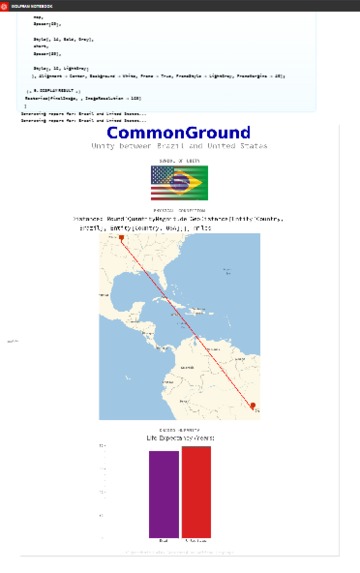
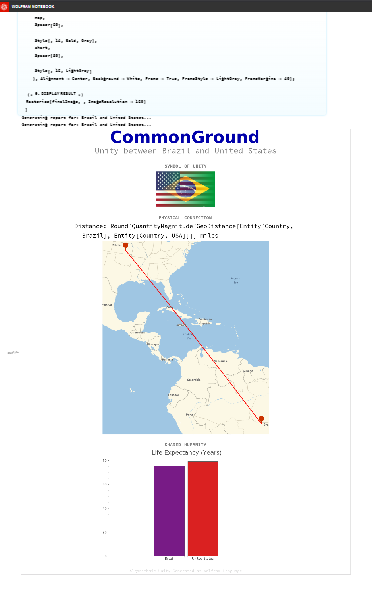
notebook image in action
CommonGround: Algorithmic Unity
Inspiration
In a digital age where algorithms are often accused of creating echo chambers and polarization, I wanted to flip the script. I asked myself: Can we write code that mathematically proves our connection? The hackathon prompt called for "unity," and I realized that while borders are political constructs, humanity is a shared constant. I was inspired by the idea of the "Overview Effect"—the cognitive shift astronauts experience when viewing the Earth from space, seeing a planet without borders. I wanted to create a digital version of that experience, using data to build bridges instead of walls.
What it does
CommonGround is a web application that takes any two nations as input and generates a "Unity Report." Instead of comparing countries to see who is "better" (GDP rankings, military size), it looks for intersections.
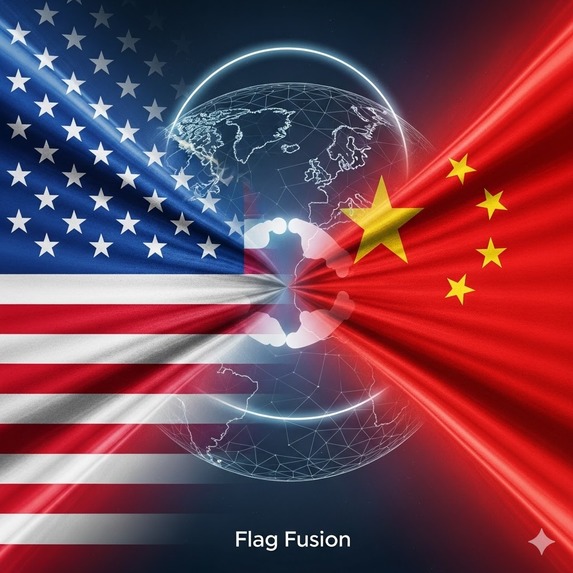
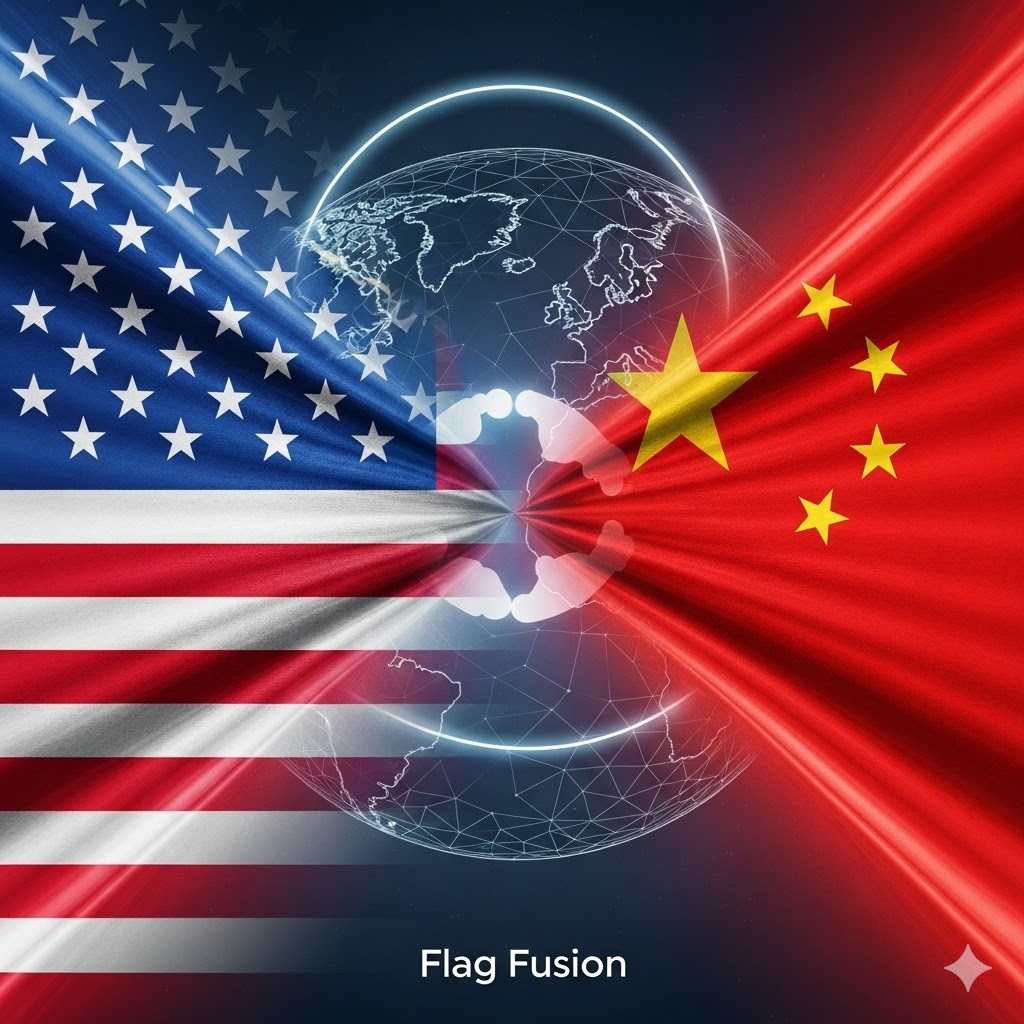
- Flag Fusion: It algorithmically blends the national flags of the two selected countries into a single, unified banner, symbolizing the merging of identities.
- The Geodesic Bridge: It renders a dynamic map showing the shortest path between the two nations, visualizing the physical link between peoples.
- Shared Humanity: It visualizes life expectancy data side-by-side, highlighting that regardless of geography, the human drive for a long, healthy life is universal.
- Language Connector: It automatically detects and lists any shared spoken languages to highlight cultural bridges.
How I built it
I built CommonGround using the Wolfram Language and the Wolfram Knowledgebase. The power of Wolfram allowed us to access curated data about every country on Earth without needing external APIs or databases.
- The Flag Fusion Algorithm: I treated the flags not just as images, but as matrices of pixel data. To create a seamless transition between two flags, $F_1$ and $F_2$, I constructed a linear gradient mask, $M$. The final image $I_{unity}$ is calculated as:$$I_{unity} = (F_1 \times M) + (F_2 \times (1 - M))$$ I used ImageResize to normalize aspect ratios and LinearGradientImage to generate the alpha mask $M$.
- Knowledge Retrieval I utilized the EntityValue function to pull real-time data.EntityValue[CountryData, "Languages"] This allowed me to instantly find the intersection of sets between two nations:$$ S_{shared} = L_{countryA} \cap L_{countryB} $$
- Cloud DeploymentInstead of setting up complex servers, I used CloudDeploy and FormPage to instantly wrap our Wolfram code into a public-facing HTML5 web app.
Challenges I ran into
- Data Heterogeneity: Not all countries have the same depth of data in the Knowledgebase. Handling Missing[] values for smaller nations without breaking the application required careful error checking.
- Image Aspect Ratios: National flags come in wildly different shapes (e.g., Nepal's non-rectangular flag vs. the standard rectangular ones). I had to write normalization logic to ensure the "fusion" didn't distort the symbols disrespectfully.
- Color Spaces: Blending flags required ensuring both images were in the same color space and had alpha channels removed before applying the gradient mask.
Accomplishments that I'm proud of
I am most proud of the "Flag Fusion" visual. It’s a simple image processing trick, but the result is emotionally resonant. Seeing the Stars and Stripes blend seamlessly into the Union Jack or the Hinomaru is a powerful visual metaphor for cooperation. I am also proud of the efficiency of our code. The entire backend, frontend, data retrieval, and image processing logic is contained in less than 100 lines of Wolfram Language code.
What I learned
I learned that symbolism can be algorithmic. I often think of "art" and "math" as separate disciplines, but using vector math to blend cultural symbols showed us that code can be a medium for emotional expression. I also gained a deeper appreciation for the Wolfram Knowledgebase's ability to connect distinct data points (geography, linguistics, and vexillology) in a single query.
What's next for CommonGround
- Musical Unity: I want to use EntityValue to pull "National Anthems" and algorithmically mash them up into a single audio track.
- 3D Globe Visualization: Upgrading the 2D map to an interactive 3D globe that users can spin to see the connection path.
- Social Sharing: Generating a downloadable "Unity Card" that users can share on social media to spread the message of connection.
Built With
- mathematica
- wolfram-cloud
- wolfram-knowledgebase
- wolfram-technologies


Log in or sign up for Devpost to join the conversation.