-
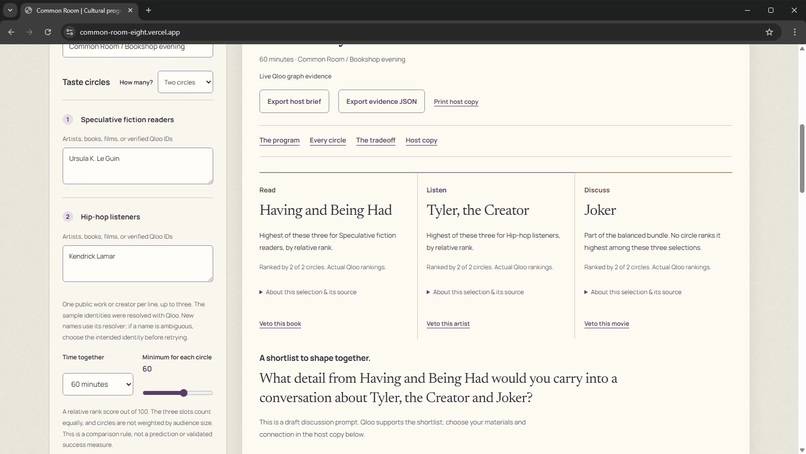
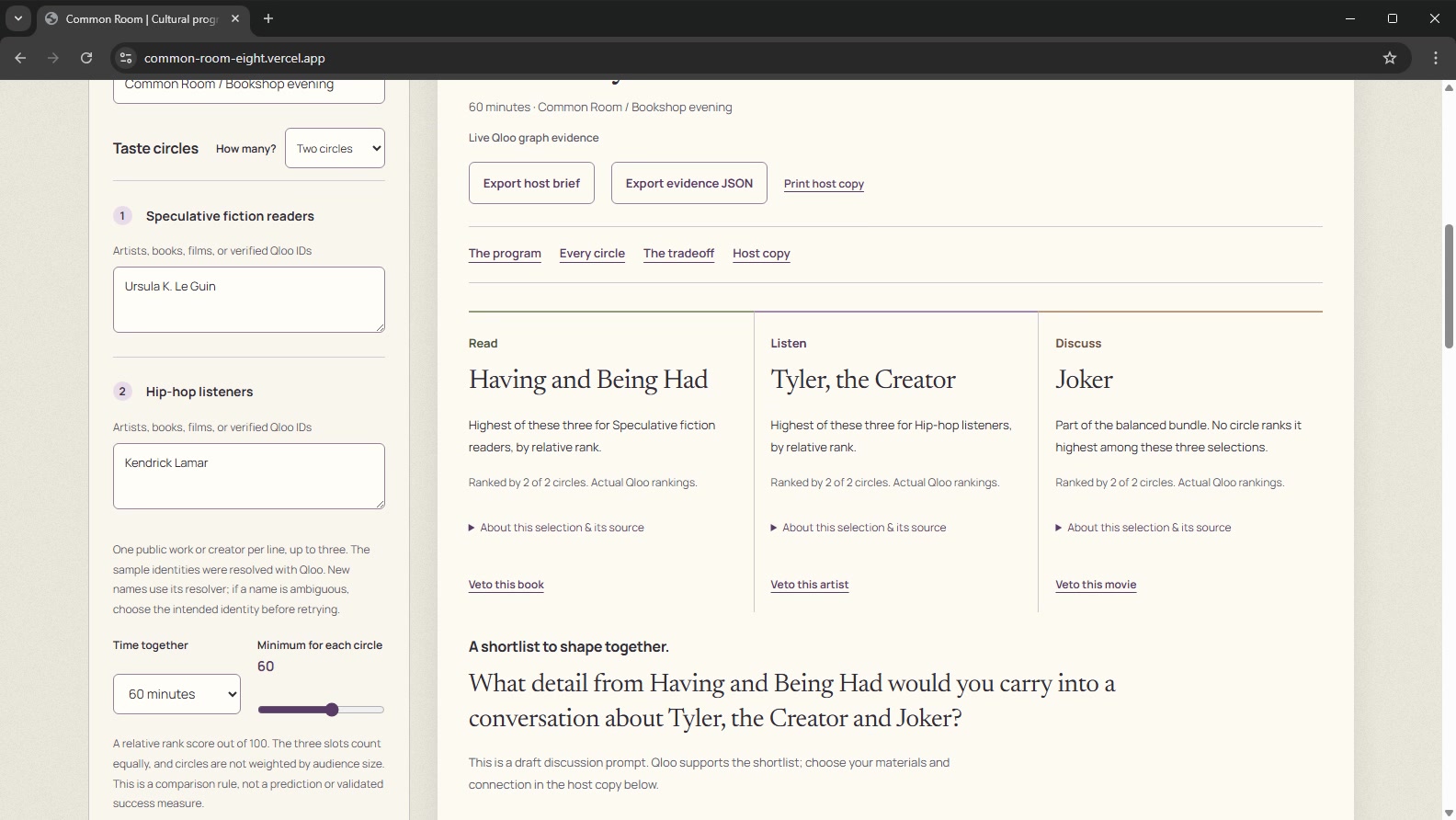
Recorded Qloo result: a book, an artist and a film for two taste circles.
-
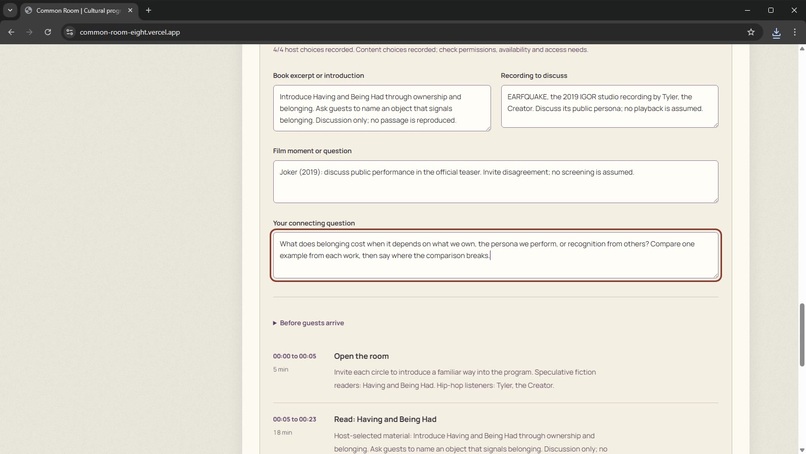
Host-authored material choices enter the running order. Qloo grounds the shortlist; the host supplies the interpretation.
-
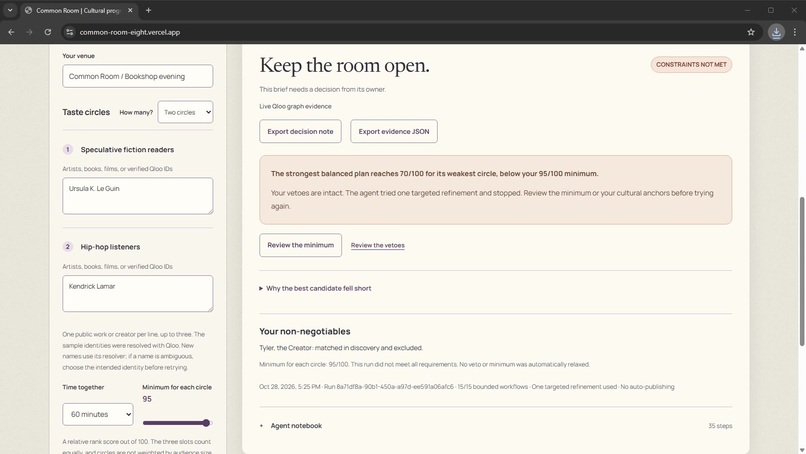
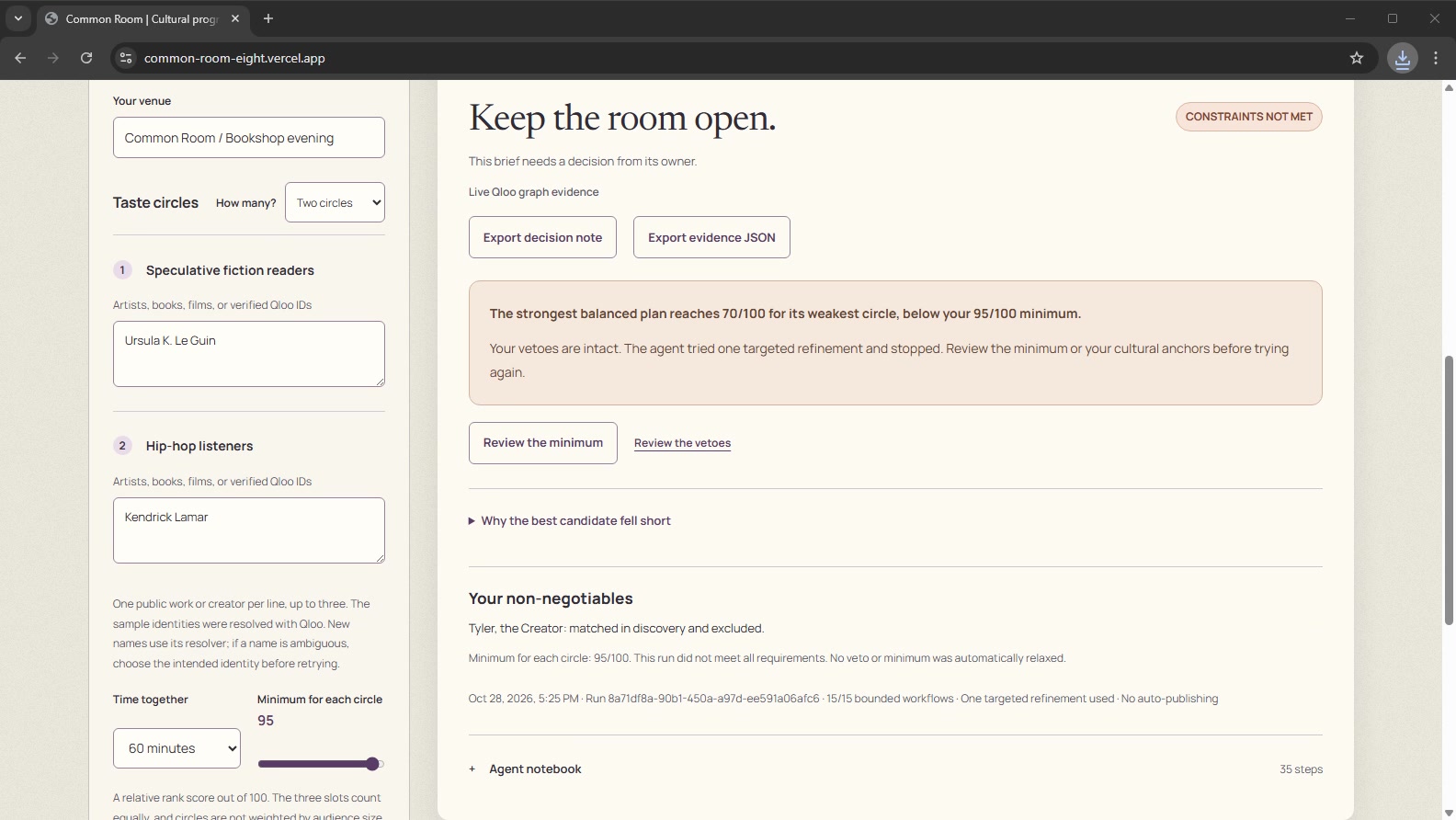
Recorded strict brief: a deeper search still falls short, so Common Room refuses an approved program and retains the veto.
Try the live app | Watch the approved 88-second walkthrough | Public source and setup
Inspiration
A bookshop host has one evening and different cultural interests to serve. Choosing something that suits the average can hide who is left behind. Common Room gives the host a shared shortlist and an inspectable comparison, then keeps the practical preparation beside the evidence.
This is a prototype for a specific host task. We have not conducted a venue pilot or measured attendance, satisfaction, revenue or time saved.
What it does
Enter public cultural anchors for two or three taste circles. Qloo supplies books, music artists and films. Common Room compares the same shortlist for every circle and prioritizes the lowest circle's relative rank coverage, with the average as a tie-breaker. An average-only comparison exposes the alternative and each circle's tradeoff.
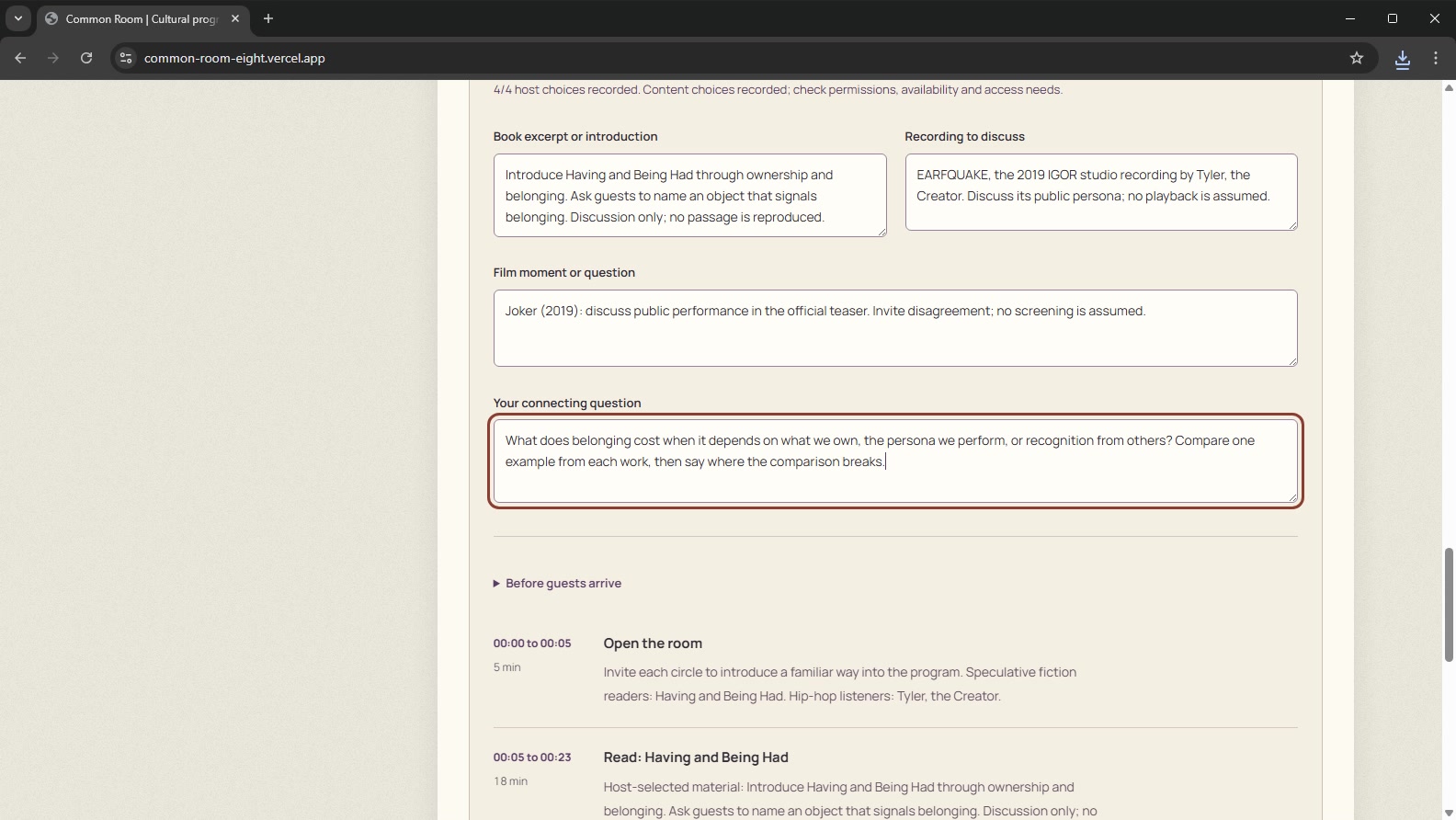
The result is a proposed shortlist, not an automatically finished event. Catalogue notes, exact identities and readable originating anchors help the host inspect unfamiliar choices. The host supplies an excerpt or written introduction, a recording, a film focus and a connecting question. Those choices enter the running order, printable working copy and Markdown/JSON downloads. Unchosen material remains an explicit preparation checklist.
The last result, brief, identity choices and host notes can be reopened from tab-local storage without another provider call. Restored results retain their original execution time and are clearly labeled. A failed rerun preserves the earlier completed artifact.
One worked example
A real anonymous run used Ursula K. Le Guin and Kendrick Lamar as anchors. Qloo returned Having and Being Had, Tyler, the Creator and Joker. Both decision policies selected the same program, so this case has zero policy gain.
For the demonstration, I wrote an introduction to the book, chose the 2019 EARFQUAKE studio recording, chose a discussion focus for Joker and wrote a question about belonging, ownership and public persona. This is an illustrative host-authored interpretation, not a Qloo-derived theme or evidence from a venue organizer. No copyrighted passage, song playback or screening is performed by the app.
Inspect the saved worked copy and its actual normalized evidence. The live app remains available for fresh inputs.
How it is built
Node.js ESM, browser JavaScript, HTML and CSS keep the implementation compact. The official Qloo harness is pinned to 0.1.26. Identity, domain, requested candidates and Insights provenance are validated. Bounded catalogue text remains display data. Raw Qloo affinity stays separate from our rank-derived coverage score.
The deterministic agent discovers, ranks and evaluates. If the evidence misses the brief, it makes one targeted deeper search, reranks and completes or refuses. Hard vetoes are never silently relaxed. A new genuine veto run excluded the selected artist; a 95-point minimum triggered refinement and refusal with no approved host program. There is no runtime language-model API.
Vercel hosts the public frontend and backend without a login. A private shared coordinator protects provider access. Confirmed identity-choice stops retain workflows actually started while reconciling slots never started; uncertain failures remain conservative. Quota errors preserve the brief and display the expiry-derived wait.
What we verified
The suite passes 61 core tests in the working project and a clean public checkout at the final source revision. Scoped browser checks cover keyboard operation, responsive layouts, identity choice, host preparation, persistence, exports, failures and refusal. Fresh anonymous production execution, catalogue metadata, readable identities, both downloads and no-query reload passed. The new two-anchor sequence used 15 workflow starts, including two explicit identity choices. Together with the new veto and strict cases, 42 actual starts raised the retained lifetime ledger from 404 to 446 without a reset or limit increase.
Independent enumeration checked every eligible bundle in the new live cases. The fresh case used 216 combinations and reached minimum coverage 66.67 with average 72.22. Average-only made the same choice. Earlier cases include positive and zero differences. This demonstrates the decision policy on a returned shortlist, not better real-world programming or superiority over a host or LLM. Detailed evidence and limits are linked from the public evidence index.
Design and limitations
Plum ink, tactile paper, Newsreader and Manrope, and credited public-domain Degas artwork give Common Room an editorial identity. The working result, host fields, recovery and print copy receive the same care as the opening. Decorative art is separate from recommendation evidence.
The objective assumes equal weight for the three cultural slots and for each circle. Its minimum is a host-chosen comparison threshold, not a validated success measure. Qloo rank coverage does not establish thematic coherence or predict people. The host checks materials, permissions, access needs and venue arrangements. No inventory, booking, rights, full screening, performer, turnout or sales is verified.
Live use remains credential/provider/quota dependent. The pinned harness retains four disclosed transitive advisories. Browser checks are scoped, not accessibility certification. A real venue pilot is the next validation step.
Codex assisted with implementation, research, design, testing, media editing and drafting. Optional stock-voice narration uses authorized existing ElevenLabs credits. The application itself makes no ElevenLabs or OpenAI call. Source is MIT; third-party licenses and credits retain their scope.
Try it as a judge
Open the public app. No account, password or payment is needed. Enter two or three public cultural anchors, select the exact identity if asked, and run the brief in live Qloo mode. Inspect the shortlist, each circle's rank-derived coverage and the average-only comparison. Add your host choices, download the Markdown brief and JSON evidence, then reload to reopen the same result without another query. Veto an entity and run again, or raise the minimum to see bounded refinement and a refusal when the evidence cannot support the brief. Provider availability and shared quota still apply; recovery messages preserve the brief. Offline fixture mode is separate and explicitly labeled.
The approved film shows genuine recorded Qloo execution, host preparation, exports, a real browser reload, binding veto and refusal. Long waits are cut and typing is paced. Reopened results keep their original evidence. The film is self-hosted and linked here because Devpost's embedded video field accepts YouTube/Vimeo.
Source and credits
Tested source: d524f3361e05a9d14042dce7c0ffcc829130799f. MIT license. Setup and tests, asset and tool credits, execution evidence.
Built With
- css
- html
- javascript
- node.js
- qloo
- vercel
- vercel-blob

Log in or sign up for Devpost to join the conversation.