-
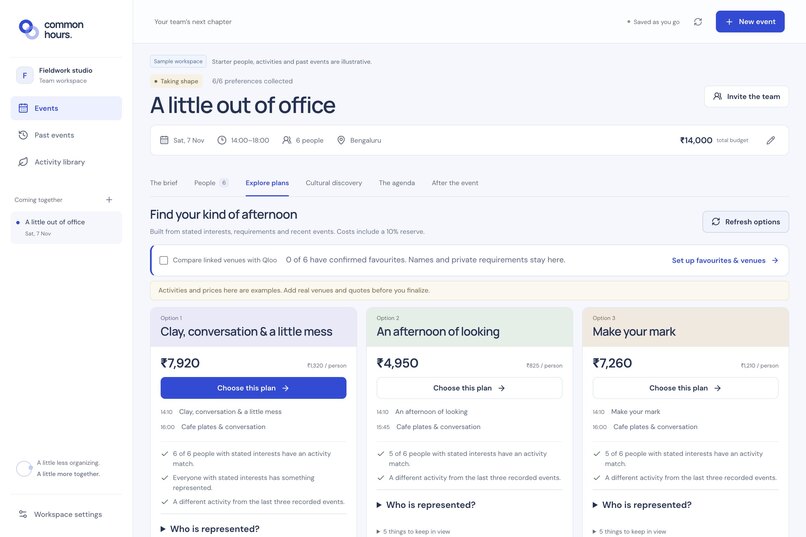
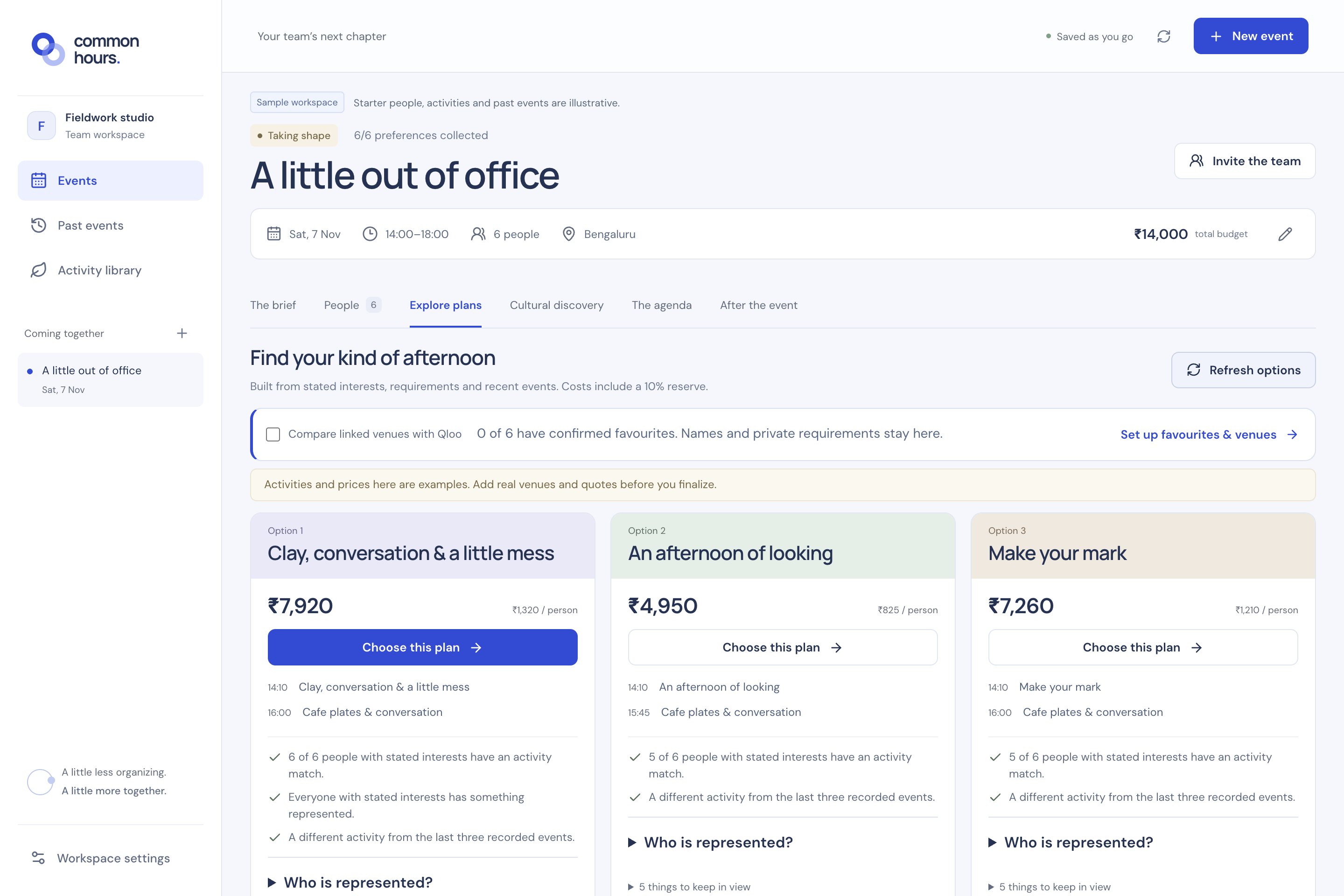
Complete event plans, priced and explained, with who each one actually represents.
-
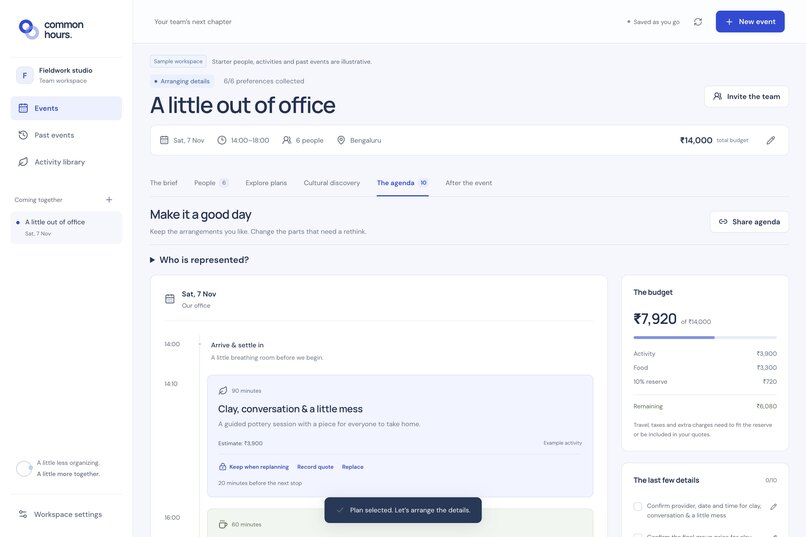
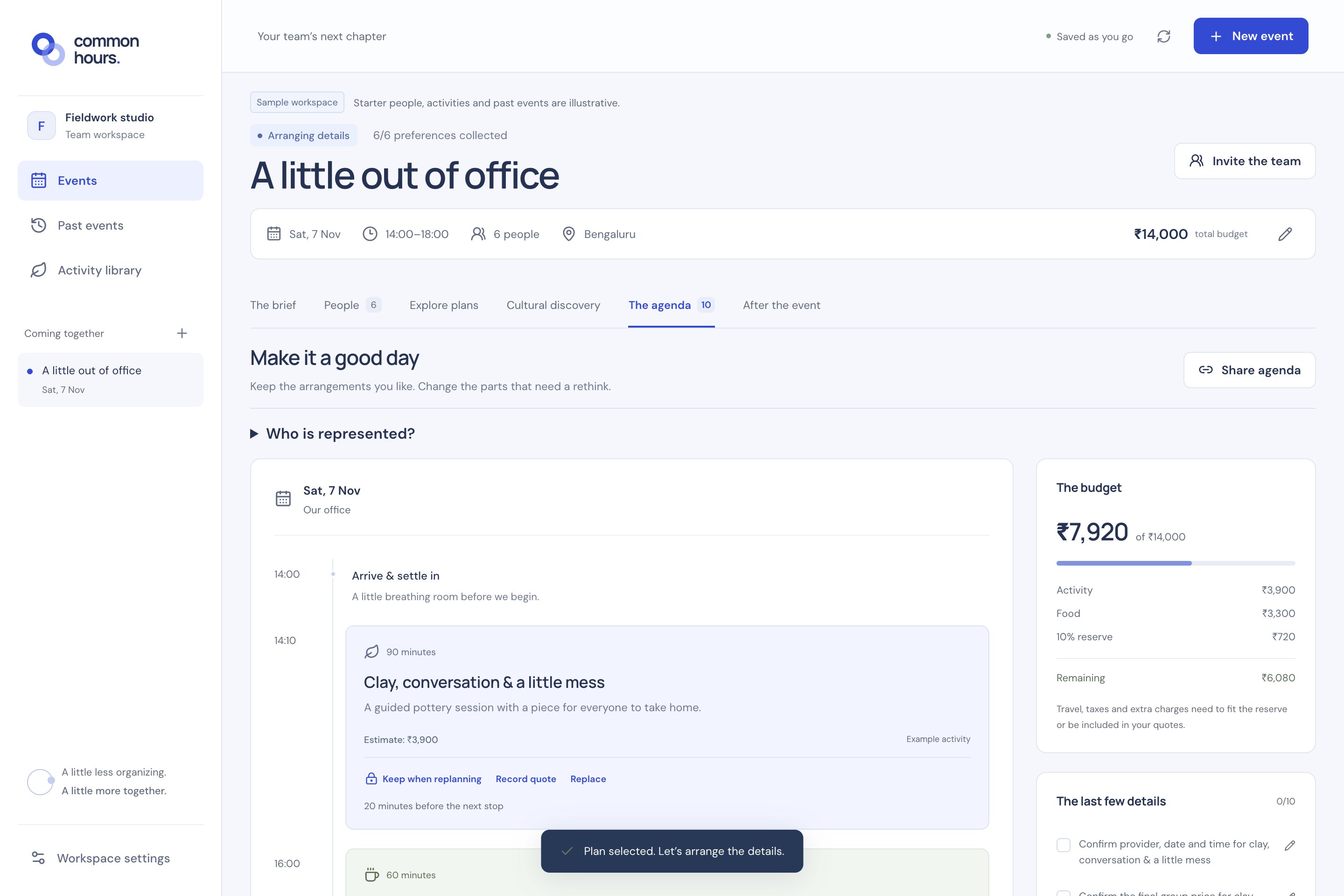
Pick a plan and it becomes an agenda, with the budget and the last few details to confirm.
Try it: common-hours.slate-app.online. Explore the sample workspace, then head to Explore plans.
Inspiration
Every team event in history has been planned the same way. Someone is told to "organize something fun." This person has a real job. They book whatever has parking. Three weeks later, eleven adults are standing in a bowling alley, in rented shoes, discussing the quarterly roadmap.
Asking the group doesn't help. You send a poll, four people answer, and the plan is then determined by whichever colleague feels most strongly about axe throwing.
What it does
Common Hours collects what people actually want and what they actually need, then proposes complete events: activity, food and timing, inside the budget. It handles the unglamorous parts that decide whether an event happens at all, like locked bookings, dietary and access requirements, share links, agendas, and feedback, so the next event is not a repeat of the bowling incident.
Qloo adds evidence on how each venue fits the group, person by person, so "Who is represented?" has an answer other than "Dave, mostly." Gemini then reads each finished plan against the brief and says, in one plain sentence, why it could suit this team.
Why Qloo is essential
Preferences tell you what people say they like. Everybody says they like "good food" and "something chill." Qloo links the specific things people love to real venues in the event's city, and shows who each option represents and why, so a plan can be compared on more than price and distance.
How we built it
- Planner: a deterministic engine assembles whole-event plans and filters them against budget (with a 10% reserve), headcount, timing, requirements and recent events, so you don't get pottery twice. Plans come with reasons in plain English.
- Gemini: after the plans are built, Gemini writes one line per plan on why it could suit the team, from the brief and plan details only. It never sees names or private needs, and if it is slow or fails, the plans come back unchanged. A second Vertex project and a chain of models catch rate limits.
- Replanning: lock what's already arranged and plan around it. Each revision shows what changed, what stayed, what it costs, and which completed checks carry over.
- Qloo: the organizer searches and explicitly confirms each favourite, since "Dune" is several things. City-scoped
/v2/insightsqueries use real category IDs with no silent fallback to some other city, then feasible venues are compared per person, in bounded calls with cache reuse. Missing evidence stays visible as unknown instead of being treated as a score. - Privacy: only selected reference IDs, venue IDs, search text and the city reach Qloo. Names, dietary needs and private notes never leave the app, and participant links cannot touch the discovery routes.
- Stack: TypeScript, Fastify and React.
Challenges
The strongest temptation was to let taste data fill in the blanks. It's right there, and it would look great. But nothing in a taste graph tells you whether a venue has a ramp or can feed a vegan, and a wrong guess there ruins someone's afternoon. So capacity, price, diet and access are never imported from taste data. A person enters them, or they stay unknown.
What's next
Calendar availability, real venue quotes, and an agent that can run the whole planning loop for an organizer.
Limits
Qloo shows cultural association, not whether anyone will attend or enjoy an event. Sample activities and prices are illustrative. We cannot make Greg come.
Built With
- fastify
- gemini
- node.js
- qloo
- react
- typescript
- vertex-ai
- vite

Log in or sign up for Devpost to join the conversation.