Watch the demo
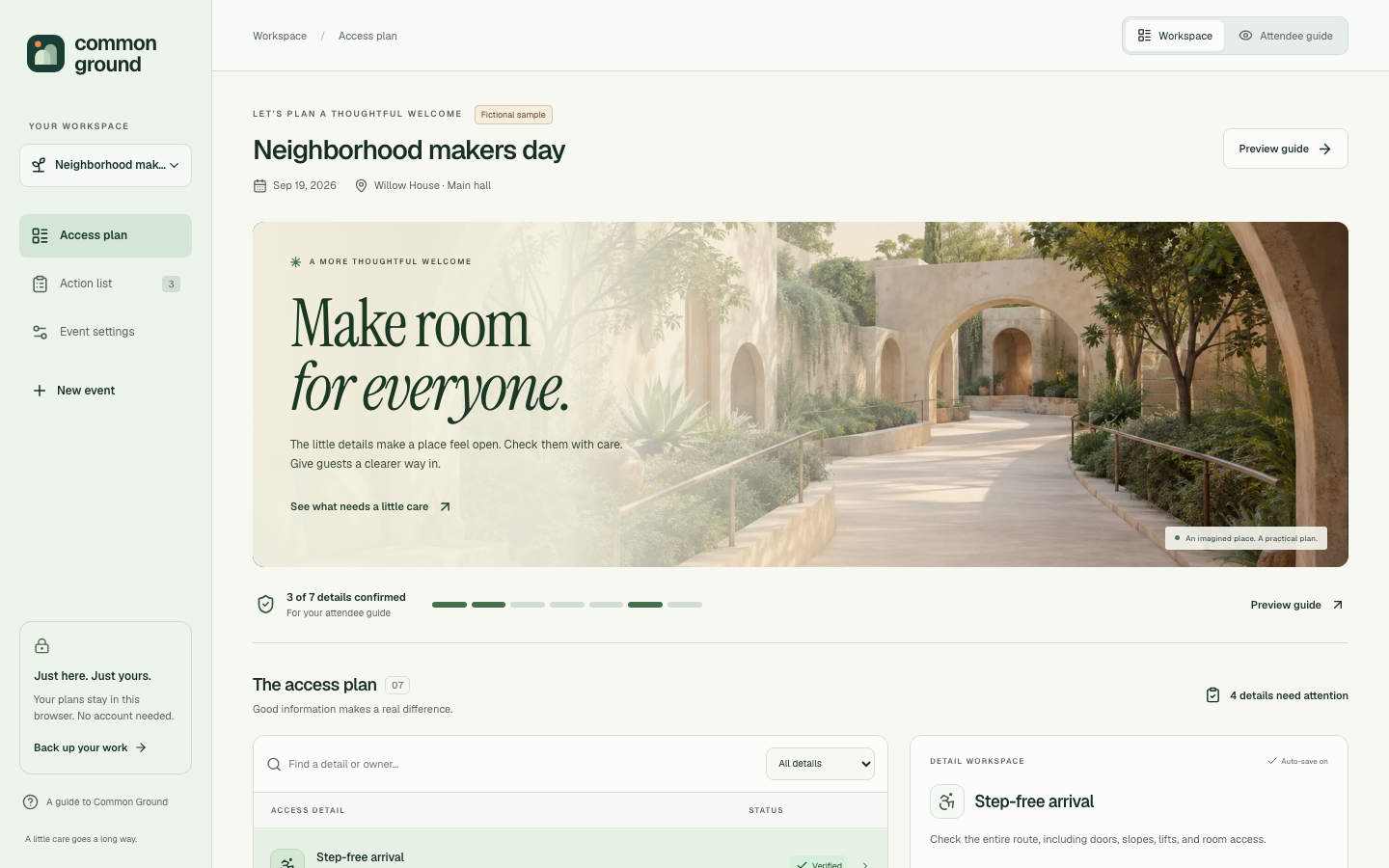
Watch the 3 minutes 49 seconds narrated application walkthrough. The video page includes native playback controls and a full transcript, requires no login, and links back to the live app and public source.
Primary track: Accessibility & Health. Common Ground helps organizers prepare and communicate specific event access arrangements.
Inspiration
An invitation can say “everyone is welcome” while leaving basic questions unanswered: which entrance should I use, are captions arranged, and is there a quiet place to pause? We wanted a small, practical tool that helps community organizers do the checking and makes their answers useful before someone arrives. W3C WAI's accessible-events guidance informed the problem framing.
What it does
Organizers work through seven access topics, record what they checked, assign an owner, and write public instructions. A deterministic gap engine surfaces unconfirmed details and unsupported claims in priority order. Gaps can become owned tasks with due dates. The attendee guide includes only supported public instructions and plainly labels unknown information. It can be printed or downloaded as Markdown. Multiple events and JSON backups work without an account.
How we built it
React and TypeScript provide the interface, Vite produces a static application, and Zod validates the saved/imported workspace. A pure domain module separates the gap rules from React state and guide rendering. The interface uses locally bundled typography, Lucide icons, an original brand mark, and an original courtyard concept image generated with OpenAI's image-generation tool. This fictional architectural artwork is decorative and is not evidence about a real venue. All event data remains in browser storage unless explicitly exported; there is no paid API or live model dependency.
OpenAI Codex substantially assisted implementation, testing, documentation, and visual design. The project openly discloses this assistance. The runtime rules are deterministic, and the project makes no claim to be a trained accessibility AI.
Challenges
The central challenge was making a status label trustworthy. Selecting Verified cannot be enough: the guide also requires evidence, a valid recent check date, and clear public instructions. A task marked complete cannot silently verify an access arrangement. Separating internal planning notes from public guide content was another important boundary.
Accomplishments
A complete local workflow connects event planning, preparation tasks, and a shareable guide. Typed validation protects imports and persistence, corrupted saved data can be downloaded before recovery, and deletion supports undo. The browser tests exercise real downloads, persistence, phone layouts, keyboard focus, and automated accessibility checks. These are implementation results, not claims about real-world participant outcomes.
Engineering lessons
Clear uncertainty is a useful product feature. A public guide becomes safer and more useful when it says what is unknown, and a preparation checklist becomes actionable when every item can have an owner. Keeping the rules in a pure module makes the reasoning inspectable and testable.
What's next
Test with organizers and attendees with varied access needs, improve the topic structure from that feedback, and evaluate controlled team collaboration and translated guide exports. Those features and validation studies have not been implemented.
Team and timing
One human entrant, working solo. The original application was created beginning September 5, 2026, with substantial OpenAI Codex assistance, for GatewayHacks 2026.
Demo format
The demo is a narrated walkthrough of actual application screenshots, clearly labelled with synthetic narration. Sample data is illustrative. It does not depict an uninterrupted live screen recording.
Built With
- axe-core
- geist
- openai-codex
- openai-image-generation
- playwright
- react
- typescript
- vite
- vitest
- zod

Log in or sign up for Devpost to join the conversation.