Inspiration
Every group has the "what are we watching / listening to / eating tonight?" standoff. Recommendation engines are built for one person; the moment two people with different taste share an evening, someone loses. Qloo models taste as a graph of cultural entities and tags, which is exactly what you need to ask a better question: not "what does she like?" but "what do they both genuinely connect with?" Taste is also universal — it doesn't depend on language or country — so the idea works anywhere in the world (we tested Lagos, London, New York and Tokyo).
What it does
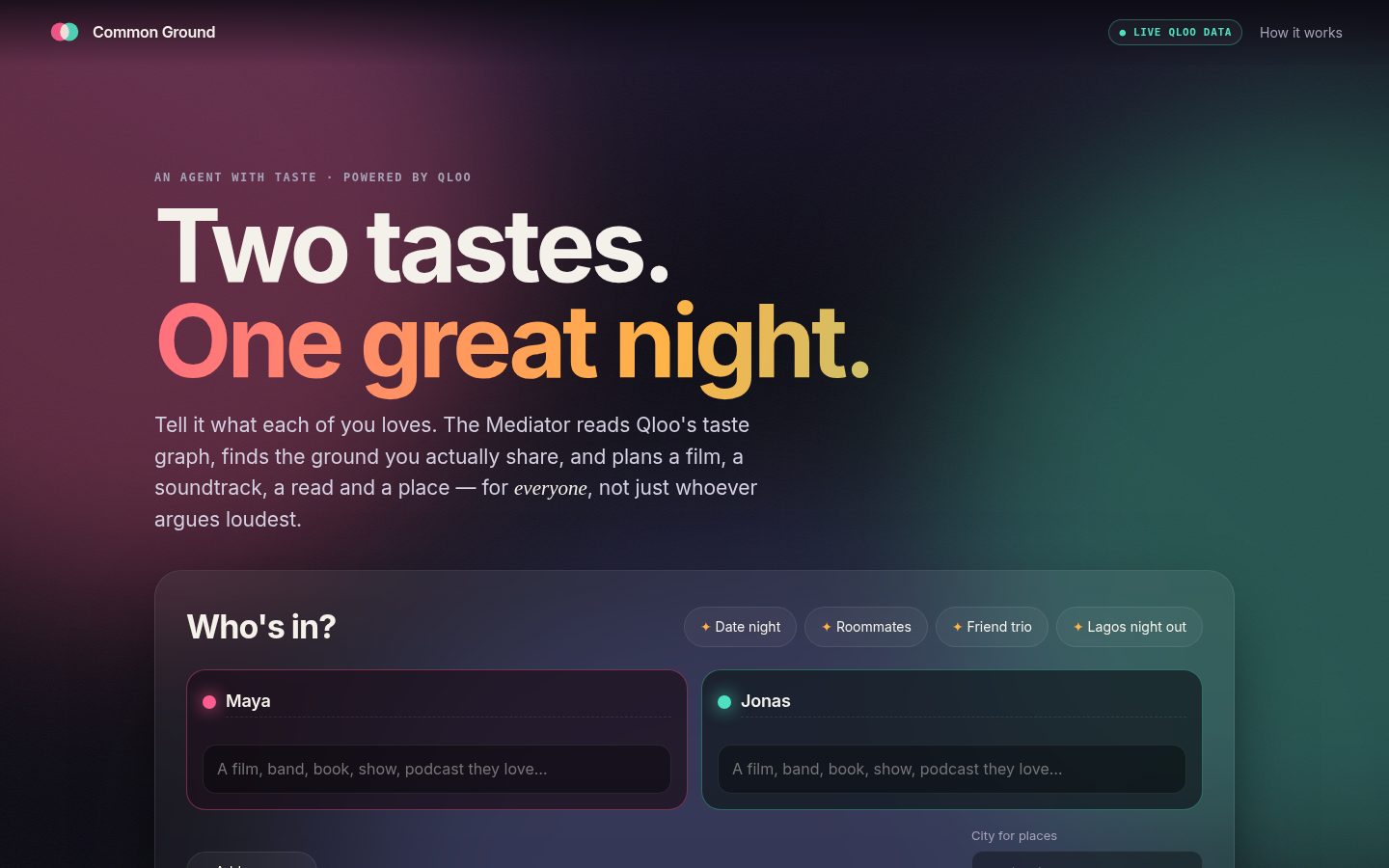
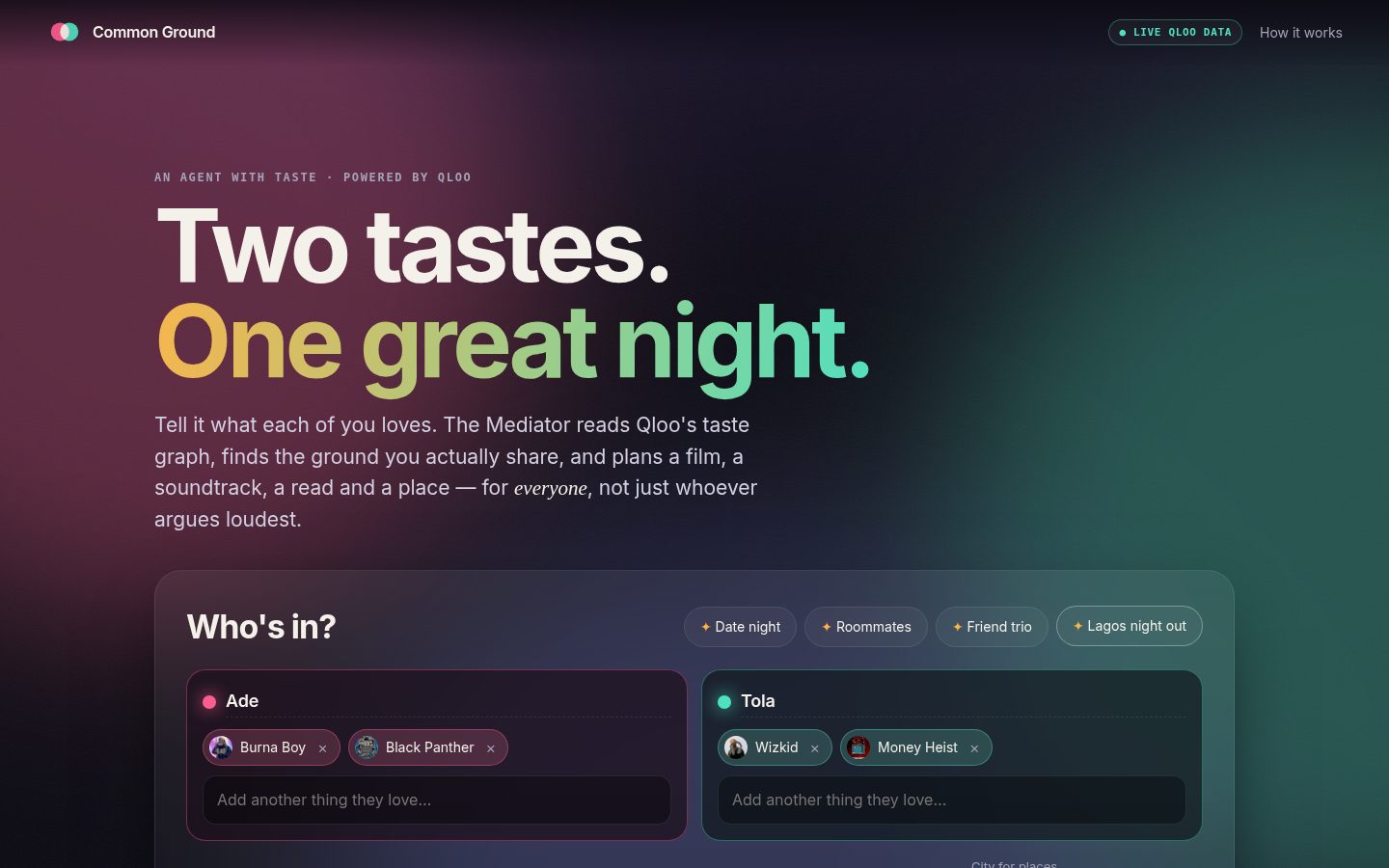
Each person (2–4) adds a few things they love — films, series, artists, books, podcasts. Common Ground's agent then:
- reads each person's taste profile from Qloo (live) and shows the common ground (shared tags) and what is distinctly theirs,
- discovers films, series, music, books and places in your city that fit the combined taste,
- scores each candidate per person and ranks by a least-misery "harmony" score, so no one gets a pick they'd hate,
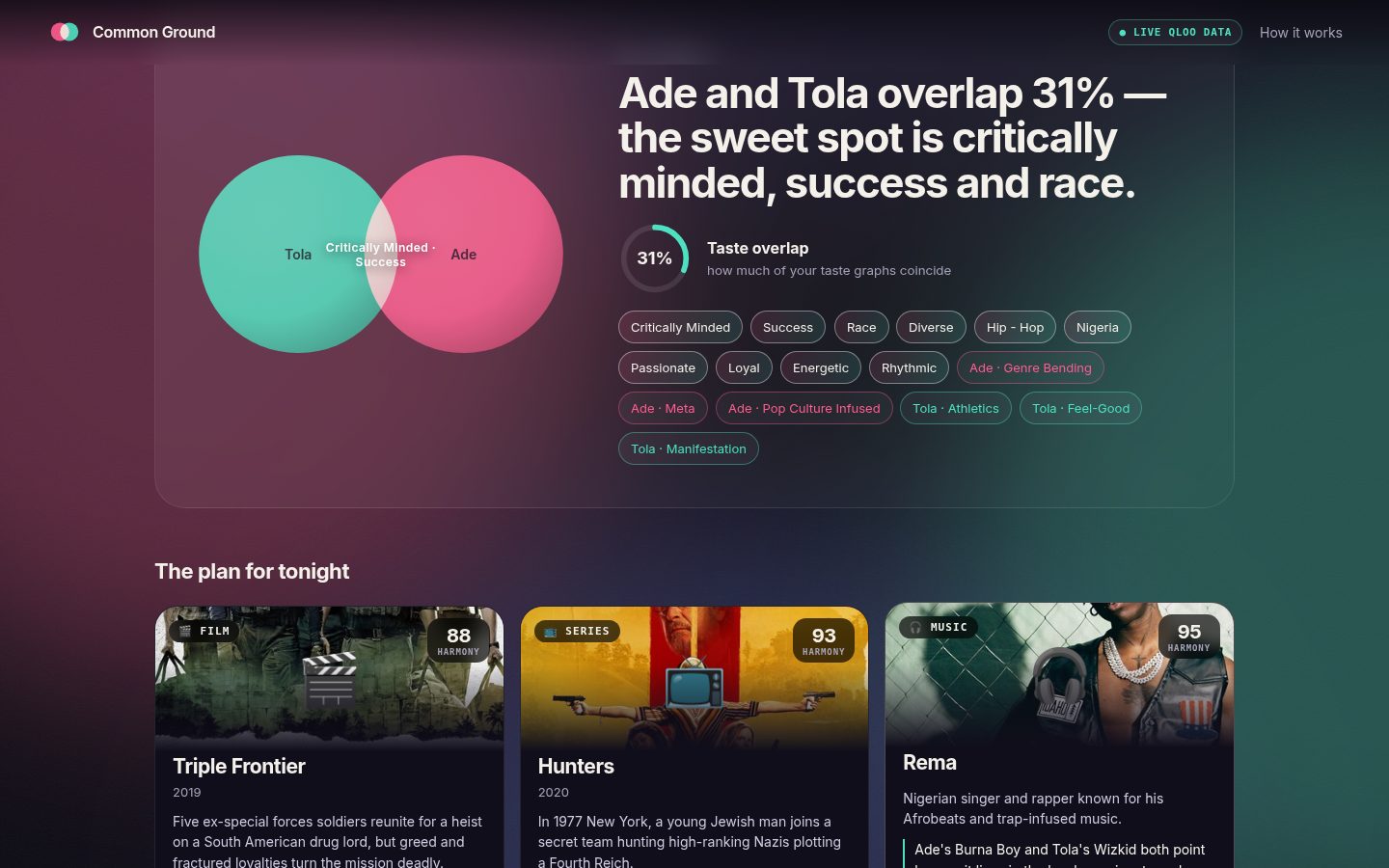
- explains every pick by bridging each person's own favourites ("this bridges Maya's Blade Runner 2049 and Jonas's Amélie"),
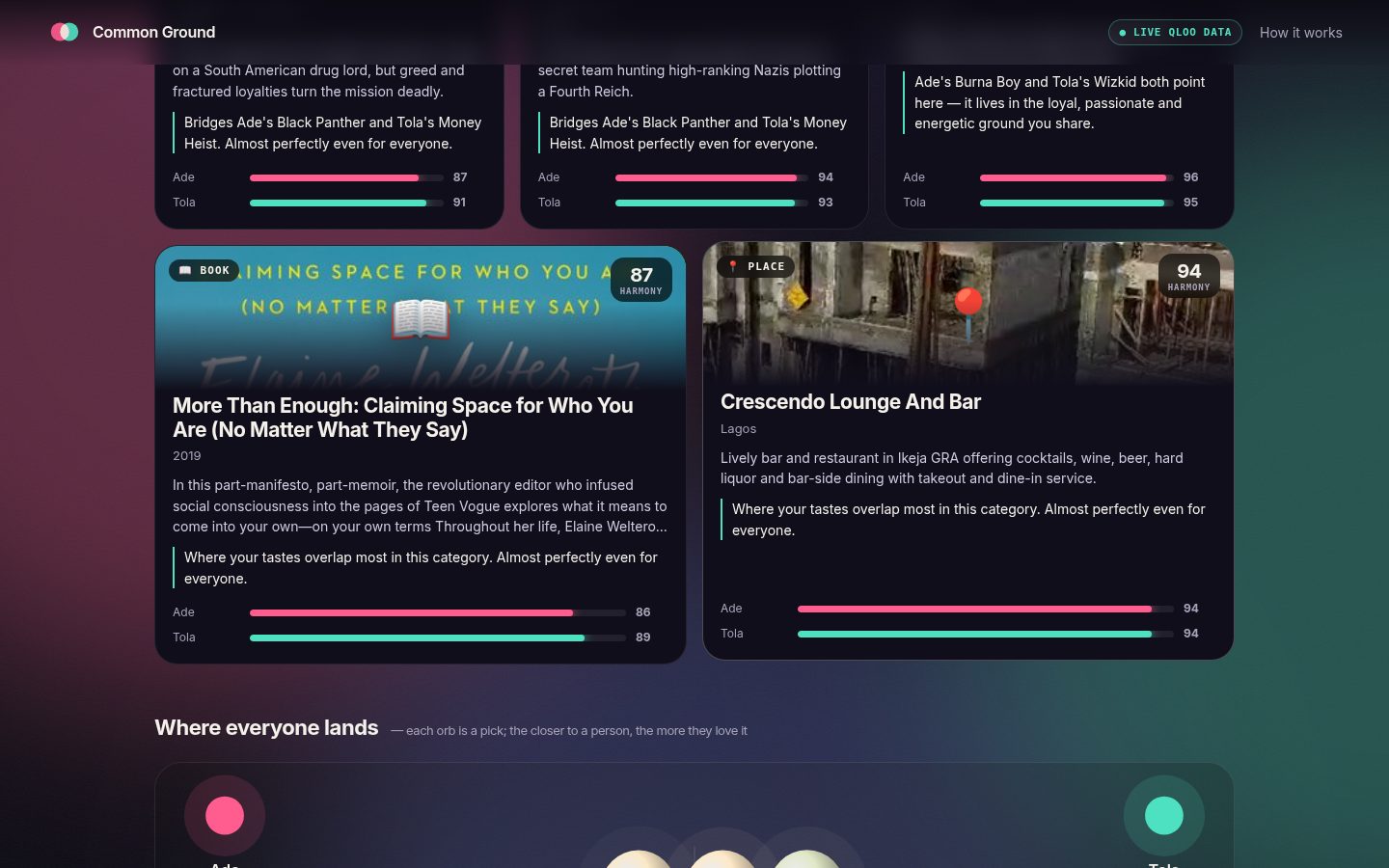
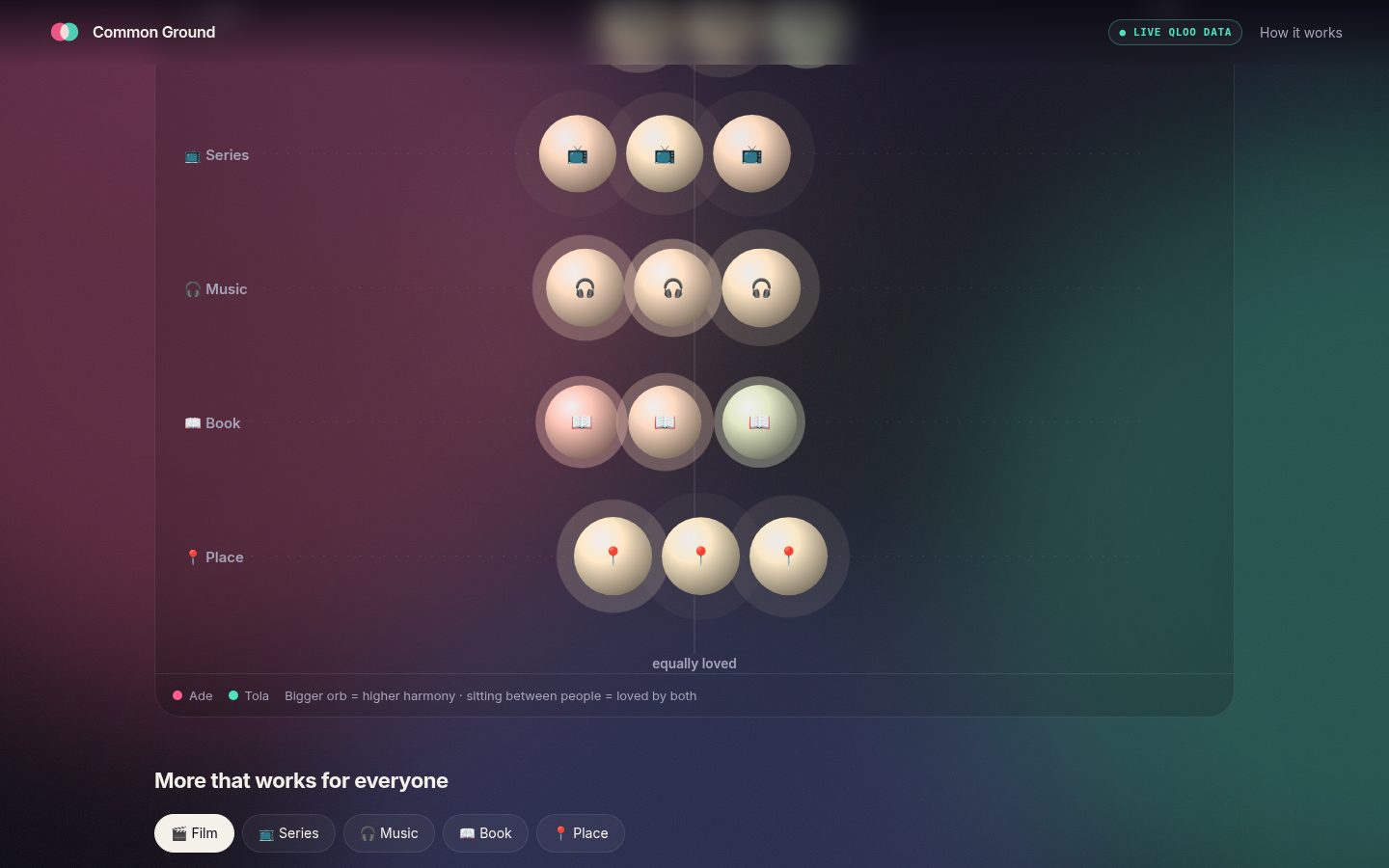
- streams its reasoning live in an agent trace and draws a "constellation" of where each pick lands between people.
How we built it
- Qloo API (hackathon endpoint, live in the deployed demo) is the core, used four ways:
/searchfor entity resolution,/v2/insightswithfilter.type=urn:tag(+filter.parents.types) for taste profiles,/v2/insightswith combinedsignal.interests.entities(+filter.exclude.entities;filter.location.queryand a restaurantfilter.tagsfor places) for discovery, and/v2/insightswithfilter.results.entitiesfor per-person affinity of each candidate. Every title, place, tag and score on screen comes from Qloo. - Agent: a small tool-using orchestrator (understand → profile → overlap → discover → compose → narrate) whose tools are Qloo calls; every step is streamed as NDJSON to the UI. Group scoring:
harmony = 0.6·min + 0.4·mean, overlap coefficient over tag-affinity maps, tag-sharing "bridges" for explanations. An optional LLM only rephrases Qloo-derived facts. - Stack: zero-dependency Node 20 server (works on Vercel as serverless functions), plain ES-module front end with hand-built SVG/CSS animation (aurora, animated Venn, orbit constellation),
node:testtest suite. The Qloo key is a server-side Vercel environment variable (the browser only calls our own/apiroutes), with per-IP rate limits, input validation, in-memory caching and retries with back-off. - Responsible by design: names never leave our server, only entity IDs go to Qloo; no Qloo data stored; affinities are described as aggregate taste signals, not predictions about individuals.
Challenges we ran into
- Making "fair" computable: a plain average lets one super-fan hide a lukewarm partner. A least-misery blend plus a per-person re-score pass (asking Qloo again for each person's own affinity) fixed that.
- Explainability without hallucination: we trace every pick to the specific favourites that share tags with it instead of letting an LLM invent reasons.
- Quota and latency: a plan takes ~20–25 calls (about 5–12 s live), so we cap concurrency, cache, retry with back-off, and stream progress so the wait is part of the show.
- Real-data surprises: Qloo's taste analysis returns each person's most distinctive tags, so two different people showed ~0 % overlap; entities can carry 300+ tags; place queries return ATMs unless filtered by category; tag analysis needs
filter.parents.types. We handled each (blend in the loved things' own Qloo tags, rank + cap tags, restaurant tag filter, scoped parent types) and cover the response shapes with tests. - Time-boxed build: a clearly labelled offline mock client (never used in the deployed demo) let us build the product and tests in parallel with API access, then we switched to the live hackathon API.
Accomplishments we're proud of
A polished, motion-heavy UI that makes the agent's reasoning visible; a fairness model that gives non-obvious but defensible picks (e.g. for a Lagos pair who love Burna Boy / Black Panther and Wizkid / Money Heist, the agent lands on Rema, with a per-person affinity of 0.96 / 0.95); live Qloo data end-to-end behind a 3-method interface.
What we learned
Taste tags are a far better "common language" between people than genre labels; asking Qloo for per-person affinity on a shared candidate list is the key to fairness.
What's next
Shareable plan links and group voting, calendar/booking hand-off (tables, tickets), more domains (food, travel, brands), saved "taste circles" for recurring groups, and a conversational mode where an LLM agent negotiates with the group using Qloo as its tool.
Built With
- css
- html
- javascript
- node.js
- qloo-api
- svg
- vercel

Log in or sign up for Devpost to join the conversation.