-
-
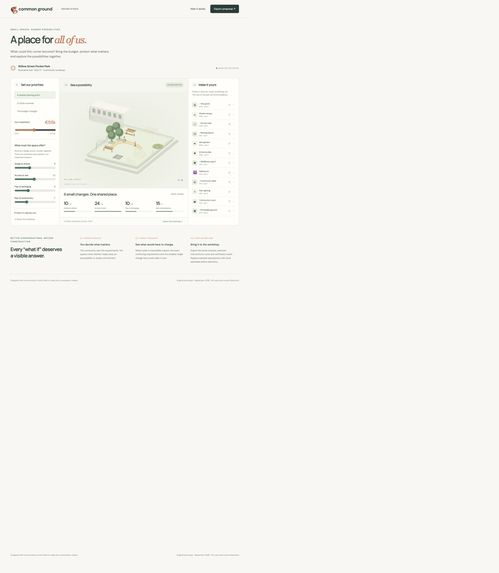
The illustrative workshop checks all 4,096 combinations; 145 meet the original €55k commitments.
-
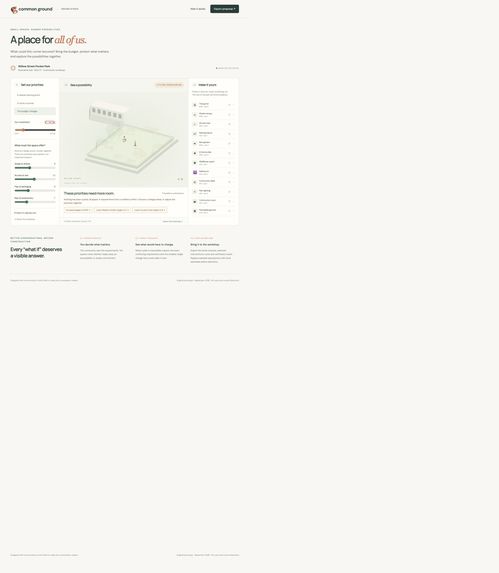
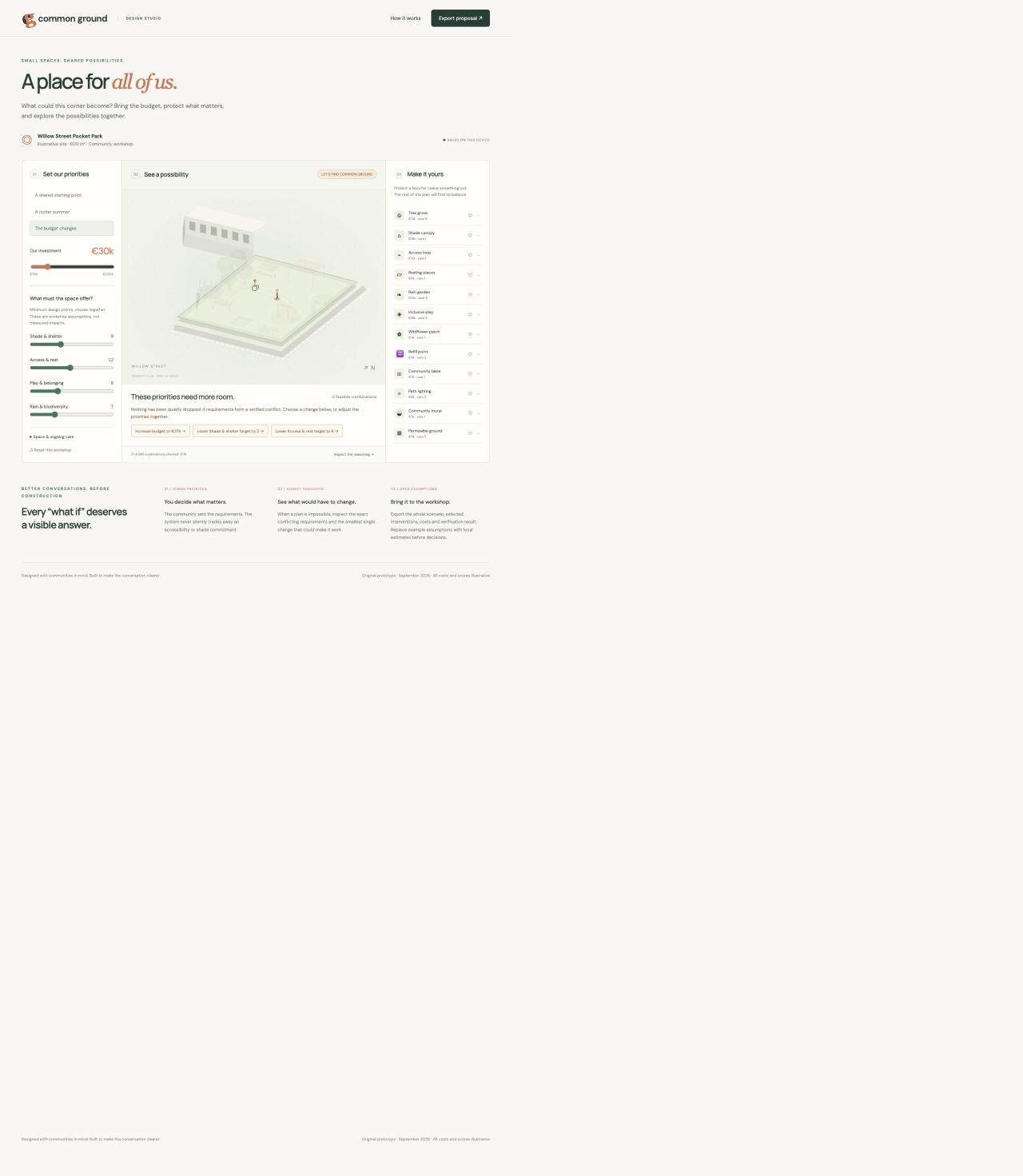
A separate €30k budget scenario reveals a verified conflict and exact repair options.
-
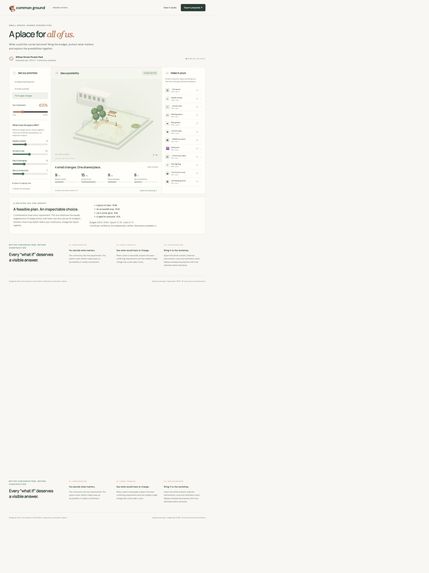
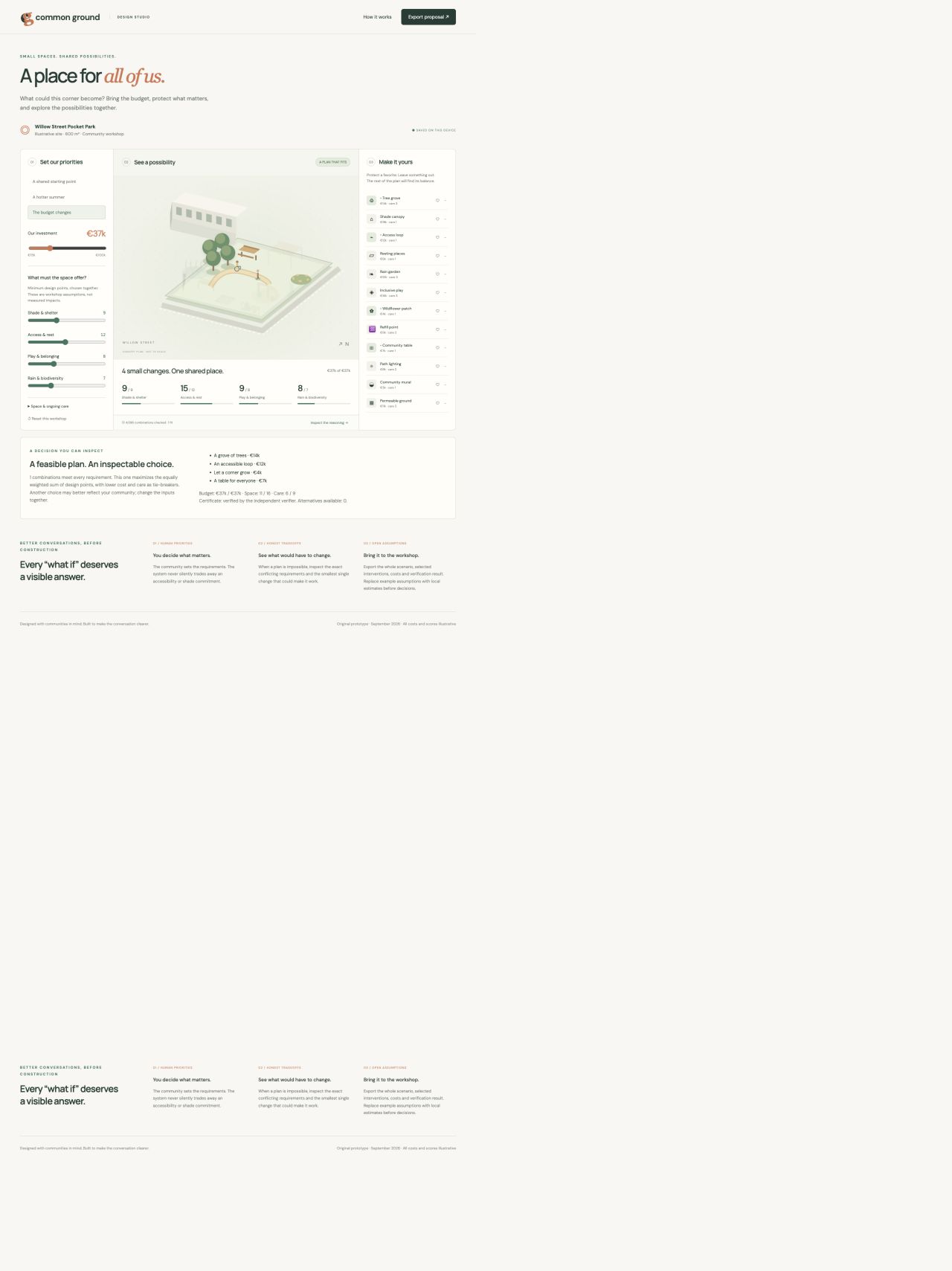
At €37k, one plan meets every original minimum. Costs and design scores are illustrative.
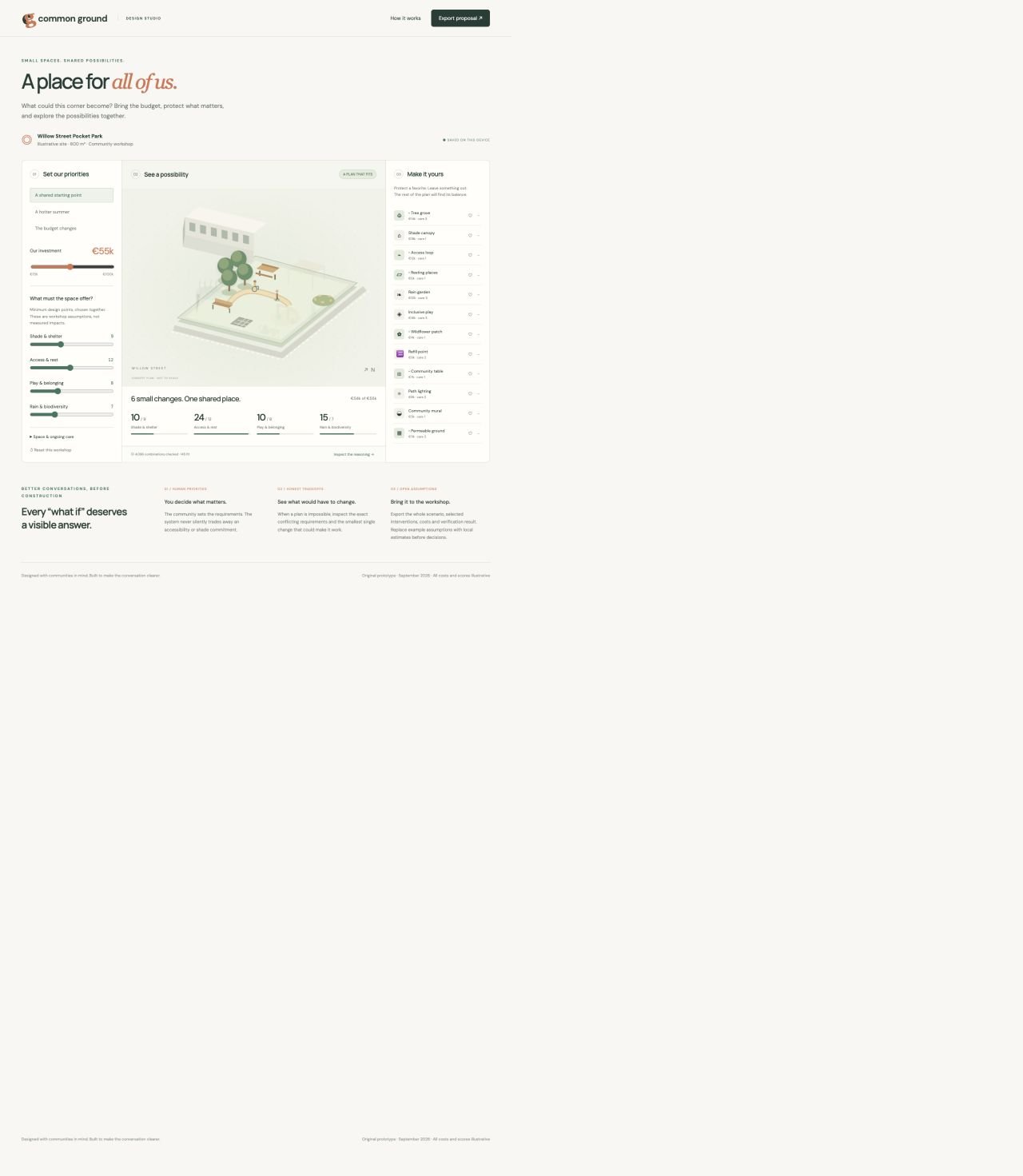
Inspiration: the drawing should not hide the compromise
A neighborhood can agree that a small public space should offer shade, access, play, and greenery—and still disagree about what a limited budget can buy. Attractive drawings rarely show whose priority disappeared along the way.
Common Ground is a participatory service concept with a working visual prototype. It lets residents and a facilitator explore the tradeoffs together, including the honest answer: these commitments cannot all fit.
Theme: Architecture & Urban Innovation. Team: Touko Ursin, individual student entry. Original development began September 21, 2026.
Watch or download the 100-second demonstration with English captions. The film shows the actual prototype; costs and scores are illustrative.
What it does
Open an illustrative 600 m² pocket park. Set minimum commitments, protect a favorite intervention, or leave an option out. The studio recomputes the possible plans and illustrates one that fits.
The demonstration begins with €55k: 145 combinations meet the original requirements. Protecting inclusive play changes the plan while keeping that choice. A separate €30k budget scenario restores the original minimums and exposes a conflict. The studio identifies an irreducible conflicting set and checks repairs against the complete scenario. Increasing the budget to €37k restores a feasible plan without dropping those minimums. Export the assumptions, selections, and verification certificate as JSON.
The proposed service
Before a workshop, a facilitator and local designer replace illustrative catalog values with locally reviewed costs, maintenance needs, and options. Residents receive accessible materials in advance. During the session, the group sets priorities and sees alternatives together. Afterward, the export becomes a shared shortlist for professional design review—not construction authorization.
A proposed pilot would involve one neighborhood organization, one designer, and two sessions of 8–12 residents. An illustrative €1,500–€3,000 facilitation budget is a hypothesis to test, separate from construction. The possible operating model is an open-source core with paid catalog preparation, facilitation, and municipal integration. No partnership, customer demand, revenue, or pilot participation is claimed.
Success would be assessed prospectively: can participants explain the tradeoff; are affected groups represented; which assumptions remain unresolved; and does the record fairly reflect the discussion? Fast consensus alone is not evidence of equitable participation.
Research and originality
WHO's review of green-space interventions motivates combining physical improvements with social engagement. Its brief for action informs the stakeholder and access considerations. These sources do not validate our scoring model or predict health benefits.
The contribution is the workshop interaction: visible community commitments, an illustrated alternative, an inspectable reason when a plan is impossible, and a reproducible way to explore a repair. It complements local design expertise and city-scale assessment tools.
How we built it and what we learned
The functional prototype uses original HTML, CSS, SVG, and JavaScript. A bounded engine checks all 4,096 subsets of twelve interventions. The verifier remeasures selections and checks constraints; an infeasible certificate checks unsatisfiability and deletion minimality. Twelve local automated tests pass, including comparison with an independent recursive enumeration and tampering checks. Hosted CI has not been verified.
The difficult design problem was making 'impossible' useful without presenting an algorithm as a moral authority. Protected choices remain explicit. Repairs are suggestions for discussion. An irreducible conflict is not necessarily the smallest conflict by number of requirements.
Limits and next steps
All costs, care units, spatial units, and design scores are illustrative. The synthetic site has not been surveyed; no resident interviews or measured environmental/health outcomes are claimed. The current catalog is fixed. A real pilot needs locally editable catalogs, non-negotiable legal access constraints, lifecycle costs, drainage and shade expertise, uncertainty ranges, multilingual materials, and evaluation with residents. Tree shade changes over time; canopy shade is immediate. The drawing is not a geometric or engineering plan.
Open materials and AI disclosure
Try the working studio · MIT source and setup · Research, service design, risks, and proposed pilot.
Codex (GPT-6) assisted concept development, code, tests, visual design, documentation, and submission preparation. The illustration and synthetic catalog are original. Google Fonts provides DM Sans and Manrope, with system fallbacks. The demo uses disclosed ElevenLabs stock synthetic narration and actual application footage, with holds edited for explanation. No fabricated field evidence or sponsor endorsement.
Sustainable cities and accountable participation
SDG 11: Sustainable Cities and Communities is the primary focus. The prototype makes inclusive access, shade, play and greenery explicit commitments in an illustrative pocket-park planning workshop. SDG 16: Peace, Justice and Strong Institutions is a secondary link through a transparent record of choices and reasons. These are intended contributions, not measured SDG or health outcomes. The exported proposal now has a separate reader that recomputes the entire result and rejects altered counts, helping people inspect the same assumptions rather than trust a screenshot.
Build chronology and other entries
Original development began September 21, 2026. This same original Common Ground project was submitted to Graphiques and Acodemic, and is being entered in LexHack with both prior entries disclosed. The work, illustrative data and substantial Codex assistance are identified above. No earlier third-party hackathon project was copied.
Civic technology contribution
Common Ground makes a proposed public-space decision inspectable: whose commitments were protected, why a set of requirements cannot fit, and which changes actually restore feasibility. It supports discussion and accountability without claiming that an algorithm decides what is fair or establishes legal compliance.
Built With
- css
- html
- javascript
- openai

Log in or sign up for Devpost to join the conversation.