Inspiration
Communication should never depend on how clearly someone can speak. People with dysarthria can know exactly what they want to say while others struggle to understand them. We built Common Ground — AI Communication Bridge to close that gap.
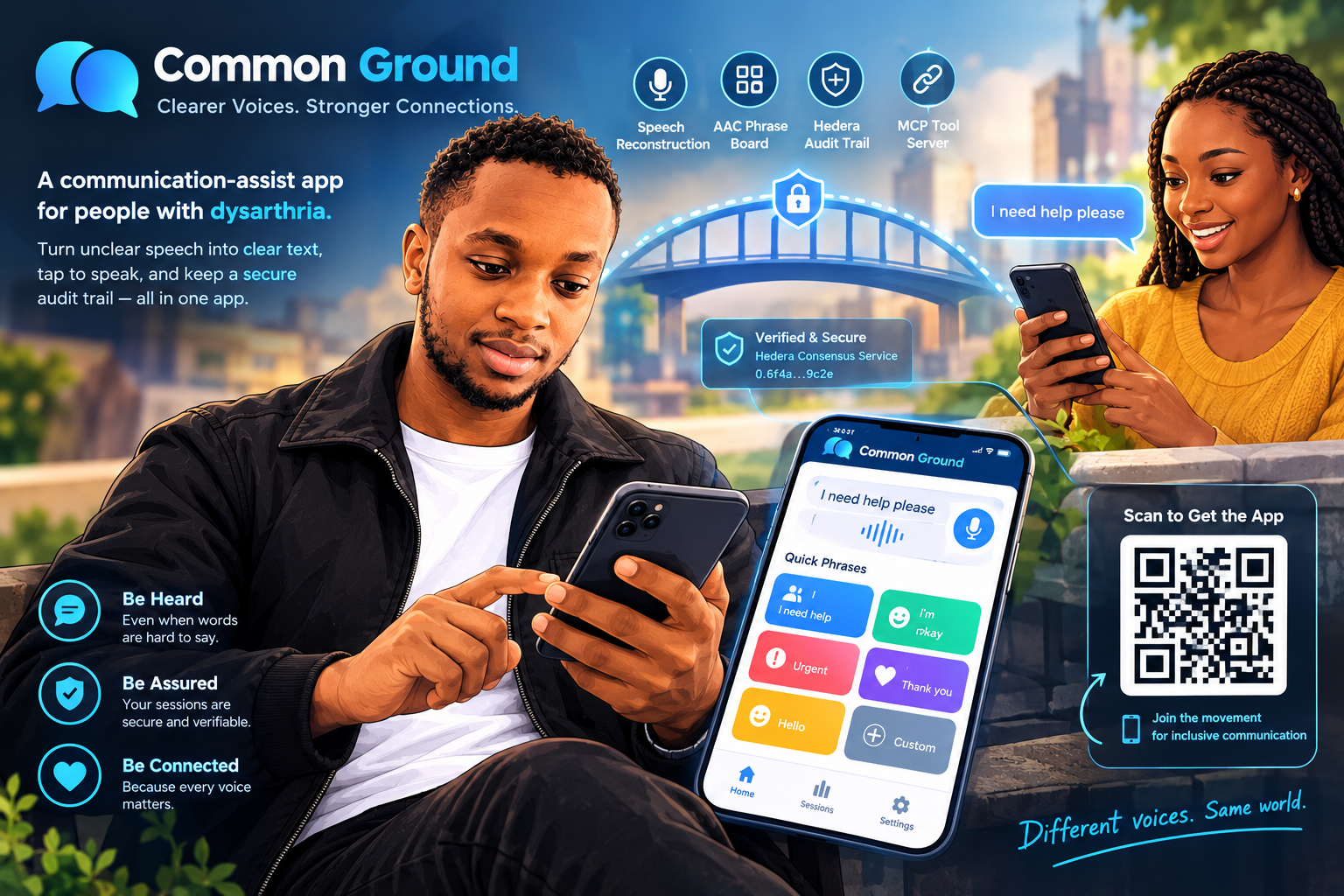
The idea is simple: give people multiple reliable ways to express themselves, rather than forcing them to depend on a single speech-recognition system. Common Ground combines speech reconstruction with an accessible AAC phrase board, while adding a tamper-evident audit layer that can independently verify saved communication sessions.
What it does
Common Ground provides two primary communication paths.
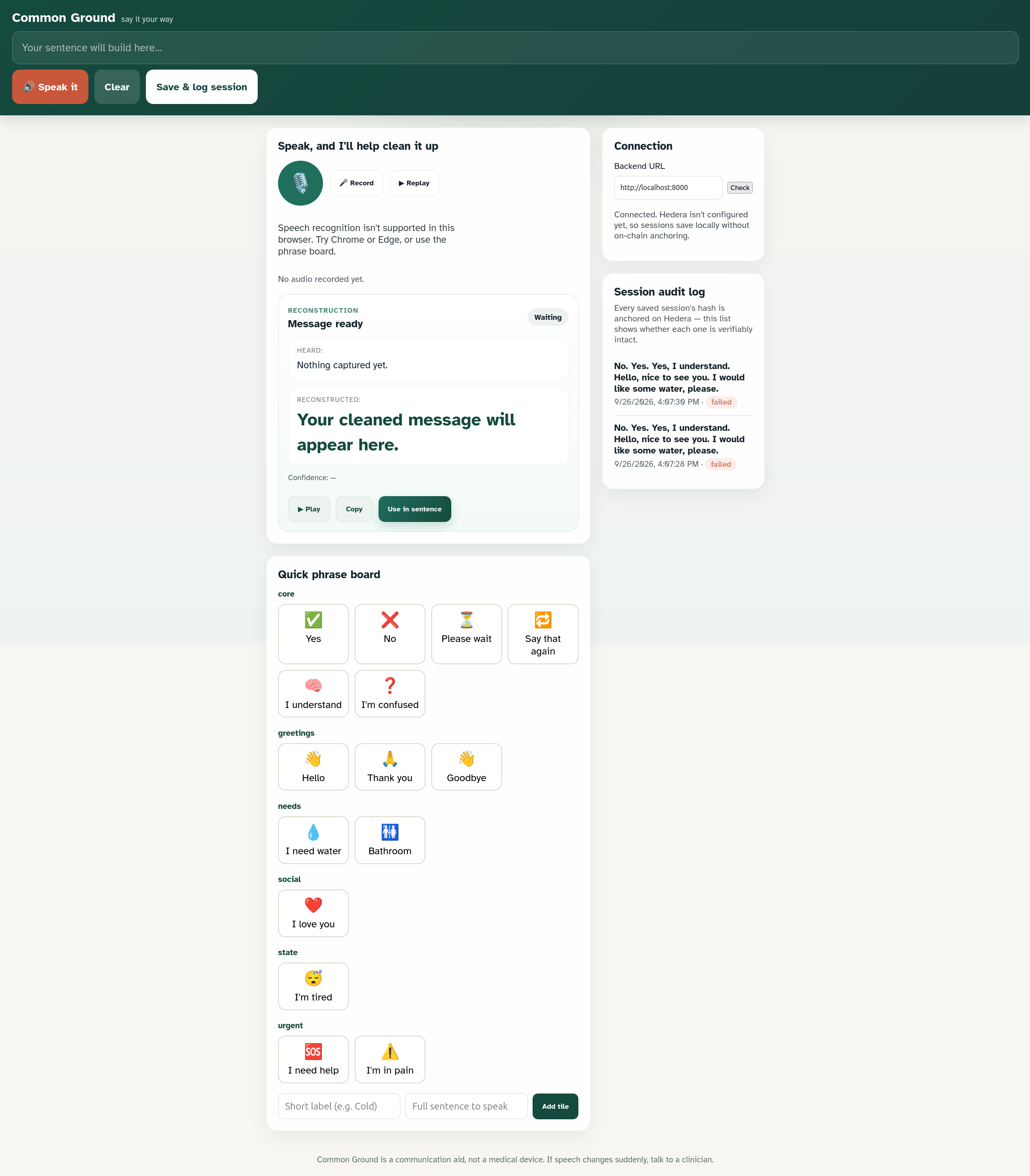
Speech Reconstruction: Users speak through a microphone, and the system reconstructs the most likely intended sentence using phonetic-confusion correction and phrase matching. An LLM-assisted pass can improve reconstruction quality. Importantly, the system provides alternatives instead of forcing a single “best guess.”
AAC Phrase Board: When speaking is difficult or too slow, users can tap large, high-contrast buttons containing frequently needed phrases. The selected phrase is immediately spoken using text-to-speech.
Verifiable Session History: Saved sessions are hashed with SHA-256 and anchored to the Hedera Consensus Service. The actual words never go onto the public ledger. This creates an independently verifiable record showing when a session occurred and whether its content has been altered.
MCP Integration: Common Ground exposes its communication capabilities through an MCP tool server, allowing MCP-compatible assistants and agents to reconstruct speech, access phrase boards, save sessions, and verify audit trails.
How we built it
The application uses a lightweight full-stack architecture.
The backend is built with FastAPI, with dedicated modules for speech reconstruction, Hedera integration, SQLite storage, Pydantic validation, configuration, and logging. The frontend is a dependency-free static SPA built with HTML, JavaScript, and CSS. A pytest suite covers validation, storage integrity, tampering detection, and graceful behavior when Hedera is unavailable.
The speech pipeline combines rule-based phonetic normalization and phrase matching, with optional LLM assistance. Sessions are stored locally, while their SHA-256 hashes can be anchored to Hedera HCS for independent verification.
We also designed the system around resilience: communication must continue even if an external service or blockchain network is unavailable.
Challenges we ran into
One of the biggest challenges was handling uncertainty in dysarthric speech. A communication system should not confidently replace someone's intended meaning with an incorrect guess. That is why Common Ground presents alternatives and combines phonetic correction with phrase matching rather than relying exclusively on one prediction.
We also had to solve the challenge of combining verifiability with privacy. Instead of putting communication content on a public ledger, Common Ground stores only a SHA-256 hash on Hedera.
Another challenge was reliability. Hedera cannot become a dependency that prevents someone from communicating, so the application continues saving sessions locally when Hedera is disabled, unreachable, or experiencing an SDK failure.
Accomplishments that we're proud of
We built more than a speech-to-text prototype. Common Ground provides a complete communication bridge with speech reconstruction, AAC support, text-to-speech, persistent sessions, audit logging, blockchain anchoring, independent verification, and MCP integration.
We are particularly proud of the privacy-conscious audit design: the system can prove that a session existed at a particular time and detect later changes without exposing the person's actual words publicly.
We also built validation and testing into the system from the beginning, including checks for malformed input, hash integrity, tampered payloads, missing sessions, and Hedera-unavailable scenarios.
What we learned
We learned that accessibility is not simply about adding more technology. The technology has to remain useful when individual components fail.
For a communication tool, reliability and user control matter as much as AI capability. That is why Common Ground provides alternatives instead of presenting uncertain speech reconstruction as fact, and why the communication experience continues even when Hedera is unavailable.
We also learned the importance of designing privacy into verifiable systems. A public audit mechanism does not require public disclosure of sensitive communication; hashing allows integrity to be checked without putting the original words on-chain.
What's next for Common Ground — AI Communication Bridge
Our next step is to make Common Ground increasingly personalized to each user's communication patterns. The current system already supports seeding reconstruction with frequently used phrases, which can improve its usefulness for individual users.
We also want to strengthen speech reconstruction beyond the current first-pass heuristic, expand the customizable AAC phrase system, and make MCP integrations more useful across assistants and caregiver workflows.
At the same time, we will continue treating safety and privacy as core requirements. Common Ground is currently a communication aid rather than a clinical or FDA-cleared medical device, and Hedera anchoring provides integrity and timing verification—not confidentiality.
Our long-term vision is a communication bridge where people with speech difficulties can express themselves through whichever channel works best for them—voice, assisted phrases, or AI-supported reconstruction—while retaining control, privacy, and confidence in what gets communicated.


Log in or sign up for Devpost to join the conversation.