-
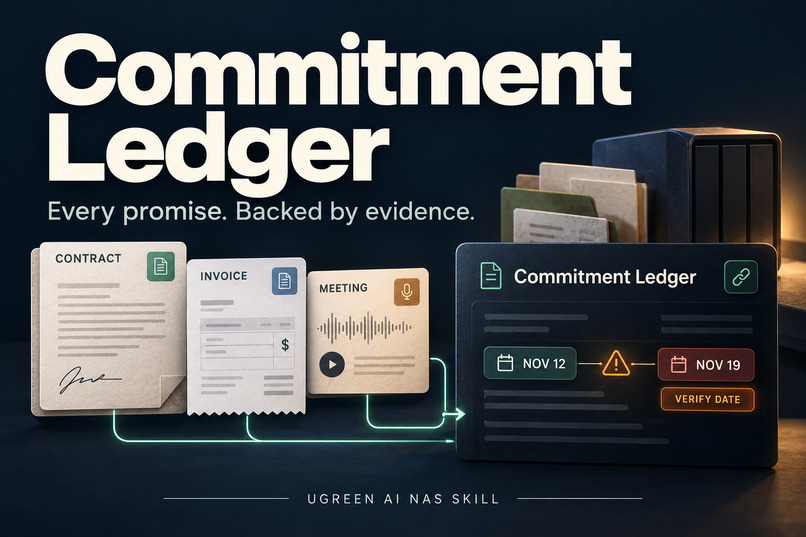
Concept artwork: documents and recordings feed a cited ledger; conflicting dates stay visible. NAS testing is pending.
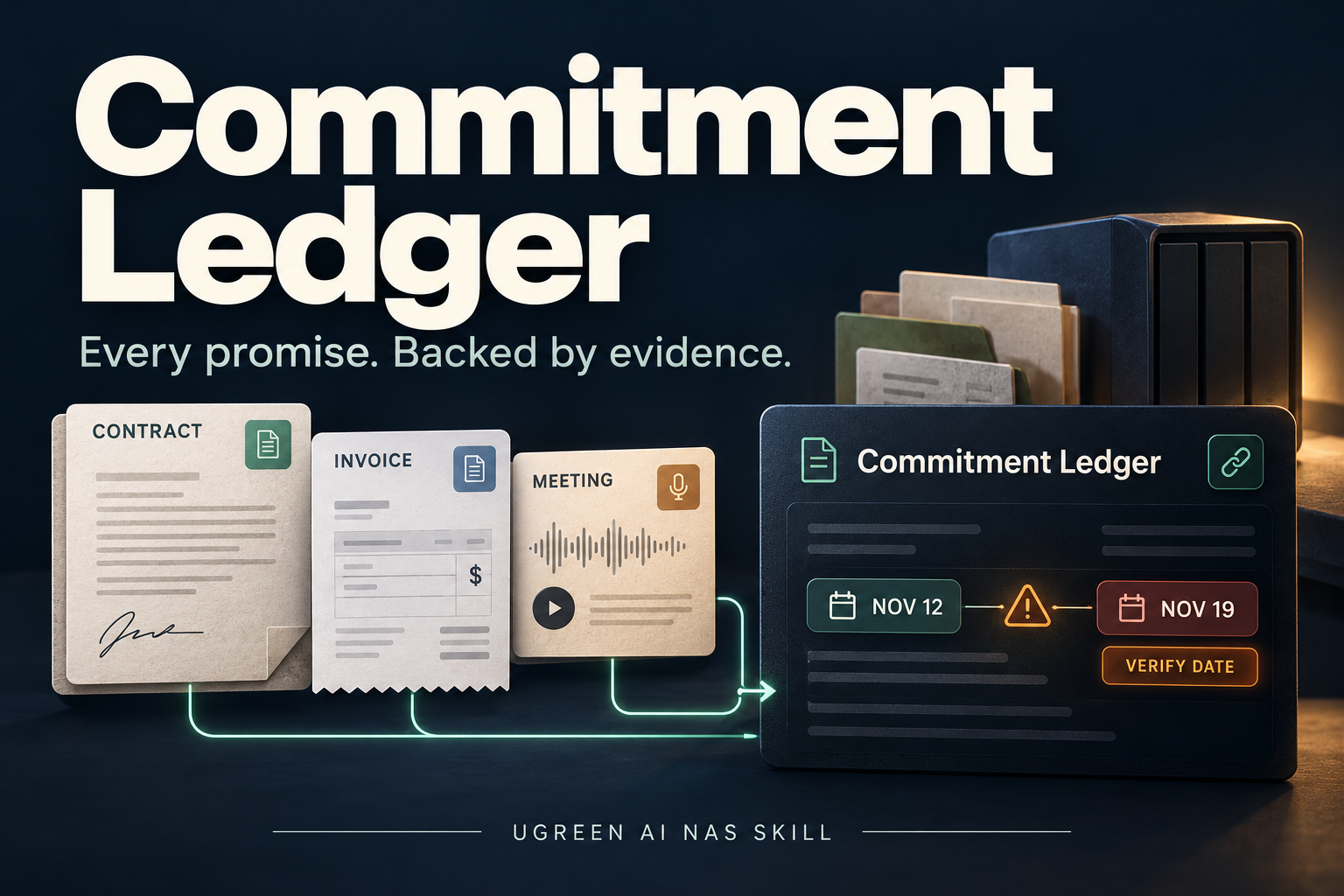
Every promise. Backed by evidence.
A contract says payment is due on November 12. A recorded meeting mentions November 19. Which date should your team follow?
Commitment Ledger is a UGREEN AI NAS Skill designed to put both claims in front of you, with the original document location and recording timestamp attached. It turns a folder of contracts, invoices, and meeting recordings into a Markdown action register: who promised what, by when, for how much, and what still needs clarification.
The dates above are illustrative. Current status: the Skill package passes UGREEN's bundled static checker. Execution on UGREEN NAS hardware is pending finalist testing. The cover is conceptual artwork, not a product screenshot.
Who it helps
Independent consultants and small project teams keep important commitments across signed PDFs, invoices, and recorded conversations. Finding a file is only the first step. They still need to compare payment dates, identify renewal windows, locate the source of a verbal change, and decide which ambiguity needs attention first.
Commitment Ledger brings those questions into one reviewable record, with the evidence close to each action.
The user experience
- Choose the scope. Select an authorized NAS folder or explicit files, optionally filtered by project, counterparty, or date.
- Review the evidence. The workflow discovers sources, transcribes recordings, extracts document commitments, and compares the returned claims.
- Resolve the gaps. Review a prioritized ledger with source references, competing values, and suggested verification steps.
- Approve the save. Confirm the destination before the final Markdown report is written.
Each ledger row is designed to retain the commitment, owner or counterparty, amount and currency, relevant dates, source path, page or timestamp where available, evidence excerpt, and uncertainty. A coverage section identifies unreadable or unprocessed sources.
What makes the ledger useful
The central feature is an agreement-gap queue. When two sources disagree, their claims remain side by side. Missing owners, unsupported changes, and ambiguous dates remain visible instead of being filled in by assumption.
In the illustrative payment example, the ledger would show November 12 from the contract and November 19 from the meeting, cite each source, and ask the user to confirm whether an amendment exists. It would not silently treat the later conversation as a binding change.
Evidence pointers, explicit conflict states, and coverage accounting are defined in the package's output contract so the result can be checked against the originals.
How we built it
The Skill orchestrates three official Uliya experts:
- file-agent discovers authorized files through
ug-filesystem.find. - knowledge-agent transcribes supplied recordings through
ug-knowledge.audio-transcription. - document-agent extracts and reconciles document claims through
ug-document.extractandug-document.reconcile. - knowledge-agent assembles the document and audio evidence, supports source verification through
ug-knowledge.collect-evidence, and saves the approved report throughug-knowledge.save-text.
The parent passes exact discovered paths and returned results between stages. It handles missing input, empty searches, partial coverage, failures, cancellation, and approval waits explicitly. A successful save requires a verified output path and byte count.
The package adds no external model service, API integration, executable, or credential. Runtime processing depends on the official UGOS/Uliya platform and its configuration. Source documents remain unchanged; the workflow requests approval for its final report write.
Challenges and lessons
The main design challenge was keeping each expert within its registered capabilities. Document reconciliation belongs to the document expert; final comparison with timestamped audio belongs to the knowledge expert. Separating those stages makes the evidence flow easier to inspect.
We also learned to treat incomplete coverage as part of the result. A useful ledger must show what it could not read, as clearly as what it extracted.
Validation and next steps
Version 0.2.0 passes UGREEN's bundled checker with zero errors and zero warnings. That verifies static package requirements; it does not establish runtime accuracy or performance.
The included finalist test plan specifies synthetic cases for consistent evidence, conflicting payment dates, unreadable files, empty searches, and an unauthorized destination. Acceptance requires zero invented values, every planted conflict retained, complete accounting of processed and unprocessed facts, and no write without approval.
If selected, we will run those cases on the supplied NAS, measure performance and format coverage, and record a three-minute demonstration. OCR and transcription quality remain practical limitations. Users must verify consequential decisions against the cited originals; the ledger does not replace legal or financial review.
Development disclosure
The original Skill workflow was developed for the UGREEN Hackathon 2026. OpenAI Codex assisted with drafting and static validation. The project cover was generated with OpenAI's image-generation tool. No model weights, credentials, personal records, or generated runtime data are bundled in the Skill package.
Built With
- markdown
- ug-document
- ug-filesystem
- ug-knowledge
- ugreen-ugos
- uliya-skills

Log in or sign up for Devpost to join the conversation.