Inspiration
Every hackathon starts the same way: you have an idea, you need a backend dev or a designer, and you end up posting in a crowded channel. Then two things go wrong. Teammates ghost after the first hour, and people hold back their best ideas because they are afraid someone will take them. We wanted a way to find a team that matches what you need, and a way to share an idea that proves it was yours first, without showing the words to anyone who should not see them.
What it does
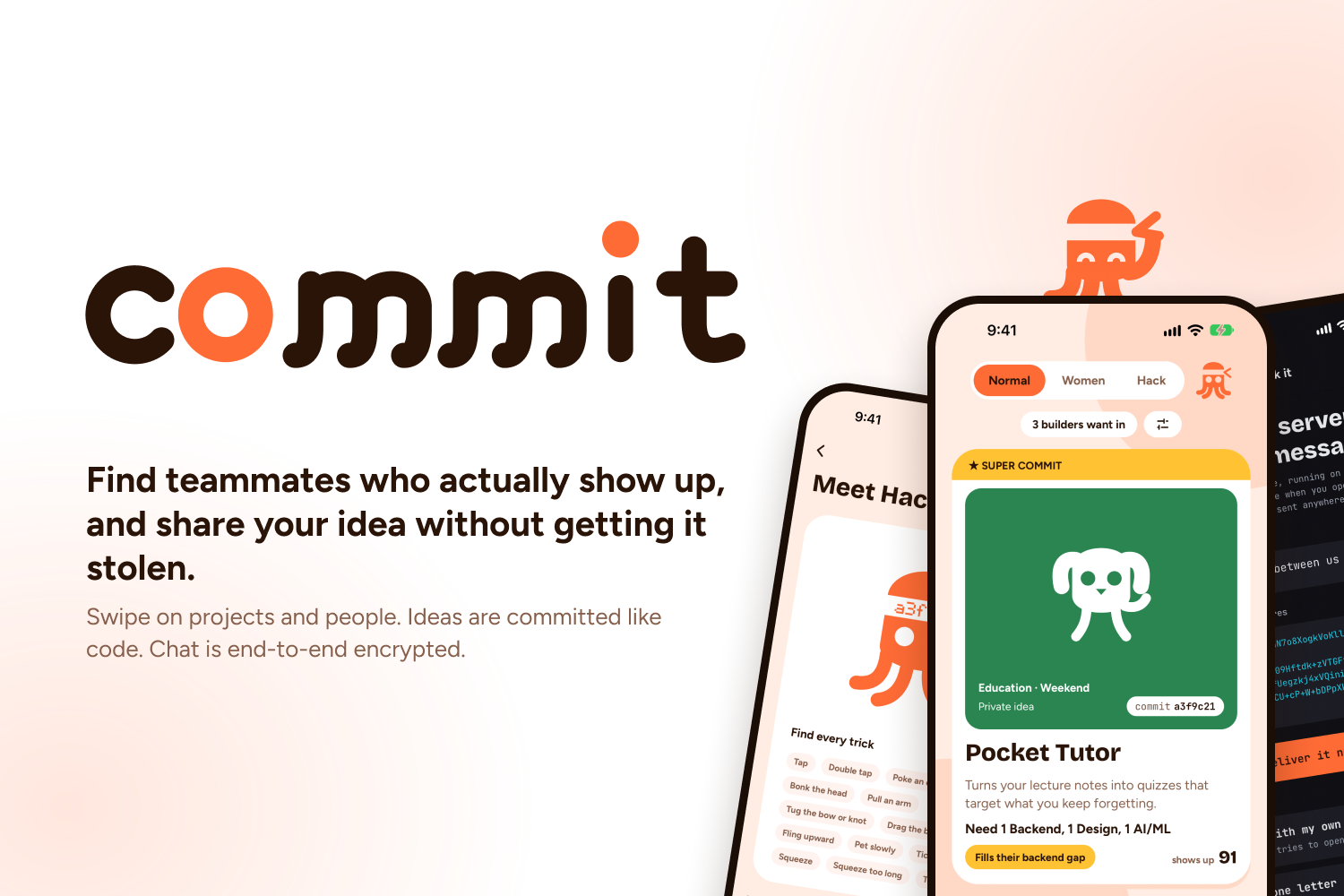
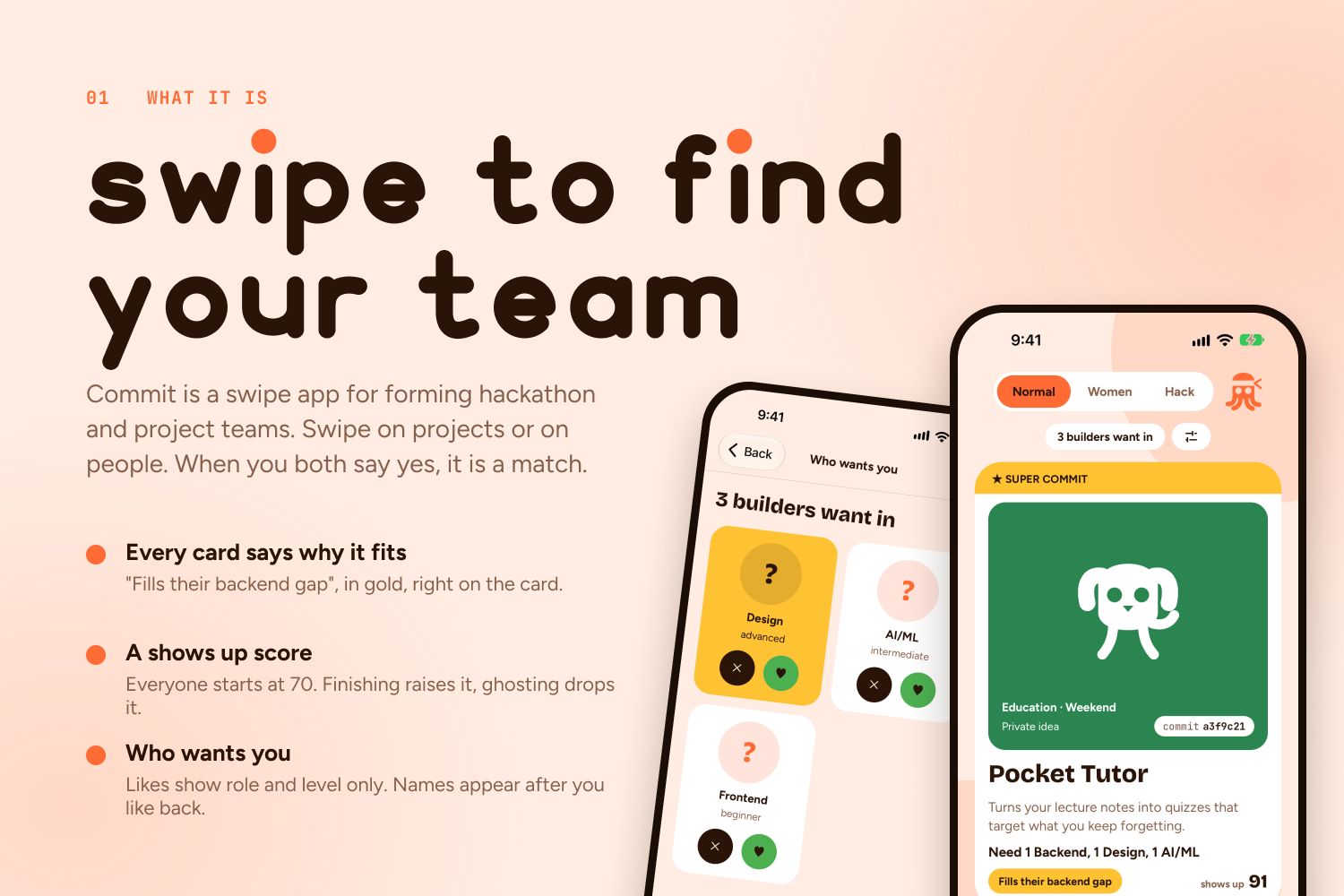
Commit is a swipe app for forming hackathon and project teams.
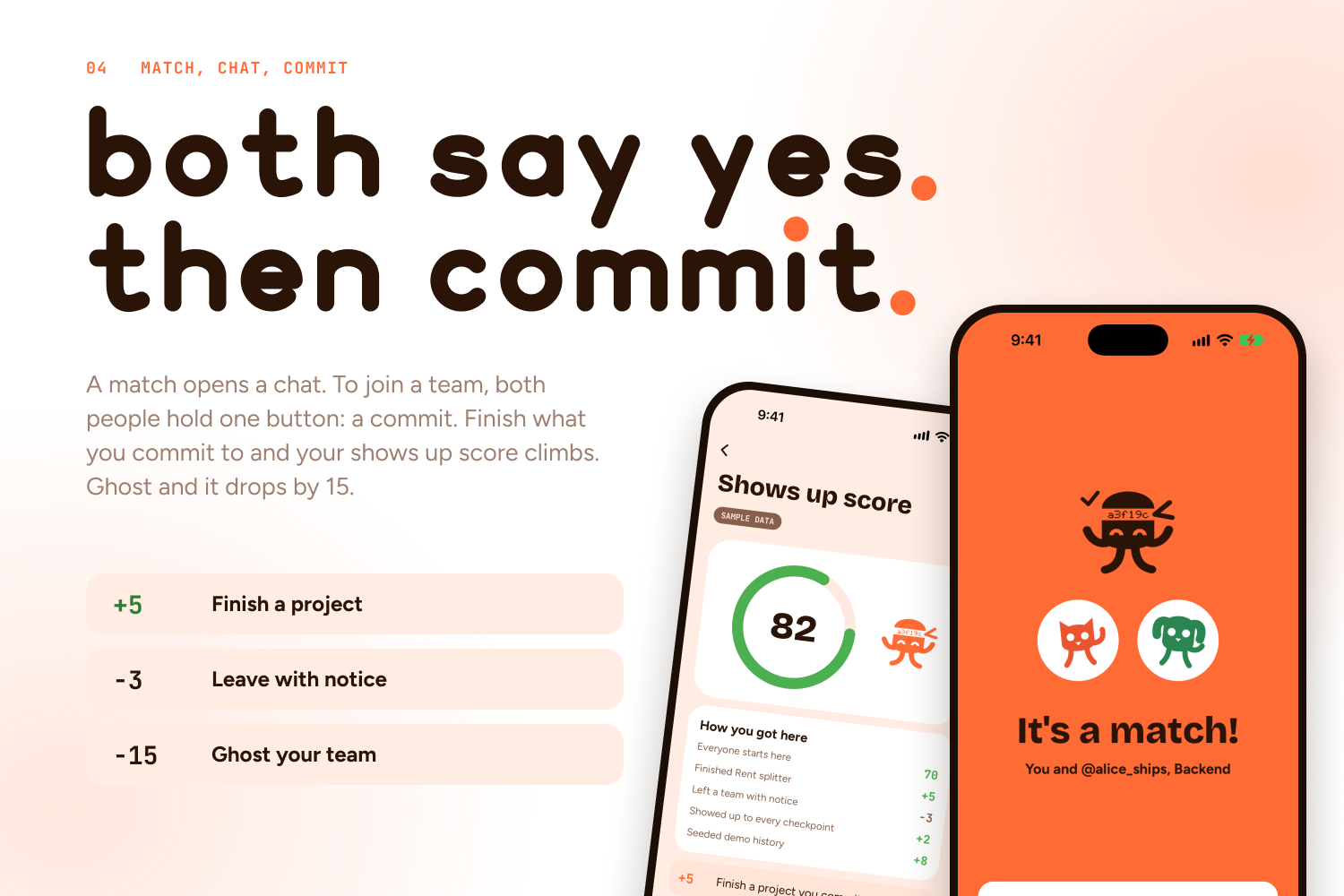
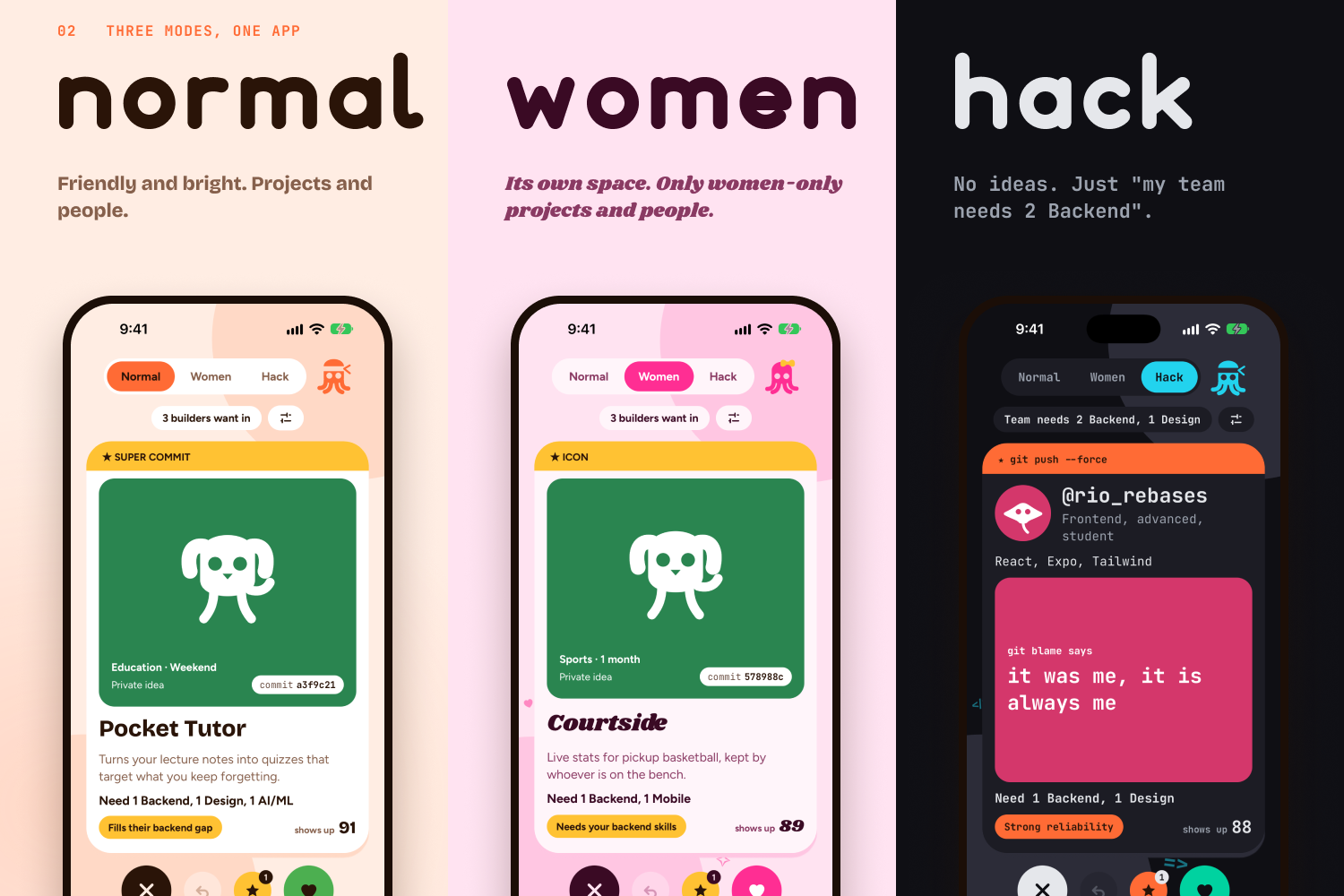
- Swipe on projects or people. Every card says why it is a fit ("Fills their backend gap") and shows a "shows up" score: everyone starts at 70, finishing projects raises it, ghosting lowers it.
- Three modes. Normal; Women mode, a separate space that only shows women-only projects and people; and Hack mode, a dark terminal look with no project ideas at all, just "my team needs 2 Backend, 1 Design".
- Who wants you. People who liked you show up as blurred cards with only a role and level. Their name is sent by the server only after you like them back.
- Match, chat, commit. A match opens a chat, and both people hold a button to commit to the team.
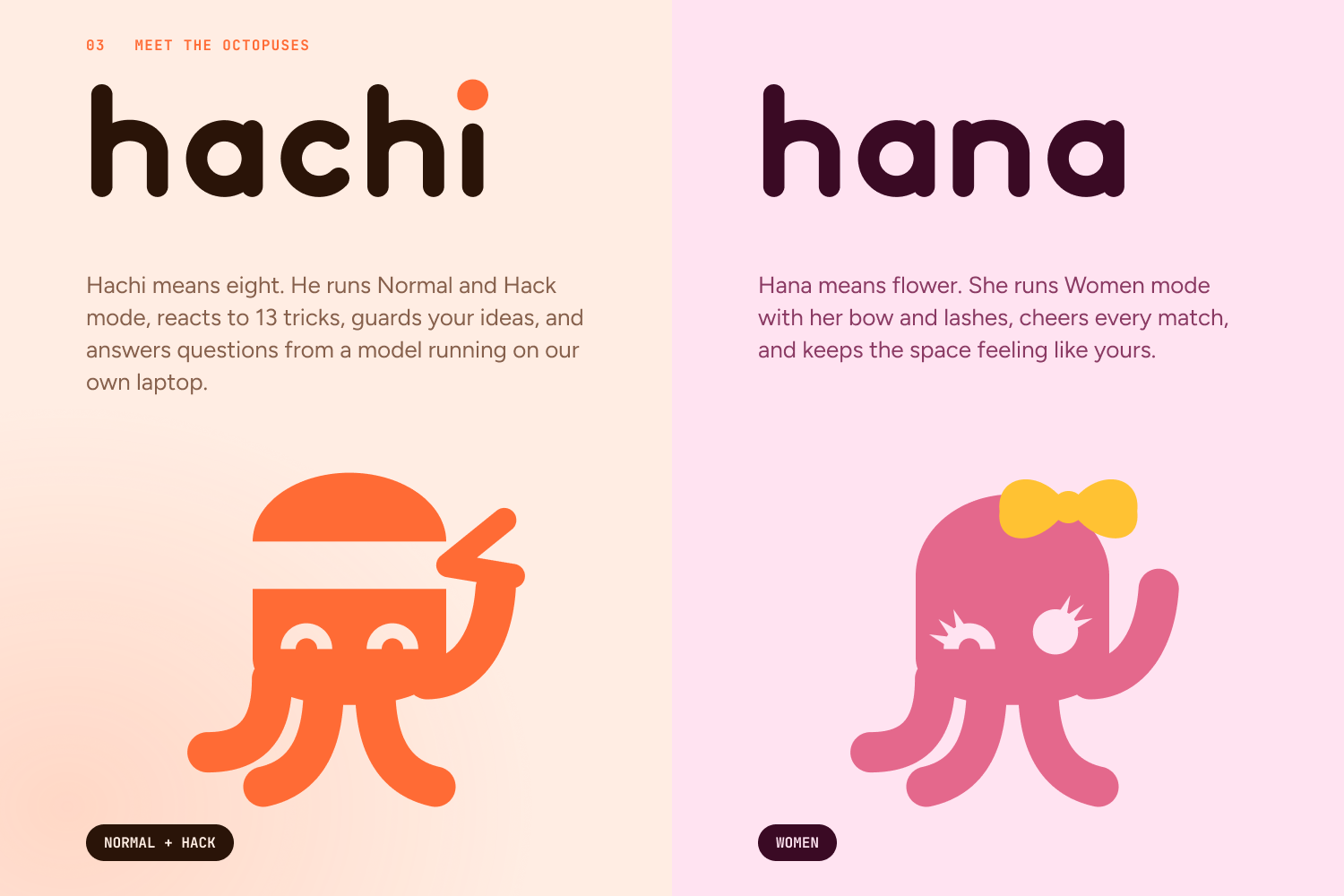
- Hachi, our octopus mascot, reacts to everything (tap, poke, drag, pet, flip) and answers questions in a built-in assistant chat that can run on a small language model on our own laptop.
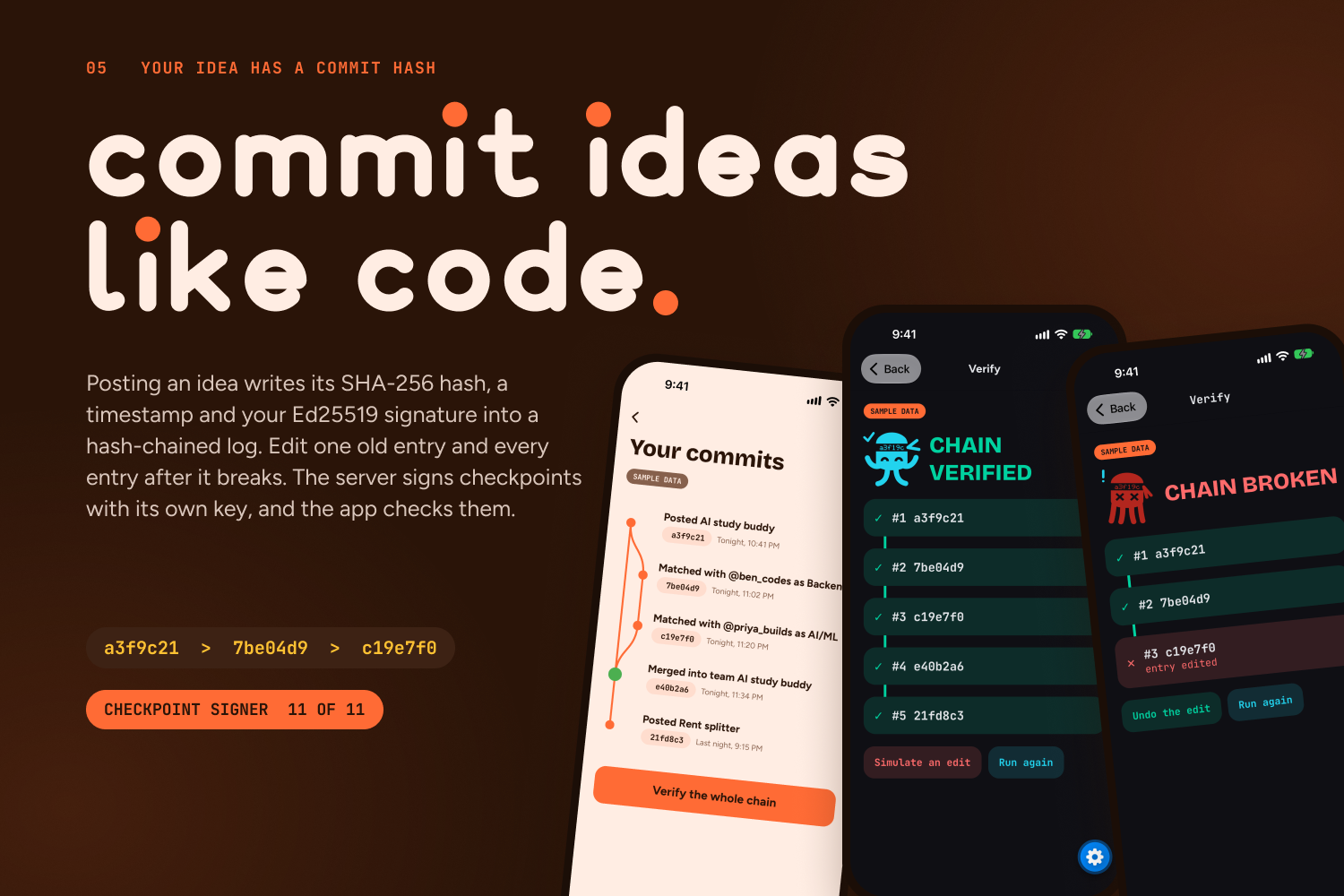
- Ideas are committed like code. Posting an idea writes its SHA-256 hash, a timestamp and the author's Ed25519 signature into a hash-chained log, so changing any old entry breaks every entry after it. The server also signs checkpoints of the log with its own key, which the app pins. A private idea is encrypted on the phone and only the team can decrypt it.
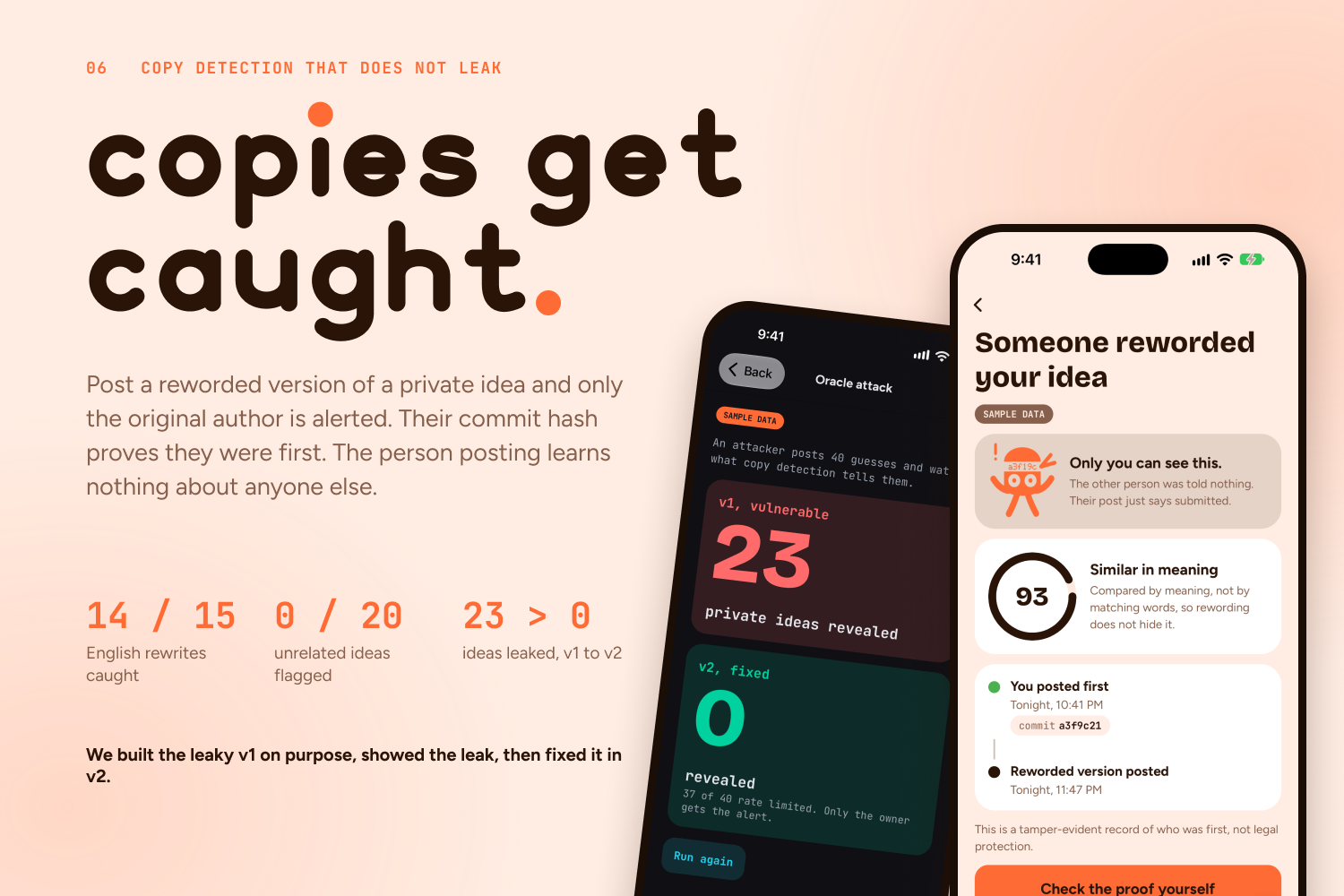
- Copy detection. If someone posts a reworded version of a private idea, only the original author gets an alert, and their commit hash proves they were first. The poster learns nothing about other ideas.
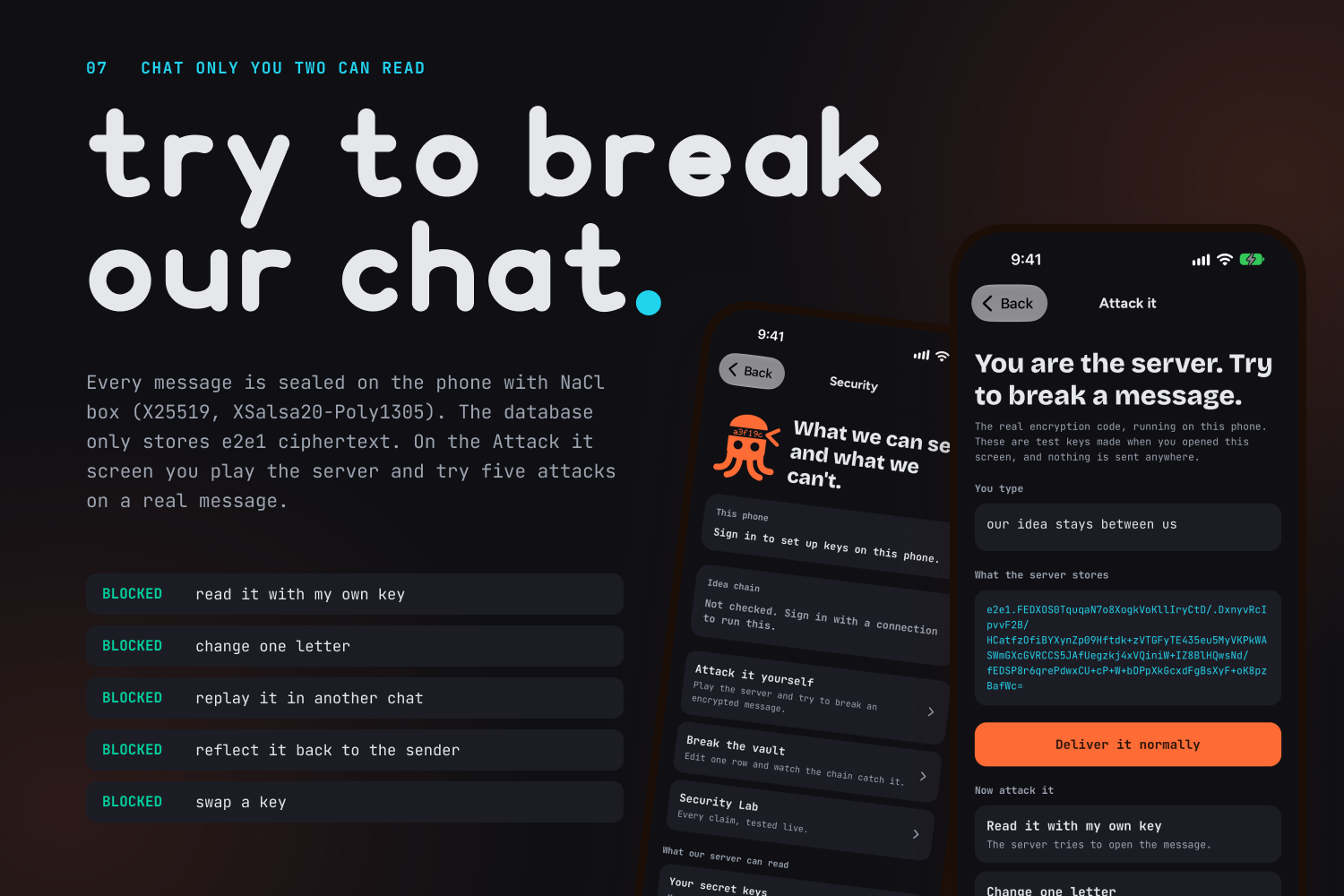
- End-to-end encrypted chat. Messages are sealed on the phone with NaCl box (X25519, XSalsa20-Poly1305). A "Server view" switch shows exactly what the database stores: ciphertext. Two people can compare a safety number and creature pair to make sure nobody swapped a key, and a changed key pauses the chat until they check.
- Attack it yourself. A screen where you play the server and try to break an encrypted message: read it, change one letter, replay it in another chat, reflect it back, swap a key. Every attack runs the real crypto code and gets blocked or caught.
- Security Center. One honest page that says what our server can and cannot read.
How we built it
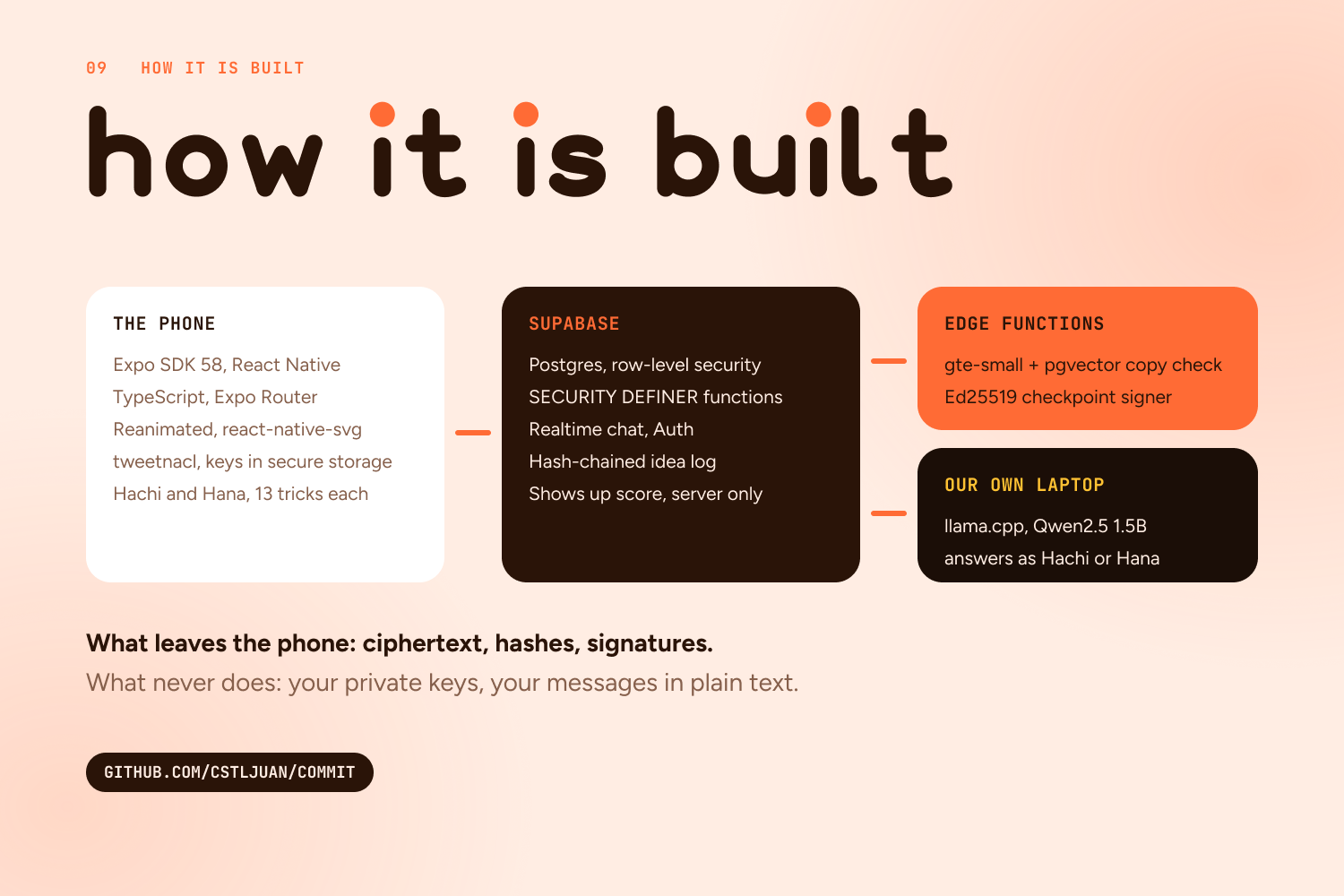
- App: React Native with Expo SDK 58, Expo Router and TypeScript. Reanimated and Gesture Handler for the swipe physics and Hachi's animations, react-native-svg for all art. Original sound effects synthesized by a Python script (no samples).
- Backend: Supabase (Postgres with row-level security on every table, SECURITY DEFINER functions for matching, swipes and the idea log, Realtime for chat, Auth).
- Crypto: tweetnacl on the device. Keys live in the phone's secure storage. Ed25519 signatures on every idea entry, secretbox for team idea encryption with per-member wrapped keys, box for pairwise chat.
- Copy detection: a Supabase edge function embeds the idea with gte-small inside our own backend, compares it against stored embeddings with pgvector, is rate limited, and returns nothing about other ideas.
- Assistant: Qwen2.5 1.5B running locally with llama.cpp, with a built-in fallback so the chat always works offline.
- Design: Figma for the mascot, wordmark and screens.
Challenges we ran into
- Copy detection can leak. A naive version that tells you which idea yours resembles lets an attacker probe for private ideas. We built the vulnerable version on purpose (v1), showed the leak, and fixed it (v2): only the original author is told.
- Making encryption honest. Our own code review caught that a failed key check could have quietly sent plain text, that a username change could skip the key-change warning, and that a server-inserted plain message would look normal. We fixed all three before the demo.
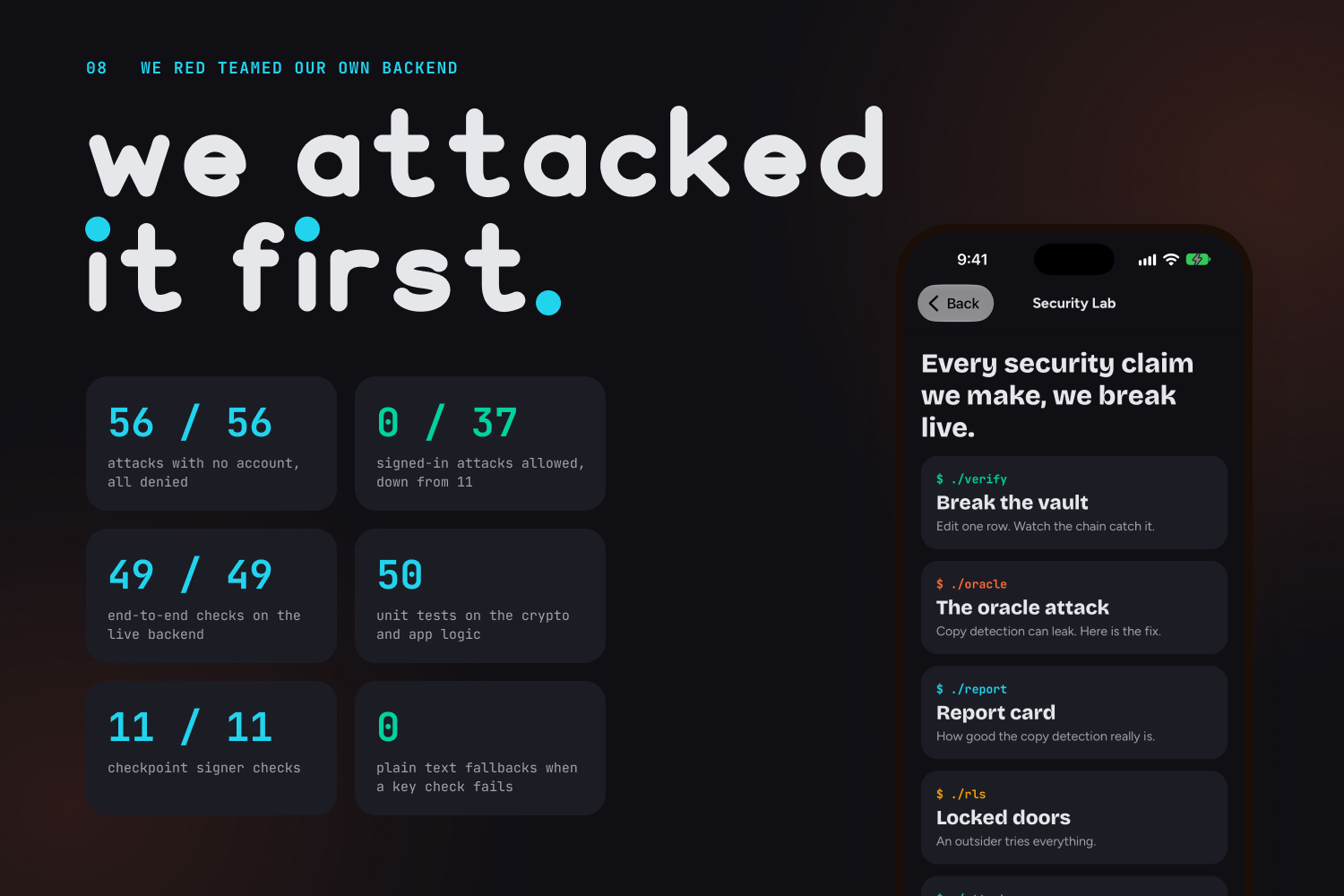
- Locking down a signed-in attacker. Our first signed-in red team run found 11 attacks that worked, such as turning on Women mode for yourself or backdating an idea in the log. We fixed every one in the database and the same run now allows 0 of 37.
- Hiding identity until a like. Who wants you had to return cards with no identity at all, so the server only reveals a name through the match.
Accomplishments that we're proud of
- Copy detection on our eval set: 14 of 15 English rewrites caught, 0 of 20 unrelated ideas flagged (precision 1.00).
- Red team on our own backend: 56 of 56 attacks without an account denied, and 0 of 37 attacks from a signed-in account allowed.
- Signed-in end-to-end harness: 49 of 49 checks pass against the hosted backend, including an encrypted chat delivered over Realtime in about 360 ms.
- 50 automated tests on the crypto and app logic, all passing.
- A full app with three distinct modes, a mascot with 13 tricks, and a security story you can break live on stage.
What we learned
- Security claims are only worth what you can show. We added screens that let anyone check them, and we wrote down the limits.
- Honest limits we state in the app: a private idea's words pass through our server once for copy detection and are not kept, but a numeric embedding is kept and can hint at the topic. The server still sees who talks to whom and when. Chat has no forward secrecy, so it is not Signal-level, and messages are tied to one device. Copy detection does not catch Spanish rewrites yet (0 of 5), because the embedding model is English-only.
What's next for Commit
- A multilingual embedding model that still runs inside our backend.
- Forward secrecy for chat and multi-device keys.
- Publish the server-signed log checkpoints so anyone can audit them.
- A real verification flow for Women mode. Today it is set on the server and cannot be turned on from the app.
Use of AI tools
We used Claude Code and Codex as coding assistants to write and test code, review it, and run security checks, with every change reviewed and committed by a team member. The app uses gte-small embeddings for copy detection (inside our Supabase backend) and Qwen2.5 1.5B through llama.cpp for Hachi's chat replies. Sound effects are synthesized by our own script. Sample profiles and projects in the demo are synthetic.
Built With
- deno
- expo.io
- figma
- gte-small
- llama.cpp
- pgvector
- postgresql
- python
- qwen
- react-native
- react-native-svg
- reanimated
- supabase
- tweetnacl
- typescript
