Inspiration
The most expensive abandoned checkout is the one that never happens.
Think about four friends trying to book a ski weekend. One has a strict budget; another needs a bed, rentals, or flexible cancellation; everyone is messaging in different places. They may genuinely want to buy, but the group never reaches a single offer everyone can accept. Checkout tools cannot convert intent that never becomes a transaction.
Commit bridges the missing step between "we should do this" and "we've all approved our shares." It helps buyers reach an exact agreement, gives merchants a way to understand blocked group demand, and uses PayPal for each person's explicit payment approval.
What it does
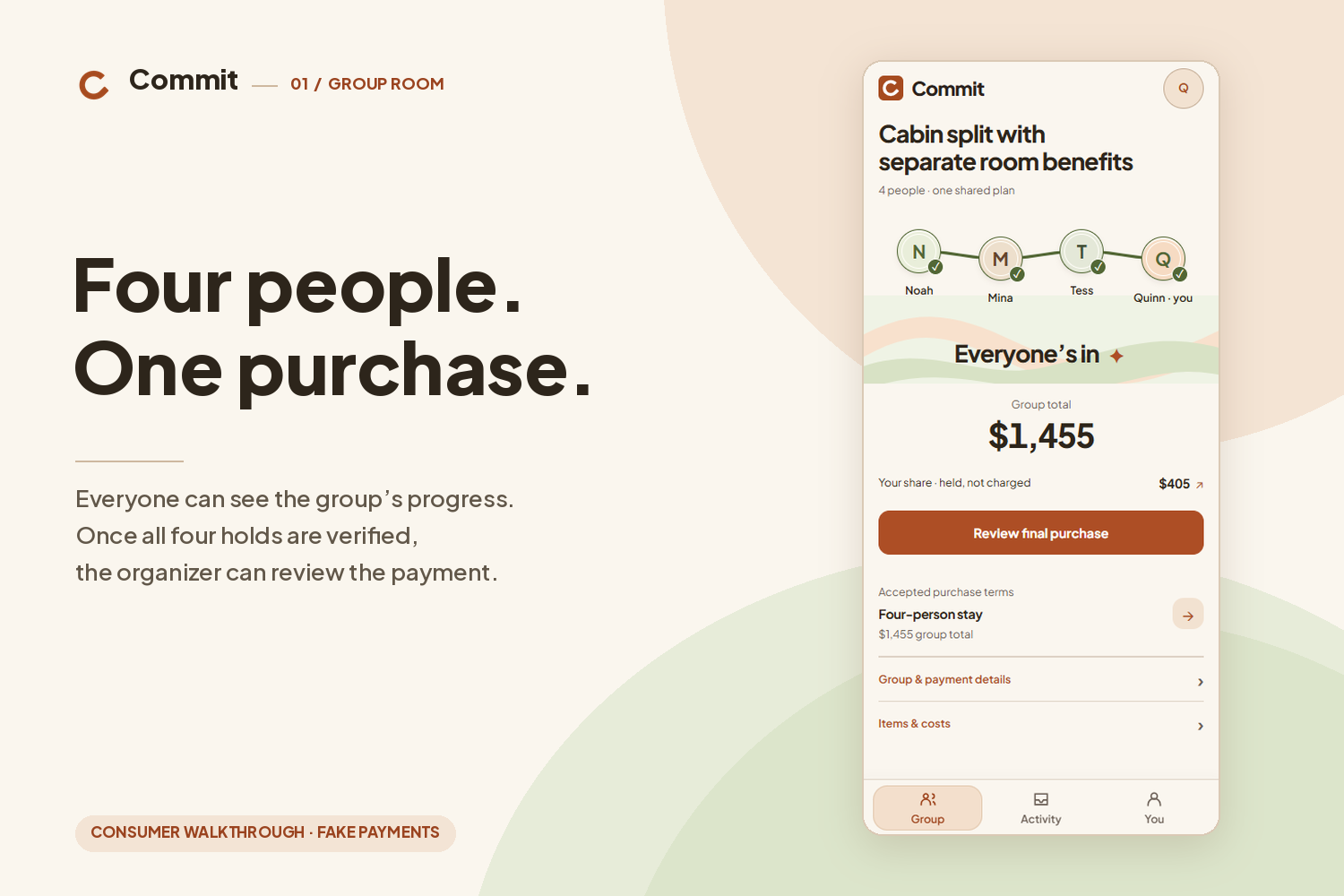
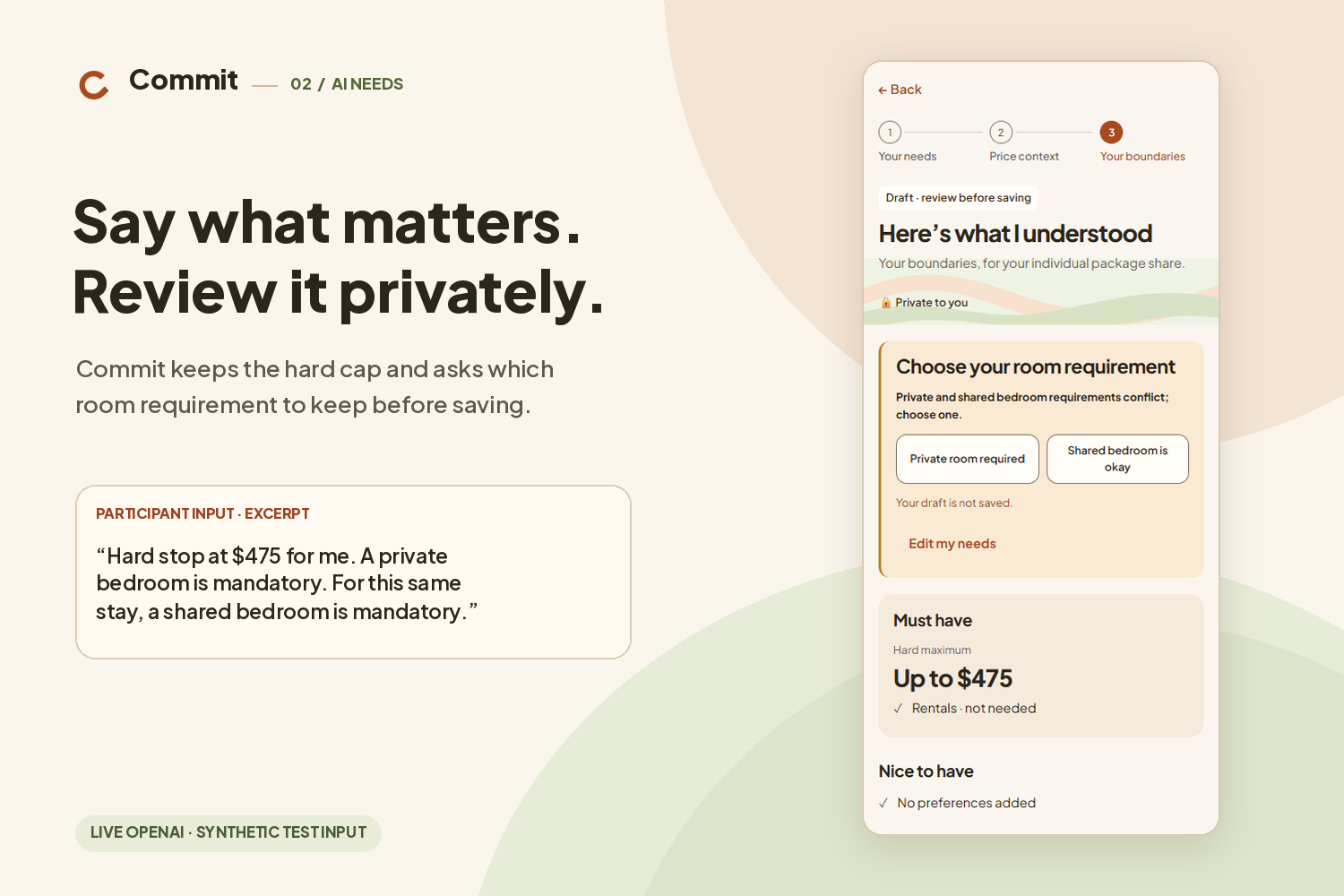
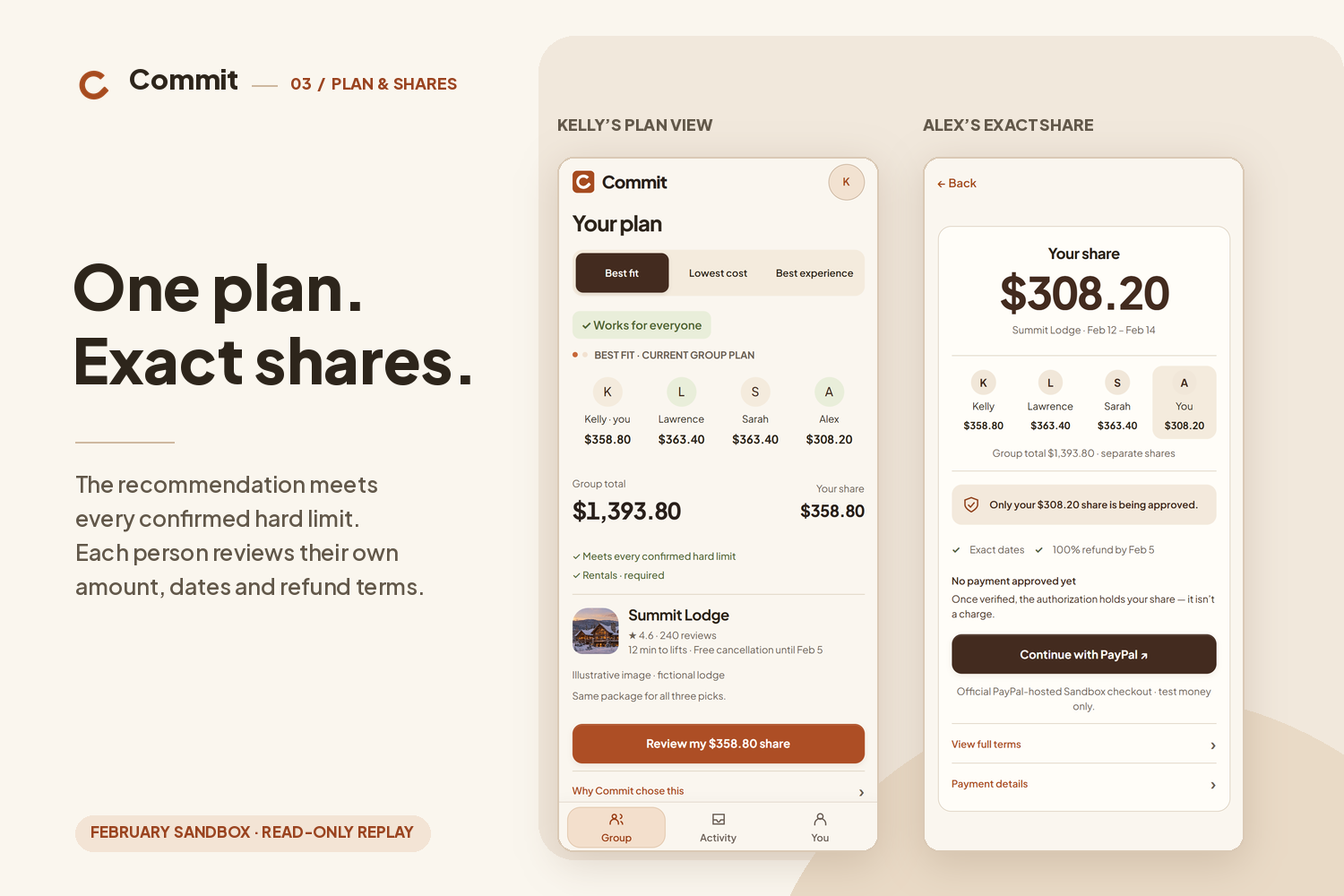
For groups: Commit's consumer app gathers each participant's needs privately. OpenAI interprets natural-language requirements into an editable draft, but each person must confirm their own hard limits. A deterministic solver checks availability, budgets, merchant boundaries, amenities, quality, and fairness; it recommends a feasible package and shows each person's exact share. Everyone reviews the same versioned terms and independently approves their own PayPal Sandbox order. Material changes invalidate earlier commitments and require fresh approval. Verified holds, finalization, refunds, and exceptions are reflected in durable status rather than optimistic success screens.
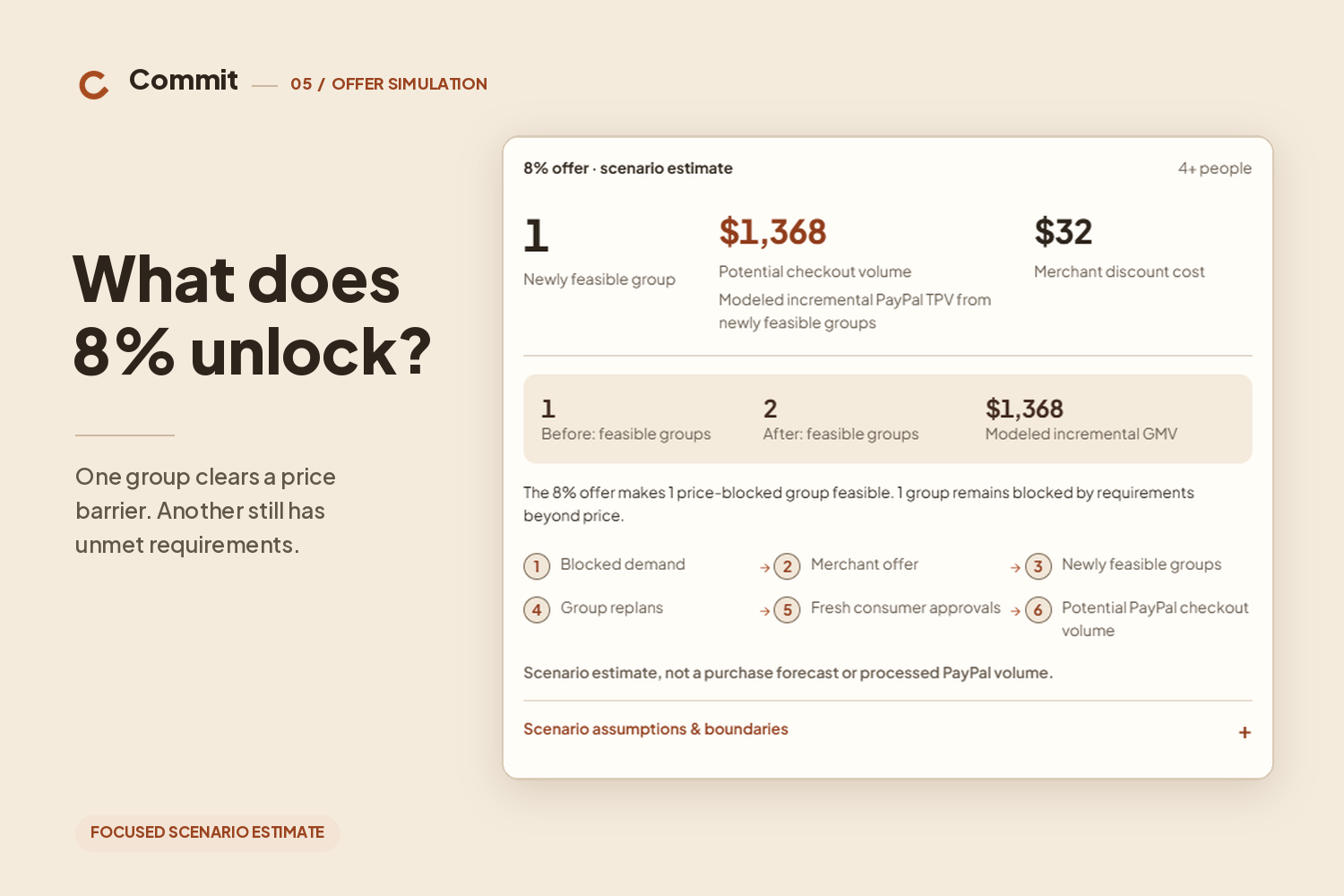
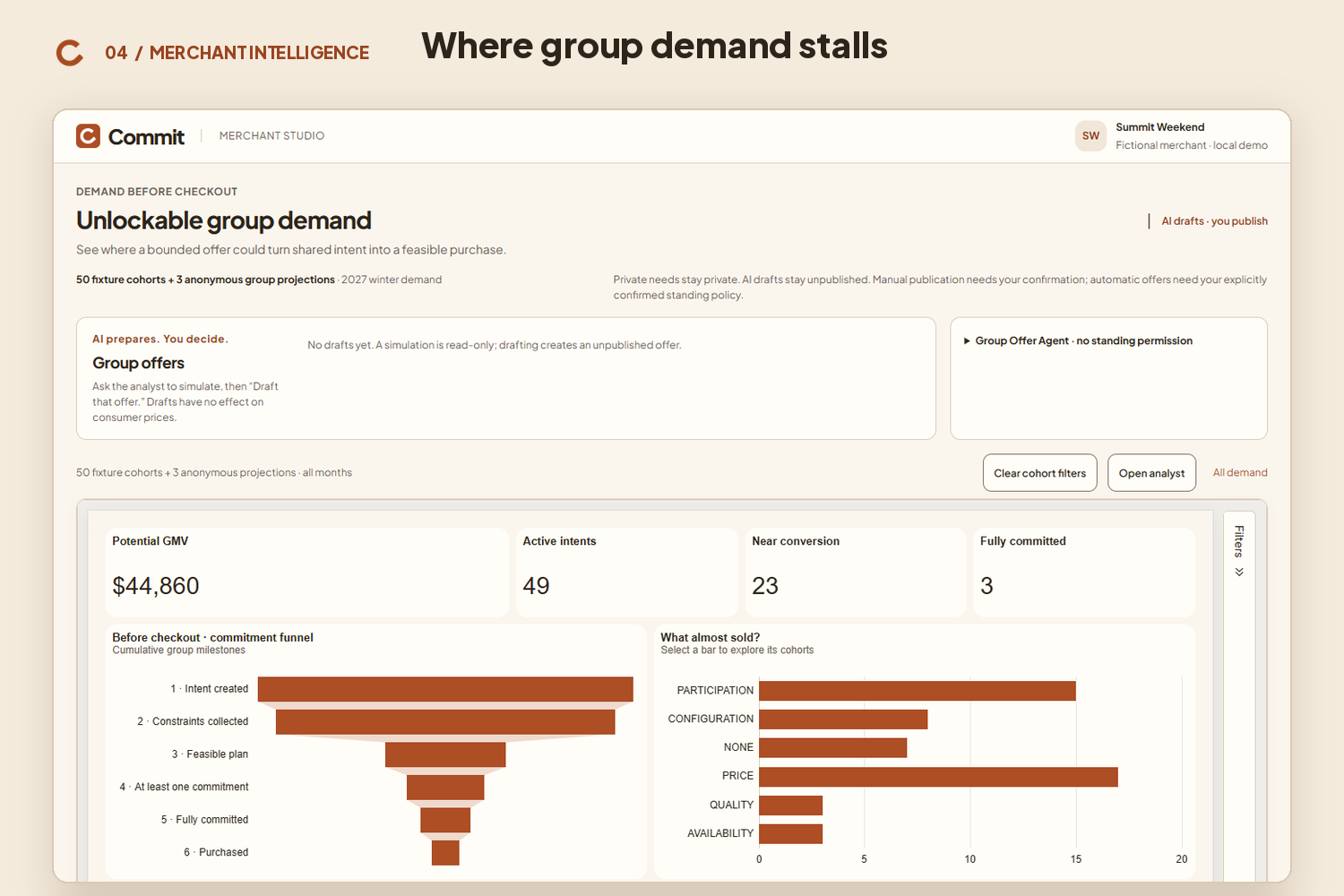
For merchants: Merchant Studio, built with AG Studio, shows aggregated, privacy-minimized group demand: where groups stall, how close they are to converting, and which bounded intervention could help. Its AI analyst can explore the dashboard and simulate offers. A deterministic simulator checks discount caps, minimum margins, eligible stays, redemption limits, and buyers' non-negotiable needs. AI can prepare an unpublished offer; a merchant must approve publication or explicitly establish a constrained standing policy. New offers create new proposal terms, never silent changes to existing payment approvals.
The product includes Group, Plan, Activity, and You views; a responsive consumer PWA; and a separate merchant analytics workspace.
Why it matters to PayPal
The most valuable checkout opportunity may be a purchase that never reached checkout. Four willing buyers can abandon a shared purchase because no one can reconcile budgets, must-haves, individual responsibility, and payment timing. Making checkout faster does not remove that earlier barrier.
PayPal has emphasized branded checkout selection, consumer engagement, and merchant growth. Commit tests a complementary growth opportunity: help merchants recover group intent before checkout and turn it into individually consented PayPal transactions. Instead of one organizer fronting the full amount or sending payment requests after buying, Commit prepares exact shares and lets every participant authorize their own order.
The path from intent to possible payment volume is concrete:
- AI structures private buyer needs into reviewed drafts. A deterministic solver finds a plan that respects everyone's hard limits.
- Merchants see anonymous aggregate demand and can simulate an offer bounded by margin, discount, dates, and inventory.
- An accepted offer creates a new exact proposal. Every buyer must approve the revised terms; automation cannot invent consent.
- PayPal Sandbox orders authorize each buyer's share, and a separately controlled capture workflow verifies or compensates the group outcome.
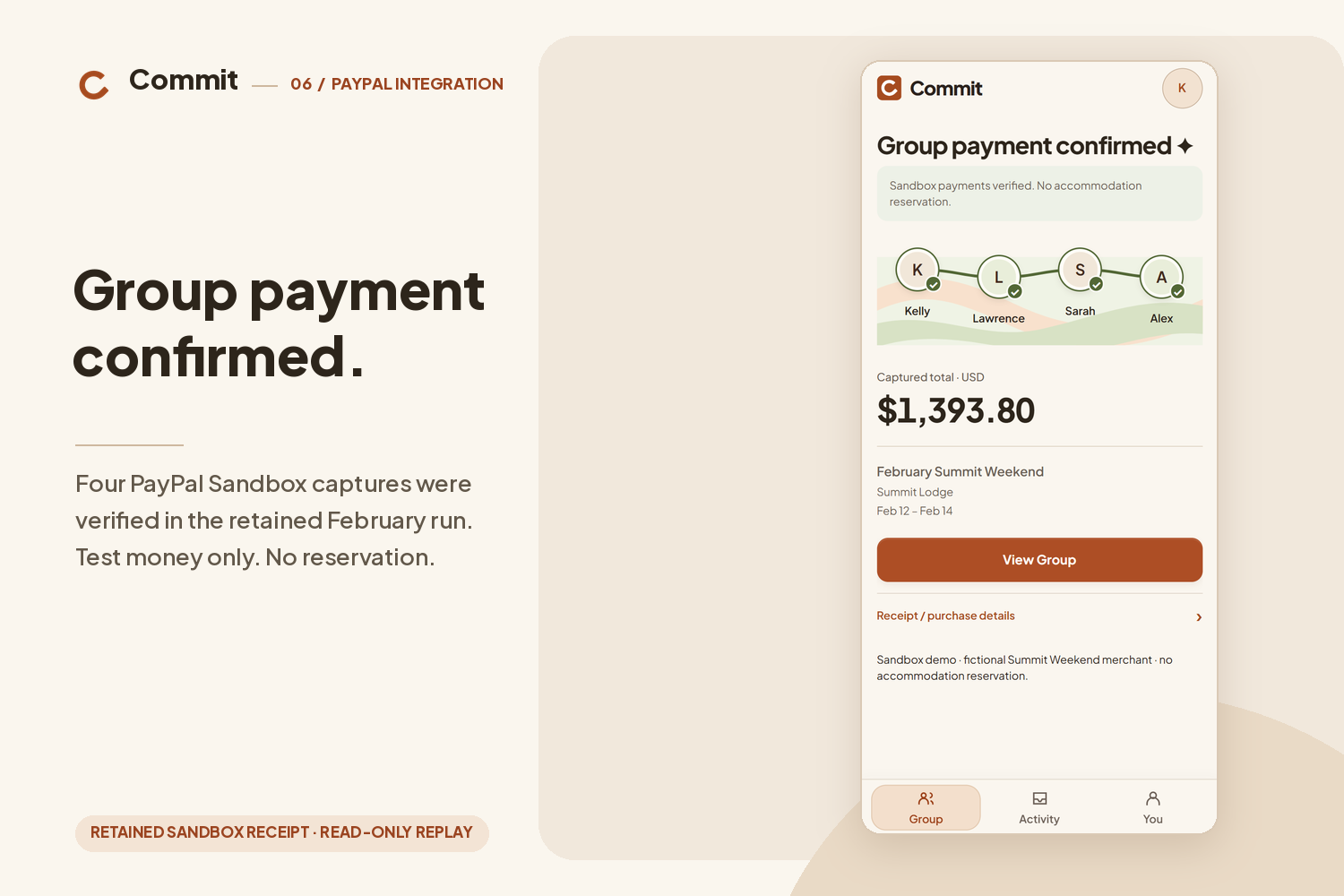
In our four-person fictional Summit Weekend example, an 8% merchant offer reduces the group quote from $1,515 to $1,393.80, saving $121.20. Its updated terms require fresh buyer approval. Historical Sandbox testing exercised four individual payment captures totaling $1,393.80; this is test money, not a real reservation. Separately, an all-cohort deterministic offer simulation found 15 newly feasible fictional groups, or $20,884 in modeled potential incremental PayPal checkout volume at $1,816 in merchant discount cost. Those figures are feasibility estimates, not actual conversions, PayPal revenue, or processed volume.
If the same mechanism helps real groups finish purchases they otherwise would abandon, the opportunity is more merchant sales and more PayPal payment volume. Real-world conversion lift remains to be validated.
What makes Commit different
Most expense-splitting experiences start after someone has paid. Many AI shopping assistants help an individual find something to buy. Commit focuses on a different moment: before a group transaction exists, when buyers must agree and a merchant may need to change an offer.
It connects private multi-person constraints, deterministic deal feasibility, anonymous merchant demand, bounded AI-assisted incentives, exact-term consent, and separate PayPal authorizations in one workflow. The AI can interpret and propose; it cannot quietly change a budget, merchant margin, payment amount, or approval. That makes agentic commerce useful without transferring financial authority to a model.
How we built it
PayPal Developer Platform (Sandbox): individual Orders API approval, exact-order authorization, independent provider-state verification, separately authorized capture, voids, full refunds, idempotency, and durable compensation/reconciliation. OpenAI Responses API: strict structured-output interpretation of private needs and fact-constrained explanations. The model cannot set prices, waive limits, approve orders, or capture funds. AG Studio / AG Grid: an interactive merchant dashboard, native AI Agent Framework, anonymized cohort analysis, filtering, charts, and custom bounded-offer simulations. Deterministic TypeScript/Node.js services and SQLite: immutable proposal versions, exact-cent allocation, constraint solving, merchant offer policies, event/outbox processing, audit trails, and durable payment workflow. React, responsive PWA, and Render: consumer and merchant experiences exposed through a staged hosted build.
Our agentic design has three deliberate levels of authority: AI can assist; deterministic software may act within an explicit grant; and financial steps require each buyer's real PayPal approval plus separately constrained capture authority.
Challenges
The hard part was not adding an AI chat window or a PayPal button. It was preserving trust when four people have different private limits and a merchant changes the price mid-plan. We built exact-term commitment envelopes, safe reapproval after changes, provider verification, idempotent retries, and explicit treatment of uncertain payment outcomes. We also separated aggregate merchant insights from individuals' private preferences.
Accomplishments and lessons
We built a coherent buyer-to-merchant workflow instead of a static mockup: private needs, a feasible group plan, versioned commitments, PayPal Sandbox payment handling, and merchant AI-assisted offer analysis. The codebase includes automated tests and a hosted staging demo. Historical Sandbox acceptance exercised four individual captures and compensation; automated fake-gateway tests are clearly distinguished from real provider evidence.
We learned that useful commerce AI needs strict authority boundaries. AI can interpret intent and surface opportunities; the application must own arithmetic, feasibility, consent, and money movement.
What's next
Extend authenticated buyer/merchant identity, robust multi-tenant operations, real-device PWA verification, and additional merchant categories. Long-term, this points toward the adjacent SkanPay app-to-wallet interoperability vision: a neutral orchestration layer through which independent applications and payment accounts can coordinate merchant invoices, wallets, promotions, vouchers, gift cards, loyalty, residual payments, and reconciliation. Commit demonstrates one group-commerce slice of that idea; it does not implement SkanPay or cross-wallet interoperability today.
Scope: Fictional inventory and demo identities; PayPal Sandbox only. Merchant simulations estimate feasibility, not confirmed revenue. This is a hackathon prototype, not a production booking service.
Built With
- ag-grid
- ag-studio
- node.js
- openai
- paypal-orders-api
- paypal-sandbox
- pwa
- react
- render
- sqlite
- typescript
