-
CommerceVault AI
-
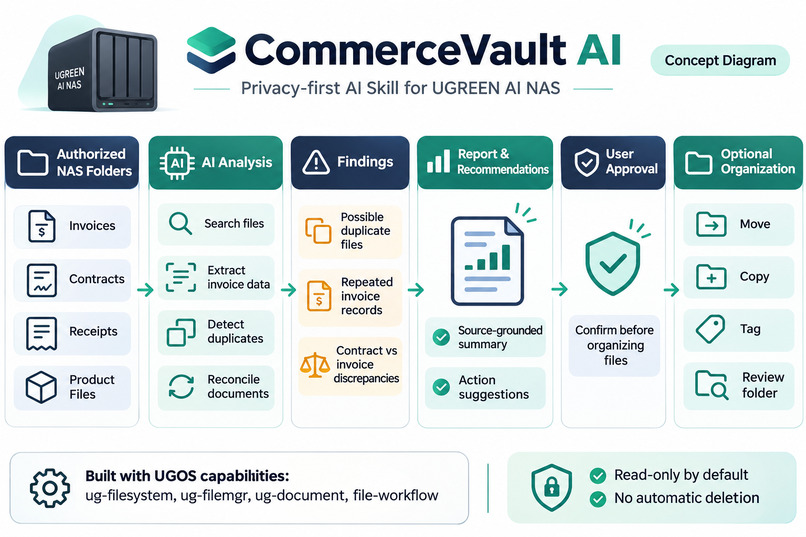
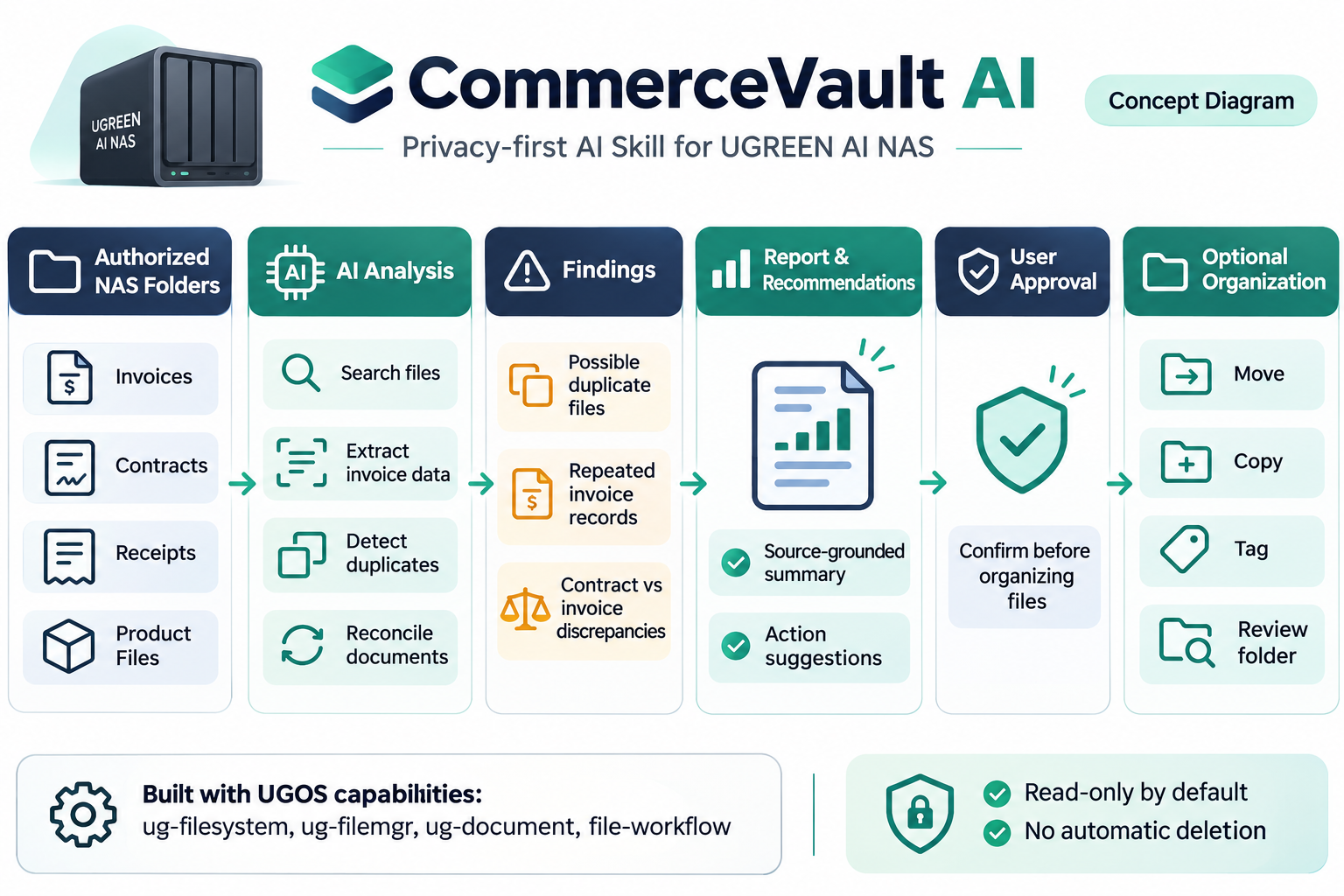
diagram
Inspiration
Small business owners manage invoices, contracts, receipts, and product-related documents every day. As their businesses grow, these files often become scattered across folders, making it difficult to find important information, identify duplicates, and detect financial discrepancies.
CommerceVault AI was inspired by my experience working with e-commerce businesses and developing AI-powered solutions for entrepreneurs.
I wanted to explore how UGREEN AI NAS could become more than a storage device: a privacy-first intelligent assistant that helps small businesses organize information, reduce repetitive work, and maintain control over their documents.
What it does
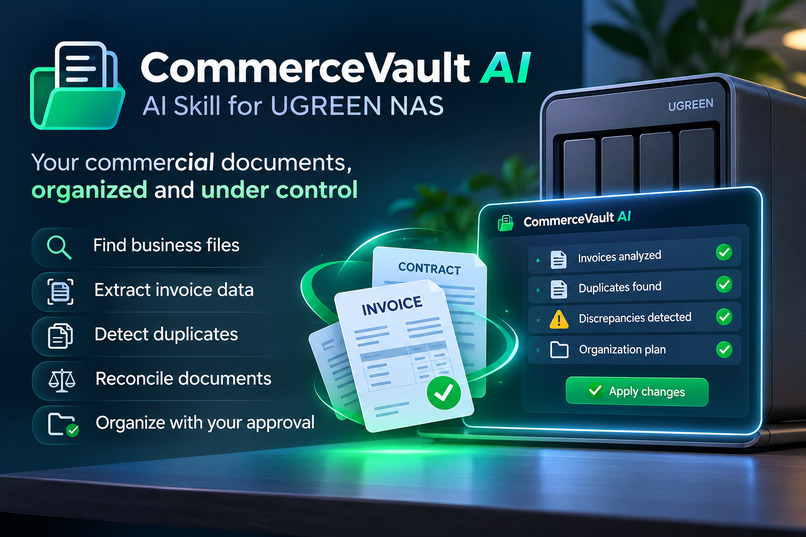
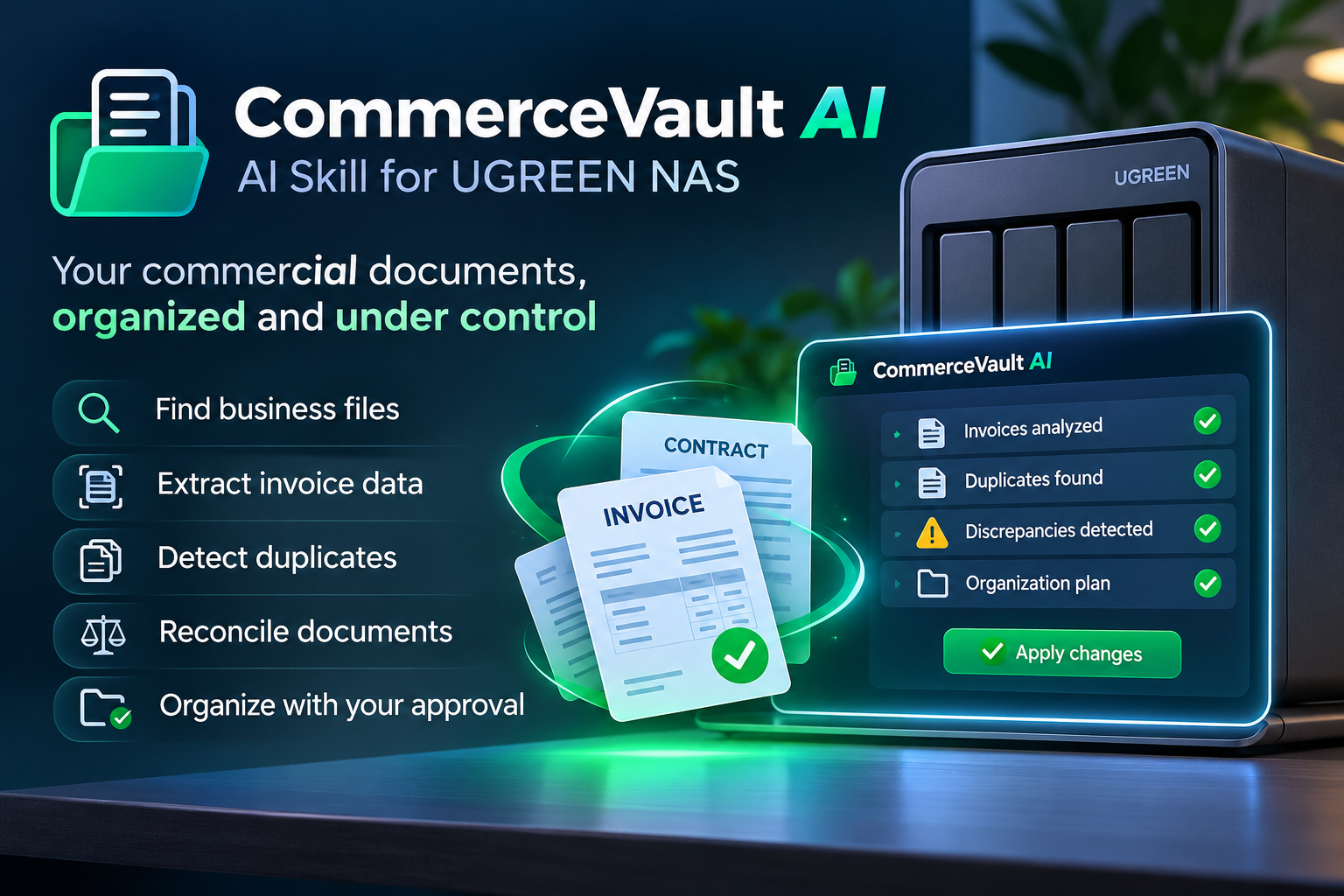
CommerceVault AI is an AI Skill designed for UGREEN AI NAS that helps small businesses manage and analyze commercial documents through natural language.
Its core capabilities include:
- Smart File Search: Locate invoices, contracts, and commercial documents within authorized NAS folders.
- Invoice Data Extraction: Identify invoice numbers, dates, suppliers, amounts, and currencies when available.
- Duplicate Detection: Detect identical files and flag potentially repeated invoice records.
- Document Reconciliation: Compare contracts and invoices to identify possible financial discrepancies.
- Business Reports: Generate structured summaries with references to the original documents.
- Approval-Based Organization: Recommend file organization actions and require explicit user confirmation before making changes.
The Skill is designed to operate in read-only mode by default, protecting business records from unintended modifications.
How we built it
I developed CommerceVault AI using the official UGREEN UGOS Skill Creation Tool and the Uliya Skill Development Standard.
I structured the project around a main SKILL.md file and supporting Markdown references covering workflow orchestration, security requirements, and error handling.
The Skill is designed to coordinate supported UGOS capabilities through registered expert agents:
ug-filesystem— File discovery and navigation.ug-filemgr— Duplicate file detection.ug-document— Document extraction and reconciliation.file-workflow— File organization with required user approval.
I focused on a workflow that separates document discovery, analysis, reporting, and optional file organization.
Rather than introducing unsupported scripts or external integrations, I prioritized the native NAS capabilities documented in the official development kit.
Challenges we ran into
One of my main challenges was designing an AI workflow that provides meaningful business value while respecting UGREEN AI NAS technical and security restrictions.
I also needed to distinguish identical files from potentially repeated business documents, since these require different detection methods.
Another challenge was designing safe file organization procedures that respect permissions, handle naming conflicts, and prevent accidental modifications.
Finally, developing the Skill without physical NAS access during Round 1 required careful documentation and static validation.
Accomplishments that I'm proud of
I'm particularly proud of transforming a practical business problem into a structured AI Skill designed for a real hardware ecosystem.
My main accomplishments include:
- Creating a Skill package following the Uliya Skill Development Standard.
- Designing an orchestration workflow using supported UGOS file and document capabilities.
- Incorporating document reconciliation and approval-based organization.
- Defining safeguards for permissions, file modifications, and error handling.
- Passing the official static package validation with zero reported errors and warnings.
I also made a deliberate decision to distinguish validated development work from features that still require testing on actual NAS hardware.
What I learned
Building CommerceVault AI reinforced my understanding that effective AI solutions should solve specific problems rather than introduce automation for its own sake.
I learned more about designing agents around platform-supported capabilities, managing permissions, handling uncertain information, and keeping automated operations under human control.
An important lesson was that finding a discrepancy does not necessarily mean finding an error. Reliable AI systems should explain their findings and provide references so users can make informed decisions.
What's next for CommerceVault AI
My immediate goal is to validate CommerceVault AI on a real UGREEN AI NAS if selected as a finalist.
My next steps are to:
- Test invoice search and structured information extraction using synthetic documents.
- Verify duplicate detection and contract-to-invoice reconciliation.
- Test approval-based organization, including permission errors and cancellation.
- Evaluate accuracy, error handling, and reliability.
- Record a demonstration of the Skill operating on the assigned NAS.
Beyond the hackathon, I would like to explore advanced business document analysis, inventory-related workflows, and potential integrations with e-commerce platforms.
My vision is to transform business file storage into an intelligent, secure, and accessible workspace for entrepreneurs.
Built With
- agent
- agents
- ai
- automation
- creation
- document
- file
- kit
- local
- management
- markdown
- nas
- orchestration
- processing
- skill
- storage
- tool
- ugos
- ugreen
- uliya
- workflow
