Inspiration
AI agents are becoming increasingly capable of proposing and executing real changes in production systems. In commerce, that creates a different problem: the more capable the agent becomes, the more important it is to define exactly what it is allowed to change, under whose authority, and how the result is verified.
Shopify stores already receive changes from people, apps, CSV imports, integrations, and increasingly AI systems. The production surface is fragmented, but the authority behind those changes often is not explicit.
CommerceGov started from a simple principle:
AI can propose. Production authority must remain bounded, reviewable, and verifiable.
For this hackathon, I wanted to explore what that principle looks like when the proposal system itself becomes an autonomous Gemini agent.
What I built
CommerceGov for Gemini adds an agentic layer to CommerceGov for handling Shopify production changes.
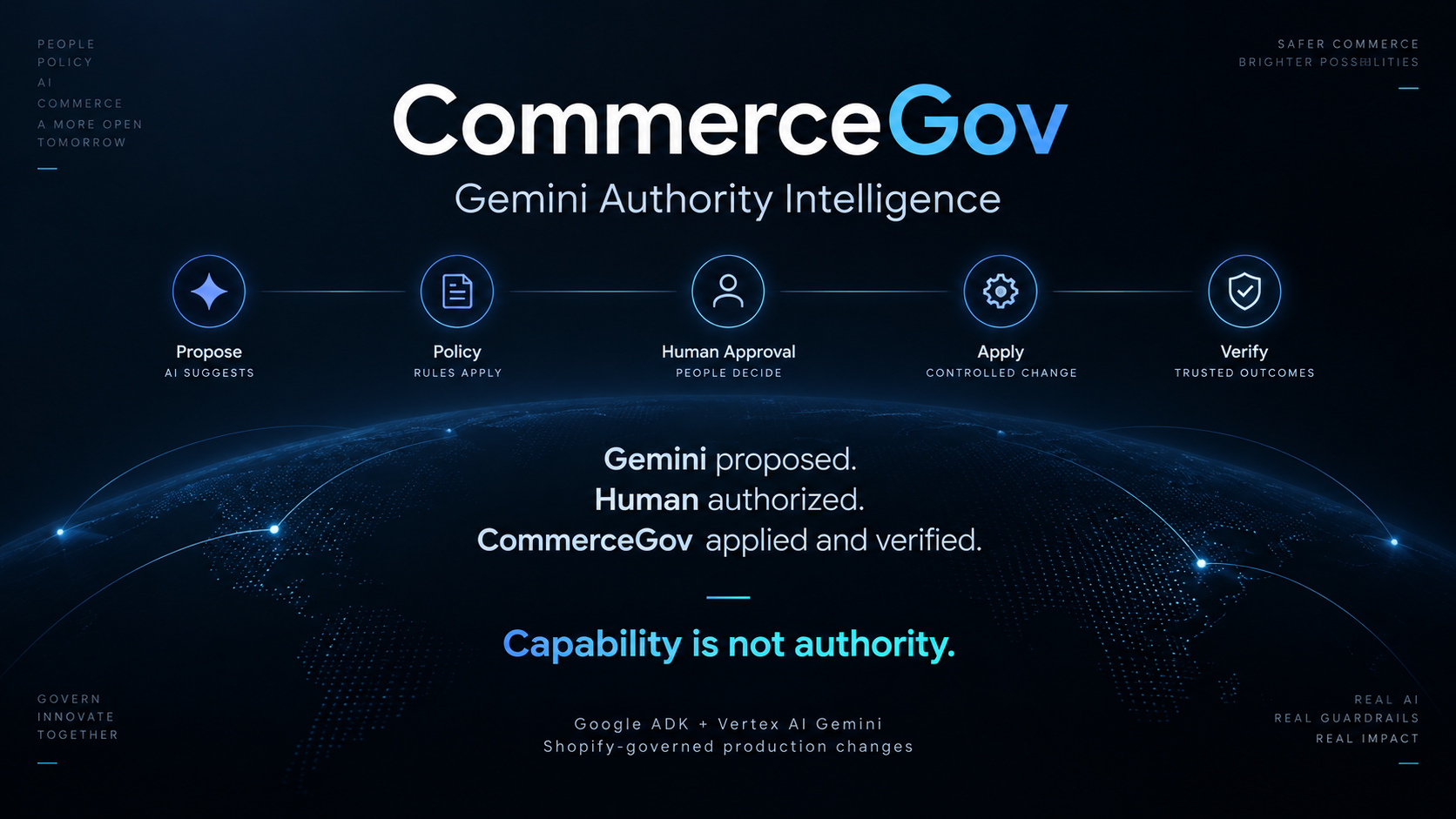
Gemini can interpret an operational objective and produce structured proposed changes. Those proposals do not receive direct production authority.
Instead, they enter CommerceGov as governed Changes, where the system can:
identify the proposed production mutation; evaluate it against policy and scope; determine whether human authority is required; preserve the exact proposal and decision lineage; execute an approved change through the controlled Shopify writeback path; read the resulting state back from Shopify; verify the approved state and observable collateral invariants; and preserve evidence of the proposal, decision, execution, and verification.
The goal is not to make the agent less autonomous. It is to give autonomous systems a defined road to production.
Architecture
The hackathon-specific agent uses Gemini 3.5+ through Google's AI stack and a Google agent framework to reason over an operational task and produce structured change proposals.
The agentic layer is deployed using Google Cloud infrastructure and communicates with the CommerceGov governance boundary rather than writing directly to Shopify.
CommerceGov then remains responsible for deterministic production controls: policy evaluation, authority binding, lifecycle state, controlled execution, verification, and audit evidence.
This separates two fundamentally different responsibilities:
probabilistic intelligence → deterministic production authority
Gemini determines what may be useful to do. CommerceGov determines what is actually permitted to reach production.
What I learned
The main lesson was that agent safety at the production boundary is not only a model-safety problem.
Prompt guardrails can constrain what an agent says or attempts. They do not by themselves establish who authorized a specific production mutation, whether that authorization still applies to the current version of the change, what was actually written, or whether production ended in the approved state.
For production systems, the Change itself needs an identity and lifecycle.
That led to a change-scoped model where policy, decisions, approval, execution, verification, and evidence are bound to the specific proposed mutation rather than loosely attached to the product being edited.
Challenges
The hardest problem was preserving useful agent autonomy without giving the model ambient production authority.
A second challenge was separating an AI proposal from an authorized mutation. A generated answer can be revised freely; an approved production change cannot. Approval therefore has to bind to the exact decision and exact change version being executed.
Verification created another boundary. An API success response only proves that an operation was accepted. It does not prove that production now matches the approved state. CommerceGov therefore performs mutation-scoped read-back rather than treating successful execution as successful verification.
Pre-existing work disclosure
CommerceGov existed before the All Things Agentic Hackathon as a Shopify production-governance system.
The Gemini-powered agent integration, Google agent-framework integration, Google Cloud deployment, and the hackathon-specific workflow described in this submission are new work created during the hackathon submission period.
The existing CommerceGov governance core is incorporated as pre-existing infrastructure and is disclosed here explicitly.
What's next
The broader goal is a reusable production-authority boundary that different AI systems and agents can connect to without each one independently implementing human approval, production policy, controlled writeback, verification, rollback evidence, and audit history.
The agent can change.
The production authority boundary remains deterministic.
Built With
- codex
- fastapi
- firestore
- gemini-3.1-pro-preview
- gemini-3.5-flash
- google-adk
- google-cloud-run
- pycharm
- python
- vertex-ai

Log in or sign up for Devpost to join the conversation.