-
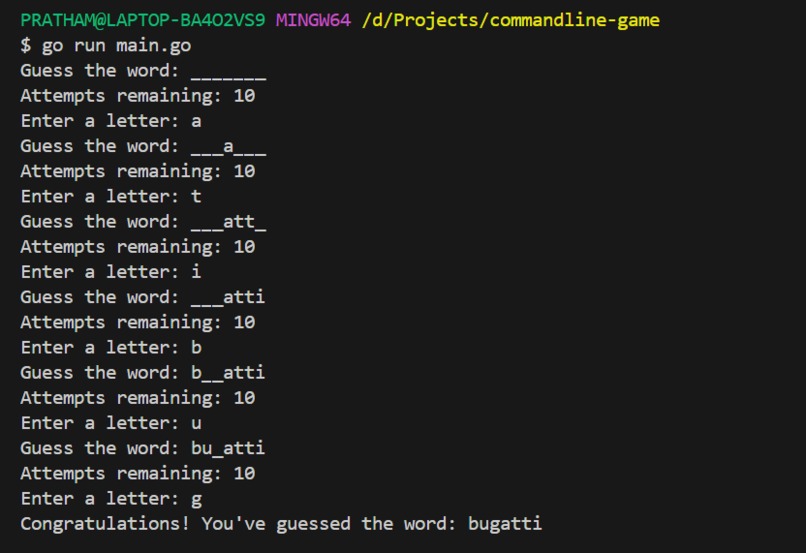
Demo
Task
Completing the GHW Games challenge - Code a Command Line Game with Copilot, and Use GitHub Copilot to complete any of this week's challenges
It requires creating a command line game using a language I've never coded in before.
I'll be using Golang as its been long since I wanted to code with it.
I'll mostly be doing Hey Copilot do this, Hey Copilot do that but before all that a quick google search would help downloading Go, and setting it up on my code editor (VSCode).
What it does
Its a command line based hangman game. Player gets a certain number of incorrect attempts and within those he'll have to guess the word, letter by letter, chosen by the computer.
How we built it
I built it by giving prompts to Copilot, no not "Make a hangman game using Go" because it would just make it too easy.
Starting with getting a basic starter code for Go.
Prompt: write a basic starter code
package main

import "fmt"

func main() {
    fmt.Println("Hello, World!")
}
Now generating 20 words (here I'm generating 20 luxury car names).
Prompt: create a global wordlist with 20 car names in lower case only
var wordList = []string{
    "rollsroyce",
    "bentley",
    "lamborghini",
    "ferrari",
    "porsche",
    "koenigsegg",
    "mercedes",
    "bmw",
    "audi",
    "jaguar",
    "lexus",
    "maserati",
    "bugatti",
    "mclaren",
    "pagani",
    "tesla",
    "cadillac",
    "lincoln",
    "infiniti",
    "acura",
}
Now defining three variables such as:
chosenWord: the string that will be chosen to guess,_guessWord: array of characters initially underscore ''. Each underscore will be replaced by a letter once player correctly guesses it.attempts: the number of attempts user will have._
Prompt: define 3 global variables, chosenWord string, guessWord array of characters, attempts int
var chosenWord string
var guessWord []rune
var attempts int
Get rid of the unnecessary print statement from within the main function.
Choose a word randomly from the wordList.
Prompt: Assign a random word from wordList to chosenWord
package main

import (
    "fmt"
    "math/rand"
    "time"
)
// Rest of the code
func main() {
    rand.Seed(time.Now().UnixNano())
    chosenWord = wordList[rand.Intn(len(wordList))]
}
Fill the guessWord with same number of underscores as the length of chosenWord.
Prompt: fill guessWord with underscores, and the array size should be same as length of chosenWord
    guessWord = make([]rune, len(chosenWord))
    for i := range guessWord {
        guessWord[i] = '_'
    }
Keep the number of attempts as 1.5 times the length of chosenWord
Prompt :attempts = length of chosenWord * 1.5 as integer
attempts = int(float64(len(chosenWord)) * 1.5)
Iterate until attempts is greater than 0, decrementing it by 1, print guessWord and attempts, and take a character input from player.
Prompt: for loop until attempts > 0. inside it print guessWord, attempts, and take character input
and make necessary print statement changes.
import (
    "bufio"
    "fmt"
    "os"
    "strings"
    "math/rand"
    "time"
)

func main() {
    // Rest of the code
    reader := bufio.NewReader(os.Stdin)
    for attempts > 0 {
        fmt.Printf("Guess the word: %s\n", string(guessWord))
        fmt.Printf("Attempts remaining: %d\n", attempts)
        fmt.Print("Enter a letter: ")
        input, _ := reader.ReadString('\n')
        input = strings.TrimSpace(input)

        attempts--
    }
}
Do not let player enter multiple letters at once
Prompt: if length of input > 1, ask the user to enter only one letter and continue
        if len(string(input)) > 1 {
            fmt.Println("Please enter only one letter.")
            continue
        }
Check if the player input letter is in the chosenWord, and if it is replace underscore with that letter at required positions in guessWord.
Prompt: check if input letter is in chosenWord. if it is then replace each _ in guessWord with the letter where the letter is in chosenWord
        found := false
        for i, c := range chosenWord {
            if rune(input[0]) == c {
                guessWord[i] = c
                found = true
            }
        }
If letter is not present in chosenWord we'll decrement attempts
        if !found {
            attempts--
        }
Keep checking is guessWord as a string is equals to chosenWord.
        if string(guessWord) == chosenWord {
            fmt.Printf("Congratulations! You've guessed the word: %s\n", chosenWord)
            return
        }
Display a message if player runs out of attempts
fmt.Printf("Sorry, you've run out of attempts. The word was: %s\n", chosenWord)
Full Code:
package main

import (
    "bufio"
    "fmt"
    "math/rand"
    "os"
    "strings"
    "time"
)

var wordList = []string{
    "rollsroyce",
    "bentley",
    "lamborghini",
    "ferrari",
    "porsche",
    "koenigsegg",
    "mercedes",
    "bmw",
    "audi",
    "jaguar",
    "lexus",
    "maserati",
    "bugatti",
    "mclaren",
    "pagani",
    "tesla",
    "cadillac",
    "lincoln",
    "infiniti",
    "acura",
}
var chosenWord string
var guessWord []rune
var attempts int

func main() {
    rand.Seed(time.Now().UnixNano())
    chosenWord = wordList[rand.Intn(len(wordList))]

    guessWord = make([]rune, len(chosenWord))
    for i := range guessWord {
        guessWord[i] = '_'
    }

    attempts = int(float64(len(chosenWord)) * 1.5)

    reader := bufio.NewReader(os.Stdin)
    for attempts > 0 {
        fmt.Printf("Guess the word: %s\n", string(guessWord))
        fmt.Printf("Attempts remaining: %d\n", attempts)
        fmt.Print("Enter a letter: ")
        input, _ := reader.ReadString('\n')
        input = strings.TrimSpace(input)

        if len(input) != 1 {
            fmt.Println("Please enter a single letter.")
            continue
        }

        found := false
        for i, c := range chosenWord {
            if rune(input[0]) == c {
                guessWord[i] = c
                found = true
            }
        }

        if !found {
            attempts--
        }

        if string(guessWord) == chosenWord {
            fmt.Printf("Congratulations! You've guessed the word: %s\n", chosenWord)
            return
        }
    }

    fmt.Printf("Sorry, you've run out of attempts. The word was: %s\n", chosenWord)
}
Challenges we ran into
- Coding in a completely new language.
- Fixing minute errors by Copilot such as that of handling character input in the for loop.
Accomplishments that we're proud of
Coding in a completely new language.
What we learned
The basics of Go.

Log in or sign up for Devpost to join the conversation.