-
-
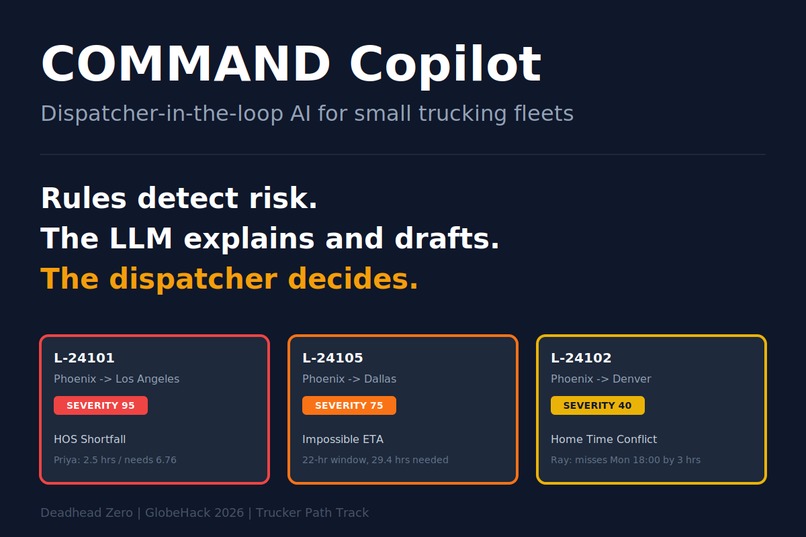
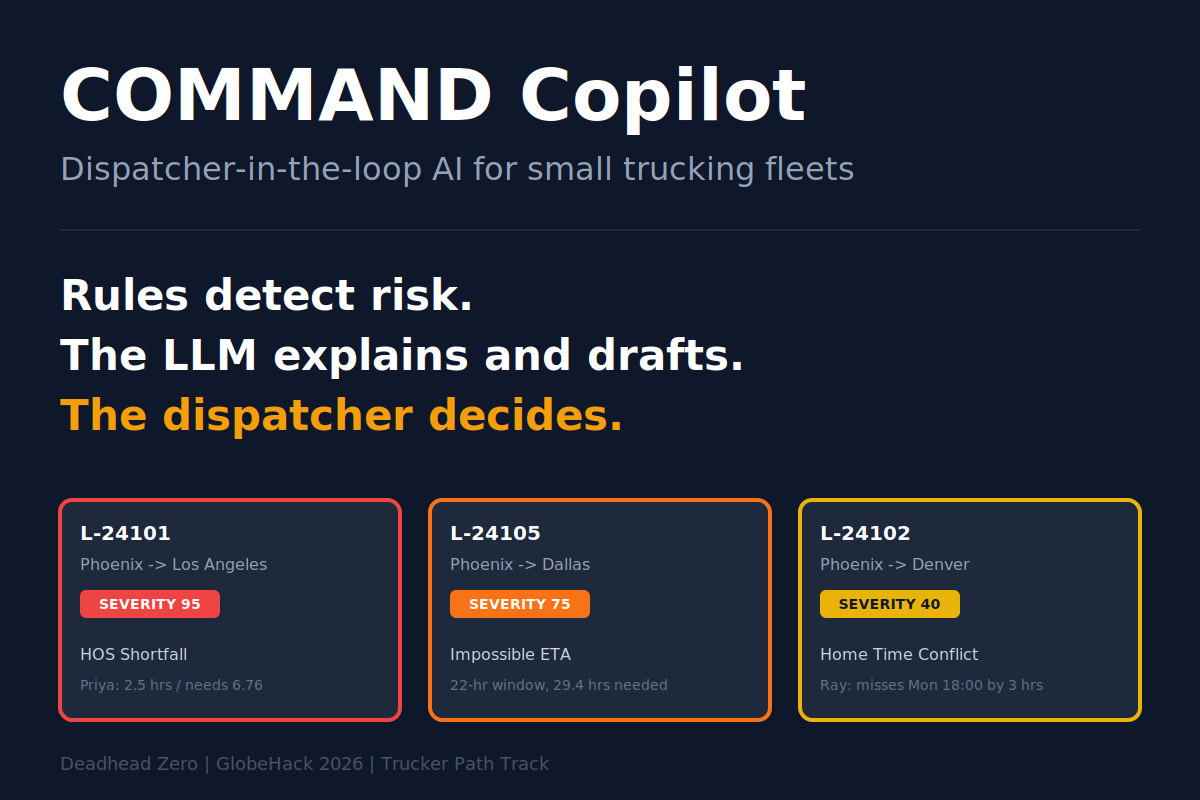
Dispatcher-in-the-loop AI for small trucking fleets. Rules detect risk, the LLM explains and drafts, the dispatcher decides.
Inspiration
Mihir's workshop hit hard: "phones, papers, and spreadsheets." "Decisions, not dashboards." "Proactive, not reactive." "The long tail of American freight." Small fleets — 5 to 50 trucks — run on exactly that, plus the dispatcher's memory. Enterprise TMS tools start at $500+/truck/month and target 100+ truck operations. The long tail is where American freight actually moves, and nobody's serving it. Henry Li's 2024 interview told us the shape: AI deployed "piece by piece," 100 bounded agents that know their limits. That's not autonomous dispatch. That's one narrow, trusted agent. Agent #1.
What it does
A dispatcher uploads today's loads and drivers as CSVs. Instead of a dashboard, she sees three cards — the three loads about to go wrong today. Three deterministic rules fire before dispatch: HOS shortfall (driver doesn't have legal hours), impossible ETA (window physically infeasible for one driver), home-time conflict (assignment misses a requested home-time). For each, a matching algorithm scores every other fit driver 0–100. Claude Sonnet 4.5 explains the flag in plain English, adds a nearest-rest-stop hint for HOS cases, and drafts the outbound message — SMS for drivers, email for brokers. Maria reads, decides. Three buttons: Approve, Reject, Edit & Approve. Every action gets an audit entry — who, when, what the AI said, what she chose. Nothing ships without her sign-off.
How we built it
FastAPI, Pydantic v2, pandas on Python 3.12 with uv. Three isolated rule modules with FMCSA citations inlined. Claude Sonnet 4.5 at temperature 0.2, with the three hero responses pre-cached for zero-latency demo reliability and graceful degradation — if the live API fails, we fall back to the rule's structured string. No cliff. Key architectural call: CSV is primary, Trucker Path API is a credibility layer. Their spec has no HOS endpoint and no loads query. An API-primary architecture wasn't available. We integrated GET /api/users/get/all for identity and ran our own CSV pipeline for the decision data. Frontend: React + TypeScript + Vite + Tailwind. 28 tests green. Built solo in under 12 hours with a decision log for every cut.
Challenges we ran into
Keeping the layers clean. Rules detect, LLM explains, human decides — that's the thesis, and the hard part is resisting every small temptation to let the LLM drive something that matters. Resisting scope creep with the clock running. We cut a fourth rule, voice narration, and error-boundary polish — each was defensible. Three shippable features beat five stubs. Claude Sonnet 4.5 deviated from the rule spec three times during generation. We reviewed each one on merit. All three were improvements — one added an FMCSA-cited formula that's strictly better than the original spec. Accepted on merit, not on adherence. Accomplishments that we're proud of A shippable prototype in under 12 hours, solo. 28 tests green. A decision log that's defensible to anyone who reads it. The architecture is, structurally, Henry Li's piece-by-piece pattern — the product is his public vision, built. Every UI element answers one question: does this make Maria faster without taking authority away from her?
What we learned
Small-fleet dispatch is a human-judgment problem, not an automation problem. The trust surface — what the AI can see, what it's allowed to propose, what it can never do without approval, and what it logs when the human decides — is the product. Deterministic rules plus LLM explanation plus human approval is a shipping pattern, not a research pattern. It's what Cigna didn't do, which is why they're a cautionary tale. Constraint-driven scoping is a design skill. Saying no to the fourth rule, to voice narration, to polish — each was a small act of respect for the 11 AM deadline and for the user. What's next for COMMAND Copilot A 30-day pilot with 2–3 small fleets inside the Trucker Path ecosystem, direct integration support from Mihir's team. Real HOS feed via the existing Samsara and ELD partnerships. Webhook mode so loads get flagged the instant they're created, not just on CSV upload. A fourth rule for deadhead optimization. Mobile-responsive dispatcher view. Platform view: COMMAND Copilot is Agent #1 of 100. Same architecture — deterministic rules, LLM explanation, dispatcher approval, full audit — applied to cost attribution, billing reconciliation, compliance audits. Piece by piece. Trusted. Approvable. Auditable. That's the platform Mihir and Henry are building. This is the first module.
Built With
- anthropic-api
- claude
- fastapi
- pandas
- pydantic
- python
- react
- tailwindcss
- truckerpath
- typescript
- vite


Log in or sign up for Devpost to join the conversation.