
comma, Every Number Has a Story.
A time machine for AI agents. Reconstruct the past, enforce temporal truth, and audit the context behind every number.
Inspiration
When evaluating past financial decisions, AI agents suffer from hindsight bias.
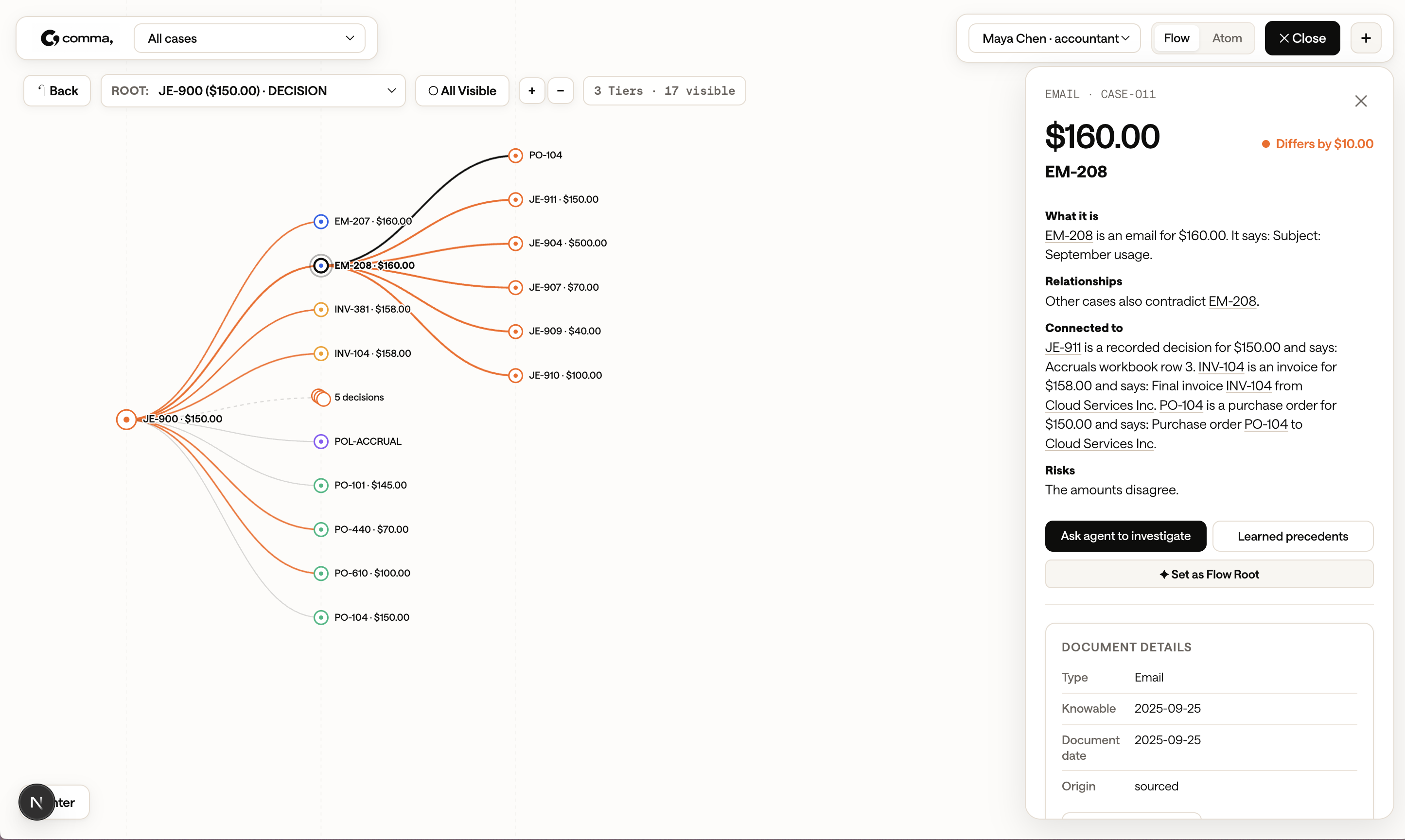
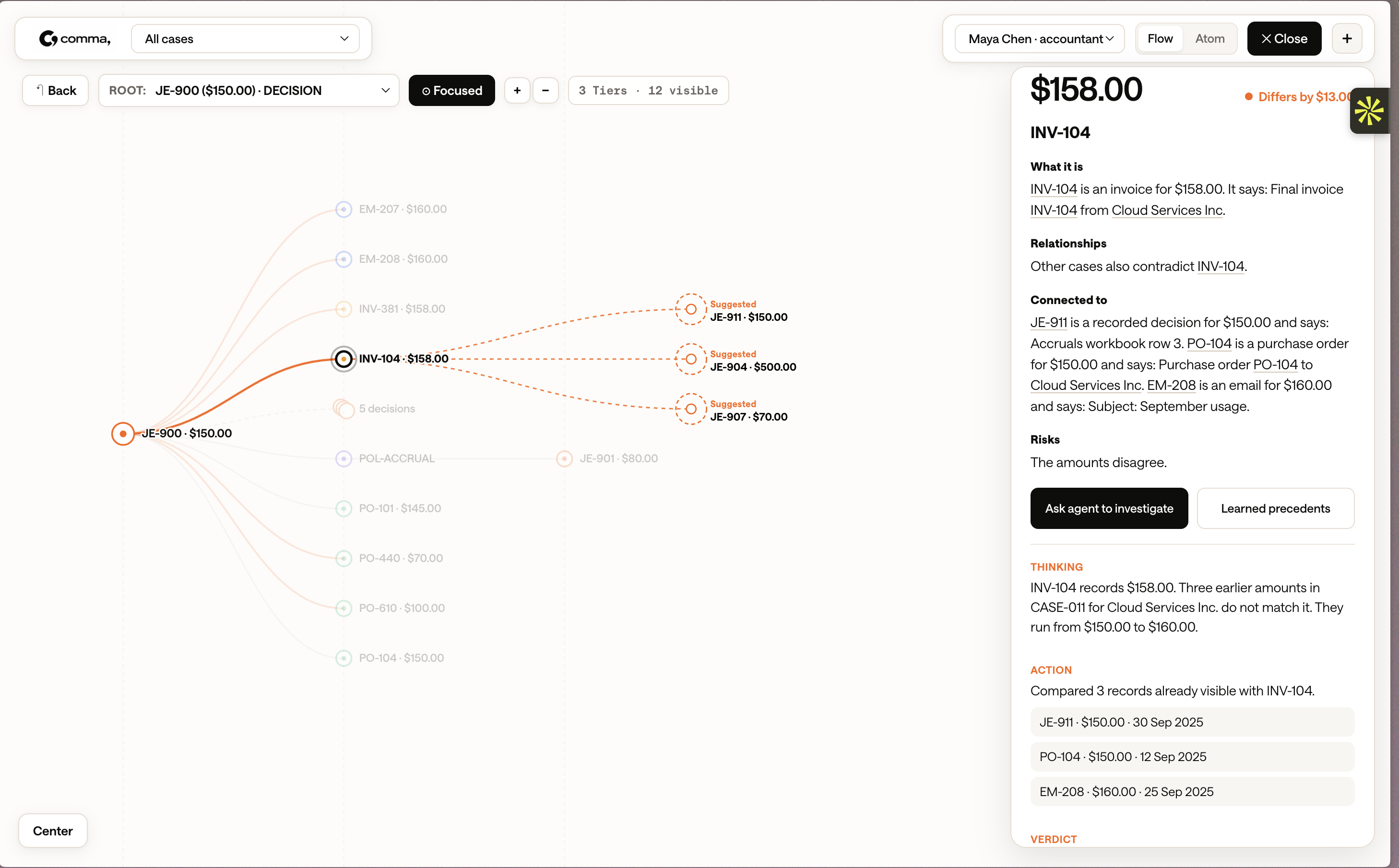
Consider a September book close: an accountant accrues $150 based on a $145 PO and a $160 vendor email. Months later, in December, an invoice arrives for $158 dated September 28. Standard AI agents operating on today's database will pull that invoice and falsely claim the accountant made an $8 error.
Under GAAP and audit standards, this is fundamentally flawed. Decisions must be evaluated only on what was knowable at that moment. We built comma, to give AI agents an immutable, point-in-time ground truth.
What it does
comma, is a temporal knowledge graph and historical context engine for enterprise AI.
1. Point-in-Time Temporal Firewall
Users and AI agents travel to any historical timestamp. comma, dynamically reconstructs the exact information environment using document availability, version history, and role-based permissions. A December invoice is strictly blocked from a September snapshot—even if the document itself is dated September.
2. 3D Financial Knowledge Graph
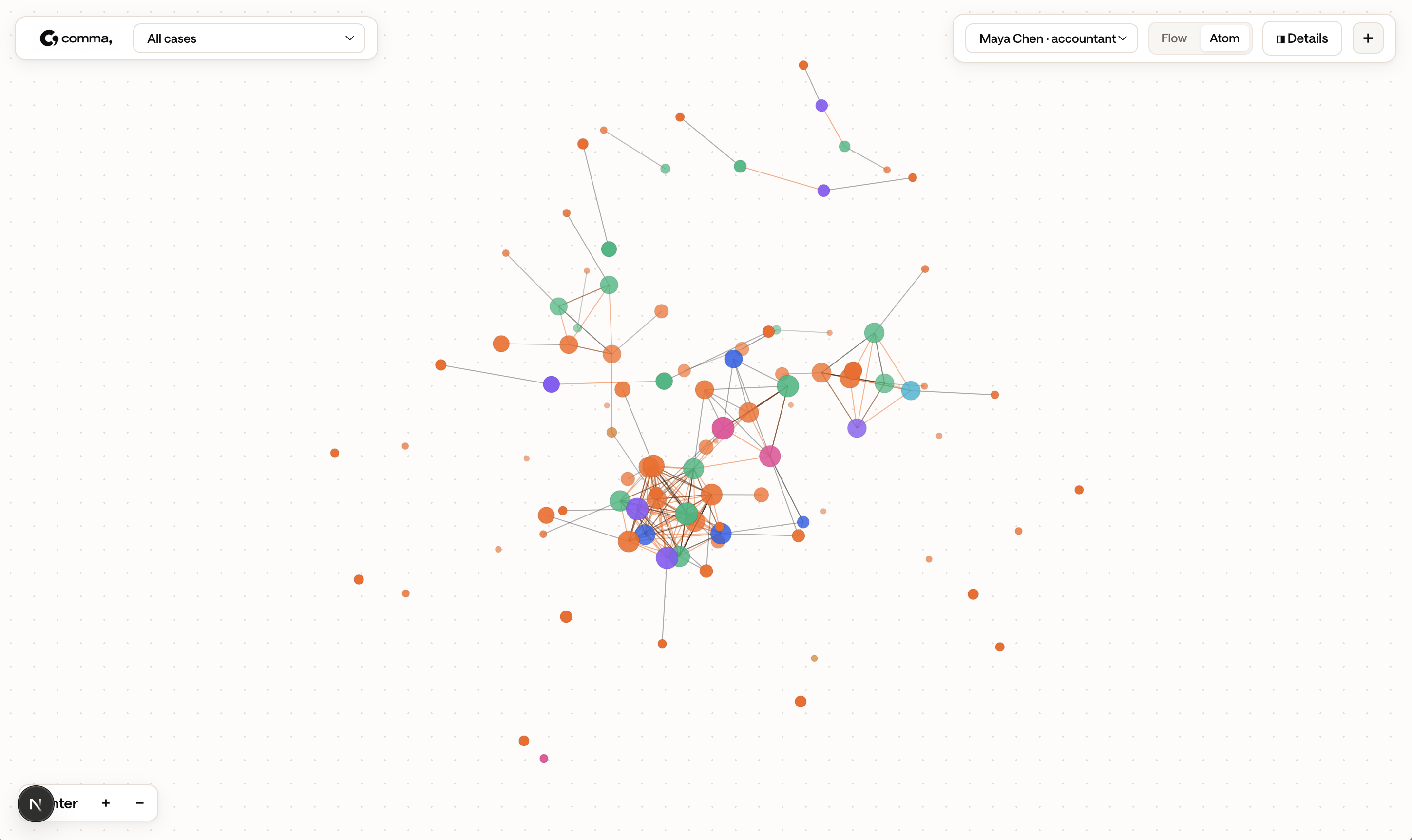
Rendered with a custom HTML5 Canvas engine, comma, maps numbers to underlying documents, calculations, and communications in an Obsidian-style 3D atom graph and 2D radial web. As users slide through time, nodes dynamically appear or withhold based on when they were actually received.
3. Native Microsoft Excel Add-in (Office.js)
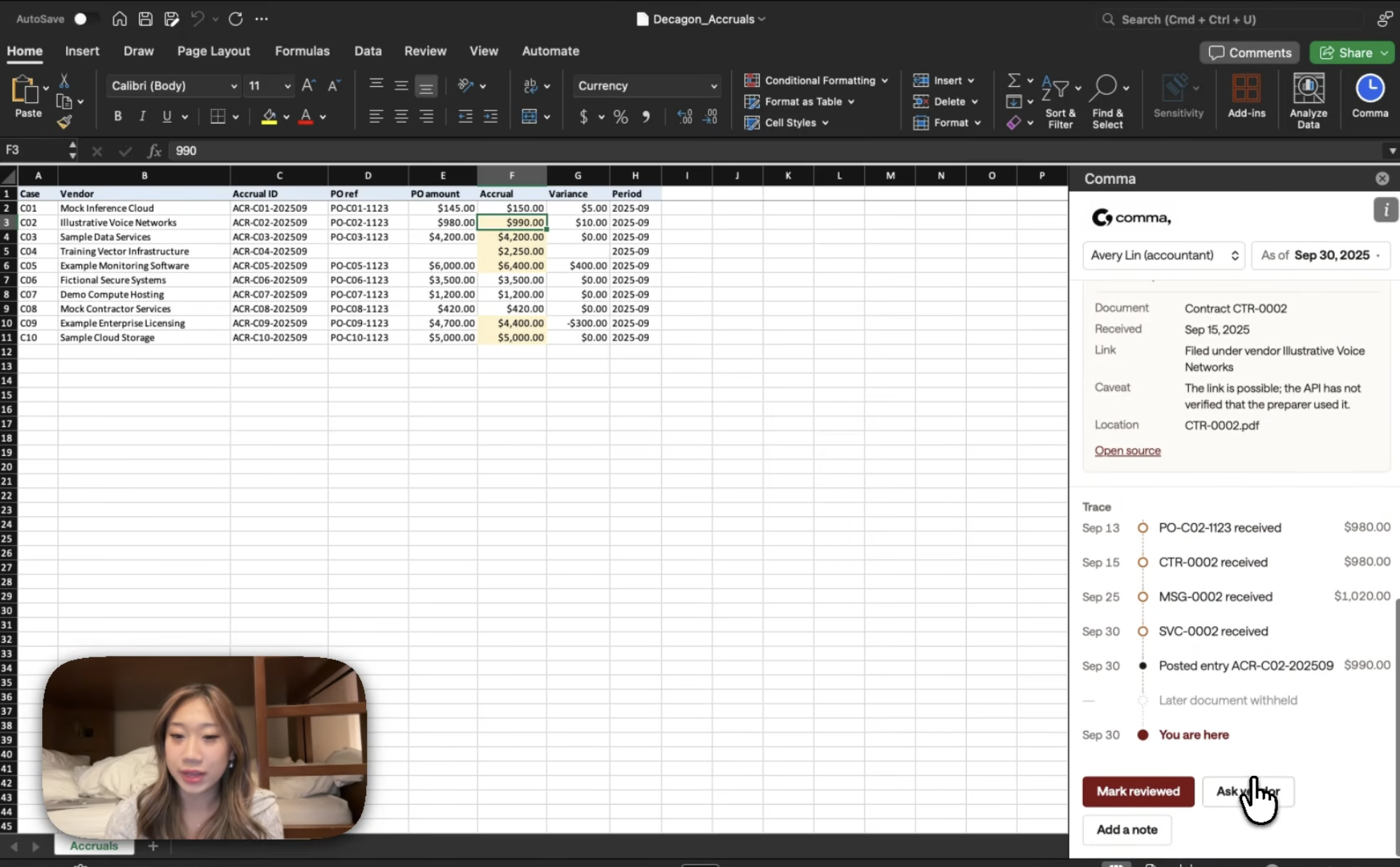
Because finance teams live in spreadsheets, comma, runs directly inside Excel:
- Cell Inspection: Traces formula precedents (
=B3+C3) and links them to underlying source claims. - Automated Scan: Scans accrual ranges, flags discrepancies in yellow, and writes native Excel hover notes via the Notes API.
- One-Click Vendor Inquiry: Extracts vendor emails directly from evidence to auto-draft discrepancy inquiries.
- Non-Destructive: Reverts cell highlights and removes only comma,'s notes on cleanup.
4. Autonomous Investigation & Baseline Comparison
- Tool-Call Firewall: An autonomous audit agent investigates historical decisions using tool calls (
get_document). Attempts to access future evidence are blocked with a loggedFUTURE_INFORMATION/ 403 denial. - SOX-Compliant Governance: The agent generates transparent findings (
SUPPORTED,QUESTIONABLE,INSUFFICIENT_EVIDENCE) and proposes actions that require human auditor approval before touching any ledger. - Side-by-Side Comparison: Our
/compareview proves how an unrestricted LLM baseline leaks future data versus comma,'s safe, time-fenced investigation.
How we built it
- Frontend: Next.js, React, TypeScript, and a custom HTML5 Canvas 3D particle/graph visualizer.
- Excel Integration: Office.js and Webpack powering a desktop task pane add-in.
- Backend: Python, FastAPI, and Uvicorn handling snapshot manifests and agent gateways.
- Data & Storage: PostgreSQL and SQLite (via SQLAlchemy) storing immutable versions, temporal access grants, and SHA-256 snapshot manifests.
- Knowledge Engine: Graphiti for entity extraction, episodic memory, and relationship resolution.
- Deployment: Containerized with Docker and hosted on Railway.
Challenges we faced
- Business Date vs. Knowledge Date: Distinguishing between the date printed on a document (
document_date) and when the business actually received it (available_from). - Enforcing Hard Temporal Boundaries: Prompt engineering fails to prevent data leakage. We moved historical access controls into the data layer—future documents return an immutable 403 denial.
- Excel Desktop Compatibility: Integrating Office.js (ExcelApi 1.12 for precedents and 1.18 for native notes) without corrupting existing formulas or user notes.
- Separation of Duties: Building agent autonomy while enforcing enterprise audit controls so accountants cannot approve their own reviews.
What we learned
- Better AI reasoning requires better temporal context: The smartest LLM will still fail if given access to data from the future.
- Auditability requires provenance: Traceability isn't just citing links—it requires proving when evidence arrived, how formulas connected, and what was missing.
What's next for comma,
- Cross-Industry Expansion: Adapting temporal snapshots for insurance claims, procurement bids, and regulatory compliance.
- Direct ERP Integrations: Bi-directional connectors for NetSuite, SAP, and Workday.
- Hindsight Benchmarking: Open-sourcing evaluation environments to benchmark financial AI agents against temporal data leakage.
comma, — Every Number Has a Story.
Built With
- canvas-api
- css3
- docker
- excel
- fastapi
- graphiti
- html5
- next.js
- node.js
- office.js
- openpyxl
- postgresql
- pydantic
- pytest
- python
- railway
- react
- rest-api
- sqlalchemy
- sqlite
- typescript
- uvicorn
- webpack


Log in or sign up for Devpost to join the conversation.