-
-
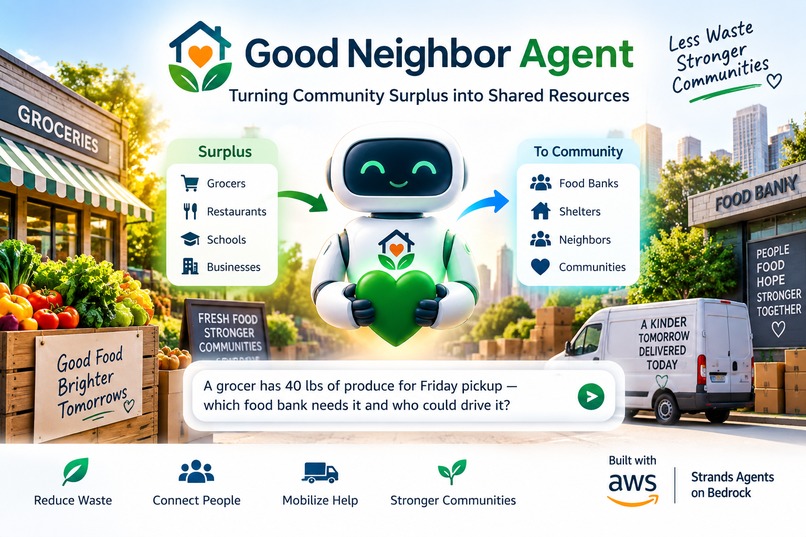
waste recovery Agent
-
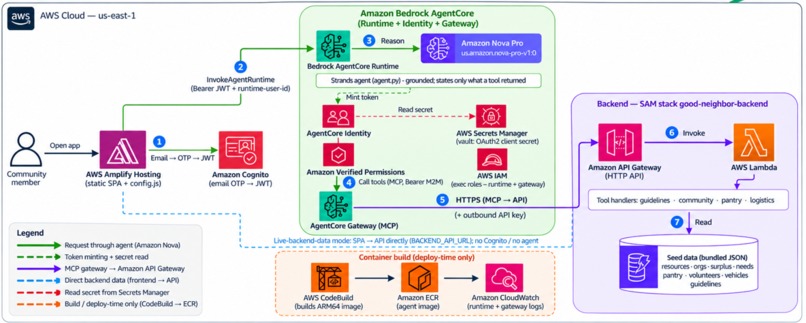
Architecture
-
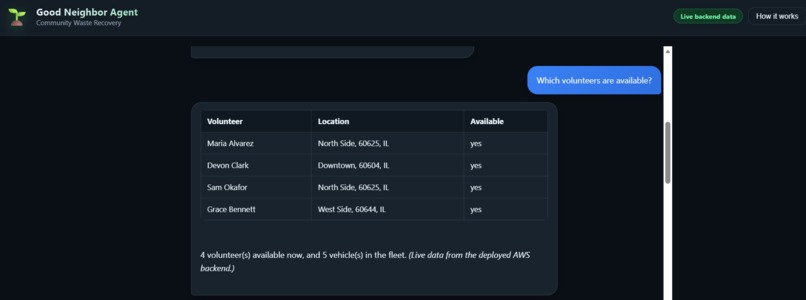
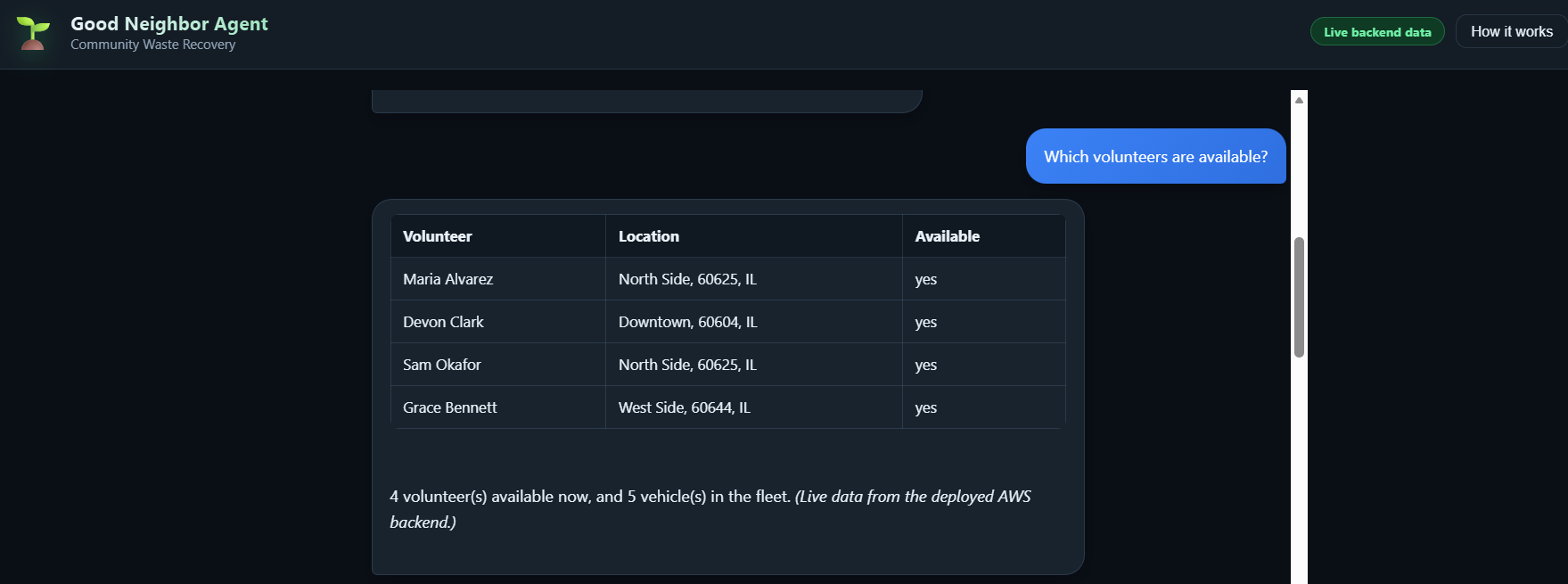
Which volunteers are available?
-
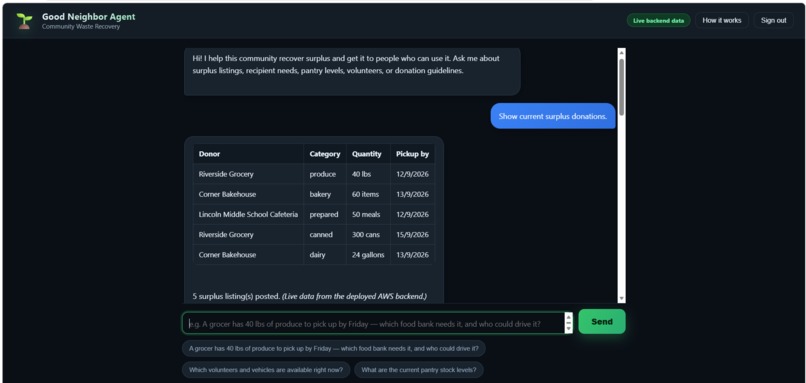
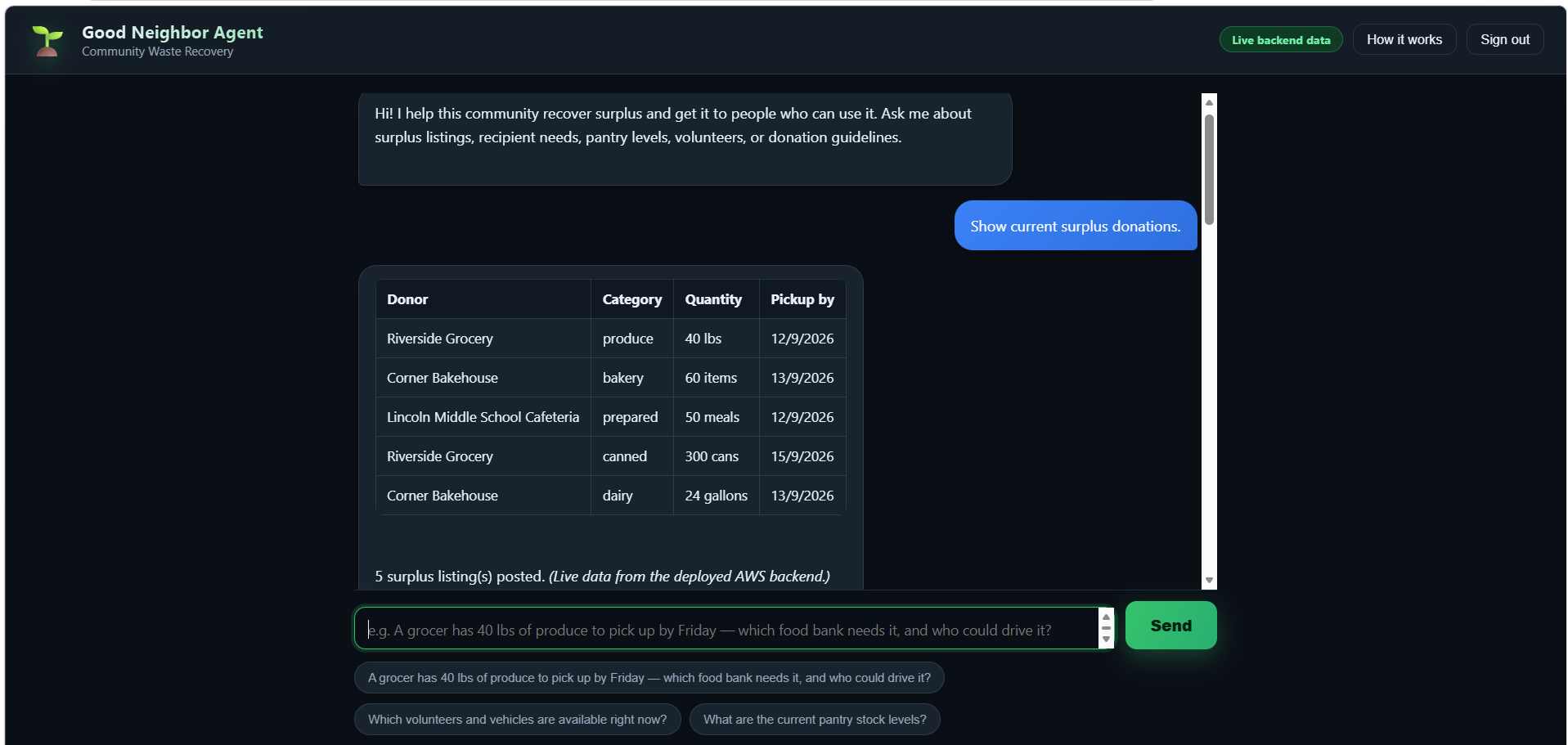
Show current surplus donations.
-
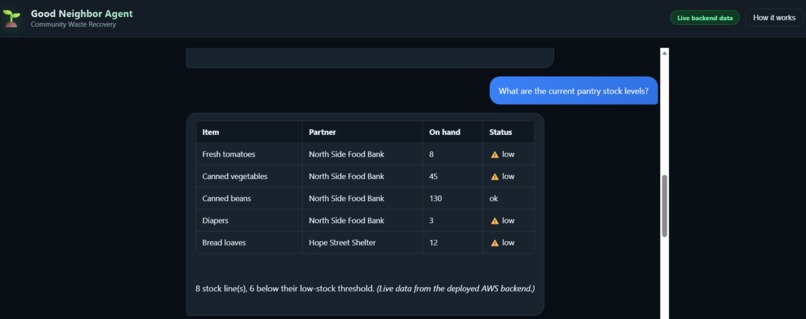
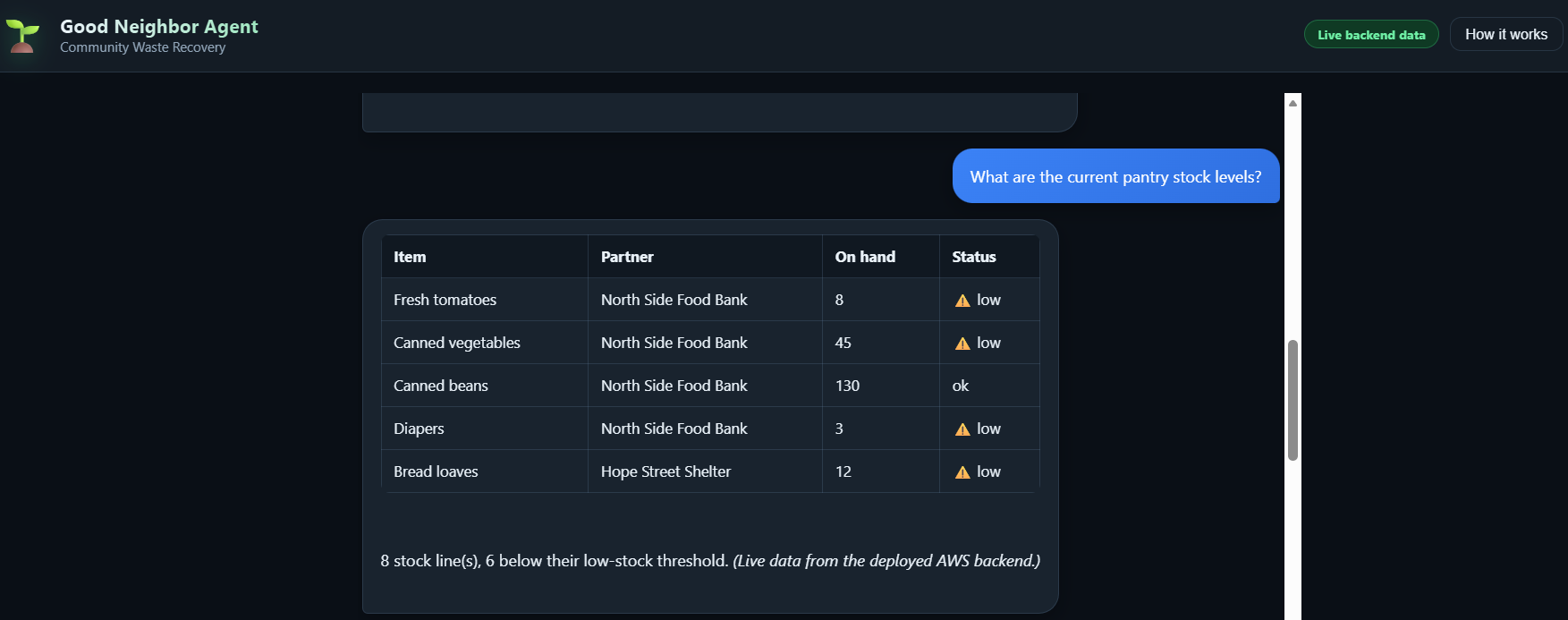
What are the current pantry stock levels?
-
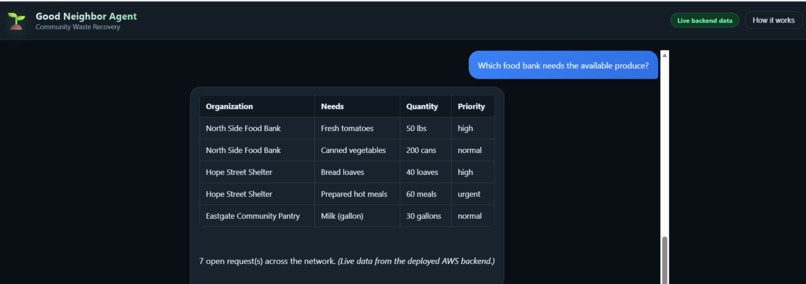
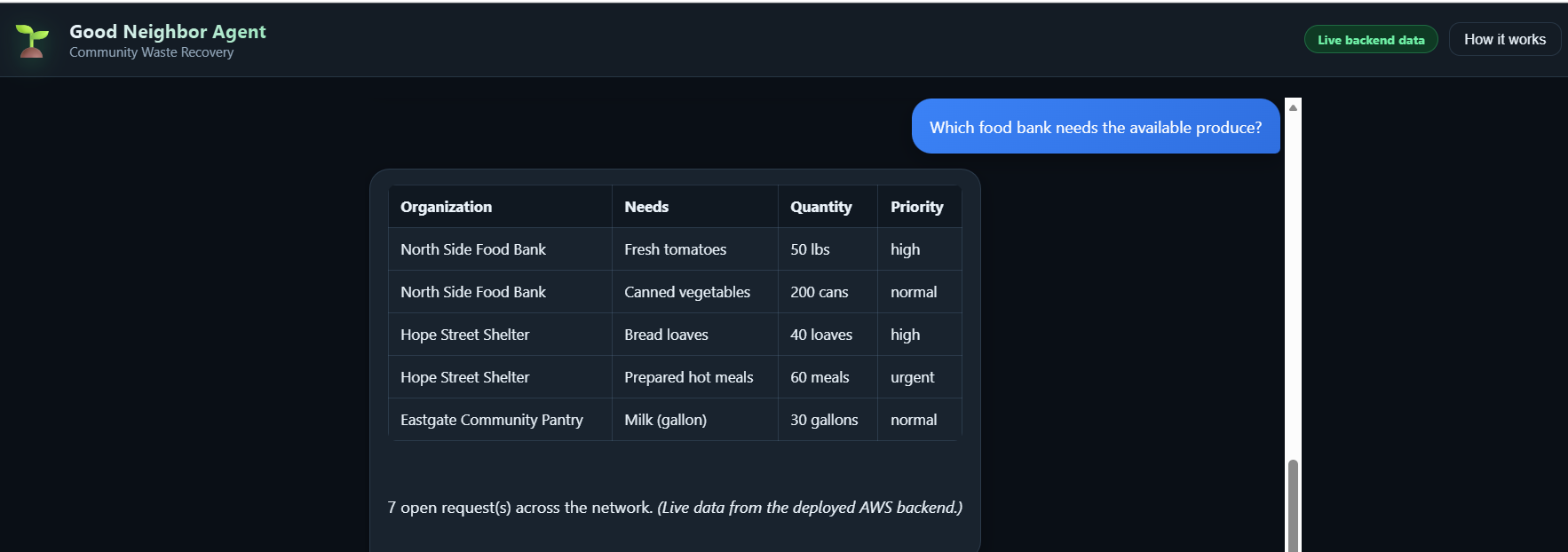
Which food bank needs the available produce?
-
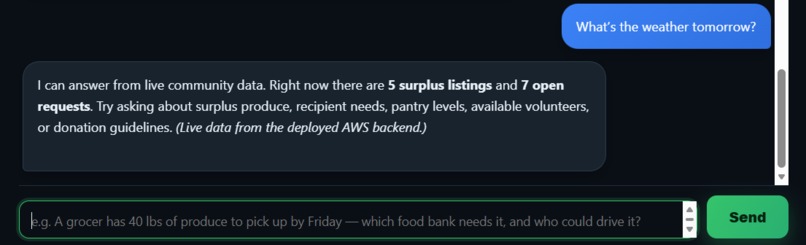
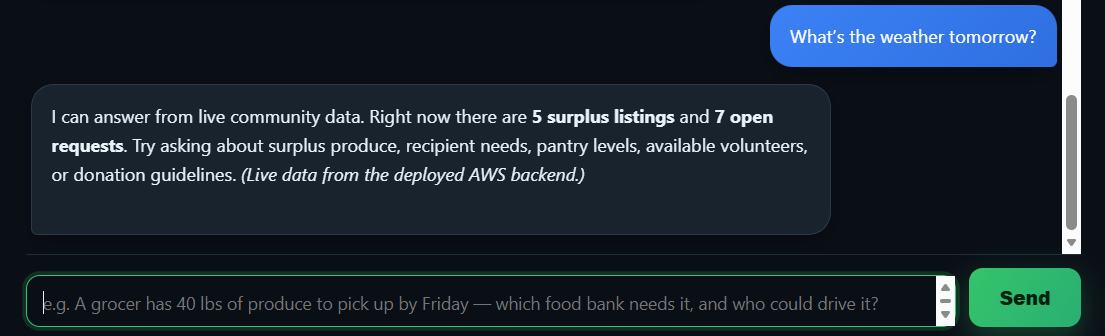
Ask an unrelated question
-
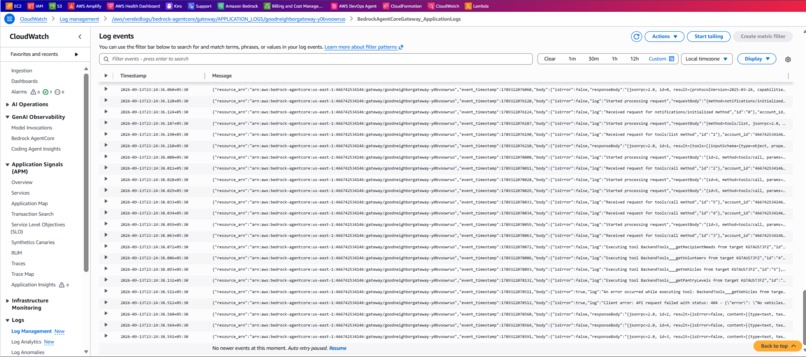
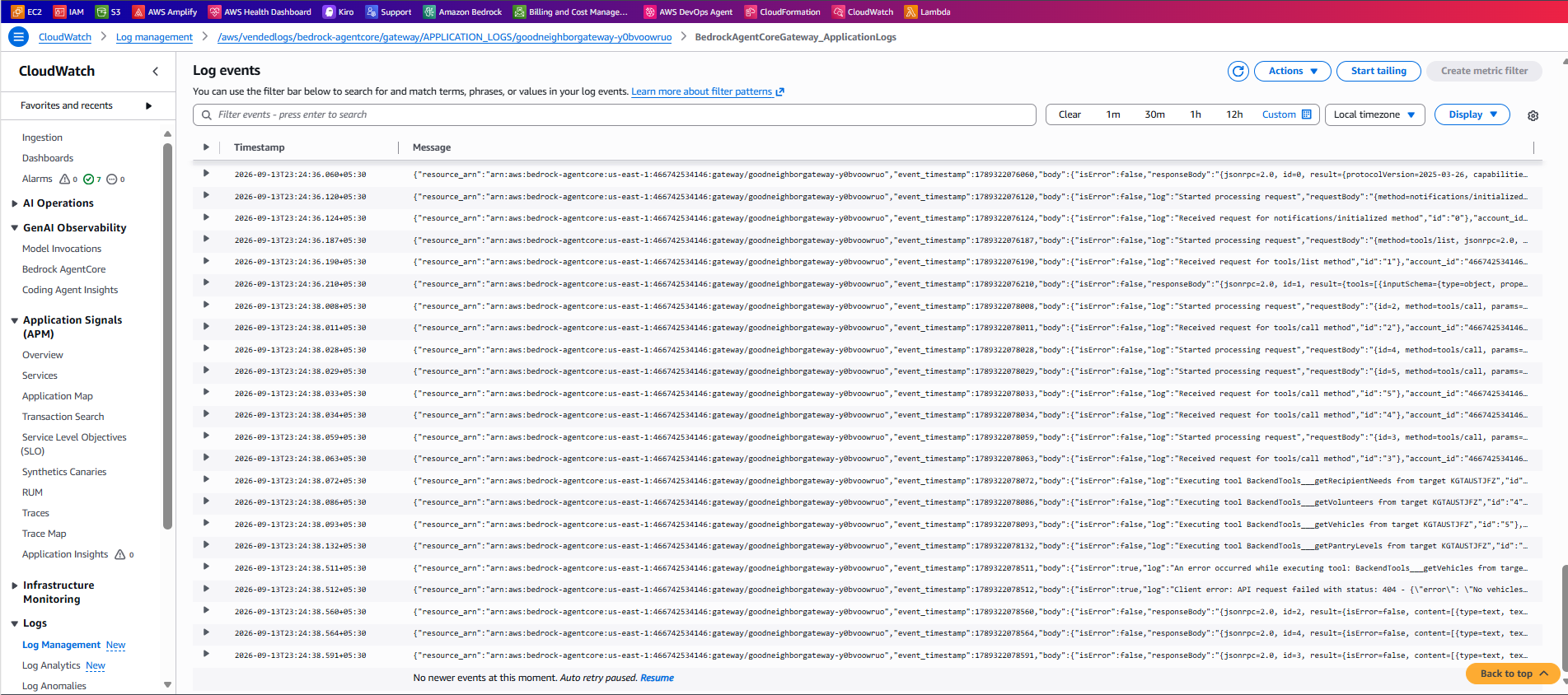
Cloudwatch
Inspiration
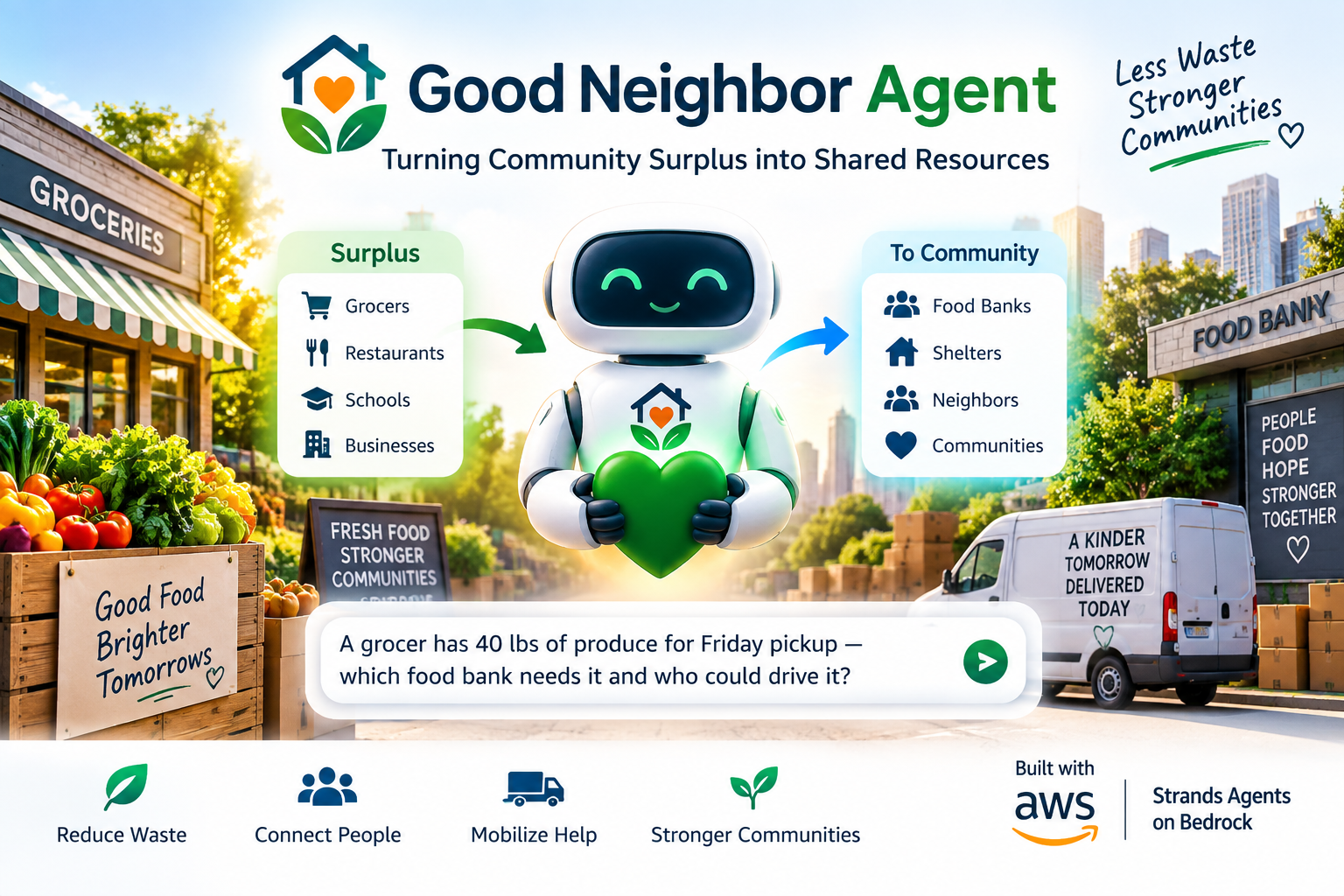
Every day, grocers, restaurants, schools, and households throw away food and goods that are still perfectly usable - while food banks and shelters just a few blocks away go short. The problem usually isn't a lack of surplus or a lack of need; it's that the two are never connected in time, and there's no one to move things before they spoil. We wanted an assistant that works for a whole community rather than one person: something that can look at who has surplus, who needs it, what's running low, and who's free to drive - and put those pieces together fast, safely, and without guessing.
What it does
The Good Neighbor Agent is a grounded AI assistant that helps a community recover and redistribute surplus instead of wasting it. You can ask it natural questions like "A grocer has 40 lbs of produce that must be picked up by Friday which food bank needs it, and who could drive it there?" and it answers from real community data, not from its own assumptions. It can:
- Look up surplus donation listings posted by donors.
- Check recipient needs from food banks, shelters, and partners.
- Report pantry / stock levels and flag what's running low.
- Find available volunteers and vehicles for pickups and deliveries.
- Surface donation & food-safety guidelines (acceptance rules, safe windows).
- Browse the shared community resource catalog.
Crucially, it's grounded: it only states information a tool actually returned during the conversation - if it doesn't have the data, it says so instead of inventing an answer.
How we built it
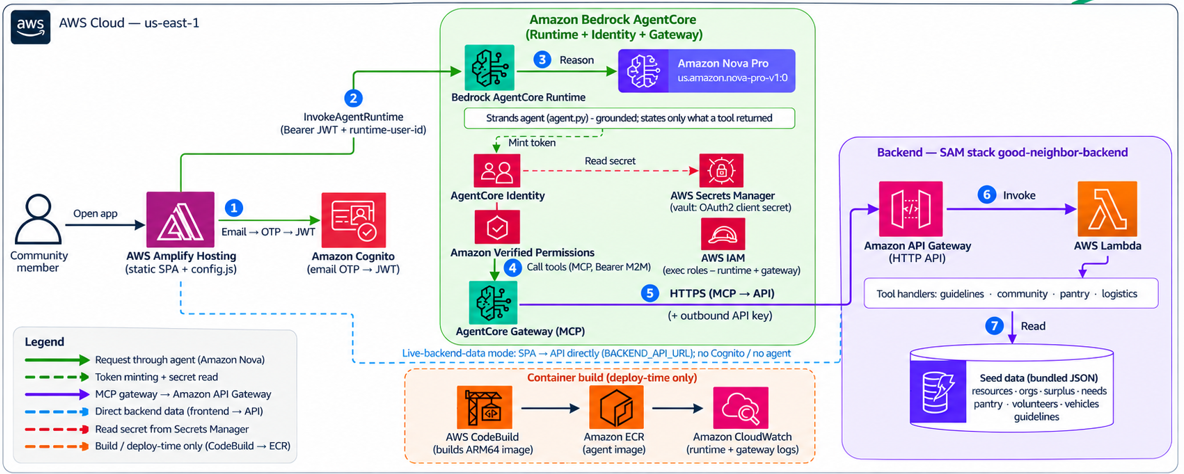
The project is three deployed pieces that fit together on AWS:
- Backend (tools + data): seven tools with real, cross-referenced seed data (surplus, needs, pantry, volunteers, vehicles, resources, guidelines). The same Python handlers run locally as a stdlib-only server and on AWS as AWS Lambda behind Amazon API Gateway, deployed with AWS SAM.
- The agent: a Strands agent running on the Amazon Bedrock AgentCore Runtime, using Amazon Nova Pro as the model. It reaches the backend through an AgentCore Gateway (MCP), exposing the REST API as tools via an OpenAPI target. It authenticates outbound with an OAuth2 token minted by AgentCore Identity, and is deployed with AWS IAM (SigV4) inbound auth - no Cognito required for the agent itself.
- Frontend: a no-build, animated single-page web app that runs in three modes (full agent via Cognito email-OTP, direct-to-backend, or offline demo), deployable to AWS Amplify Hosting.
End-to-end, a question flows: Browser → Cognito (JWT) → AgentCore Runtime (Nova) → AgentCore Gateway (MCP) → API Gateway → Lambda → real data → formatted answer.
Observability & monitoring
Every layer emits logs to Amazon CloudWatch, which was essential both for operating the agent and for debugging the auth chain during the build.
AgentCore Runtime logs - the agent's own stdout/stderr (tool registration, each tool call, model responses, tracebacks) land in a dedicated log group:
/aws/bedrock-agentcore/runtimes/good_neighbor_agent-<id>-DEFAULTTail it live while invoking the agent:
aws logs tail /aws/bedrock-agentcore/runtimes/good_neighbor_agent-<id>-DEFAULT \
--region us-east-1 --follow
These logs surfaced the exact
AccessDeniedmessages that told us which IAM permission each hop of the runtime → identity → gateway chain needed.AgentCore Gateway logs - the gateway enables CloudWatch log delivery on creation, in its own group:
/aws/vendedlogs/bedrock-agentcore/gateway/APPLICATION_LOGS/goodneighborgateway-<id>This is where a tool call could show HTTP 200 while the body was actually an "unable to fetch outbound api key" error - the clue that the gateway's execution role was missing
GetWorkloadAccessToken.Lambda / API Gateway logs - the backend function logs to its standard
/aws/lambda/good-neighbor-backendgroup (per-request output, errors, timing).CodeBuild logs - each
agentcore deploystreams its container build (QUEUED → PROVISIONING → BUILD → POST_BUILD → COMPLETED) to CloudWatch, so a failed image build is diagnosable without local Docker.Traces (optional). OpenTelemetry tracing on the runtime was disabled (
--disable-otel) to keep the footprint minimal, and the gateway's X-Ray trace delivery was left off (logs alone were enough to operate it). Enabling OTel / X-Ray is a one-flag change for deeper request tracing later.
Debugging pattern we relied on: when the agent misbehaved, we checked the
runtime log group first (was the tool even called?), then - if the tool returned
but the answer was wrong - bypassed the model entirely with a small MCP probe
script (gateway/probe_tool.py) to read the raw tool result. Logs told us
where it broke; the probe told us what the gateway actually returned.
Challenges we ran into
- Model access / billing: our first model choice was gated by an
INVALID_PAYMENT_INSTRUMENTerror. We switched to Amazon Nova Pro, which is served directly by Amazon with no Marketplace subscription - and it worked. - Deploying without the original bootstrap stack: the agent was written to
expect a Cognito authorizer + a workshop
bootstrap-stack. We re-architected the deploy to use IAM/SigV4 inbound auth and a standalone execution role so it runs without that stack. - A multi-hop auth chain: wiring the agent to the gateway surfaced a series
of
AccessDeniederrors, each one hop further along - the invoke needed a--runtime-user-id, the runtime role neededGetResourceOauth2Tokenand Secrets Manager read, and the gateway role neededGetWorkloadAccessTokento fetch its own outbound credential. A direct MCP "probe" script was the key to diagnosing each one. - The agent over-declining: even after tools returned real data, a very strict "you MUST decline" system prompt made the model refuse. Rebalancing the prompt to lead with "use the tool result" fixed it.
- Windows tooling quirks: the AgentCore CLI crashed on the console codepage (fixed with UTF-8 env vars), and container builds had to run to completion uninterrupted.
- A leaked secret: a Cognito client secret was hardcoded in helper scripts. We moved all credentials to environment variables and documented rotation.
Accomplishments that we're proud of
- A fully working end-to-end deployment on AWS - the live agent answers from real backend data, verified with both single-tool and multi-tool questions.
- Getting the AgentCore Runtime + Gateway + Identity auth chain working without Cognito or a prebuilt stack, and documenting every required IAM permission so it's reproducible.
- A frontend that degrades gracefully across three modes, so it's useful whether or not any AWS is deployed - great for demos.
- Honest, accurate documentation and two architecture diagrams (plain + AWS service icons) that match what's actually running.
What we learned
- Amazon Nova is a clean choice for agents when you want to avoid Marketplace subscription/billing friction.
- AgentCore's power comes from its layered identity model (workload identity, outbound OAuth2 via AgentCore Identity, per-request Verified Permissions) - but each layer needs its own explicit IAM permission, and the errors point you exactly where.
- A tool-using agent is only as good as its prompt balance: too strict and it refuses real data; too loose and it hallucinates. "Use the tool result" as the dominant instruction, with declining as the rare fallback, is the sweet spot.
- The fastest way to debug an agent is to call the tool path directly (bypass the model) to separate infrastructure failures from model behavior.
What's next for Community Waste Recovery AI agent
- Smarter matching: guide the agent to map categories (e.g. "produce" → tomatoes/carrots) and match vehicles to load size, so multi-tool routing is more accurate.
- Write actions: move from read-only lookups to letting donors post surplus and coordinators confirm pickups.
- Real data store: swap the bundled JSON for Amazon DynamoDB (the volunteer/vehicle schemas already reference the GSIs) for live, multi-org data.
- Per-organization authorization: turn on Amazon Verified Permissions so donors, recipients, and coordinators each see only the tools they should.
- Notifications & routing: alert volunteers of nearby pickups and suggest efficient routes within food-safety time windows.
- Production hardening: add an authorizer to the backend API, rotate secrets automatically, and set up CI/CD for the whole stack.
Built With
- amazon-api-gateway
- amazon-bedrock
- amazon-cloudwatch
- amazon-cognito
- amazon-ecr
- amazon-nova
- amazon-verified-permissions
- aws-amplify
- aws-codebuild
- aws-iam
- aws-lambda
- aws-sam
- aws-secrets-manager
- bedrock-agentcore
- css
- html
- javascript
- mcp
- openapi
- python
- strands


Log in or sign up for Devpost to join the conversation.