Inspiration
Most browser agents still interact with creative tools by reading the DOM, finding buttons, and simulating clicks. That works, but it is fragile and forces the agent to reverse-engineer an interface that was designed for humans.
ComicSol explores a different idea: what if a comic creation app exposed its creative capabilities directly to the browser through native WebMCP?
Instead of teaching an agent how to operate ComicSol's UI, ComicSol lets the browser discover structured tools for creating, understanding, and revising a comic project.
What it does
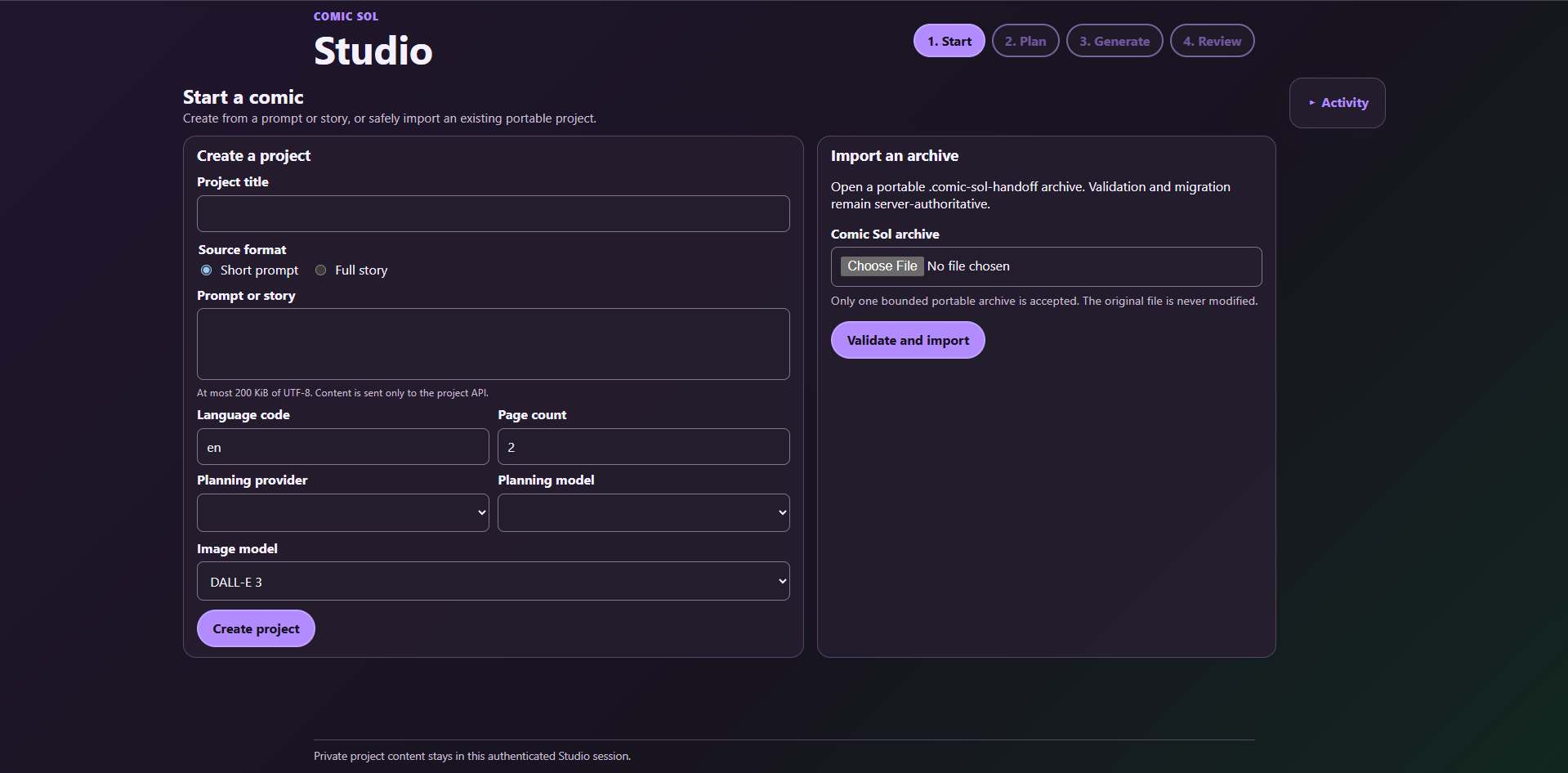
ComicSol is a creator-first comic production studio enhanced with native WebMCP.
Its browser WebMCP surface exposes 17 tools, including three creator-level actions:
create_comicget_comic_contextrevise_comic
An agent can create a structured comic project, read its current creative context, and propose revisions without scraping the page or reconstructing state from UI elements.
The creative state includes the story plan, character bible, storyboard, and visual identity.
Revisions are intentionally human-in-the-loop. An agent cannot silently overwrite the creator's working copy. Proposed changes appear as a draft review, and the creator explicitly decides whether to promote them.
How we built it
ComicSol uses native browser WebMCP through document.modelContext.
The WebMCP tools are connected to the same ComicSol project model used by the Studio rather than a separate demo-only interface. This keeps the browser agent and the human creator working against shared structured state.
The project also includes a Python/FastAPI local production runtime with SQLite-backed project revisions, workflow state, generation jobs, recovery, QA, and export infrastructure.
For the challenge demo, the focus is the creator-facing WebMCP interaction and the human approval boundary. We do not claim live paid-provider execution in the hosted static demo.
Challenges
The hardest part was designing an agent interface that was useful without taking control away from the creator.
We had to make revision behavior explicit and safe, preserve project/revision boundaries, prevent stale writes, and keep the higher-level creator tools simple while maintaining lower-level production primitives underneath.
We also had to account for the difference between a static hosted browser demo and the durable local production runtime, so the submission accurately represents what is running in each environment.
What we learned
WebMCP is more interesting than simply replacing UI automation.
The biggest benefit is giving agents a semantic interface to an application. The agent no longer needs to infer what a button means or reconstruct application state from rendered HTML.
For creative software, this also creates a clean place to define boundaries: what an agent can propose, what it can read, and what still requires explicit human approval.
ComicSol's goal is not to remove the creator from the workflow. It is to let agents participate in the workflow without pretending to be the creator.

Log in or sign up for Devpost to join the conversation.