Inspiration
Every comic creator faces the same challenge: characters subtly change facial structure between panels, environments lose their visual identity, and AI image generators demand endless prompt tweaking just to maintain consistency.
When I discovered Bria FIBO’s JSON-native architecture, it immediately stood out as a fundamentally different approach to visual generation-deterministic, structured control instead of fragile, trial-and-error prompting. It felt like the missing foundation for building real production-grade creative tools, not just demos.
The hackathon’s focus on HDR and 16-bit color workflows further pushed this idea. While most current models still output 8-bit images, I wanted to design a platform architected from day one to be HDR-ready-with structured controls, forward-compatible pipelines, and clear separation between creative intent and rendering constraints. comicOS is built to support fully professional, high-dynamic-range comic workflows the moment the ecosystem enables them.
What it does
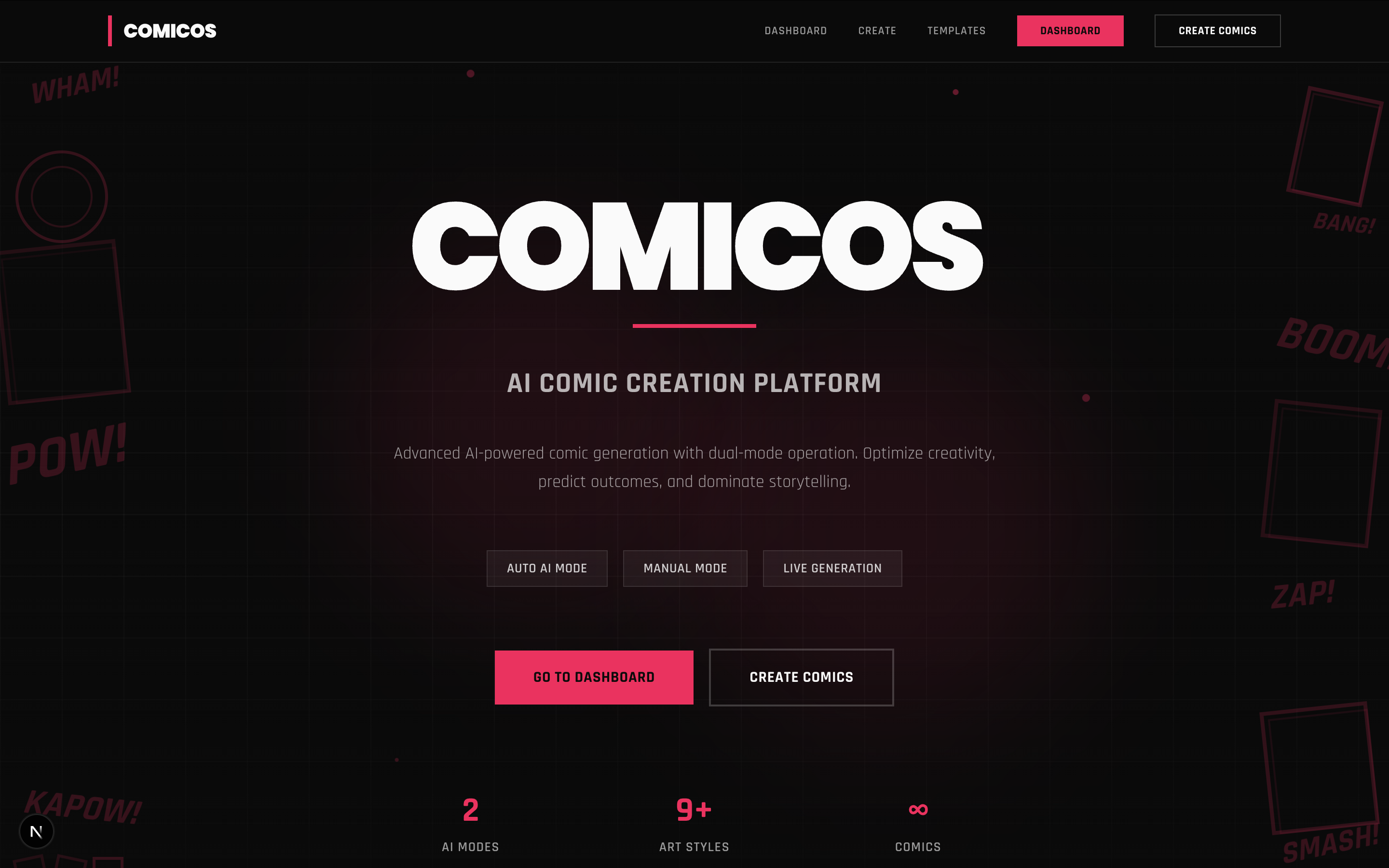
comicOS is an HDR-ready, production-grade comic creation platform designed to solve one of the hardest problems in AI comics: panel-to-panel visual consistency.
Built on Bria FIBO’s JSON-native controllability, comicOS generates stable characters, environments, poses, and cinematic panels-either automatically from a story or manually through precise structured controls. Instead of relying on fragile prompt tweaking, creators work with deterministic parameters that preserve identity across panels.
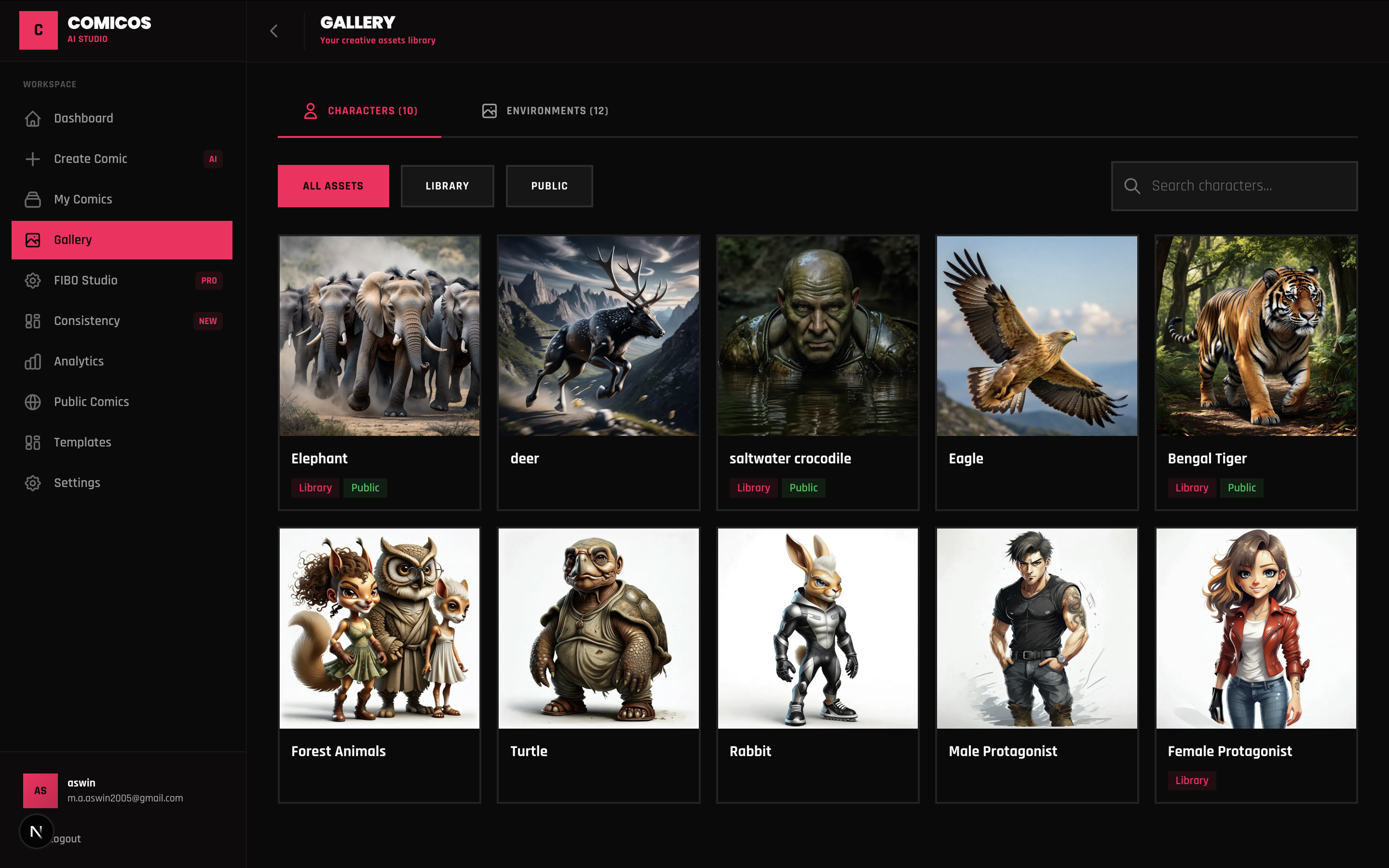
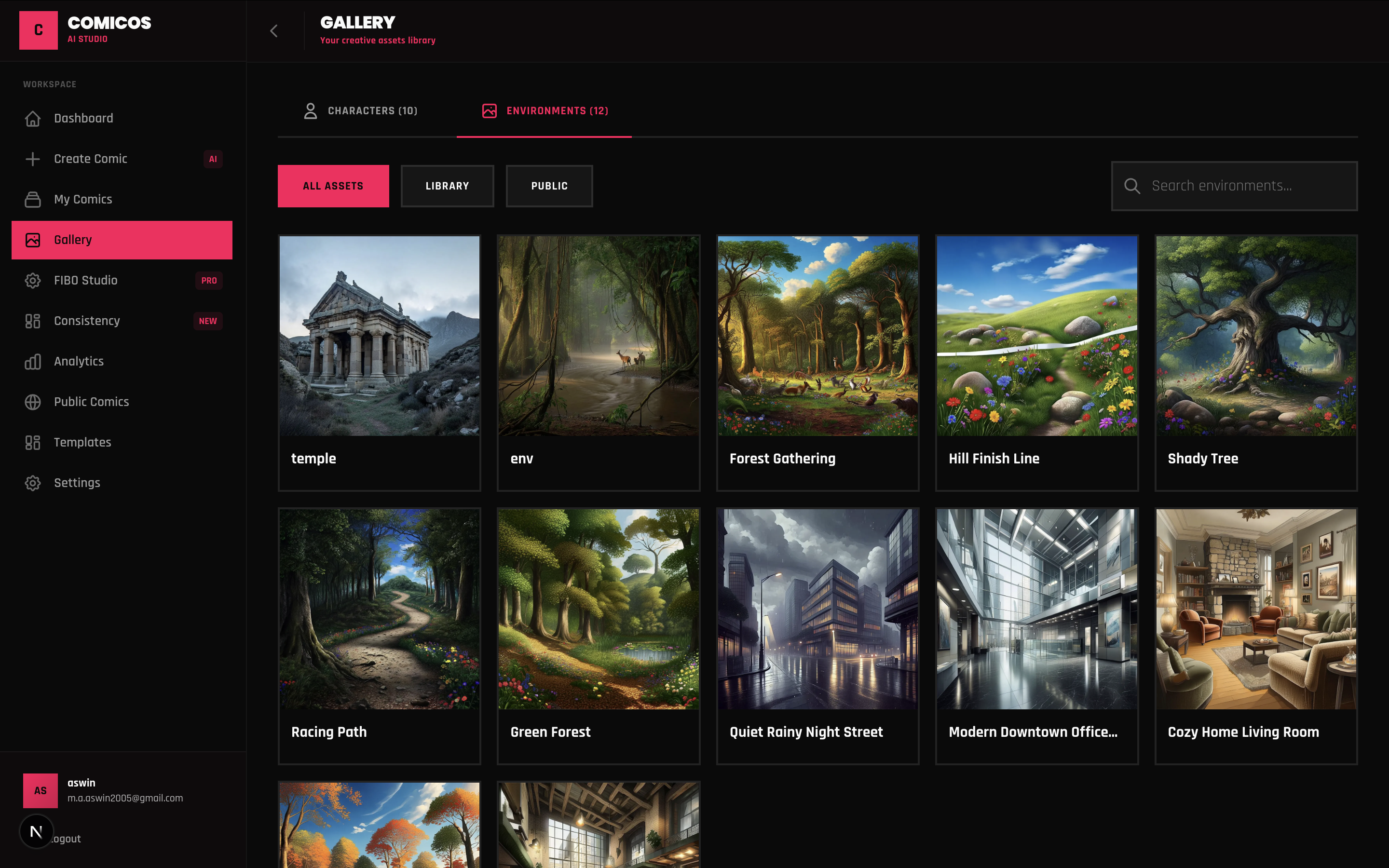
The platform provides character and environment libraries, story-to-panel structuring, panel-level composition controls, and separate dialogue and caption handling, all within a workflow designed to be HDR-ready and production-pipeline friendly as higher-bit-depth outputs become available.
Core Features
HDR-Ready Architecture
While Bria FIBO currently outputs 8-bit images, comicOS is architected to be HDR-ready at the workflow and parameter level.
- Global HDR-style rendering toggle
- HDR preferences stored at user and project levels
- Request schemas designed for wide-gamut color intent (Rec.2020)
- Backend pipeline prepared for future 16-bit image formats
- Forward-compatible design aligned with upcoming FIBO capabilities
comicOS treats high-dynamic-range workflows as a first-class design constraint, rather than an afterthought.
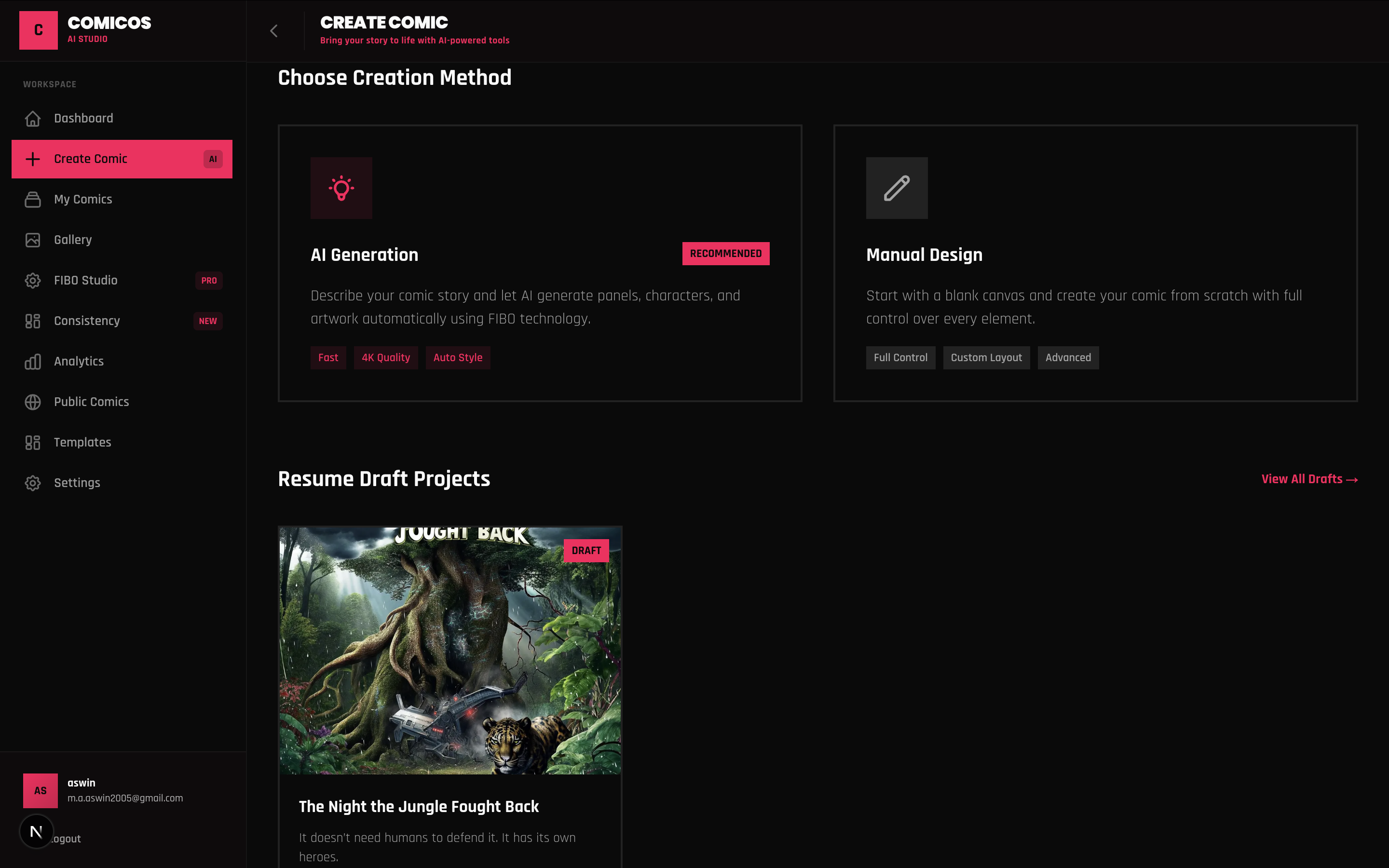
Dual Creation Workflows
comicOS provides two complementary creation paths built on the same structured JSON foundation:
- AI Mode - automated analysis and generation
- Manual Mode - creator-driven editing using Easy Mode, Pro Mode, and a JSON Editor
1️⃣ AI Mode - Automated Analysis & Generation Pipeline
AI Mode focuses on analysis first, generation second, ensuring consistency before any image is created.
Workflow
Project Setup → Story Input → AI Analysis → Asset Creation → Panel Generation → Editor
How It Works
- The user provides a story or scene description
- An internal AI analysis model automatically extracts:
- characters
- environments
- actions and interactions
- dialogue and narration (stored separately from visuals)
- From this analysis:
- Characters are automatically created with structured JSON schemas defining identity, appearance, and style
- Environments are automatically created with structured parameters for lighting, mood, scale, and atmosphere
- Panels are generated by combining existing characters and environments.
- Structured FIBO prompts are produced from JSON with identity locks and deterministic seeds
This pipeline eliminates manual prompt tuning while maintaining panel-to-panel visual consistency.
2️⃣ Manual Mode - Creator-Controlled Editing System
Manual Mode is designed for creators who want direct, hands-on control while still benefiting from structured AI assistance.
Manual Mode supports three levels of control:
Easy Mode - AI-Assisted Editing
Easy Mode allows creators to make changes using natural language, while the system handles structure automatically.
- Users describe changes in plain text
- An internal AI model:
- Interprets the request
- Updates only the relevant fields in the structured JSON
- Identity and consistency locks are preserved automatically
Easy Mode is available when creating or regenerating:
- Characters
- Environments
This provides accessibility without sacrificing structure.
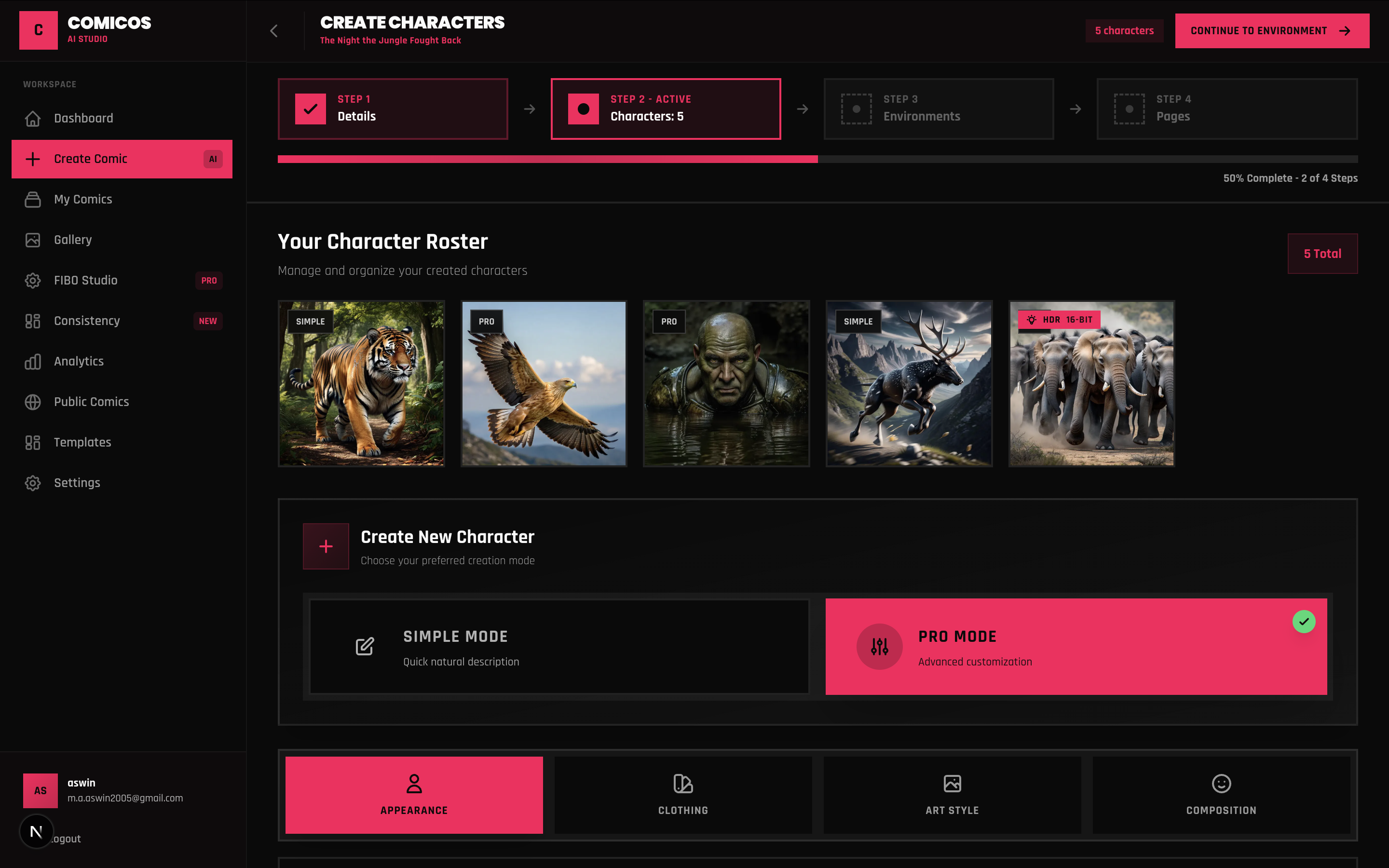
Pro Mode — Parameter-Driven Visual Control
Pro Mode exposes explicit visual parameters for creators who want precision.
Character Parameters
- Name, age, gender
- Body type, height, skin / fur / scale tone
- Hair or texture style, color, eye color
- Distinctive features and visual anchors
- Clothing, accessories, and color palettes
- Art style, line weight, lighting, mood
- Personality traits and default poses
Environment Parameters
- Environment type, location type, era, scale
- Architecture style, materials, textures
- Time of day, weather, season, temperature feel
- Overall mood and ambiance
- Art style and color palette
- Lighting type, direction, intensity, shadows
- Camera angle, distance, perspective
- Focal points, foreground and background elements
Panel Parameters
- Character pose and expression
- Camera angle, distance, and shot type
- Composition focus and framing
- Deterministic variation without identity changes
Every control maps directly to JSON keys, making generation predictable, repeatable, and debuggable.
JSON Editor — Full Transparency & Determinism
For advanced users, comicOS exposes the entire structured prompt.
- Direct editing of character, environment, and panel JSON
- No hidden prompt logic
- Deterministic regeneration from edited schemas
- Clear separation between identity and variation layers
This turns AI generation into a configuration-driven system, not trial-and-error prompting.
The Consistency Engine (Key Innovation)
The Consistency Engine is the core system behind comicOS.
It is a reference-based, JSON-constraint pipeline designed to preserve visual identity across panels—solving the single biggest failure point in AI-generated comics.
How it works
- Structured Identity Capture Character and environment identity is represented as explicit JSON parameters (appearance, palette, style, anatomy, and rendering intent).
- Persistent Identity Storage These structured identity references are stored as versioned JSON objects (JSONB) and reused across panels.
- Constraint Injection into FIBO During panel generation, identity JSON is injected into FIBO’s structured prompt, separating what must stay fixed from what is allowed to vary.
- Controlled Variation Weights Panel-level parameters (pose, camera, framing) are allowed to change while identity parameters are weighted and preserved.
- Deterministic Regeneration Panels can be regenerated repeatedly without drifting character appearance or environment identity.
Rather than relying on fragile prompt repetition, comicOS treats consistency as a first-class system constraint.
Why this matters
This approach:
- Prevents facial and anatomical drift
- Preserves color palette and style across scenes
- Enables reliable multi-panel storytelling
- Makes regeneration predictable instead of random
It directly addresses the #1 problem in AI comics: maintaining visual continuity across panels.
Challenges We Ran Into
While building comicOS, we faced several challenges that helped shape the final product.
Keeping Characters Consistent Across Panels
One major problem was that characters often looked different from one panel to the next. Small changes in face, color, or body shape broke the story flow. We learned that repeating prompts was not enough. So we designed a system that keeps character details fixed while only allowing safe changes like pose or camera.
Preventing Animal Characters from Looking Human
Animal characters sometimes turned into human-like figures when they had story-style names.
To fix this, we added clear rules that tell the system:
- what kind of character it is (human or animal)
- how the body should look
This kept animals looking like real animals in every panel.
Making the Tool Simple but Powerful
We wanted the tool to be easy for beginners but still powerful for advanced users.
This was difficult, so we added:
- Easy Mode for simple text changes
- Pro Mode for detailed controls
- JSON Editor for full control
Users can choose how deep they want to go.
Planning for HDR Before It Fully Exists
The hackathon encouraged HDR and 16-bit workflows, but current models don’t fully support them yet. The challenge was to plan for HDR without making false claims. We solved this by designing the system to be HDR-ready, so it can support higher-quality output in the future.
Accomplishments That We’re Proud Of
- Built a complete comic creation system, not just an image generator
- Achieved strong visual consistency across multiple comic panels
- Designed a JSON-based control system instead of relying on fragile prompts
- Successfully separated story, visuals, and dialogue for stable generation
- Created both AI Mode (automatic) and Manual Mode (Easy, Pro, JSON)
- Built reusable character and environment libraries
- Enabled safe regeneration without breaking character identity
- Designed the platform to be HDR-ready for future high-quality workflows
- Handled human, animal, and non-human characters correctly
- Turned complex AI behavior into a simple and usable creator experience
What’s Next for comicOS
comicOS is built as a foundation, and there is a clear path to grow it further.
- Support true 16-bit and HDR output as soon as generative models allow it
- Improve the Consistency Engine with stronger identity locking and versioning
- Add panel layout tools for full page composition
- Enable team collaboration, version history, and shared libraries
- Expand ControlNet and reference-image support for higher accuracy
- Add style packs for different comic genres (manga, noir, sci-fi, fantasy)
- Optimize the system for studio-scale workflows and batch production
- Explore motion comics and animated panel transitions
Built With
- bria
- fibo
- llm
- next.js
- supabase
- tailwind
- vercel


Log in or sign up for Devpost to join the conversation.