-
-
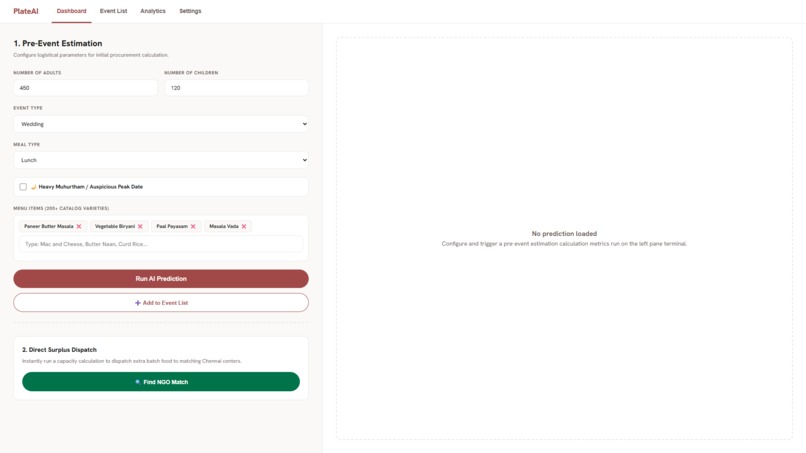
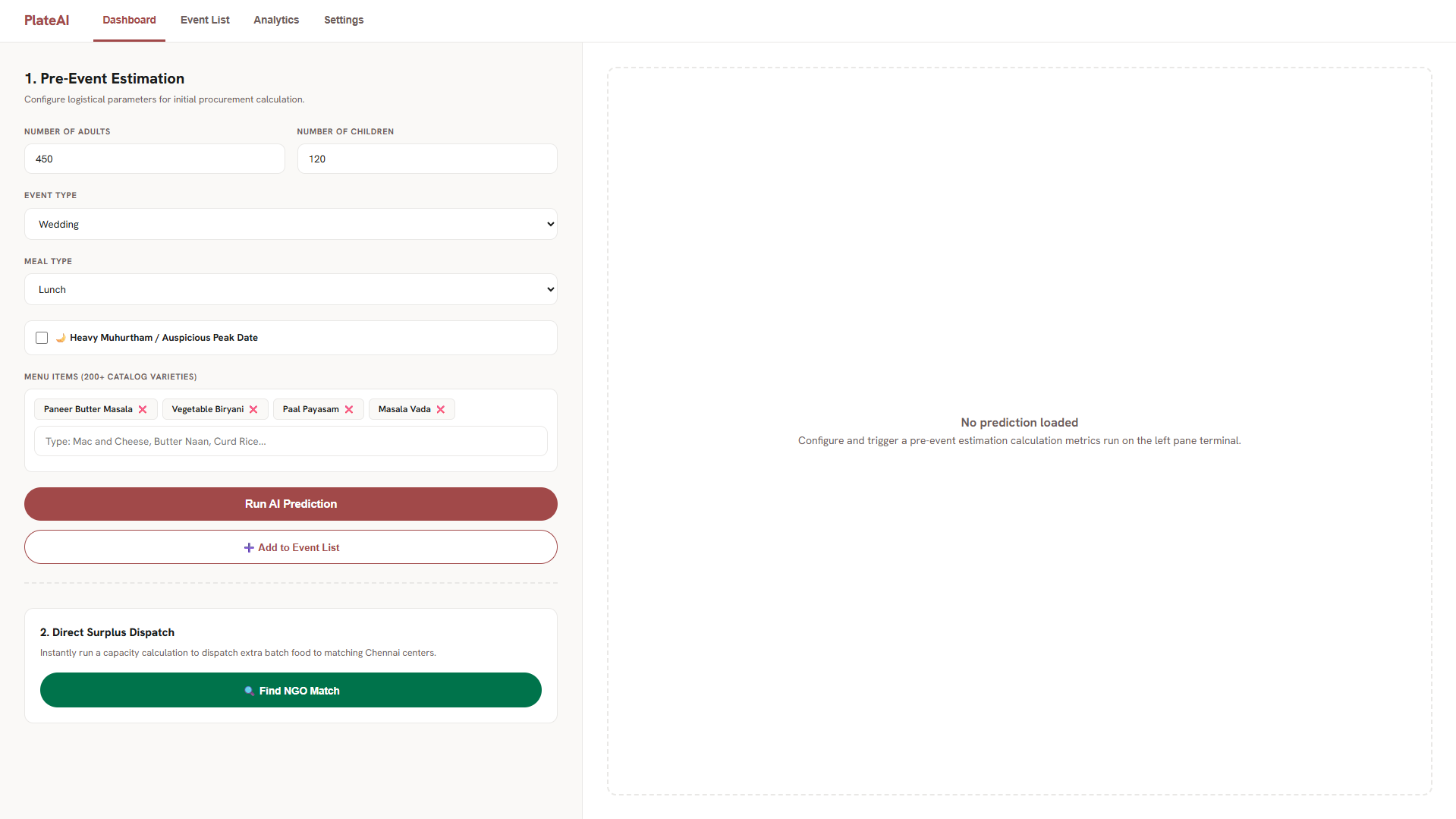
Our Dashboard
Inspiration
The true measure of technology isn't in how fast it computes, but in how deeply it impacts a community. Growing up surrounded by the vibrant culture of Indian celebrations—weddings, temple festivals, and grand Indian feasts—we witnessed how food is our ultimate love language. But beneath the joy lies a silent, logistical tragedy.
After attending a massive local wedding, we stayed back late into the night and watched the tired catering staff face a heartbreaking reality: nearly 40 kilograms of perfectly good, premium food was destined for the landfill. People don't waste food on purpose; they waste it because, at 11:30 PM, the logistics of rescuing it are impossible. Current food rescue models are entirely reactive, leading to a frantic midnight scramble where highly perishable items spoil in the heavy ambient heat before trucks can arrive. We wanted to shift this paradigm from reactive to predictive.
What it does
PlateAI is an enterprise-grade logistics and margin-protection tool designed for catering businesses. It uses machine learning to accurately forecast the exact kilogram volume of leftover food hours in advance.
- Margin Protection (Business Value): It helps catering owners dynamically optimize their raw material procurement. By predicting exact consumption drops on heavy hall-hopping days, it prevents over-purchasing and protects profit margins.
- Automated Climate Action (Communal Value): By predicting surplus ahead of time, local NGOs are placed on an automated standby. This gives them the crucial lead time needed to arrange volunteers and transport, actively diverting methane-producing organic waste away from municipal landfills.
How we built it
We engineered a clean, minimalist 40/60 split-screen frontend dashboard focused entirely on high-density data legibility for business owners. The backend is a robust Python architecture built on FastAPI and Uvicorn, handling live REST endpoint requests and data validation via Pydantic to ensure strict security and logical inputs.
The core predictive engine relies on a Random Forest Regressor built with Scikit-Learn. The AI pipeline uses a Column Transformer to process categorical data (Event Type, Meal Type, Cuisine) through a OneHotEncoder, converting strings into binary matrices. It then evaluates this against numerical parameters (Guest Demographics) and hyper-local variables (such as Muhurtham peak dates).
We can mathematically model our underlying AI prediction logic in two steps. First, the system calculates the true expected guest count:
$$E_{\text{guests}} = (A + C) \times f_{\text{RF}}(X) \times \delta_{M}$$
Where \(A\) is the adult count, \(C\) is the child count, \(f_{\text{RF}}(X)\) represents the consumption multiplier outputted by the Random Forest model based on input matrix \(X\), and \(\delta_{M}\) represents our dynamic Muhurtham dampening factor (scaled at 0.82) to account for cultural venue-hopping behaviors.
Once this baseline is predicted, the algorithm calculates the exact expected waste profile (\(W_{\text{expected}}\)) across the specific \(n\) selected menu items:
$$W_{\text{expected}} = \sum_{i=1}^{n} \left( A \cdot w_{A,i} + C \cdot w_{C,i} \right) \times f_{\text{RF}}(X) \times \delta_{M}$$
Where \(w_{A,i}\) and \(w_{C,i}\) represent the historical gram-weight waste probability for adults and children per specific dish \(i\).
Challenges we ran into
- The "Cold Start" Data Problem: Because our solution addresses a completely unmapped sector of logistics, there are no existing open-source datasets for hyper-local Indian catering waste. The industry currently operates on informal, last-minute decision-making and poor documentation. To overcome this, we engineered a mathematically constrained synthetic dataset using Gemini to train our baseline model. However, we built a continuous learning loop (
/retrain) into the architecture so that as real-world managers log their post-event Wrap-Up metrics, the system replaces synthetic data with hard regional facts over time. - Scrapping the Computer Vision Engine: Initially, we built a Computer Vision (YOLOv8/CNN) classification pipeline to scan leftover food pans and detect micro-bacterial risk parameters. However, we made the critical engineering decision to scrap this feature prior to deployment because visual AI is simply too inconsistent at detecting hidden spoilage or cross-contamination in deep catering vats. We replaced the CV engine with a strict, two-step Human-in-the-Loop verification protocol (Visual Pre-Check via photo upload + Physical Inspection by NGO volunteers) to ensure strict food safety and protect venues from legal liability.
Accomplishments that we're proud of
We are incredibly proud of successfully translating a complex climate and sustainability problem into a highly profitable, viable business tool. Building a fully functional Machine Learning pipeline with FastAPI and Scikit-Learn that doesn't just display static data, but actually acts on it, was a major technical milestone. Furthermore, engineering the dynamic /retrain endpoint—allowing the model to constantly learn, adapt, and correct its own weights based on user feedback—makes PlateAI a true enterprise-grade system.
What we learned
We learned the brutal reality of pitching climate tech to traditional businesses. If you pitch a tool strictly for "climate action and waste reduction," business owners will ignore it because they do not bear the financial burden of over-ordered plates. To drive actual environmental impact, you must disguise the climate action inside a tool that strictly improves business profit margins, logistical efficiency, and liability protection. By aligning the AI's goals with the caterer's wallet, we ensure the environmental mission actually gets adopted.
What's next for PlateAI
Our immediate next step is to deploy the prototype to a pilot group of local Kalyana Mandapams in Tiruchirappalli. This will allow us to trigger the /retrain pipeline and begin replacing our synthetic baseline with real-world, hyper-local metrics. Beyond that, we plan to fully integrate the Meta Prophet and LSTM Time-Series forecasting layers to predict macro-seasonal booking trends, allowing caterers to optimize their bulk procurement months in advance based on regional climate variables.
Built With
- claude
- css3
- fastapi
- gemini
- google-fonts-api
- html5
- lstm
- metaprophet
- pandas
- python-multipart
- random-forest-regressor
- scikit-learn
- stitch
- uvicorn
- vanilla-javascript


Log in or sign up for Devpost to join the conversation.