-
-
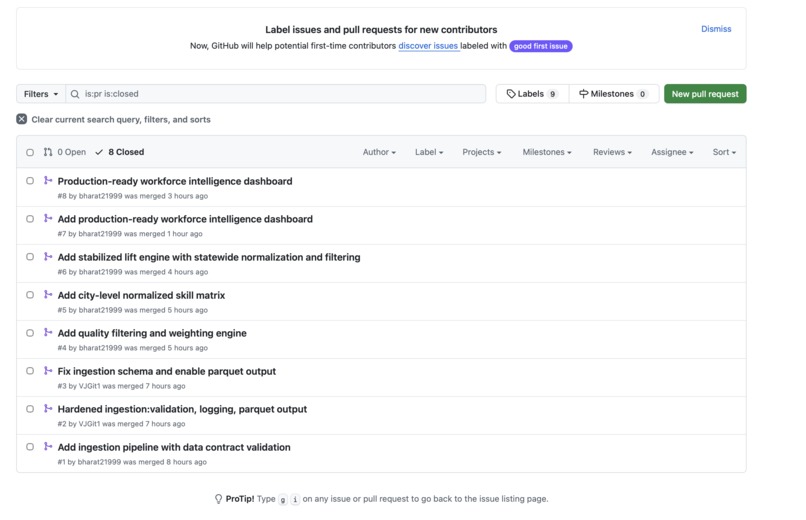
We have made different branches for each feature and made 8 pull requests

Workforce systems often rely on high-level job counts, which fail to reveal the specific skills driving regional competitiveness. We were inspired to bridge this gap by building a platform that translates raw job data into actionable workforce intelligence for policymakers and economic development leaders. The Colorado Workforce Intelligence Platform transforms job posting data into skill-level insights. It identifies statewide demand trends, city-level specialization using lift, regional workforce archetypes through clustering, opportunity gaps, and strategic training priorities. We engineered an end-to-end data pipeline that cleaned and normalized job skill data, applied statistical thresholds to remove noise from low-sample cities, calculated lift to measure specialization, and used PCA and KMeans clustering to identify workforce archetypes. We then deployed an interactive Streamlit dashboard to make these insights accessible and policy-ready. We faced challenges with noisy data, statistically insignificant cities, large file handling, deployment constraints, and ensuring clustering stability. Addressing these required thoughtful threshold selection, validation checks, and optimization of the deployment environment. We built a fully functional workforce intelligence system that moves beyond descriptive analytics into strategic insight. The platform is scalable, replicable for other states, and designed to support real policy decision-making. We learned how to translate raw labor market data into interpretable economic signals, apply statistical rigor to workforce analytics, and design data products that communicate clearly to both technical and policy audiences. Next steps include expanding the dataset, refining clustering methodology, incorporating time-series forecasting, and enhancing the dashboard with deeper regional comparisons and predictive workforce modeling. To get a better idea of the project please refer to the docs folder in the github repo.

Log in or sign up for Devpost to join the conversation.