🚀 NEXUS-V: The Future of Circular Logistics
💡 Inspiration
The inspiration for NEXUS-V came from a staggering reality: nearly 30% of all e-commerce purchases are returned. Due to the high cost of reverse logistics, millions of these items are destroyed rather than restocked. We realized that while a package might be "unwanted" by one person, it is often exactly what someone else in the same neighborhood—or on the same campus—is looking for. We decided to build an AI infrastructure that intercepts these returns to create a zero-waste loop.
⚙️ How We Built It
We focused on a decentralized architecture to minimize the carbon footprint:
- Computer Vision: Integrated Google Cloud Vision AI to automate product identification and quality grading from a simple smartphone scan.
- Smart-Routing Engine: Developed a Python-based algorithm that matches returned items with local demand in real-time.
- Multi-Cloud Infrastructure: Leveraged Azure Cosmos DB for low-latency inventory tracking and AWS S3 for secure data storage.
- Financial Layer: Integrated the Stripe API to enable secure, instant transactions between users.
🧠 The Math Behind the Savings
To quantify our impact, we modeled the efficiency of our local interception compared to traditional centralized returns. If $D_{t}$ represents the total distance of a traditional return (shipping to a hub and back) and $D_{l}$ is the local distance in our micro-hub, the efficiency gain $E$ is calculated as:
$$E = 1 - \left( \frac{D_{l}}{D_{t}} \right)$$
With $D_{t} \approx 800$ km and $D_{l} \approx 0.5$ km, our model achieves a logistics energy reduction of over 99.9% per intercepted item.
🚧 Challenges We Faced
The biggest hurdle was the "Cold Start Problem": a marketplace is only useful if it has inventory. We solved this by designing a "Retailer Bridge" where users can scan any return label to instantly list the item before it even leaves their hands. We also faced challenges with image processing latency, which we optimized by using a lightweight local CNN architecture for initial classification before calling heavier Cloud APIs.
📚 What We Learned
This project taught us that sustainability and profitability are not mutually exclusive. By using a decentralized AI approach, we can save retailers billions in shipping costs while simultaneously protecting the environment. We also mastered the art of bridging different cloud ecosystems (Google, AWS, Azure) to create a truly robust and scalable application.
NEXUS-V: Reshaping logistics for a greener tomorrow.
Built With
- amazon-web-services
- azure-cosmos-db
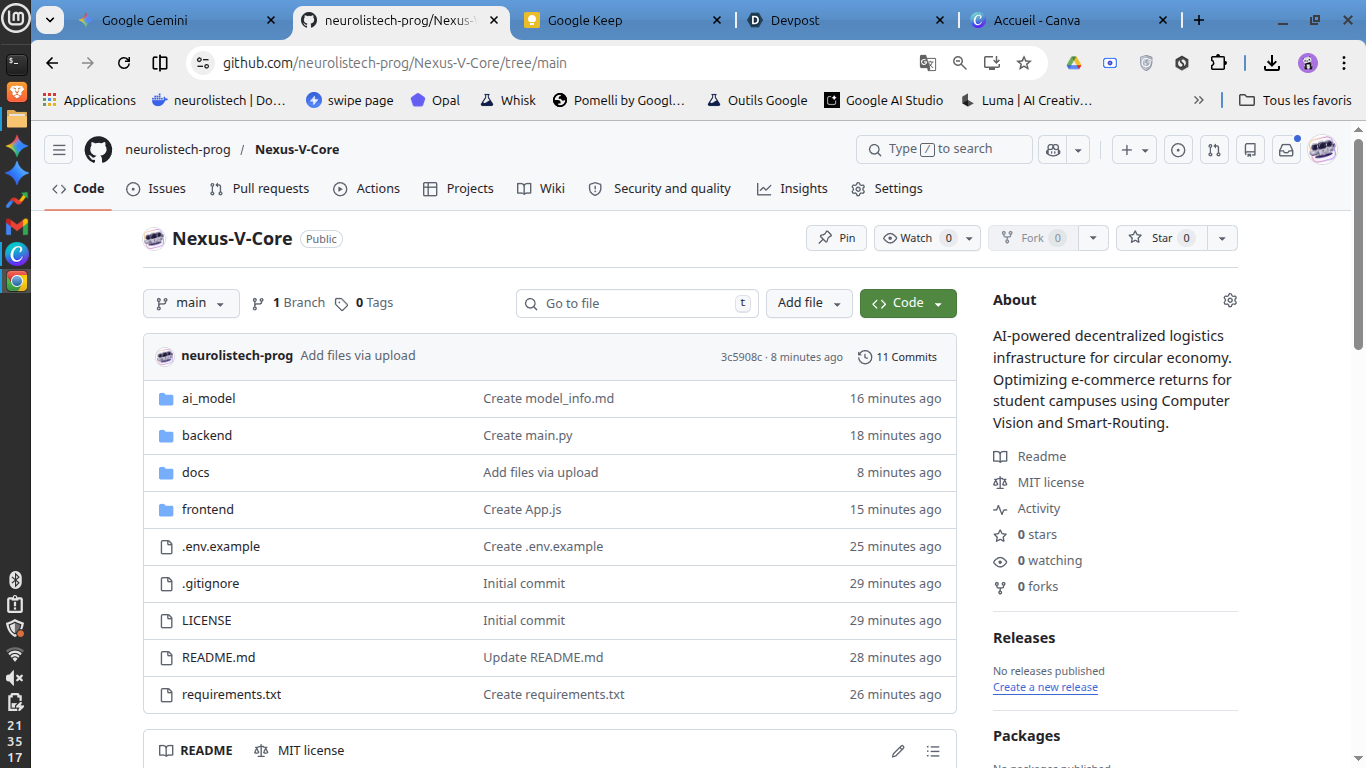
- github
- google-cloud-vertex-ai
- google-cloud-vision-ai
- node.js
- python
- react-native
- stripe


Log in or sign up for Devpost to join the conversation.